Source of Record: Why Carl-Gustaf Procurement Is Sole Source Even Though Four Countries Build It
The Carl-Gustaf 84mm recoilless weapon system is manufactured today in four countries, and will be manufactured in a fifth by 2028. The defence press routinely lists each of those national manufacturers as a Carl-Gustaf source of supply, which finds its way into procurement-officer source lists and then into the determination of whether a Carl-Gustaf requirement is open competition, single source, or sole source. The determination is wrong almost every time. The Karlskoga commercial door is the only commercial door. Two of the national manufacturers supply their own armed forces and nobody else. The other two sit inside Saab’s own corporate perimeter and route external sales back through Karlskoga. The result is a procurement architecture that looks distributed at the supplier-list level and is centralised at the commercial level. This article keeps to the land environment, walks through the public US Government contract record, then sets out the three-layer architecture that ties manufacturing, training and the still-emerging sovereign-integration interface together.
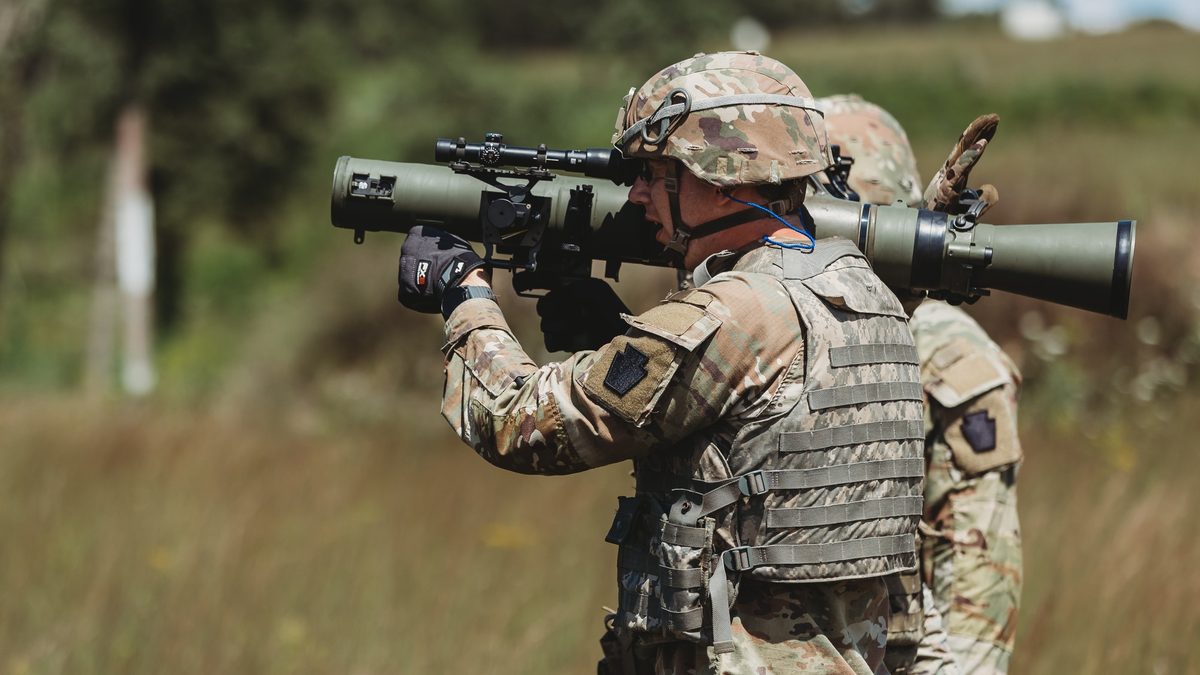
The Weapon and the Year-Zero Question
The Carl-Gustaf is an 84mm reloadable recoilless weapon system in continuous Saab production since 1948 at Bofors Karlskoga in central Sweden. The current variant in production at the master plant is the M4 (CGM4), known in United States service as the M3E1. Previous variants in continuing licensed national service include the M2 and the M3. The system fires a family of natures that includes the FFV 441 / 441D high-explosive (HE) round, the FFV 502 high-explosive dual-purpose (HEDP) round, the FFV 509 anti-structure munition (ASM), the FFV 551 / 551C high-explosive anti-tank (HEAT) round, the FFV 545 illuminating round, the FFV 469C smoke round, the ADM 401 area defence munition, the MT 756 multi-target round, the HE 448 programmable high-explosive round (designated HE 441E in United States service), and, from May 2026, the HEAT 758 tandem-warhead round.
The year-zero question for any procurement officer looking at a Carl-Gustaf requirement is straightforward. Who can lawfully sell this system, and these rounds, to my armed forces? The defence press will offer a list that includes Saab Dynamics in Sweden, Advanced Weapons and Equipment India Limited (AWEIL) at Kanpur, Howa Machinery in Japan, the new Saab FFVO India Pvt Ltd plant under construction at Jhajjar, and, from 2028, Saab Land Systems at Grayling, Michigan. Each of those entities does in fact manufacture the weapon or the ammunition. The procurement-officer error is to read “manufactures” as a synonym for “can sell to me”. It is not.
One Door, Four (Soon Five) Floors
The cleanest way to read the Carl-Gustaf supply architecture is as a single commercial door with several production floors behind it. The door is Saab Dynamics AB, headquartered in Karlskoga. The production floors are the master plant at Karlskoga and the four national sites. The procurement-officer-relevant fact is that a customer outside Sweden, India, Japan or the United States walks up to one door regardless of how many floors are running behind it. The choice of which floor fulfils a given order is a Saab corporate decision driven by capacity allocation, export-control approvals and customer-specific configuration, not a customer-side choice that translates into a contract with the floor in question.
The four (soon five) production floors split cleanly into two categories: those inside Saab’s own corporate perimeter, and those operated by independent national licensees under transfer-of-technology agreements. The distinction matters because the rules of the two categories are different.
Inside the Saab Corporate Perimeter
Karlskoga (Björkborn), Sweden: the master plant
Karlskoga is the design authority, the master assembly line, the Bofors test range and the home of Saab Business Area Dynamics. It has produced the Carl-Gustaf continuously since 1948 and remains the only site qualified to deliver every variant of the weapon and every round in the M4 ammunition family. Every Carl-Gustaf commercial contract Saab signs with an external customer is signed by Saab Dynamics AB out of Karlskoga, regardless of where the physical hardware is ultimately built. Saab has committed in the region of EUR 500 million to expand Business Area Dynamics capacity, the bulk of it at Karlskoga, with a stated objective of multiplying output by at least a factor of four against the February 2022 baseline.
Jhajjar (MET City), Haryana, India: Saab FFVO India Pvt Ltd
Saab broke ground on a Carl-Gustaf M4 manufacturing facility at MET City, Jhajjar district, Haryana on 4 March 2024. The plant is operated by Saab FFVO India Pvt Ltd, a 100 percent Saab-owned subsidiary that was approved in October 2023 as the first 100 percent foreign-direct-investment company in the Indian defence sector. Saab’s own published statement on the facility is explicit about the commercial mechanism: components produced at Jhajjar that are intended for export will be routed through Sweden first, and onward export to third countries will require both Indian Government and Swedish Government approval, governed by the end-user-agreement regime under each country’s export-control law. In Saab’s formulation: “all exports from the India facility will be only to Sweden after approval from the Government of India, which will also be required for re-exports to third countries. More specifically, components may be included in other users’ systems by exporting them to Sweden first and subsequently to other customers, based on India’s export policy which will be governed by the end-user agreement.”
The substantive point is that even Saab’s own Indian subsidiary, sitting inside Saab’s corporate perimeter, cannot sell a Carl-Gustaf or a Carl-Gustaf round directly to a third-country customer. Exports flow back through Sweden. The Karlskoga door remains the door.
Grayling, Michigan, United States: Saab Land Systems campus
Grayling is a more than 400-acre Saab Land Systems campus in northern Michigan, of which about 65 acres are currently developed. Current production focuses on the AT4 tandem warhead and the Ground-Launched Small Diameter Bomb (GLSDB) co-produced with Boeing. Full-scale Carl-Gustaf production from Grayling is scheduled for 2028, primarily to serve United States Government customers under the Federal Acquisition Regulation’s domestic-content preferences. The Grayling plant is a Saab subsidiary (Saab Defense and Security USA, LLC and related entities), so its contractual posture toward third-country exports is the same as Jhajjar’s in principle: any external sale is at the discretion of the Saab principal in Sweden and runs through Karlskoga’s commercial channel, subject to United States and Swedish export controls.
Outside the Saab Corporate Perimeter
Field Gun Factory, Kanpur, India: AWEIL (M3 launcher)
Saab entered into a licensed-production partnership with the erstwhile Indian Ordnance Factory Board (OFB) in 1976. Field Gun Factory Kanpur was stood up in 1979 and, following the 2021 corporatisation of OFB, became a unit of Advanced Weapons and Equipment India Limited (AWEIL), with AWEIL headquartered at Kanpur. AWEIL manufactures the Mark 3 (M3) variant of the Carl-Gustaf launcher under licence, exclusively for Indian Armed Forces use. It does not export the weapon. The 1976 framework predates the current Saab corporate structure and is best understood as a long-running national-supply arrangement under which Saab licenses the M3 design to the Indian state-owned defence sector for domestic consumption. This pattern is normal in licensed-production agreements: technology is transferred to enable national capability, with onward sale to third countries restricted by contract clause and reinforced by national export-control regimes.
Howa Machinery, Aichi Prefecture, Japan (M3 launcher)
Howa Machinery, headquartered in Kiyosu, Aichi Prefecture, has manufactured the Carl-Gustaf 84mm recoilless rifle under licence for the Japan Ground Self-Defense Force (JGSDF) since the 1980s. The JGSDF initially fielded the M2 variant, retained it through a period of declining tactical relevance against modern main battle tanks, and re-adopted the M3 variant in 2012 for service primarily with the Western Army Infantry Regiment and the 1st Airborne Brigade. The Howa-built launcher is a licensed copy. There is no Howa Carl-Gustaf export route. Howa supplies the JGSDF only.
Munitions India Limited (MIL): ammunition for the Indian Army
MIL is the post-OFB ammunition successor that absorbed the legacy 84mm ammunition lines under the 1976 framework. MIL manufactures the in-service older Carl-Gustaf ammunition family for the Indian Army across its inherited ordnance factories. MIL output is for Indian Armed Forces consumption, not export. Where Saab publicly references the Indian ammunition supply, it does so in the context of the Indian Army life-cycle ammunition pipeline that runs alongside Saab’s own Karlskoga ammunition production for the rest of the world.
The Public US Government Contract Record
The clearest illustration of the single-commercial-door architecture is the public United States Government contract record. Every Carl-Gustaf and Carl-Gustaf ammunition contract in the US public record is awarded to a Saab entity (Saab Dynamics AB out of Sweden, or Saab Defense and Security USA, LLC, the United States subsidiary that holds the US contracting role). None are awarded to a licensee. The table below captures the publicly disclosed framework contracts and significant call-offs from 2014 to date, drawn from Saab press releases, Defense Department releases, and the open defence press.

| Date | Awarding authority | Contractor | Scope | Disclosed value |
|---|---|---|---|---|
| 27 Aug 2014 | US Special Operations Command (USSOCOM) | Saab | Five-year framework for the Carl-Gustaf weapon system and ammunition; initial order $14.3 million | Up to $187 million (framework ceiling) |
| 2014 (announced) | US Army | Saab | Carl-Gustaf selected as standard issue (M3 / subsequently M3E1) | Selection decision; subsequent call-off contracts followed |
| 2017 | US Department of Defense | Saab | Type-classification completed; M4 qualified for purchase by all US services as the M3E1 | Qualification decision (no dollar value) |
| 2019 | US Department of Defense | Saab | Indefinite Delivery / Indefinite Quantity (IDIQ) framework for AT4 and Carl-Gustaf close-combat solutions; original ceiling reported as up to $445 million over five years | Up to $445 million |
| 2020 | US Army | Saab | IDIQ for M3E1 weapons; initial call-off $9.2 million for 2021 delivery | Up to $87 million ceiling |
| 2021 | US Armed Forces | Saab | Carl-Gustaf ammunition call-off under framework | Disclosed in Saab Q-results, value not separately released |
| 2022 | US Army | Saab | Carl-Gustaf recoilless rifles (M3E1) call-off; announced in Saab press release | Disclosed; value reported by US Army |
| 23 Sep 2023 | US Department of Defense | Saab | Framework extension; AT4 and Carl-Gustaf ammunition (including HE 441E / HE 448, AT4CS RS); deliveries 2024–2026 | $104.9 million (single call-off) |
| 2023 | US Department of Defense | Saab | Framework extension ceiling raised | Up to an additional $422 million |
| 4 Sep 2024 | US Air Force | Saab | Carl-Gustaf M4 (M3E1 / MAAWS) systems; delivery 2026 | $7.8 million |
| 2024 | US Army | Saab | IDIQ for the XM919 Individual Assault Munition (IAM) programme; AT4CS TW selected as the US Army IAM solution | Up to $494 million over five years |
Two patterns are visible in the record. First, every contract is with a Saab entity. The Saab Defense and Security USA, LLC role exists to satisfy United States Government procurement administration; the commercial principal sitting behind it remains Saab Dynamics AB in Sweden. Second, the dollar values disclose a deep, sustained United States customer relationship: a framework ceiling of roughly $187 million in 2014 has grown to a combined AT4 and Carl-Gustaf framework architecture with cumulative announced ceilings well in excess of $1 billion, before counting the separately competed XM919 IAM programme.
What is absent from the record is equally important. There is no US Government contract on file with AWEIL, with Howa or with MIL for a Carl-Gustaf weapon or for Carl-Gustaf ammunition. There are no contracts because there cannot be contracts. The licensees are not the supplier. The supplier is Saab.
Procurement Source List: Sole, Single, or Open Competition?
The point of the architecture matters most when a procurement officer is making a competition determination. The defence press lists five Carl-Gustaf manufacturers. A naive reading of the supplier landscape can place all five on a procurement source list, which under most Western public-procurement frameworks would push the requirement toward an open or restricted competition. The correct read, item by item, is different. The table below maps the determination by what is actually being procured.
| What is being procured | Determination | Why |
|---|---|---|
| Carl-Gustaf M4 / M3E1 launcher (new build) | Sole source. Saab Dynamics AB | Saab Dynamics AB is the only original equipment manufacturer (OEM). Licensee output (AWEIL M3 / Howa M3) is not lawfully available to a third-country buyer and is in any case the older M3, not the M4. |
| Carl-Gustaf M3 launcher (new build) for any non-Indian, non-Japanese customer | Sole source. Saab Dynamics AB | AWEIL and Howa M3 production is for their own armed forces only. Saab Karlskoga remains the only commercial source for an external customer wanting an M3. |
| M4-era ammunition family (FFV 441D, FFV 502, FFV 509, FFV 551C, HE 448 / HE 441E, ADM 401, MT 756, HEAT 758) | Sole source. Saab Dynamics AB | OEM-controlled ammunition family. Qualification, lot acceptance, ballistic limits and life-cycle quality assurance are all Saab-owned. Non-Saab production of these natures does not exist outside the bilateral licensee arrangements, and licensee output is not certified for the M4 launcher. |
| Newest ammunition (HEAT 758, ADM 401, MT 756) | Sole source. Saab Dynamics AB, Karlskoga only | The most recent natures are not yet produced anywhere except Karlskoga. They are not in licensee catalogues. Procurement is sole source in the strictest sense. |
| Older M2 / M3-era natures historically licensed to MIL or other producers | Single source within the Indian Armed Forces (MIL); sole source from Saab for everyone else | Within India, MIL is the single licensed source for domestic consumption. Outside India, the only lawful commercial source is Saab. Hypothetical “open competition” outcomes here rest on legacy stockpile transfers or historical sub-licensing that do not provide a current production source for an external customer. |
| Historical / legacy ammunition transferred from operator stockpiles | Open competition only as a one-off second-hand transfer; not a sustainable supply | Possible for a one-off operational requirement (for example, donation flows), but cannot be the basis of an in-service procurement decision because there is no continuing production source under qualification. |
| Sustainment, training rounds, depot spares for in-service M4 | Sole source. Saab Dynamics AB | Tied to OEM qualification of the launcher; non-OEM spares and training rounds are not certified. |
Why Licensee Output Does Not Certify for the M4
The certification point is the part of the architecture that is most likely to be missed in a procurement-officer source-list review, and it is the one where the consequences of getting it wrong are most operational. The Carl-Gustaf M4 ammunition family is qualified against the M4 launcher under Saab’s OEM qualification programme, which establishes the ballistic limits, the pressure-temperature envelope, the recoil performance, the firing-safety case and the lot-acceptance regime that the round must meet inside the M4 launcher specifically.
Older ammunition produced under historical licences (most relevantly MIL’s legacy 84mm natures, and ATK’s legacy production of AT4-family rounds for United States forces) was qualified against the older Saab launcher variants. That qualification does not transfer to the M4. A non-OEM round of the same nominal designation, produced under an older licence, would require requalification against the M4 launcher to be certified for in-service use. There is no public evidence that such requalification has been undertaken by any non-Saab producer.
For an in-service M4 operator, the practical implication is straightforward. Procurement of M4-compatible ammunition cannot lawfully be opened up to non-OEM sources without first commissioning, completing and certifying a requalification programme, which is expensive, time-consuming, OEM-dependent (because the OEM holds the qualification data) and unlikely to be authorised by Saab. Procurement source-list documentation should therefore record the M4 ammunition family as sole source with the OEM certification basis explicit in the supporting record. Doing so pre-empts the audit challenge that “there are other listed manufacturers” by demonstrating that no other manufacturer holds the certification that the M4 life-cycle quality-assurance regime requires.
Could a Licensee Ever Fulfil an External Sale?
In principle, yes; in practice, only as a Saab-led arrangement and only at Saab’s direction. The Saab FFVO Jhajjar case is the explicit example: Saab’s own published policy is that components made at Jhajjar can flow through Sweden into other-customer systems if Indian and Swedish export-control approvals are obtained. This is not a Jhajjar-to-customer sale; it is a Jhajjar-to-Karlskoga internal component transfer that is then incorporated into a Karlskoga-controlled export. The contractual external seller in such a transaction remains Saab Dynamics AB in Sweden.
For the independent licensees (AWEIL Kanpur, Howa Japan, MIL ammunition plants), the same outcome is conceivable only as a bilaterally negotiated exception to the underlying licence, requiring Saab’s consent, Saab’s commercial leadership, and resolution of national export-control approvals on both sides. There is no current public evidence of such an exception having been used for either AWEIL or Howa for the Carl-Gustaf system. Their published activity remains domestic-supply only.
The procurement-officer-relevant version of all of this is: do not plan around a licensee fulfilling an external order. If a licensee did so, the contract would still be with Saab, the certification basis would still be Saab’s, and the commercial protection would still flow from Saab. The architecture is centralised by design.
Why Jane’s and Defence Media Will Keep Listing the Licensees
None of this means the defence trade press is wrong to list AWEIL, Howa and MIL as Carl-Gustaf manufacturers. They are. Industrial-base trade journalism is, properly, a list of who is physically capable of producing what, where, in what numbers, against what specification. That is useful information in its own right (for capacity planning, for supply-chain risk analysis, for understanding national industrial capability). It just is not the same as a supplier list for procurement purposes.
The procurement-officer error is one of register, not of fact. Reading a manufacturing list as a supplier list collapses two distinct categories of information that the defence ecosystem has historically kept separate. A useful internal discipline is to maintain two registers: a Manufacturing Register that names every entity physically capable of producing the system or its components, and a Supplier Register that names only the entities lawfully able to sell into the requirement. For the Carl-Gustaf, the first register has five entries (Karlskoga, Jhajjar, Grayling, Kanpur, Howa) plus the ammunition producers (Karlskoga, MIL, and Grayling once it comes online). The second register has one entry: Saab Dynamics AB.
What This Looks Like in a Procurement File
The implication for a Carl-Gustaf or Carl-Gustaf-ammunition procurement file is a set of documentary steps that match the architecture. For a new M4 or M3E1 launcher requirement, the file should record a sole-source determination against Saab Dynamics AB (or its United States subsidiary for United States Government customers), with the source-list rationale explicitly addressing why the listed national manufacturers are not lawful alternative sources. For an M4-era ammunition requirement, the file should record the same sole-source determination, supported by the OEM-qualification basis. For an older M3-era ammunition requirement, the file should record the lawful sources by jurisdiction: within India, MIL or Saab; outside India, Saab only.
Calling these requirements open competition based on a Jane’s manufacturing list does not survive audit. It will fail the lawful-source test, the certification test, and the OEM-qualification test, in that order. Recording the sole-source determination correctly at the procurement-file stage is faster than fixing it after a competitive process has produced no compliant bids.
The Training and Sustainment Ecosystem Around the Weapon
Procurement of the Carl-Gustaf launcher and ammunition is one half of the supply story. The other half is the training and sustainment ecosystem that Saab wraps around the weapon, and that ecosystem belongs in the procurement file alongside the hardware because it is the mechanism through which life-cycle quality assurance, OEM certification, instructor cadre development and digital records management actually happen. For a land-environment operator the relevant Saab products are the Ground Combat Indoor Trainer (GCIT) family, live-training adapters and sub-calibre devices, and the long-term Training-as-a-Service and Contractor Logistic Support contracts that bundle them.
The Ground Combat Indoor Trainer (GCIT)
The GCIT is Saab’s OEM-correlated virtual trainer for ground-combat weapons, including the Carl-Gustaf M4, the AT4 family and the NLAW anti-tank weapon. It uses physically representative replica launchers with correct weight and balance, simulated recoil, and integrated optical and electronic sighting that reflects the firing-control regime of the live system. Ballistic behaviour, environmental effects and ammunition configurations are modelled against the OEM data set, which is the practical reason it can be used for credentialled qualification and not only familiarisation. The trainer captures performance data for after-action review and instructor scoring at the individual-gunner level.
In December 2024 Saab introduced the GCIT publicly as an indoor solution for all ground-combat weapons. In December 2025 Saab debuted the GCIT Studio variant at I/ITSEC 2025 in Orlando (booth 1039, 1 to 4 December), extending the model from individual-gunner training to a collective configuration that supports up to ten soldiers training simultaneously. The Studio variant carries the same fidelity for ballistics, effects and replicas as the individual trainer and was positioned by Saab as a market-leading multi-trainee solution.

Confirmed Customer Base and Contracts
Saab’s own published list of GCIT customers in the public record covers Finland, Sweden, the United Kingdom, Poland and Latvia. The supporting contract evidence in the open record is consistent with that list. Saab delivered Carl-Gustaf M4 virtual Indoor Trainers to United Kingdom Defence Equipment and Support (DE&S) on 30 April 2025, approximately eight months after contract signing, for issue to United Kingdom Armed Forces. Latvia placed orders for Carl-Gustaf M4 indoor trainers under a framework that also allows Estonia and Sweden to call off the same equipment alongside launchers and ammunition. Poland’s headline March 2024 Carl-Gustaf contract with the Ministry of National Defence procurement authority (SEK 12.9 billion, approximately USD 1.2 billion, 2024 to 2027) explicitly bundles the weapon, the ammunition and the associated training equipment as a single integrated package. The Swedish Defence Materiel Administration (FMV) has issued separate Carl-Gustaf ammunition orders running to approximately SEK 3 billion with deliveries scheduled across 2026 to 2030.
Two procurement-relevant points follow. First, every one of these GCIT and training-package contracts is, like the weapon and ammunition contracts, a Saab contract. There is no licensee-supplied GCIT in the public record. Second, the integrated weapon-ammunition-training package model that Poland used in 2024 is the procurement template that Saab is actively promoting elsewhere; it lets the customer treat the Carl-Gustaf as a system buy rather than three separate buys, and it locks the OEM-certification chain across all three components from the start.
Why the Training Layer Reinforces the Sole-Source Determination
The training-system architecture mirrors the launcher and ammunition architecture in one important respect: the OEM holds the correlation data. A GCIT trainer is only as useful as the fidelity of its ballistic and effects model against the live system, and the live-system data set is Saab’s. A non-OEM virtual trainer for the Carl-Gustaf M4 is technically conceivable but would not have access to the Saab ballistic data or the live-fire correlation that allows credentialled qualification training to substitute for live-fire training. From a procurement-officer point of view, the training-system requirement therefore reads the same way as the ammunition certification gate: sole source against the OEM, on credentialled-correlation grounds.
The same logic applies to live-training devices, sub-calibre adapters and Combat Training Centre integrations. Each of these touches the live launcher specification and depends on Saab-supplied data, parts or qualification. Long-term Training-as-a-Service and Contractor Logistic Support contracts that Saab signs alongside major Carl-Gustaf orders bundle this work into a single managed service, which is administratively convenient for the customer and commercially advantageous for Saab; it also keeps the training cadre’s qualification regime tied to the OEM.
The Layered Architecture: Manufacturing, Training, Integration
Reading the manufacturing footprint, the training ecosystem and the longer-term sovereignty discussion together, what emerges is a coherent three-layer architecture that Saab is building around the Carl-Gustaf and, by extension, around its other land-domain products. The architecture is worth setting out explicitly because it changes the procurement question from “which manufacturer can sell me a launcher?” to “which Saab interface am I buying into for the next twenty years?”
Layer 1: Hardware Manufacturing
The Karlskoga master plant plus the Saab-owned subsidiaries at Jhajjar (under construction, production expected to commence in 2026) and Grayling (full Carl-Gustaf from 2028), with the independent national licensees at AWEIL Kanpur (M3, Indian Armed Forces only) and Howa (M3, JGSDF only) running their own domestic lines. Capacity is being scaled hard, with the EUR 500 million Business Area Dynamics investment programme aiming at output of at least four times the February 2022 baseline. External commercial sale of Carl-Gustaf hardware remains centralised at Saab Dynamics AB in Sweden.
Layer 2: Training and Sustainment
The GCIT family (individual and Studio variants), live-training devices, sub-calibre adapters, Combat Training Centre integrations, and the long-term Training-as-a-Service and Contractor Logistic Support contracts that bundle them. This layer is being rolled out actively at the time of writing, with a confirmed customer base of at least five nations and a steady cadence of single-package weapon-ammunition-training contract awards (Poland, Latvia, and the United Kingdom GCIT deliveries are the visible examples). Layer 2 is the part of the architecture most heavily tied to OEM data and certification, and is therefore the part where sole-source determinations are most defensible against audit challenge.
Layer 3: Sovereign Integration (Naval and Air Today, Land Tomorrow)
Saab’s Sovereign Combat Systems Collaboration Centre (SCSCC), opened at Mawson Lakes, South Australia in March 2025 with a A$22.6 million grant under the Australian Modern Manufacturing Initiative, is the visible Layer 3 instance to date. SCSCC gives a partner nation ownership of the integration and software layer of a combat system (the Australian variant of the 9LV Combat Management System is the lead use case), while Saab retains hardware intellectual property and OEM responsibility. It is currently a naval and air-domain construct.
The land-domain extension is not yet instantiated for the Carl-Gustaf in any public document, but the architecture is plainly extensible. The 9LV system itself is described by Saab as scalable across naval combatants, ground-based air defence and joint force integration, and the SCSCC model has been publicly positioned as a replicable template for partner nations. For a Carl-Gustaf operator in particular, what a Layer 3 land-domain instance might look like is a national integration capability that owns the digital sustainment, training-record management and OEM-certified ammunition lot governance for the in-country fleet, with the hardware design authority and the M4 launcher and ammunition qualification baseline still anchored at Karlskoga. Whether and when Saab opens such an instance for the Carl-Gustaf is not currently a matter of public record and should be treated as a data gap in this article.
Why the Three-Layer Read Matters for Procurement
The defensible procurement determination for the Carl-Gustaf today is sole source for Layer 1 (the weapon and the M4 ammunition family), sole source for the OEM-correlated parts of Layer 2 (GCIT, sub-calibre devices, qualified live-training adapters) and a watching brief for any future Layer 3 instance that may emerge in the land domain. None of the three layers becomes an open-competition determination as long as Saab retains the OEM responsibility, the design authority and the qualification data. Reading the layers together also clarifies why the integrated weapon-ammunition-training package model is becoming the default contracting form: the package locks each layer to the OEM at the same moment, which is the right administrative outcome for the certification chain and the right commercial outcome for the OEM.
Footprint at a Glance
| Site | Operator | Status (2026) | Variant / role | External sale right | Training and sustainment overlay |
|---|---|---|---|---|---|
| Karlskoga (Björkborn), Sweden | Saab Dynamics AB | Operational since 1948; capacity expansion to 2027 | All variants and natures; design authority; HEAT 758 source | Yes. The only commercial channel for external sale | OEM data set; GCIT correlation baseline; CLS / TaaS contracting principal |
| Jhajjar (MET City), Haryana, India | Saab FFVO India Pvt Ltd (100% Saab FDI) | Under construction; production expected to commence 2026 | M4 launcher and export-capable components | Indirect. Components flow to Sweden first; onward export at Saab’s direction with Indian and Swedish approval | Local sustainment and training co-location planned alongside production; GCIT rollout pathway not yet publicly confirmed |
| Grayling, Michigan, United States | Saab Land Systems campus (Saab subsidiary) | Site partially developed; full Carl-Gustaf production from 2028 | M4 launcher, AT4 tandem warhead, GLSDB | Indirect. Saab subsidiary; external sales remain a Saab principal decision routed through Karlskoga | US-based training, life-cycle support and depot work expected to expand alongside production; GCIT supplied separately under Saab Defense and Security USA |
| Field Gun Factory, Kanpur, India | AWEIL (formerly OFB) | Operational since 1979 | M3 launcher under 1976 licensed-production framework | No. Indian Armed Forces only | Indian Armed Forces national sustainment under domestic arrangements; not part of Saab’s GCIT customer record |
| Howa works, Aichi Prefecture, Japan | Howa Machinery (licensed) | Operational since the 1980s; M3 from 2012 | M3 launcher | No. JGSDF only | JGSDF national sustainment under domestic arrangements; not part of Saab’s GCIT customer record |
| MIL ammunition plants, India | Munitions India Limited (formerly OFB) | Operational | Older 84 x 245 mm R natures for the Indian Army | No. Indian Armed Forces only | Domestic Indian Army ammunition lot management under MIL |
ISC Commentary
The Carl-Gustaf is an unusually clean example of a procurement source-of-supply architecture that the open-source defence press systematically misrepresents. Listing AWEIL, Howa and MIL alongside Saab in a Carl-Gustaf supplier round-up reads, to a procurement officer, like a procurement source list. It is not. Two of the three serve their own armed forces only, with no external sale right. The third is an ammunition producer for the Indian Army, again with no external sale right. The new Saab-owned sites in Jhajjar and Grayling do sit inside Saab’s perimeter, but their external sales still route through Karlskoga as a matter of Saab’s explicit published policy.
The principled procurement read is therefore: the Carl-Gustaf launcher and the M4 ammunition family are sole source from Saab. Older M3-era ammunition is single source within India (MIL) for Indian Army consumption, sole source from Saab elsewhere. The most recently introduced natures, particularly the HEAT 758, are sole source from Karlskoga in the strictest sense, with no licensee production available. Open-competition determinations are not available for any of this, and certification rules will reinforce that result for the M4 family even if a procurement officer wished to attempt it.
Reading the three Saab layers together (hardware manufacturing, training and sustainment, and the still-emerging sovereign-integration layer) sharpens the picture rather than complicating it. Layer 1 has been visibly restructured by the Karlskoga capacity expansion, the Jhajjar and Grayling builds, and the two continuing national licensee lines. Layer 2 is the part of the architecture that is most actively scaling in 2025 and 2026, with the GCIT customer base reaching at least five nations and the Studio variant debut at I/ITSEC 2025 extending the trainer from individual-gunner to ten-soldier collective use. Layer 3 is currently a naval-and-air construct anchored on the Sovereign Combat Systems Collaboration Centre in Australia, with no public land-domain instance for the Carl-Gustaf yet; whether and when Saab opens one is a watching brief, not a procurement question for today.
The supplier-list error that motivates this article is institutionally durable because the defence trade press is rewarded for breadth of industrial-base reporting, which is legitimate journalism, and is not rewarded for translating that reporting into procurement-source-of-supply determinations, which is not the press’s job. The remedy is on the procurement side. A procurement organisation that maintains a Manufacturing Register and a separate Supplier Register, that records the OEM-certification basis for the M4 ammunition family and the GCIT correlation data explicitly, and that trains its officers to distinguish between the three layers, will get the Carl-Gustaf determination right every time. One that conflates the layers will keep getting it wrong, and the M4 ammunition certification gate will keep catching the error at the lot-acceptance stage, where it is most expensive to fix.