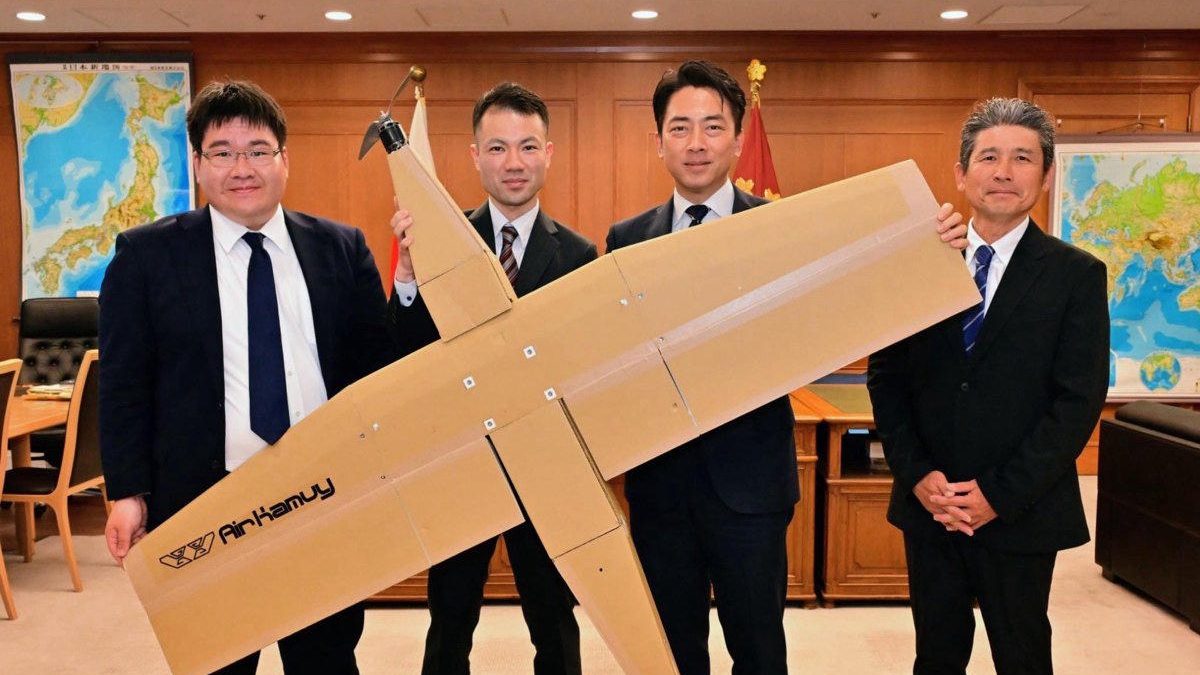
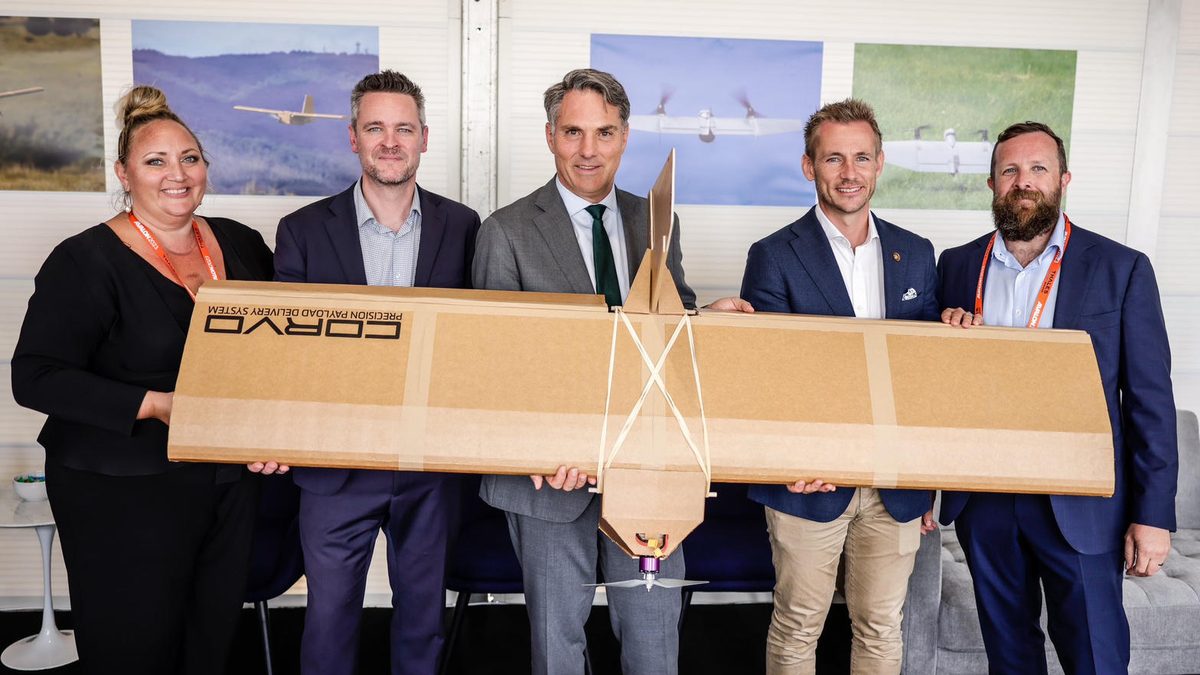
On 28 April 2026 Japan’s Defense Minister Shinjirō Koizumi posted a photograph on X of himself flanked by AirKamuy Inc. executives, holding a corrugated-cardboard fixed-wing aircraft roughly the size of a small surfboard. He confirmed that the Japan Maritime Self-Defense Force (JMSDF) is already using the AirKamuy 150 as a live aerial target. A target buy is the polite procurement category that allows a defence ministry to put a new kind of platform into the air, watch it fly, and learn its envelope without committing to a weaponised variant. Japan has, in effect, joined Ukraine and Australia in a small group of nations that have moved cardboard expendable drones from concept to fielded military inventory. The point of the AirKamuy is not that it is made of cardboard. The point is what cardboard costs.
The Numbers That Broke the Doctrine
Air-defence systems are sized around two assumptions. The first is that the airframes being shot down are expensive (a fighter, a cruise missile, a strike aircraft) so that exchanging a $1 million to $4 million interceptor for the kill is rational. The second is that the attacker also pays large costs to put those airframes over the target. Both assumptions have failed.
Open-source pricing from the last twenty-four months puts the unit cost of a Shahed-136 one-way attack drone at $20,000 to $50,000, with Russian domestic Geran-2 production running $35,000 to $70,000 depending on the iteration and where the components were sourced. A Patriot Missile Segment Enhancement (MSE) interceptor costs approximately $4.1 million per round. The cheaper PAC-2 variants are still in the seven-figure range. Even before any system-level costs (radar duty cycle, magazine depth, sustainment), the round-on-round exchange ratio is roughly 80 to 200 in the attacker’s favour, with 450:1 reported in cases where a PAC-3 is launched against a baseline Shahed.
That is at the upper end of the cost curve. At the lower end (the AirKamuy 150 at around $2,500 a unit, the Corvo PPDS at $670 to $3,350) the exchange ratio against any Patriot-class interceptor exceeds 1,000:1. Even if Patriot is replaced with a hypothetical $100,000 cheap interceptor drone, the ratio against a $2,500 cardboard airframe is still forty to one in favour of the attacker. There is no obvious price floor below which the defender can prevail on cost alone, which is why every serious air-defence community in NATO is now investing in layered C-UAS combining guns, electronic warfare, microwaves, lasers, and (importantly) cheap kinetic interceptors of their own.
From Melbourne to Kursk: How the Concept Was Proven
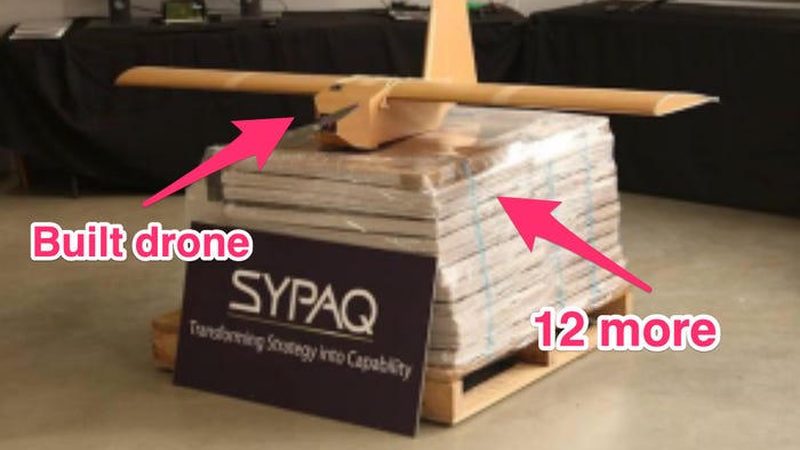
The contemporary cardboard-drone story is not a Japanese story. It is an Australian engineering story that crossed a war zone in 2023. The SYPAQ Corvo Precision Payload Delivery System (PPDS) is built by Melbourne-based SYPAQ Systems. The airframe is best described, in technical terms, as waxed foamcore with corrugated reinforcement rather than pure corrugated cardboard. It ships in a flat-pack, assembles in roughly an hour, has a maximum range of about 120 kilometres, and the published unit price band is $670 to $3,350 depending on configuration. SYPAQ has been producing approximately 100 systems per month for Ukraine since March 2023.
On the night of 26 to 27 August 2023 the Security Service of Ukraine (SBU) conducted an operation against the Russian Air and Space Forces base at Kursk Vostochny Airport using Corvo PPDS as a one-way attack platform. Ukrainian claims (which Russian sources never confirmed publicly and ISC has not independently verified through post-strike imagery) are that the swarm damaged four Su-30 and one MiG-29 fighter aircraft, an S-300 radar, and two Pantsir-S1 short-range air-defence systems. Reported swarm cost is around $24,000. If the high end of the claimed damage list is accurate, the cost-to-damage ratio runs into the thousands. Even on a deeply conservative reading (assume only the air-defence radars and a single fighter were damaged), the operation reset assumptions about what could penetrate a defended Russian air base.
Two technical features made it possible. The first is the non-metallic skin: a waxed-foamcore airframe gives a substantially lower radar cross-section than aluminium, composite or metal-framed UAS at comparable size, particularly at the X-band frequencies most short-range air-defence radars operate in. The second is the speed-altitude flight profile: slow, low and small, which sits below the detection floor of many medium-range air-defence systems that are tuned to discriminate against ground clutter at higher closing velocities. Neither feature gives the Corvo PPDS true low-observable performance. They simply put it in the same engagement-difficulty bracket as a small unmanned commercial aircraft, which is a much harder problem than the threat-set most legacy air-defence systems were designed against.
Japan’s AirKamuy 150: The Concept Industrialises
The AirKamuy 150 is the same concept, refined for mass production and Japanese export. Nagoya-based AirKamuy Inc. describes the platform as a fixed-wing UAS constructed from corrugated cardboard with a water-resistant coating. The published technical envelope is:
| Parameter | AirKamuy 150 (published) | SYPAQ Corvo PPDS (published) | ISC technical note |
|---|---|---|---|
| Unit cost | $2,000 to $2,500 | $670 to $3,350 | Both below the cost of a single Stinger missile (~$120,000) or Javelin (~$240,000). |
| Assembly time | ~5 minutes flat-pack | ~1 hour flat-pack | AirKamuy claim is plausible given a die-cut sheet design and snap-fit construction. |
| Shipping density | ~500 units per 20-foot ISO container | Flat-pack, similar density | Logistic footprint of a single container can therefore sustain a 500-airframe sortie wave. |
| Speed | 100 to 120 km/h (62 to 75 mph) | ~60 km/h cruise, higher dash | Both sit in the slow-low-small (SLS) engagement bracket. |
| Endurance | 80 minutes (up to 2.5 h) | ~3 h published | Endurance is in the loitering-munition band, not the strike-aircraft band. |
| Range | ~80 km typical, up to 150 km | ~120 km | Operational radius useful for archipelago defence (Japan) and shallow-strike (Ukraine). |
| Payload | 0.7 to 1.5 kg | Up to ~3 kg | Payload mass dictates either reconnaissance/EW package or a sub-grenade-class warhead. |
| Production model | Cardboard factories with die-cutters | SYPAQ Melbourne (~100/month for Ukraine) | Decentralised production: any cardboard packaging facility can be converted. |
The JMSDF deployment is currently in the aerial-target role: a live-fire training platform that lets JMSDF radar and weapons crews train against a realistic small-UAS signature without expending a more expensive target drone. That is the cautious doorway. The roles under public discussion (per multiple Japanese and Western outlets) include reconnaissance and ISR, electronic warfare carrier, decoy, and one-way attack. The same airframe class, with a different payload, covers all four. Japan’s island-chain defence posture (the Nansei Shotō running south-west from Kyushu toward the Senkaku and Taiwan) is exactly the kind of dispersed, archipelagic geometry in which a flat-pack, container-sustainable, sub-$3,000 airframe at scale is operationally compelling.
The Shahed Math: Why $4M Interceptors Are Unsustainable
The Shahed-136 (and the Russian-produced Geran-2 derivative) is at a different point on the cardboard-drone family tree. It is not cardboard, it is a low-cost composite, and at 200 kilograms gross weight with a 30 to 50 kilogram warhead it is a different threat class than the Corvo or AirKamuy. But the underlying economic logic is identical: cheap one-way attack airframes at scale, used to deplete the defender’s magazine.
The 2024 to 2026 use case made the math public. Russian and (separately) Iranian-aligned actors have routinely launched Shahed and Geran in salvos of dozens to over a hundred per night against Ukrainian and Israeli infrastructure. The Patriot system can intercept them, but a Patriot magazine reloaded from a stock pile that costs the buyer $4.1 million per round runs out faster than the attacker’s production line runs out of $30,000 airframes. The American defence-industrial community has spent 2025 and the first half of 2026 visibly looking at three categories of response: cheap kinetic interceptor drones (the Coyote Block 2 family and Ukrainian-developed equivalents), directed-energy effectors (laser and high-power microwave), and a doctrinal shift to layered C-UAS where Patriot is reserved for the highest-value threats and cheaper effectors absorb the saturation salvo.
WOME Technical Notes: What These Airframes Actually Carry
For WOME, EOD and ammunition-technical readers, three points deserve precision.
Payload class. The AirKamuy 150 published payload mass of 0.7 to 1.5 kilograms means that as a one-way attack platform it would carry a warhead in the hand-grenade-plus to RPG-warhead band: a Net Explosive Quantity (NEQ) in the region of 0.3 to 0.8 kilograms TNT equivalent, configured either as a fragmentation warhead, a shaped charge for point targets, or a thermobaric payload for soft-target effect. The Corvo PPDS at up to three kilograms can carry slightly heavier loads but is still well below the Shahed-136 warhead bracket. Mission effect is therefore not warhead size, it is accuracy plus saturation. Hazard Division and Compatibility Group are not in the public published material and would be a function of the specific warhead variant; ISC has not seen authoritative HD/CG attribution from either AirKamuy Inc. or SYPAQ for armed configurations and rates this as a DATA GAP.
Radar cross-section. “Low RCS” is a function of geometry plus material plus radar frequency. A waxed-foamcore or corrugated-cardboard airframe presents a substantially lower backscatter signature than aluminium at X-band, but the propulsion components (electric motor, propeller, fuel cell or battery, GNSS antenna) remain conventional and contribute to the total signature. Practitioners should treat the published “low radar signature” claims as comparable to a small commercial UAS in the same size class, not as a true low-observable performance category.
Counter-measures applicability. The Slow-Low-Small (SLS) engagement bracket favours C-UAS effectors that work on visual, acoustic and electro-optical tracking rather than radar discrimination. Layered defence (radar cueing, electro-optical confirmation, kinetic or directed-energy engagement, electronic-warfare jam-or-spoof) is the doctrine that has emerged from the Ukrainian and Israeli operational experience. Pure radar-on-missile architectures are the worst match for the threat class.
What Procurement and Operational Communities Should Do Now
Three actions sit outside the contested zone of doctrinal debate and inside the do-this-now category for NATO defence ministries and procurement bodies.
One: stop pricing C-UAS against the platform you wish you faced. The reference threat is no longer a Tu-22M3 with a Kh-22 cruise missile. It is a swarm of $2,500 to $50,000 airframes that the adversary can sustainably produce at hundreds to thousands per month. C-UAS pricing comparisons that assume Patriot-class interceptors as the baseline are no longer realistic, and several NATO ministries (notably the UK MOD’s C-sUAS Centre and the German Bundeswehr’s Air Defence Roadmap) have begun reflecting this in 2026 procurement documentation. ISC has covered both in companion analysis.
Two: invest in domestic low-cost UAV and C-UAS production capacity. The single most consequential feature of the AirKamuy programme is that it can be built in ordinary cardboard factories with die-cutting tooling that already exists in the civilian economy. The same logic applies to cheap interceptor drones built around commodity components. Nations with manufacturing depth (Japan, Germany, Italy, Poland, Turkey, South Korea) can build C-UAS sovereignty around adapted civilian manufacturing rather than waiting for the next $1 billion procurement programme. The UK’s 2026 announcement of an indigenous interceptor-drone fund is an explicit acknowledgement of this.
Three: train against the actual threat envelope. JMSDF buying AirKamuy 150 as a training target is a more sophisticated procurement move than it appears. The published target-drone market has been dominated by twentieth-century reusable platforms (BQM and ANSAC families) that cost five to seven figures per unit and do not present the SLS signature. A cardboard target at $2,500 lets a defender expend it on realistic engagements without breaking the budget. Other NATO navies (RN Maritime UxV programme, US Navy NIWC Pacific, French Méditerranée exercises) are reportedly examining the same approach. ISC expects the target-drone segment to bifurcate over the next eighteen to twenty-four months between high-fidelity reusable training assets and cheap, attritable, realistic-signature airframes.
Indicators to Watch
Four open questions will shape whether the cost-asymmetry curve continues to widen through 2026 and 2027.
The JMSDF combat-role decision. AirKamuy 150 is currently a training target. A JMSDF or Japan Ground Self-Defense Force decision to field an armed or ISR-equipped variant for the Nansei Shotō would be a first-tier NATO-aligned operator confirming the platform class beyond the Ukrainian operational proof.
The US cheap-interceptor decisions. Coyote Block 2 procurement scale, the FY27 budget request for directed-energy programmes (HELWS, IFPC-HEL, HPM), and the Pentagon’s reported interest in Ukrainian-developed interceptor drones. If those programmes scale, the cost-exchange curve narrows on the defender side. If they stall, the structural problem deepens.
European industrial response. Whether the UK’s 2026 indigenous interceptor-drone fund, the German Air Defence Roadmap, and the European Defence Fund counter-UAS calls translate into procurement-at-scale within 18 months, or whether they remain at the demonstrator stage.
The Iranian and Russian production curve. Russian Geran-2 production was reported in March 2026 at roughly 4,000 to 5,000 units per month, with planned expansion. Iranian Shahed-136 production estimates vary widely. If the attacker production curve continues to outpace the defender’s interceptor magazine refresh, the structural gap will be the dominant air-defence policy question of the second half of the decade.
About this research
This analysis was produced by the ISC Defence Intelligence research team, the open-source intelligence publication of Integrated Synergy Consulting Ltd. It is one of an ongoing series on Counter-Unmanned Aerial Systems (C-UAS), the cost-exchange crisis in air defence, and the implications for Weapons, Ordnance, Munitions and Explosives (WOME) procurement.
ISC Defence Intelligence publishes on WOME, NATO procurement, the defence industrial base, and explosive safety. Independent consulting, training and bespoke briefings are available on the same subject matter. For media enquiries, expert commentary requests, or a private briefing on the topics covered here, contact /contact.
Published by Integrated Synergy Consulting Ltd · trading as ISC Defence Intelligence · Registered in England and Wales · integratedsynergyconsulting.com
Acronyms Used
C-UAS Counter-Unmanned Aerial Systems · CG Compatibility Group · EW Electronic Warfare · GNSS Global Navigation Satellite System · HD Hazard Division · HELWS High-Energy Laser Weapon System · HPM High-Power Microwave · IFPC-HEL Indirect Fire Protection Capability High-Energy Laser · ISO International Organization for Standardization (container) · ISR Intelligence, Surveillance, Reconnaissance · JMSDF Japan Maritime Self-Defense Force · LO Low Observable · MSE Missile Segment Enhancement (Patriot variant) · NEQ Net Explosive Quantity · PAC-2 / PAC-3 Patriot Advanced Capability missile families · PPDS Precision Payload Delivery System (SYPAQ) · RCS Radar Cross-Section · SBU Sluzhba Bezpeky Ukrayiny (Security Service of Ukraine) · SLS Slow-Low-Small · UAS Unmanned Aerial System · UAV Unmanned Aerial Vehicle · WOME Weapons, Ordnance, Munitions and Explosives.
References
- Tom’s Hardware, “Japan is deploying ultra-cheap cardboard drones built for swarm warfare and expendable combat missions,” 3 May 2026. tomshardware.com (NATO STANAG 2022: B-2).
- Futurism, “Japan Deploying Combat Drones Made of Cardboard,” 10 May 2026. futurism.com (B-3).
- Interesting Engineering, “Japan’s low-cost cardboard drones can make war expenses nosedive,” 29 April 2026. interestingengineering.com (B-3).
- UPI, “Japan deploys low-cost ‘cardboard drones’ for warfare,” 3 May 2026. upi.com (B-2).
- 404 Media, “Japan Is Building Cardboard Suicide Drones,” 2026. 404media.co (B-3).
- The Debrief, “Japan Just Unveiled a Game-Changing New Combat Drone,” 2026. thedebrief.org (C-3).
- Tech.Yahoo, “Japan’s $2,500 Cardboard Drones Are Beating Million-Dollar Military Logic,” 2026. tech.yahoo.com (C-3).
- Militaer Aktuell, “AirKamuy drone: Japan with the courage to use cardboard,” 2026. militaeraktuell.at (B-3).
- Wikipedia, “Sypaq Corvo Precision Payload Delivery System.” en.wikipedia.org (C-3, used as cross-reference; underlying sources verified independently).
- Army Recognition, “Australian Sypaq cardboard drones used in Ukraine to attack a Russian air base,” 2023. armyrecognition.com (B-2).
- Aerotime, “Ukraine allegedly used cardboard drones to bomb Russian base,” 2023. aerotime.aero (B-3).
- Gigazine, “Detailed explanation with images of the specifications and features of the cardboard drone used by the Ukrainian military,” 6 September 2023. gigazine.net (C-3).
- Drone Warfare research, “Shahed-136: Cost, Production Rate, RCS and Countermeasures.” drone-warfare.com (B-2).
- Quwa, “Shahed Drone: Iran’s Attrition Weapon and the Cost-Exchange Crisis of 2026.” quwa.org (B-2, primary analytical reference for the cost-exchange framing).
- Norsk Luftvern, “Air Defense Systems Cost Database: Acquisition, Interceptor, and Lifecycle Costs — Editor’s Update March 2026.” norskluftvern.com (B-2).
- CNBC, “Iran’s Shahed-136 drone: How the poor man’s cruise missile is shaping Tehran’s retaliation,” 5 March 2026. cnbc.com (B-2).
- DroneXL, “Pentagon and Gulf States Eye Ukrainian Interceptor Drones As Patriot Missile Stocks Run Low,” 5 March 2026. dronexl.co (B-3).
- SYPAQ Systems Pty Ltd, Corvo Precision Payload Delivery System product page. sypaq.com.au (B-2, manufacturer primary).
- AirKamuy Inc., company website. airkamuy.com (B-3, manufacturer primary).
- Shinjirō Koizumi (@koizumi.shinjiro), 28 April 2026 X (formerly Twitter) post confirming JMSDF use of AirKamuy 150 as aerial targets, with photograph (B-1, primary, official source).
- Hero image (left): Defence Minister Shinjirō Koizumi with AirKamuy Inc. executives, holding the AirKamuy 150. Source: Shinjirō Koizumi’s official X account, 28 April 2026 (B-1, primary).
- Hero image (right): Australian Deputy Prime Minister Richard Marles with SYPAQ Systems team holding the Corvo PPDS at Avalon Australian International Airshow 2023. Source: SYPAQ Systems Pty Ltd press kit (B-2, manufacturer primary).
- Figure 2 (Corvo pallet): Pallet of flat-packed Corvo PPDS kits at the SYPAQ Systems Melbourne workshop, with one assembled airframe on top. Source: SYPAQ Systems Pty Ltd photography, annotated by Business Insider, 2023 (B-2).
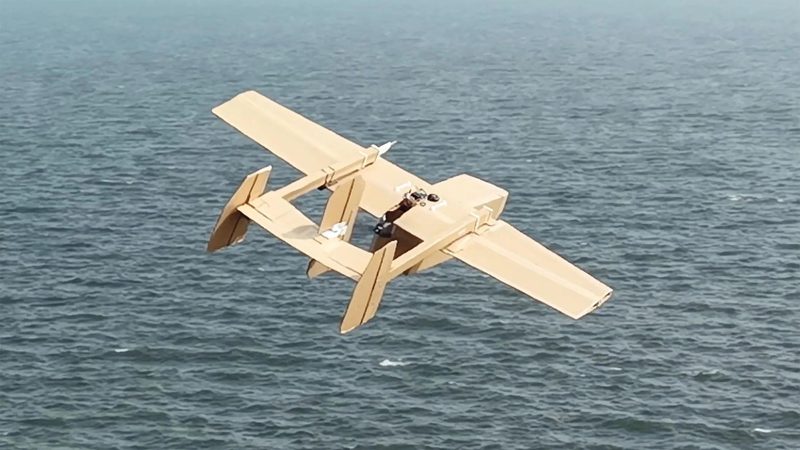
- Figure 3 (Corvo sea-skimming): Twin-boom Corvo PPDS variant in low-altitude flight over open water. Source: SYPAQ Systems Pty Ltd promotional footage (B-2, manufacturer primary).
Note on the Kursk strike attribution. The damage list reported for the 26 to 27 August 2023 SBU operation against Kursk Vostochny (four Su-30, one MiG-29, one S-300 radar, two Pantsir-S1 systems) is the Ukrainian-side claim. Russian sources did not publicly confirm. Open-source post-strike imagery is consistent with damage to multiple aircraft and air-defence systems but does not by itself substantiate the full claimed list. The operation as a fact (a successful strike using cardboard one-way attack drones) is well-evidenced; the specific count is at lower confidence.
Note on cost figures. All USD figures are open-source published values from manufacturer disclosures, defence-industry reporting, and the Norsk Luftvern Air Defence Cost Database. Patriot PAC-3 MSE unit cost ($4.1 million) reflects 2025 Foreign Military Sales pricing per Defense Security Cooperation Agency notifications and is consistent with the CSIS and RUSI assessments cross-referenced in the Quwa cost-exchange analysis. Production-cost ranges for Shahed-136 and Geran-2 reflect the published CSIS and RUSI bands; lower-end Iranian and Russian internal numbers may differ.
This article is AI-assisted, drawn from open-source materials, and intended for analytical purposes only. It is not a substitute for legal, procurement, financial or operational advice. Source ratings follow NATO STANAG 2022 (Reliability A–F, Accuracy 1–6). Acronyms are expanded on first use.
ISC Assessment
The honest read of the AirKamuy 150 announcement is not that Japan has invented a new weapon. The honest read is that Japan has industrialised a known concept and confirmed publicly that its armed forces are now buying it. Cardboard military drones have moved from Australian engineering curiosity (2022 to 2023) through Ukrainian operational proof (August 2023) to formal Japanese defence-ministerial endorsement (April 2026) in under three years. That is a fast technology-transition tempo for a NATO-aligned manufacturing base.
What it means for the cost-exchange crisis is more contested. The pessimist read is that no NATO air-defence system currently in service can sustainably engage a saturation swarm of $2,500 to $50,000 airframes against a $4 million interceptor magazine, and that the operational shortfall is now structural rather than tactical. The optimist read is that the same low-cost engineering logic that produced AirKamuy can also produce the cheap interceptors and electronic-warfare effectors that close the gap, and that 2026 to 2028 is the catch-up window. ISC’s working assessment is that both reads are partly correct: the structural problem is real, the engineering solution is achievable, and the open question is whether NATO procurement timelines can match the manufacturing tempo that Iran, Russia and now Japan have already demonstrated for the attacker side of the equation.
For UK, German, Italian and US ammunition and C-UAS programme managers reading this in May 2026, the indicator to watch is not whether more nations field cardboard drones. They will. The indicator is whether 2026 procurement decisions on cheap kinetic interceptors and directed-energy effectors move faster than the swarm side of the curve.