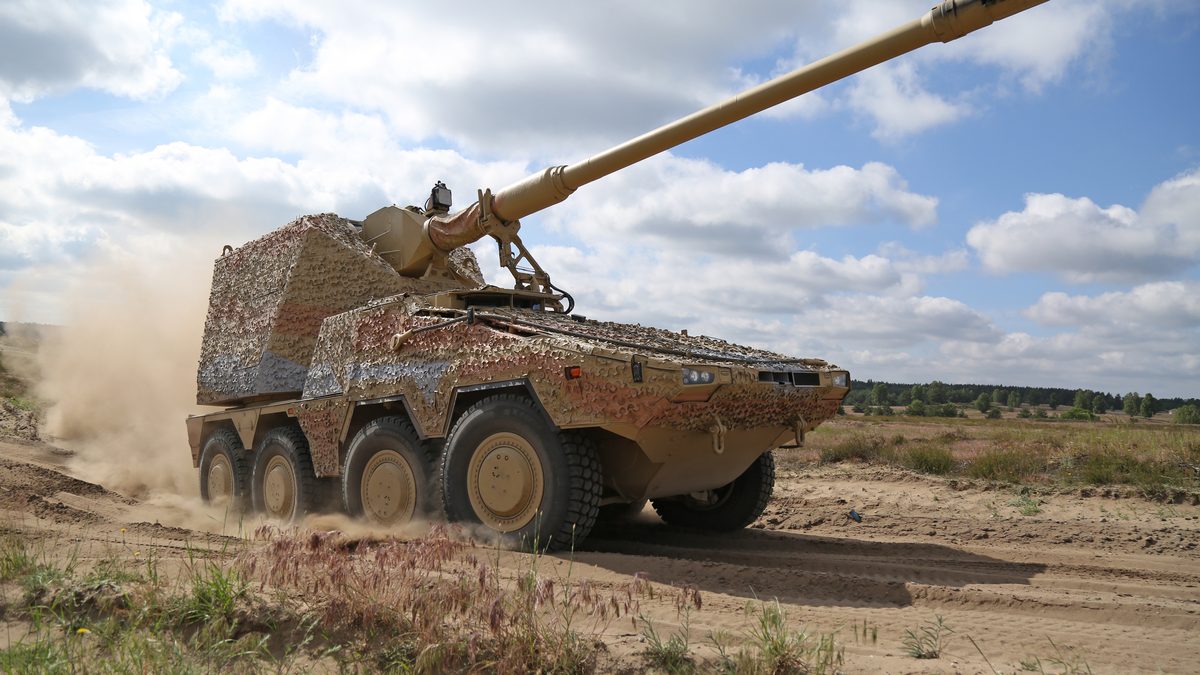
QinetiQ has been awarded an £18 million multi-year contract from the National Armaments Director Group (NADG) to put the British Army's newly ordered Remote Controlled Howitzer 155 (RCH 155) through the full Safety and Suitability for Service test cycle. The work follows the £1 billion production contract for 72 systems and lands at a moment when the Royal Artillery has been without organic Close Support 155 mm fires for almost three years.
What the Contract Covers
The QinetiQ press release of 19 May 2026 confirms the company will assure "every element of the RCH 155 from how safe the ammunition will be to the degradation of the gun barrel over time, and even how environmental factors such as extremes of temperature will affect the safety of the platform and those who operate it." Work will be delivered across QinetiQ sites operated under the Long Term Partnering Agreement (LTPA) with the Ministry of Defence and at QinetiQ's own ranges.
The contracting route is significant in its own right. This is the first major artillery test programme awarded under the National Armaments Director Group, a body the MoD established in March 2025 and which Rupert Pearce took over in October 2025 with a remit to consolidate eight separate procurement budgets and accelerate decision-making. Where past UK artillery test programmes ran through Defence Equipment & Support (DE&S), the RCH 155 work has been routed through the new NADG governance from the outset.
For the production buy itself, the contracting route is OCCAR (the Organisation for Joint Armament Cooperation), which signed with ARTEC (the joint venture between KNDS and Rheinmetall) on behalf of the UK and Germany. The model mirrors the Boxer Mechanised Infantry Vehicle (MIV) buy and is the third significant UK procurement to use OCCAR in the last decade. The deal sits inside the Trinity House Agreement signed by John Healey and Boris Pistorius in October 2024, which formally commits the two nations to deeper interoperability and to sharing test and evaluation facilities. The QinetiQ contract is, in that sense, Trinity House moving from communique into invoiced delivery.
The contract also follows a £52 million Early Capability Demonstrator contract signed in December 2025 and a £53 million Long Lead Item procurement contract earlier in 2026, which paid for Rheinmetall's large-calibre gun manufacturing line at Telford to be tooled up. Until first delivery in 2028 the Royal Artillery's interim Close Support 155 mm capability rests on around 14 Archer wheeled howitzers loaned from Sweden, which is doing the job the AS90 did before 2023 but in materially smaller numbers.
The Capability Being Tested
The RCH 155 is the wheeled variant of the KNDS Artillery Gun Module (AGM). Where the AGM was originally designed as a flexible turret module, the RCH 155 marries it to a Boxer 8×8 drive module. The result is a self-propelled howitzer with two crew, fully automated gun-laying, an autoloader, and the ability to deliver fires from the short halt or on the move. KNDS markets it as the world's first howitzer that can fire while in motion; for the Royal Artillery the practical implication is a step-change in survivability against counter-battery radar (CBR) detection, since the firing position itself is moving. That is a meaningful change from the AS90's three-crew, tracked, partly manual loading cycle.
| Calibre & barrel length | 155 mm L/52 (Rheinmetall, PzH 2000-compatible) |
|---|---|
| Rate of fire | 8 rounds per minute, sustained for 3 minutes |
| Range, Base Bleed (BB) | Up to 40 km |
| Range, V-LAP | Up to 54 km |
| Range, VULCANO GLR (guided) | Up to 70 km |
| Onboard magazine | 30 projectiles & 144 modular charges (DM72 / DM92, Nitrochemie) |
| Traverse / elevation | 360° / −2.5° to +65° |
| Crew | 2 (driver / system operator + commander) |
| Powerpack | MTU 8V199 TE21 diesel V8, 820 PS (600 kW) |
| Road speed / range | 100 km/h, >700 km |
| Operational signature | Stop, fire, displace within ~30 seconds; fire-on-the-move capable |
Three details matter for the test programme. The 70 km figure quoted by QinetiQ in the press release is achievable only with VULCANO Guided Long Range (GLR) ammunition; unguided ammunition tops out at 54 km with V-LAP and 40 km with the more commonly stocked Base Bleed family. The 8 rounds per minute figure is the manufacturer's sustained burst over three minutes, and sustained fire beyond that envelope is constrained by barrel heating and propellant temperature management. And the 360° firing capability at full elevation, combined with the fire-on-the-move requirement, places fresh demands on the chassis, on stabilisation, and on the safety case for crew dismount distances.
The Wider Order Book
The UK is the fourth confirmed RCH 155 customer and the largest non-German one to date. Mapping the global order book matters because it tells us how much industrial throughput Rheinmetall and KNDS have to deliver in parallel, which directly affects UK delivery risk in 2028.
| Operator | Units |
|---|---|
| Germany (Bundeswehr) | 80 firm under contract (Dec 2025, €1 bn); 149 further units planned for 2026; framework agreement for up to 500 |
| United Kingdom (Royal Artillery) | 72 firm under contract (May 2026, ~£1 bn); deliveries from 2028 |
| Ukraine | 54 (German-funded across three tranches, 2022 to 2024); first deliveries 2025 |
| Qatar | 12 (Sept 2024, swap arrangement in which Qatari PzH 2000 went onward to Ukraine) |
| Prototypes | 4 (3 Germany, 1 UK), ordered December 2025 |
| Active interest, no order | Netherlands (Royal Netherlands Army, expressed Aug 2024); United States (KNDS pitching the tracked variant as a candidate M109 replacement) |
Two implications follow. First, on current numbers, around 218 RCH 155 are under firm contract globally, with the German framework agreement adding capacity for up to a further 416 units. Rheinmetall's Telford gun line and KNDS Stockport drive-module line are therefore not just serving the UK order; they sit inside a programme of record several times larger. Second, the Ukrainian and Qatari fleets give QinetiQ a useful corpus of in-service data to triangulate against during the test campaign, particularly on cold-weather performance (Ukraine) and high-temperature performance (Qatar).
The WOME Test Envelope
Translating the QinetiQ description into Weapons, Ordnance, Munitions and Explosives (WOME) terms, the multi-year test programme sits across four workstreams.
1. Insensitive Munitions (IM) and ammunition safety
"How safe the ammunition will be" is shorthand for compliance with STANAG 4439 and the AOP-39 test family: Fast Cookoff (FCO), Slow Cookoff (SCO), Bullet Impact (BI), Fragment Impact (FI), Shaped Charge Jet Impact (SCJI) and Sympathetic Reaction (SR). With 30 projectiles and up to 144 modular propellant charges carried in close proximity to a two-person crew compartment, the IM response of the stowed natures (HE, illuminating, smoke, and the modular charges themselves) is a first-order safety case question. The Nitrochemie DM72 / DM92 modular charge families used with the L/52 AGM, and the standard NATO charge module options, will need to be qualified in the integrated stowage.
2. Barrel life and Equivalent Full Charge (EFC) testing
An L/52 barrel firing top-charge modular propellant erodes faster than the 39-calibre AS90 barrels the Royal Artillery is familiar with. QinetiQ's barrel-degradation work is, in practical terms, an Equivalent Full Charge cycling programme to establish wear curves, condemnation criteria, and inspection schedules under STANAG 4224 methods. For a fleet of 72 barrels with no domestic surge re-bore capability outside Rheinmetall Telford, the inspection interval Royal Artillery field workshops can sustain will materially affect the operational availability number quoted in the through-life cost model.
3. Environmental envelope
"Extremes of temperature" maps to STANAG 2895 climatic categories. For a British Army system that must deploy from Norway to the Gulf, qualification has to cover at least A1 (Hot Dry, ±63 °C ground temperature) through C2/C3 (Cold and Severe Cold, down to −46 °C). Each category changes propellant burn rates, breech-clearance tolerances, hydraulic fluid viscosity, electronics behaviour, and crew ergonomics. The automated loader is the highest-risk subsystem in this envelope, and manual back-up is limited.
4. Human factors and platform safety integration
A two-person crew firing a 21-round ready supply at 9 rounds per minute generates particular fume-extraction, vibration, peak overpressure and chamber-noise exposure profiles. The Defence Ordnance Safety Group (DOSG) and the Defence Safety Authority (DSA) will need a defensible safety case before in-service release, and the data will come from QinetiQ's Eskmeals and Shoeburyness ranges. The standard QinetiQ artillery instrumentation chain (high-speed video, strain gauging, in-bore yaw cards, sound and overpressure surveys) is the obvious tool set.
UK Industrial Footprint
The production package has more UK content than the headline "German howitzer on a German chassis" suggests. Rheinmetall's large-calibre plant in Telford will manufacture the barrel, breech, recoil mechanism and trunnions; Sheffield Forgemasters supplies the steel; KNDS UK's Stockport facility manufactures the Boxer drive module. That gives the Royal Artillery a domestic spares and re-life capability that the AS90 fleet, drawing heavily on Vickers Shipbuilding heritage parts, increasingly lacked towards the end of its service life.
It also gives QinetiQ a meaningful in-country test partner network. Rather than shipping articles back to Germany for any non-routine investigation, the LTPA model allows QinetiQ to draw on Telford and Stockport for engineering support during the test campaign, shortening the corrective-action loop.
What Has Not Yet Been Funded
The 13 May 2026 GOV.UK announcement and the 19 May 2026 QinetiQ press release between them cover the guns, the test programme, the industrial commitments, and the headline jobs number. What neither covers is the wider support architecture that the Bundeswehr has built around its RCH 155 fleet. For UK readers tracking the Defence Investment Plan, this is the territory in which the next set of funding decisions will sit, and where the political case for additional money still has to be made.
The German support ecosystem the UK has not matched
Germany has built its RCH 155 procurement inside a wider "Mittlere Kräfte" (medium forces) Boxer programme that treats the gun as one node in a unified family. The standout element is an automated robotic-arm ammunition resupply Boxer in advanced development at KNDS / Rheinmetall. The concept is a dedicated rear mission module with a six-degree-of-freedom industrial robotic arm and a magazine of around 38 projectiles plus 220 to 242 modular charges, mating directly to the RCH 155's autoloader hatches and transferring rounds with zero crew exposure. Sustained high-tempo fires under counter-battery threat, which Ukraine has demonstrated as the dominant survivability driver for tube artillery, become tractable in a way they are not with manual resupply. Germany has also confirmed a dedicated support-battery structure (three firing batteries plus one support battery per artillery battalion) and is allocating Boxer-family recovery, engineer and bridging variants against the RCH 155 fleet rather than relying on legacy support assets.
The UK programme of record announced so far covers none of this explicitly. KNDS UK Stockport will manufacture the RCH 155 drive modules, but no public statement has set out how the Royal Artillery will resupply 30-round magazines under fire, how the regiments will be structured organisationally, or which Boxer support variants will be allocated against the new batteries.
ISC capability-gap assessment
The following table is an ISC assessment of the minimum viable support package the UK would need to match the German operating concept. The quantities, priorities and timelines are ISC analytical recommendations, not contracted figures. They are intended to inform the funding conversation the Defence Investment Plan team will need to have over the next twelve to eighteen months.
| Capability | Recommended quantity |
|---|---|
| Robotic-arm resupply Boxer CRITICAL priority · target 2027 to 2029 | 18 to 24 platforms. Major survivability and tempo gain. Closes the single largest gap against the German concept. |
| Boxer recovery vehicles HIGH priority · target 2026 to 2028 | 24 to 30 platforms. Essential recovery support; partly addressable from the existing UK Boxer Mechanised Infantry Vehicle fleet but a dedicated allocation is required. |
| Boxer engineer / bridging variants MEDIUM priority · target 2027 to 2030 | 12 to 18 platforms. Mobility and obstacle clearance for forward gun positions. Currently only partially covered. |
| Dedicated support-battery structure HIGH priority · target 2026 to 2027 | One support battery per RCH 155 regiment. Organisational foundation for the rest of the package; can be stood up without further platform procurement. |
| Training & in-service support Already contracted | Included in the main £1 bn buy. No additional funding required. |
A three-phase funding envelope
Three phases would carry this from current state to full alignment with Germany by 2032.
Phase 1, 2026 to 2027. Foundation. Stand up the dedicated support-battery structure inside each new RCH 155 regiment and allocate existing UK Boxer recovery and engineer variants from the Mechanised Infantry Vehicle fleet against the new artillery role. This is the lowest-cost phase because it is largely organisational and re-roling rather than new procurement.
Phase 2, 2027 to 2029. Critical capability. Procure 18 to 24 robotic-arm resupply Boxers in parallel with the RCH 155 in-service introduction. Procure additional Boxer recovery and engineer variants where existing fleet allocation proves insufficient. This is the highest-value phase and the one most likely to need primary-source ministerial advocacy because the platform is novel.
Phase 3, 2029 to 2032. Full alignment. Adopt the German robotic resupply solution as it matures, or take a joint UK-German variant if Trinity House Agreement industrial discussions go that way. Standardise tactics, techniques and procedures with the Bundeswehr so the two fleets are operationally interchangeable on NATO's eastern flank.
Why this matters now
The funding window for Phase 2 closes faster than it looks. Robotic resupply Boxers will need to be on contract by 2028 at the latest to be in service alongside the gun. The political case for the additional spend is materially easier to make while the RCH 155 announcement is still fresh, the Trinity House Agreement is still a live communications theme, and the AS90 capability-gap narrative still resonates in Parliament. Push that conversation past the 2028 Strategic Defence Review refresh and the case has to be re-built from scratch against competing demands.
Programme Risk: The 2028 Deadline
The expedited delivery timeline is the one element that has drawn cautious commentary from defence analysts. Production starts in 2028 against a contract signature in May 2026, under two years from order to first delivery for a system that has only recently entered serial production in Germany and Ukraine. Army Technology has flagged that compressed test schedules historically correlate with deferred safety findings landing in service. The QinetiQ contract is therefore both a confidence signal (the MoD has resourced the test work properly) and a stress point. There is no margin for re-testing if a first-cycle finding requires a design change.
Acronyms Used
AGM Artillery Gun Module · AOP Allied Ordnance Publication · AS90 Self-Propelled Howitzer (legacy UK 155 mm system) · BB Base Bleed · CBR Counter-Battery Radar · CS Close Support · DE&S Defence Equipment and Support · DOSG Defence Ordnance Safety Group · DSA Defence Safety Authority · EFC Equivalent Full Charge · HE High Explosive · IM Insensitive Munitions · LTPA Long Term Partnering Agreement · MFP Mobile Fires Platform · MIV Mechanised Infantry Vehicle (Boxer family) · NADG National Armaments Director Group · OCCAR Organisation for Joint Armament Cooperation · RCH Remote Controlled Howitzer · SDR Strategic Defence Review · SRO Senior Responsible Owner · STANAG Standardisation Agreement (NATO) · V-LAP Velocity-enhanced Long-range Artillery Projectile · WOME Weapons, Ordnance, Munitions and Explosives.
References
- Ministry of Defence (UK Government), "Next-generation remote controlled artillery systems to transform British Army," press release, 13 May 2026. gov.uk (NATO STANAG 2022: A-1, primary government source, Crown Copyright / OGL v3.0). Confirms 72-unit order, ~£1 bn value, 2028 first delivery, Trinity House Agreement context, Sheffield Forgemasters and KNDS Stockport industrial commitments, Archer interim capability.
- QinetiQ press release, "QinetiQ to test Army's new remote-controlled artillery systems," 19 May 2026. qinetiq.com (B-2, official corporate statement, partial corroboration available).
- Breaking Defense, "All guns blazing: The UK sets up $1.35 billion RCH 155 artillery order," May 2026. breakingdefense.com (B-2).
- Defence Industry Europe, "UK awards £1 billion RCH 155 artillery contract to strengthen British Army capability and NATO interoperability," 2026. defence-industry.eu (B-2).
- KNDS Group, "RCH 155" product page, technical specification. knds.com (B-2, manufacturer source, performance figures are vendor-stated).
- Army Technology, "Is there a risk with the UK's expedited RCH 155 artillery order?," 2026. army-technology.com (B-3).
- Forces News, "Royal Artillery to get 72 RCH 155 howitzers: British chassis, British turret, British steel," 2026. forcesnews.com (B-2).
- GOV.UK, "National Armaments Director Group," institutional reference. gov.uk (A-1).
- Wikipedia, "RCH 155," compiled technical specification and operator list (cross-checked against KNDS, Forces News and Defence Industry Europe). en.wikipedia.org (C-3, compiled secondary source).
- Below the Turret Ring (technical defence analysis blog), reporting on the KNDS / Rheinmetall automated robotic-arm Boxer ammunition resupply module concept. Used for the German support-ecosystem context. (C-3, expert open-source secondary, used only for capability description not numbers.)
- Hero image: KMW-RCH155-01.jpg via Wikimedia Commons. Licence shown on the file page; please verify before re-publication. OGL v3.0 alternative: RCH 155 demonstrator on trials (UK MOD, Crown Copyright).
Note on the funding-gap section. The capability-gap table and the recommended quantities (18 to 24 robotic resupply Boxers, 24 to 30 recovery vehicles, 12 to 18 engineer / bridging variants, one support battery per regiment) are ISC analytical assessment, not contracted figures. They are derived by mapping the publicly announced German support concept against the UK announcements to date, and are offered as a starting point for the funding conversation. Readers should treat them as analyst recommendation rather than fact.
This article is AI-assisted, drawn from open-source materials, and intended for analytical purposes only. It is not a substitute for procurement, legal or operational advice. Source ratings follow NATO STANAG 2022 (Reliability A–F, Accuracy 1–6). Acronyms are expanded on first use.
ISC Assessment
This is the first sizeable artillery T&E contract awarded under the National Armaments Director Group governance model, and the structure suggests the NADG is willing to front-load test funding rather than discover problems late. The £18 million envelope is in the right order of magnitude for a multi-year, multi-site campaign on a fleet of 72 platforms with a guided ammunition variant.
The real test, no pun intended, is whether QinetiQ can deliver a defensible safety case in time for the 2028 in-service date without the test programme becoming the bottleneck. The IM workstream is the single most likely candidate for a finding that requires propellant or stowage rework, and the modular charge system is the most exposed sub-assembly. Watch for the first DOSG technical report and the Defence Safety Authority's Issue Authorisation; those are the milestones that will tell us whether the timeline is achievable.
The harder conversation, and the one nobody in the public announcements has had yet, is about the support package. Germany has built its RCH 155 procurement inside a Boxer-family ecosystem that includes an automated robotic-arm resupply variant; the UK has bought the gun without yet announcing the supporting capability that makes the gun survivable at sustained tempo. On ISC's read the UK needs roughly 18 to 24 robotic resupply Boxers, plus a dedicated support-battery structure and properly allocated Boxer recovery and engineer variants. Phase 2 of that package should be on contract by 2028 to come into service alongside the gun. Push it past the next Strategic Defence Review refresh and the political case has to be re-built from cold.
For the Royal Artillery, the operational implication of even a six-month slip on the gun is another period of leaning on around 14 Archers. The bigger implication of skipping the support package altogether is fielding a 21st-century howitzer on a 20th-century logistics tail. That is the funding decision the Defence Investment Plan team will need to make over the next twelve to eighteen months.