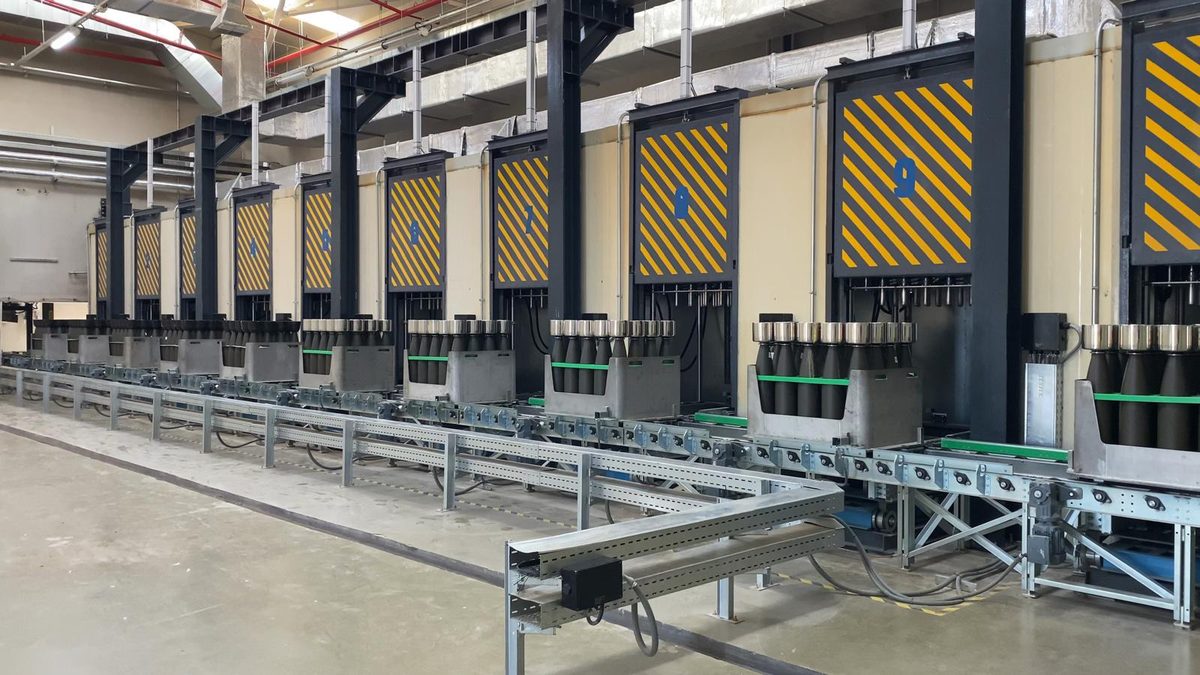
Estonian Defence Minister Hanno Pevkur and ARCA Baltics Operations OÜ signed a joint statement at SAHA Expo 2026 in Istanbul on 7 May, committing €300 million to a large-calibre ammunition plant at the Põhja-Kiviõli Defence Industry Park in Varinurme village, Lüganuse municipality, Ida-Viru County. The underlying contract was signed by the Estonian Centre for Defence Investments (ECDI) on 21 April. The 141-hectare site, selected by the Estonian state in August 2025, is to produce 155 mm artillery, mortar rounds in three calibres, and 122 mm rockets. Production is due in 2028, with up to 1,000 jobs once the line is at full ramp.
Strategic significance
Estonia had no domestic ammunition manufacturer for almost a century. Nitrotol OÜ's military explosives plant at Ämari, opened on 15 January 2026, broke that gap. ARCA Baltics is the second project to land, and the first to do large-calibre Load, Assemble, Pack (LAP) of complete artillery rounds. Energetics come from Ämari to the west of Tallinn; projectiles will be loaded at Põhja-Kiviõli in the north-east. The country now has both halves of a 155 mm round being made on Estonian soil.
The Estonian Ministry of Defence (MoD) has been unusually direct about who the plant is for. Long-range 155 mm output is built primarily for European and US export, with the state holding a contractual option to buy from the line in support of the Estonian Defence Forces (EDF). That sequencing is unusual for a national producer. Estonia's 12-howitzer follow-on order for CAESAR self-propelled guns, announced in February 2026, joins the 36-unit K9 Thunder (K9 Kõu) fleet contracted across three tranches and now distributed across the Estonian artillery structure. Both are 52-calibre systems, and both are the natural domestic customer for the extended-range natures the line is being built to make.
The announcement also feeds the EU and NATO ammunition frameworks, though not symmetrically. The European Union's Act in Support of Ammunition Production (ASAP, Regulation 2023/1525) is closed to new applicants, with disbursements continuing on the existing cohort; the European Defence Industry Programme (EDIP), now under Council consideration as the proposed successor, is the more relevant future funding instrument for the Estonian line. ARCA Baltics' eligibility under EDIP's third-country participation criteria, given a Turkish-headquartered parent, is the question to watch. On the buyer side, the NATO Support and Procurement Agency (NSPA) Land Battle Decisive Munitions (LBDM) framework, administered out of NSPA Luxembourg, is the multinational vehicle that could lift output across roughly twenty participating nations. Geographically the plant is approximately 68 km east of the British-led NATO enhanced Forward Presence (eFP) battlegroup at Tapa, and reachable by rail or road from the Canadian-led battlegroup at Ādaži in central Latvia. That shortens at least part of the eastern-flank resupply chain compared with shipping rounds in from France, Germany or Poland.
The site: Põhja-Kiviõli Defence Industry Park
The 141-hectare site at Varinurme village, Lüganuse municipality, was one of two locations approved by the Estonian government in August 2025 following a five-site selection process. The other site, Ermistu village in Pärnu County (204 ha), is the primary park and has already secured four anchor tenants. Site-selection criteria, articulated publicly by Indrek Sirp (special adviser on defence industry development at the Ministry of Defence), prioritised plot size with room for expansion, minimal environmental impact, and distance from the eastern border with Russia.
Across both parks, the Estonian state has committed up to €50 million for core infrastructure: access roads, perimeter fencing, water, gas, electricity, a testing area, a demolition site, and storage. For Põhja-Kiviõli specifically, the ECDI contract earmarks up to €10 million of that envelope. The land will be granted on long-term use-rights rather than freehold sale; the Pärnumaa tenants received terms of up to 70 years in October 2025, but the term agreed with ARCA has not been disclosed.
| Parameter | Põhja-Kiviõli Defence Industry Park |
|---|---|
| Location | Varinurme village, Lüganuse municipality, Ida-Viru County |
| Plot area | 141 hectares (greenfield) |
| State spatial plan | Approved (national designated spatial plan) |
| State infrastructure investment | Up to €10 million (access roads, fencing, utilities) |
| Anchor tenant | ARCA Baltics Operations OÜ |
| Tenant investment | ~€300 million |
| Production start | 2028 (planned) |
| Workforce target | Up to 1,000 jobs at full ramp |
| Programme parent | Estonian Centre for Defence Investments (ECDI / RKIK) |
Key players
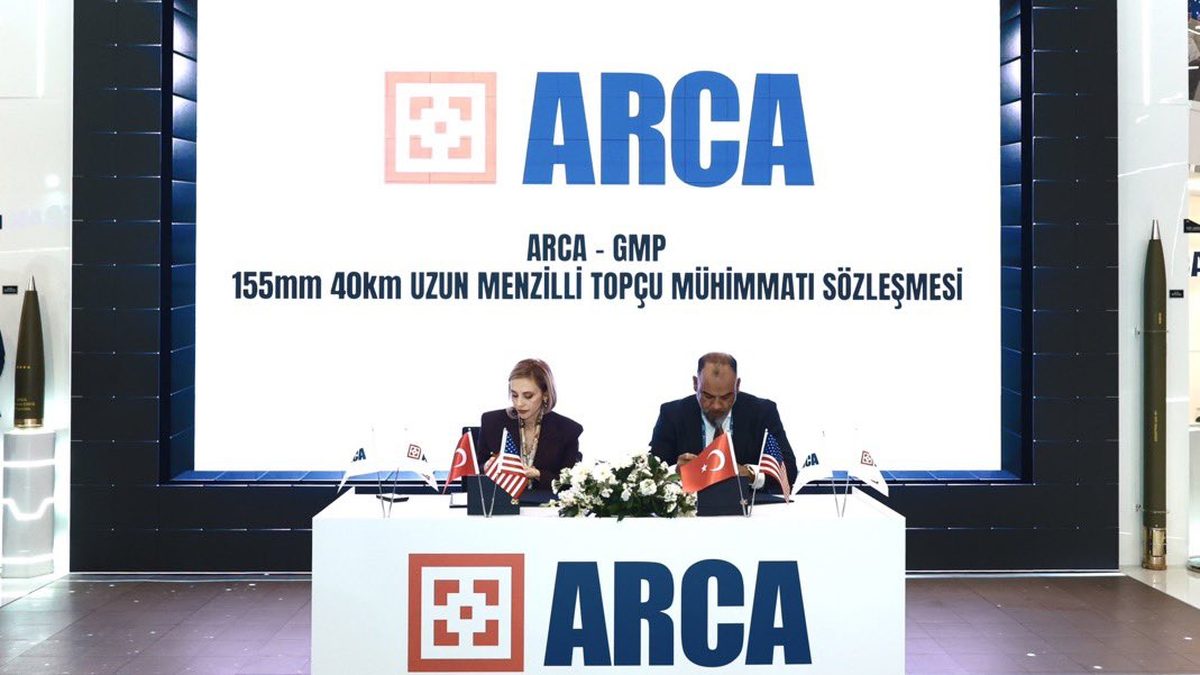
 ARCA Defense (ARCA Savunma Sanayi, Turkey)
The Turkish parent group recorded export volumes exceeding €3 billion in 2025 across all sectors and operates nine factories with approximately 5,000 employees. Activity extends beyond defence and aerospace into the energy and construction sectors. Certified Turkey's Export Champion in 2025, ARCA's existing 155 mm shell-body mass-production programme in Turkey provides a likely supply-chain anchor for the Estonian LAP operation. The group produces the AR-1071 Malazgirt 122 mm rocket at a 20 km nominal range, with a separate 122 mm extended-range product at 40 km that was the subject of a parallel SAHA Expo 2026 signing with US firm GMP. The Turkish portfolio additionally includes 60 mm, 81 mm and 120 mm mortar bombs. The same calibre suite is slated for Põhja-Kiviõli.
ARCA Baltics Operations OÜ (Estonia)
The Estonian-registered subsidiary holds the 141-hectare land-use rights and will operate the LAP facility. Ismail Terlemez, founder of the ARCA Defense group and the senior figure across the parent's Turkish operations, signed the contract on the SAHA Expo floor on 7 May 2026. Initial public statements indicate the plant will primarily produce long-range 155 mm artillery natures for European and US markets, with capacity to address other ammunition types as customer requirements develop.
Estonian Centre for Defence Investments (ECDI / Riigi Kaitseinvesteeringute Keskus, RKIK)
The state agency responsible for defence procurement, infrastructure and asset management. Press-release content quoted Tambet Tõnisson (Head of State Assets) framing ARCA's Turkish track-record and market knowledge as decisive in the selection. Asko Kivinuk, Deputy Director General, signalled in October 2025 that the Põhja-Kiviõli negotiations were running in parallel to the Pärnumaa allocations. ECDI registration code is 70009764; offices at Järve 34a, Tallinn.
Estonian Ministry of Defence (Kaitseministeerium)
Minister Hanno Pevkur signed the joint statement with ARCA in Istanbul on 7 May 2026, during a wider bilateral visit that also included meetings with Aselsan, Roketsan and Baykar leadership. Pevkur framed the deal alongside the upcoming NATO Ankara Summit and Estonia's 2026 budget commitment to raise defence spending to 5.4% of GDP, set in March 2025.
Product mix and technical context
Three calibres are confirmed in ECDI's release: 155 mm artillery, mortar bombs in unspecified calibres, and 122 mm rockets. ARCA's existing Turkish portfolio fills the gaps in what those generic descriptions probably mean.
155 mm artillery. ARCA already produces M107-pattern high-explosive (HE) in Turkey, so M107 is the safe baseline. The Estonian MoD's repeated reference to long-range natures (Minister Pevkur's "long-range" framing in Istanbul on 7 May, repeated in Postimees) points to one of the extended-range families: Extended-Range Full-Bore Base-Bleed (ERFB-BB) out to roughly 40 km, possibly Rocket-Assisted Projectile (RAP), possibly improved-lethality M795-class HE. Which specific projectile gets qualified first is not public. Compatibility with NATO 52-calibre howitzers (Estonia's CAESAR and K9 Thunder, plus allied platforms in the export-customer pool) will need confirmation in proof firings before initial operating capability (IOC). Of the charge architectures available, the NATO-standard Modular Artillery Charge System (MACS, M231 / M232A1 / A2) is the obvious export-credible choice given CAESAR's MACS qualification and K9's broadly-compatible Korean K676 modular system; legacy bag charges (M3A1 / M4A2) and Top Charge (M203A1 / A2) for maximum range would have narrower customer appeal. ARCA's existing Turkish portfolio covers both bag and modular configurations, but the architecture choice has not yet been disclosed.
Mortar rounds. ARCA's published Turkish range covers 60 mm, 81 mm and 120 mm, matching Western reporting on the Estonian product list. That tracks EDF and wider NATO inventory: 60 mm light, 81 mm medium, 120 mm heavy. HE, smoke and illumination natures are the realistic IOC mix.
122 mm rockets. ARCA's AR-1071 Malazgirt is a 20 km BM-21 Grad-pattern rocket. A separate 122 mm extended-range product at 40 km is the subject of a parallel ARCA / GMP signing at SAHA 2026; together they fit Soviet-era launchers that are still in service across Eastern Europe and that Ukraine continues to receive from NATO depots. This is the part of the deal least often flagged in coverage but arguably the most operationally useful: it removes the dependence on captured or grey-market Soviet rocket stocks that has dogged the Grad fleet since 2022.
WOME technical and safety considerations
A greenfield site loading 155 mm HE, mortar bombs and 122 mm rocket motors will hold articles across multiple UN Class 1 hazard division and compatibility group codes simultaneously, with each packaged article's classification tested and assigned by the competent authority. HE-filled 155 mm projectiles, unfuzed and without propelling charge, sit at 1.1D under UN 0167. Mortar bombs with bursting charge and own means of initiation typically classify at 1.1F or, with adequate protective features, 1.2F (UN 0292 or UN 0293). 122 mm rockets with bursting charge and own initiation fall into 1.1E, 1.2E, 1.2C or 1.3C (UN 0181 / 0182 / 0436 / 0437) by design; rocket motors shipped alone sit at 1.3C under UN 0186, with smaller motors at 1.4C. Propelling charges for cannon classify at 1.1C (UN 0279), with lower-energy designs at 1.3C (UN 0242) or 1.4C (UN 0414); general propelling charges run through UN 0271 (1.1C), UN 0415 (1.4C) and UN 0491 (1.4C). Detonating fuzes for 155 mm and mortar applications classify as 1.1B (UN 0106, older designs), 1.2B (UN 0107) or, for in-service modern fuzes with protective features such as the M739A1 PD and M734A1 multi-option, 1.4B (UN 0257). UN 0367 (1.4S) is the narrow case reserved for designs with two effective protective features packaged to confine effects to the package, not the general fuze class. Tubular primers for propellant ignition classify at 1.3G (UN 0319), 1.4G (UN 0320) or 1.4S (UN 0376). Detonators are a separate article class running through UN 0029 / 0030 (1.1B), UN 0255 / 0267 (1.4B) and UN 0455 / 0456 (1.4S). An Insensitive Munitions signature alone under STANAG 4439 does not change UN classification; the route to a lower division is the UN Manual of Tests and Criteria Test Series 7, which places qualifying articles in 1.6N (Extremely Insensitive Articles) or, for EIDS-bearing items not meeting all 1.6 prerequisites, in 1.5. Quantity-Distance (QD) site-licensing under AASTP-1 is the layout's design driver, with Inhabited Building Distance (IBD) the binding constraint against Kiviõli town centre to the south; for a mixed-LAP site the IBD will be driven by the largest single Potential Explosion Site (PES) NEQ in 1.1D under cube-root scaling (K≈22.2 m/kg1/3 unbarricaded, per AASTP-1 Ch.II), with separate Public Traffic Route Distance (PTRD) calculations dominated by thermal flux modelling around the 1.3 rocket-motor magazines.
For Ammunition Technicians (ATs) reviewing the site at IOC, the technical-assurance questions write themselves: declared Net Explosive Quantity (NEQ) per Potential Explosion Site (PES); separation distances and traverse or earth-cover specifications between LAP buildings; fire-fighting access for the 1.3 rocket-motor magazines; lightning protection meeting AOP-7 storage criteria (Estonia, as a NATO and EU member, will align to IEC 62305 where AOP-7 sets the baseline). Bulk energetics handling triggers Seveso III major-accident classification. Whether the qualified product set will be required to meet STANAG 4439 Insensitive Munitions (IM) thresholds is contract-dependent and not yet on the public record.
NATO supplier qualification through AQAP-2110 (Edition D) is the standard contract baseline, supported by AQAP-2105 (Edition C) for deliverable quality plans, AQAP-2131 (Edition C) for final inspection and testing (essential for batch-sentencing on a LAP line), and AQAP-2210 (Edition A) for any programmable or electronic fuze software qualified on the line. Estonia and Turkey are both participating states under STANAG 4107 (Edition 11), so Government Quality Assurance (GQA) is not constrained to a single national authority. Three routes are legitimately available under the mutual GQA process documented in AQAP-2070: the Estonian national QA authority via ECDI can stand up its own Government Quality Assurance Representative (GQAR) on the production floor from IOC; ECDI can delegate GQA to the Turkish national authority, which already covers ARCA's parent production; or buyer states taking the European and US export volumes can request ECDI to perform GQA on their behalf. Insensitive Munitions compliance to STANAG 4439 Type V (passing all six stimulus tests without violent reaction) or Type VI (limited burning only) is the contemporary US and Western European customer expectation, with the methodology framed by AOP-39 and the qualification baseline in AOP-7. STANAG 4439 sets the IM signature; UN Test Series 7 is the separate route by which an IM-qualified item can be reclassified into hazard division 1.6N or 1.5 if Test Series 7 criteria are met. The qualified product set's IM signature class will be a procurement question, particularly for US-bound output, where DSP-5 export licences and DSP-83 non-transfer / use certificates would govern any US-origin technology, design data, or sub-component touching the line.
Industrial ecosystem context
Põhja-Kiviõli does not stand alone. The Estonian defence-industrial pivot now has at least three working strands:
- Ämari mini-park. Nitrotol OÜ military explosives plant, ribbon-cut 15 January 2026 at Ämari Air Base west of Tallinn. Already supplying the EDF and exporting to NATO partners. Plans a second facility at Ermistu by 2027. The upstream supply of energetic fillings for Põhja-Kiviõli LAP is the most likely commercial integration path, though the propellant origin (Nitrotol, ARCA Turkish lines, or third-party) is not publicly resolved.
- Ermistu Defence Industry Park (Pärnumaa, 204 ha, primary site). Four tenants announced on 7 October 2025: Nitrotol OÜ (mines and charges), Thor Industries Ltd via its Estonian subsidiary Odin Defence OÜ (plastic explosives), Frankenburg Technologies OÜ (short-range air-defence missiles), Infinitum Strike OÜ (ammunition components). Capacity for one or two further tenants.
- Põhja-Kiviõli Defence Industry Park (Ida-Virumaa, 141 ha, secondary site). ARCA Baltics Operations as anchor and currently sole tenant under the 21 April 2026 ECDI contract.
Two further pre-selected areas, Piirsalu and Aidu, remain in planning. Earlier ERR reporting in April that a Swedish-backed company would join Põhja-Kiviõli was subsequently retracted; ARCA is the confirmed anchor.
ISC commentary
The market framing is the most interesting part of the deal. ARCA Baltics is not, on paper, an EDF supplier; it is a NATO-export producer that happens to sit inside an Article 5 country. The production base is about as far east in NATO as it is sensible to put one, and the principal off-take goes west. For Allied procurement officers running into saturated loading lines in France and Germany, a 141-hectare greenfield in Ida-Viru is a capacity backstop with a NATO flag on it, not a small national producer.
The 122 mm rocket line tends to get overlooked. Coverage gravitates to 155 mm because that is where the planning capacity gap hurts. But 122 mm Grad-pattern stocks across the Baltics, Poland and Ukraine are still operationally significant and remain energetics-constrained. ARCA's Malazgirt at 20 km, and the separate 40 km extended-range product covered by the SAHA signing with GMP, together fill a gap Western producers have largely declined to address.
The three-deal day at SAHA matters too. The ARCA / VTIC artillery agreement (Bulgaria) and the ARCA / GMP 122 mm 40 km rocket agreement (United States) signed on the same day are the buyer-side context for Põhja-Kiviõli. Estonia is not the only NATO state choosing ARCA as a 155 mm and rocket source; ARCA is building a Europe-plus-US export book in parallel with the Estonian production base. That ties the Estonian plant's commercial case to a wider portfolio of NATO-aligned customer commitments rather than to Estonian state procurement alone.
Data gaps and unresolved questions
Capacity. Annual output figures per nature have not been disclosed. No benchmark plant has been named for comparison.
Product detail. Specific projectile families to be qualified (M107, M795, ERFB-BB, RAP) and the charge architecture are not disclosed.
Supply chain. Fuze, propellant and shell-body origin (Nitrotol energetics, ARCA's Turkish shell-body lines, third-party) is not documented in the public record.
Customers. No off-take agreements with EDF, Baltic states, other NATO members or Ukraine have been published. The state procurement option is contractual but not quantified.
Compliance. AQAP-2110 qualification timeline, the chosen GQA delegation pathway under STANAG 4107 (Estonian self-perform, delegation to the Turkish authority, or delegation from a buyer-state GQAR under AQAP-2070), IM (STANAG 4439) compliance posture, and ITAR/EAR re-export exposure on any US-bound deliveries are all open.
Land tenure. Use-rights term not confirmed for the ARCA contract (Pärnumaa tenants received up to 70 years; the Põhja-Kiviõli term has not been disclosed).
EU funding pathway. The applicable European production-support instrument (ASAP closed to new applications; EDIP successor regulation still in Council; ARCA Baltics' eligibility under the proposed third-country participation criteria as a Turkish-headquartered group remains an open question).
References & primary sources
- Estonian Centre for Defence Investments (ECDI / RKIK). ARCA Baltics Operations to Build €300 Million Ammunition Factory in North Kiviõli, 21 April 2026 (official primary source). https://www.kaitseinvesteeringud.ee/en/arca-baltics-operations-to-build-e300-million-ammunition-factory-in-north-kivioli/
- Estonian Ministry of Defence (Kaitseministeerium) via GlobalSecurity. Defence Minister Pevkur in Istanbul: Defence cooperation between Turkey and Estonia intensifies, 7 May 2026 (Pevkur, Aselsan/Roketsan/Baykar/ARCA meetings, joint statement). https://www.globalsecurity.org/military/library/news/2026/05/mil-260507-estonia-mod01.htm
- ECDI / RKIK. Companies Announced for Pärnumaa Defence Industry Park, 7 October 2025 (Asko Kivinuk on parallel Põhja-Kiviõli negotiations). https://www.kaitseinvesteeringud.ee/en/companies-announced-for-parnumaa-defence-industry-park/
- Invest in Estonia. Estonia gives a green light to defence industry park in two strategic locations, 29 August 2025 (Ermistu 204 ha primary, Põhja-Kiviõli 141 ha secondary, Indrek Sirp criteria, €50 m envelope). https://investinestonia.com/estonia-gives-a-green-light-to-defence-industry-park-in-two-strategic-locations/
- ERR News (Estonian Public Broadcasting). Major ammunition plant in Estonia to be built by Turkish company, 21 April 2026, updated 22 April 2026 (Pevkur statement; Ismail Terlemez identified as signatory). https://news.err.ee/1610002228/major-ammunition-plant-in-estonia-to-be-built-by-turkish-company
- ERR News. Minister: Deal in place for 155 mm munitions factory in Estonia, 21 April 2026 (Pevkur announcement). https://news.err.ee/1609976997/minister-deal-in-place-for-155-mm-munitions-factory-in-estonia
- ERR News. Talks continue over large-caliber ammunition production in Ida-Viru County, 26 September 2025 (background to ARCA negotiations). https://news.err.ee/1609940030/talks-continue-over-large-caliber-ammunition-production-in-ida-viru-county
- ERR News. Estonia to procure another 12 CAESAR self-propelled howitzers, 12 February 2026 (EDF artillery demand-side context). https://news.err.ee/1609939514/estonia-to-procure-another-12-caesar-self-propelled-howitzers
- ERR News. Estonian company Nitrotol begins producing military explosives at Ämari, January 2026 (Nitrotol Ämari opening). https://news.err.ee/1609878391/estonian-company-nitrotol-begins-producing-military-explosives-at-amari
- Postimees. Turkish defense industry manufacturers promised to produce long-range 155 mm ammunition in Kiviõli, 7 May 2026 (Pevkur Istanbul visit, long-range emphasis). https://news.postimees.ee/8466708/turkish-defense-industry-manufacturers-promised-to-produce-long-range-155-mm-ammunition-in-kivioli
- Janes. SAHA 2026: Turkish company ARCA to build ammunition factory in Estonia. https://www.janes.com/defence-intelligence-insights/defence-news/weapons/saha-2026-turkish-company-arca-to-build-ammunition-factory-in-estonia
- The Defense Post. Turkish Firm to Boost Estonia's Ammo Production With $352M Plant, 22 April 2026 (USD conversion of the €300 m figure). https://thedefensepost.com/2026/04/22/turkish-firm-estonias-ammo/
- Militarnyi. Turkish Company to Build 155 mm Ammunition Plant in Estonia (product mix detail: M107 baseline, AR-1071 122 mm rockets, 20 km / 40 km variants). https://militarnyi.com/en/news/turkish-company-to-build-155mm-ammunition-plant-in-estonia/
- SAHA Expo. Istanbul defence exhibition, 5 to 9 May 2026. https://www.sahaexpo.com/en
- Trade with Estonia. Powerful start: four companies will launch production at Estonian Defence Industry Park, October 2025. https://tradewithestonia.com/powerful-start-four-companies-will-launch-production-at-estonian-defence-industry-park/
- Estonian World. Estonia opens first ammunition factory in a century, January 2026 (Nitrotol opening context). https://estonianworld.com/security/estonia-opens-first-ammunition-factory-in-a-century/
- Estonian Ministry of Defence (corporate site, English). https://www.kaitseministeerium.ee/en
- ECDI Flickr (RKIK). Licensed Estonian state defence imagery. https://www.flickr.com/people/199302158@N02/
- UN Recommendations on the Transport of Dangerous Goods, Model Regulations (Orange Book), Rev.23. Part 2 §2.1 Class 1, and Chapter 3.2 Dangerous Goods List. Authoritative source for all UN Class 1 division / compatibility group classifications and UN serial numbers cited in the Hazard Division discussion. Specifically: HE-filled projectiles UN 0167 / 0168; cannon propelling charges UN 0242 / 0271 / 0279 / 0414 / 0415 / 0491; mortar bombs with bursting charge UN 0292 / 0293; 122 mm rockets with bursting charge UN 0181 / 0182 / 0436 / 0437 / 0438; rocket motors UN 0186 / 0280; detonating fuzes UN 0106 / 0107 / 0257 / 0367; tubular primers UN 0319 / 0320 / 0376; detonators UN 0029 / 0030 / 0255 / 0267 / 0455 / 0456. https://unece.org/transport/dangerous-goods/about
- UN Manual of Tests and Criteria, Rev.7. Part I, Test Series 7 governs the assessment of Extremely Insensitive Detonating Substances (EIDS) and Extremely Insensitive Articles (EIA); the route by which an IM-qualified article can be reclassified into hazard division 1.6N (or 1.5 for EIDS-bearing items not meeting all 1.6 prerequisites). https://unece.org/transport/dangerous-goods/manual-tests-and-criteria-rev7
- NATO STANAG 4439 Edition 3, Policy for Introduction and Assessment of Insensitive Munitions. Defines IM signature requirements (Types I to VI) against the six stimulus tests (fast cook-off, slow cook-off, bullet impact, fragment impact, sympathetic reaction, shaped-charge jet impact); paired with AOP-39 (assessment methodology) and AOP-7 (qualification baseline).
- ADR (European Agreement concerning the International Carriage of Dangerous Goods by Road). EU and Estonian transport regime applying UN classification to road movements of finished articles. https://unece.org/transport/dangerous-goods/adr-2025-files
- European Commission DG DEFIS. European Defence Industry Programme (EDIP), proposed successor to ASAP and the relevant future EU funding instrument for European ammunition production. https://defence-industry-space.ec.europa.eu/eu-defence-industry/european-defence-industry-programme-edip_en
- NATO Support and Procurement Agency (NSPA). Land Battle Decisive Munitions (LBDM) framework, multinational vehicle for 155 mm and complementary munitions procurement across participating Allied nations. https://www.nspa.nato.int/about/news/2024/nspa-land-battle-decisive-munitions-initiative
- Royal United Services Institute (RUSI). Whitehall reporting on European 155 mm production capacity, supplying the quantitative baseline for the European ammunition uplift target context referenced in the strategic-significance section. https://www.rusi.org/
- Estonian Centre for Defence Investments. K9 Thunder (K9 Kõu) programme reporting, 36-unit fleet across three procurement tranches. https://www.kaitseinvesteeringud.ee/en/
AI-assisted technical assessment based on open-source material. Not a formal intelligence product. Source reliability (NATO STANAG 2022): primary government sources rated A2 (reliable, confirmed by other sources); trade-press reporting rated B2 (usually reliable, probably true). Acronyms expanded on first use throughout.