Pentagon MAC Names 14 Critical Munitions for Surge Production
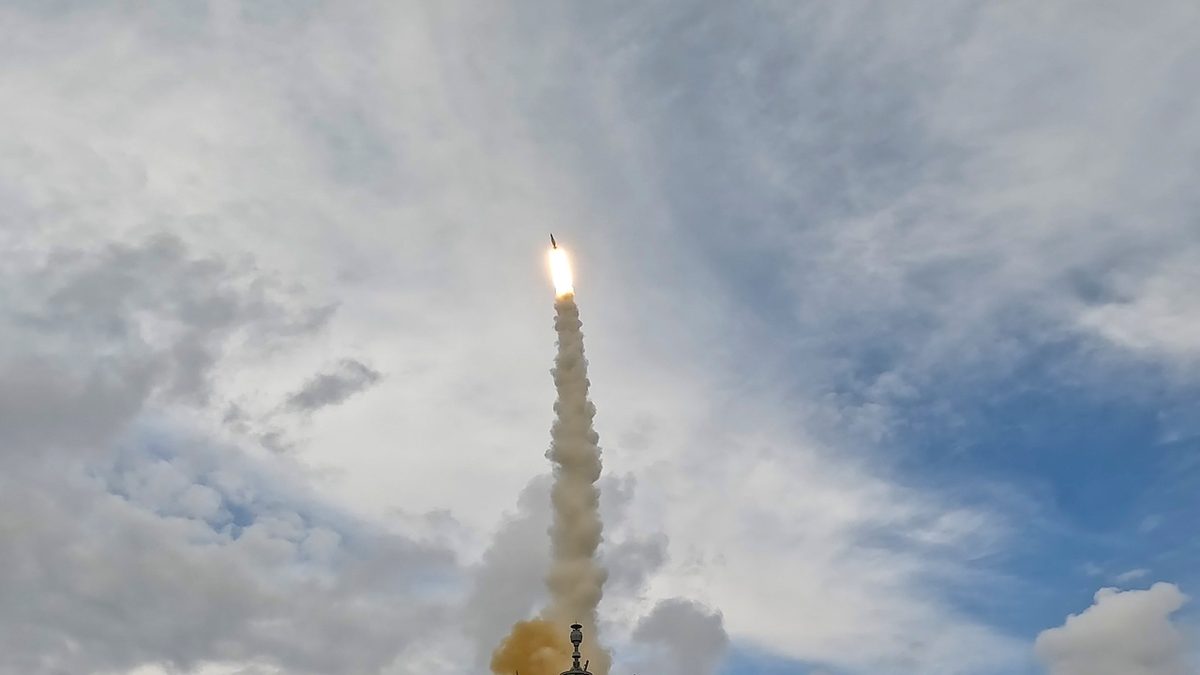
SM-3 Block IIA interceptor launches from USS Bulkeley (DDG 84) during Exercise Formidable Shield 2025. PAC-3 Missile Segment Enhancement (MSE) represents the largest single MAC priority line item in the FY2027 budget at approximately $7 billion. Credit: MAJ Nicholas Chopp / DVIDS / U.S. Department of Defense. Public domain.
Technical Summary
The Pentagon’s Munitions Acceleration Council (MAC) has named 14 weapons (12 legacy systems and two emerging programmes) as the priority munitions for surge production under the FY2027 budget request. The MAC, established in 2025 as a senior-leader prioritisation body, frames the list against the requirement to replenish inventories consumed during Operation Epic Fury, the US-Israeli campaign against Iran. The Pentagon is offering industry multi-year procurement (MYP) deals of up to seven years to underwrite tooling investment, second-source qualification, and long-lead component supply chains.
The FY2027 Mandatory Funding Overview submitted by the Department of War Comptroller requests approximately $52.9 billion for critical munitions production across the priority list. Acting Pentagon Comptroller Jules “Jay” Hurst outlined the acquisition model at an on-the-record briefing on 21 April 2026, describing a departure from standard procurement practice: industry will be required to fund capital expenditure from its own balance sheet, with MYP guaranteed demand as the return mechanism.
We’re making them put skin in the game … and we expect them to meet the ramp rates that they agree to. And, if they don’t, there’ll be penalties for them.
— Jules “Jay” Hurst, Acting Pentagon Comptroller, Pentagon news briefing, 21 April 2026
The MAC list was first reported by Breaking Defense correspondent Ashley Roque on 24 April 2026, drawing on FY2027 budget justification documents. A subsequent Stars and Stripes report on 1 May 2026 cited an internal MAC memo confirming the prioritisation. The official programmatic basis is the FY2027 Mandatory Funding Overview, available from the DoD Comptroller portal.
The 14 MAC Priority Munitions
The MAC identified 12 legacy and two emerging munitions for priority surge production and MYP deals of up to seven years. Specific MYP contract values for individual programmes are not fully disclosed in open-source material; the PAC-3 Missile Segment Enhancement (MSE) budget request of approximately $7 billion represents the largest single item identified in the budget documents.
| # | Munition | Category | Prime / Notes |
|---|---|---|---|
| 1 | Patriot PAC-3 MSE | Legacy | Lockheed Martin • ~$7B FY2027 request • endo-atmospheric hit-to-kill |
| 2 | THAAD Interceptor | Legacy | Lockheed Martin • exo-atmospheric terminal defence • KKV kill vehicle |
| 3 | SM-3 Block IIA | Legacy | Raytheon / Mitsubishi Heavy Industries • co-production • mid-course BMD |
| 4 | SM-3 Block IB | Legacy | Raytheon • sea-based BMD • Aegis-integrated |
| 5 | SM-6 | Legacy | Raytheon • active-seeker AAW/BMD • anti-surface capability |
| 6 | Tomahawk Block V (Land Attack) | Legacy | RTX • JMTR/JMTM variants • Williams F107 turbofan |
| 7 | Maritime Strike Tomahawk | Legacy | RTX • anti-ship Tomahawk Block V derivative • moving target seeker |
| 8 | AIM-120 AMRAAM (AIM-120D-3) | Legacy | RTX • active-radar BVR AAM • HTPB propellant / PBXN warhead |
| 9 | AGM-158C LRASM | Legacy | Lockheed Martin • long-range anti-ship missile • low-observable |
| 10 | JASSM-ER / Maximized JASSM-ER | Legacy | Lockheed Martin • extended-range CALCM • low-observable airframe |
| 11 | Joint Advanced Tactical Missile (JATM / AIM-260) | Legacy | RTX • AMRAAM replacement • greater range / counter-VLO |
| 12 | Low-Cost Cruise Missile / FAMM | Legacy | Family of Affordable Mass Missiles • attritable cruise • volume-fire concept |
| 13 | Low Cost Hypersonic Strike Weapon (LCHSW / MACE) | Emerging | Multiple vendors • cost-attritable hypersonic • Mach 5+ terminal phase |
| 14 | Precision Strike Missile (PrSM) Increment 1 | Emerging | Lockheed Martin • GMLRS replacement • 499–500 km range |
Sources: DoD FY2027 Mandatory Funding Overview; Breaking Defense (24 Apr 2026); Stars and Stripes (1 May 2026). Vendor and technical notes from published programme data. Full classified list may differ.
Official Acquisition Model: Contractor CapEx at Risk
The MAC framework represents a structural departure from standard US defence acquisition. Hurst confirmed at the 21 April 2026 briefing that contractors will be required to invest capital expenditure from their own balance sheets rather than having the government fund facility expansion upfront. Guaranteed MYP demand, with penalty clauses for production shortfalls, is the instrument of repayment.
We’re requiring contractors to foot the bill for CapEx, right, which is something we haven’t done before. So, in order to pay for that CapEx, they have to sell a certain number of munitions to the United States. If they don’t meet their production goals … their initial penalty is the CapEx itself … and then there will be provisions in contracts to penalize contractors who don’t meet production ramp rates as well.
— Jules “Jay” Hurst, Acting Pentagon Comptroller, Pentagon news briefing, 21 April 2026
The FY2027 Mandatory Funding Overview describes the strategic intent of the MAC framework in the following terms:
These investments are vital to ensuring the department’s ability to meet immediate and long-term munitions demands, replenish depleted stockpiles, support the operational needs of U.S. forces, allies, and partners, reestablish deterrence, and meet long-term demand.
The Munitions Acceleration Council (MAC) initiative represents a comprehensive approach to addressing critical munitions needs through strategic investments, innovative acquisition strategies, and vendor partnerships. By combining government funding with private capital, modernizing facilities, and accelerating delivery schedules, the Department ensures we will meet the demands of current and future operations, while maintaining cost efficiency and readiness.
Source: Department of War FY2027 Mandatory Funding Overview, DoD Comptroller, April 2026

WOME Industrial-Base Analysis
From a WOME industrial-base perspective, the 14-munition list concentrates demand on a comparatively narrow set of energetic-material supply chains. PAC-3 MSE, THAAD, and the SM-3/SM-6 family all rely on solid rocket motors using hydroxyl-terminated polybutadiene (HTPB)-bound ammonium perchlorate (AP)/aluminium composite propellants from a limited qualified US supplier base. The AMRAAM and AIM-120D-3 family draw on the same propellant chemistry plus shared blast-fragmentation warhead fills (PBXN-class HMX/binder formulations). Tomahawk Block V uses Williams F107 turbofans rather than propellant, but shares fuze, warhead, and booster components with other surface-launched precision-strike systems.
The net effect is that any disruption at the energetics tier (AP, HMX, nitrotriazolone (NTO), or dinitroanisole (DNAN) feedstock; HTPB binder supply; or qualified booster grain production at Allegany Ballistics Laboratory, Holston Army Ammunition Plant, or Radford Army Ammunition Plant) will propagate simultaneously across multiple MAC priority programmes. This single-fabric supply chain structure is precisely the systemic risk the MAC framework is intended to address through facility investment and second-source qualification.
Two notable absences from the MAC list warrant analyst attention. Patriot GEM-T (the Raytheon legacy PAC-2 interceptor variant) and Stinger MANPADS are not among the 14 priority munitions. This suggests Pentagon planners are consciously accepting residual risk on lower-tier area air defence to concentrate available capital on PAC-3 MSE and THAAD throughput. The inclusion of the Low Cost Hypersonic Strike Weapon (LCHSW) signals a continuing institutional preference for cost-attritable hypersonic capability over exquisite single-source programmes.

Safety and Storage Considerations
Storage and handling personnel should anticipate compressed insensitive munitions (IM) qualification windows under STANAG 4439 as second-source production lines are stood up under the MAC MYP awards. Where new energetics suppliers enter the qualified products list, the in-service stockpile may carry mixed-lot ammunition with varying ageing characteristics: a material factor for ammunition surveillance programmes (US: Surveillance Management Center for Ammunition, SMCA; UK: Defence Ordnance Safety Group, DOSG).
Principal Explosive Site (PES) managers should re-examine Net Explosive Quantity (NEQ) aggregation assumptions where stockpile growth approaches site licence ceilings. PAC-3 MSE growth in particular can stress fielded magazine capacity at forward air-defence locations. Allied Ordnance Publication 7 (AOP-7) entries for any munition added under accelerated MYP should be reviewed against the as-produced energetic formulation, not the original qualification-lot baseline.
Data Gaps and Open Questions
- The full named list of 14 munitions has not been published in a single unclassified document; items are assembled across budget justification annexes and trade press reporting.
- Specific MYP contract values for individual programmes (other than the PAC-3 MSE ~$7B figure) are not disclosed in open source.
- Second-source supplier identities approved under the MAC framework are not publicly listed.
- NEQ growth implications at named PES locations are not addressed in published budget documents.
- The relationship between the MAC priority list and the US Navy’s Preferred Acquisition Entity (PAE) Munitions construct (announced 11 May 2026) is not clarified in open source.
- Classified annex to the FY2027 Mandatory Funding Overview may contain additional munitions not represented in the 14-item list.
References and Primary Sources
- Pentagon’s Munitions Acceleration Council identifies 14 ‘critical’ weapons for 2027
- Pentagon picks 14 ‘critical’ munitions as top production priorities
- Department of War FY 2027 Mandatory Funding Overview (PDF)
- Pentagon news briefing — Acting Comptroller Jules “Jay” Hurst, on-the-record statements on contractor CapEx requirements and production penalties
- FY2027 Defense Budget Request Overview Book
ISC Commentary
The contractor CapEx-at-risk model described by Acting Comptroller Hurst is the most structurally significant aspect of the MAC framework. US defence acquisition has historically treated facility investment as a government obligation under cost-plus and FFP contracts. Requiring primes and tier-1 suppliers to absorb CapEx (with production volume guarantees as the repayment vehicle and penalty clauses as the enforcement mechanism) transfers financial risk in a way that will test the balance-sheet resilience of mid-tier suppliers and sub-vendors, who do not have the same access to capital markets as Lockheed Martin or Raytheon Technologies.
For allied nations drawing on the same supply chains (the UK’s ASRAAM and Common Anti-Air Modular Missile (CAMM) family share AP/Al motor propellant heritage with AMRAAM; European SHORAD programmes draw on the same HTPB binder chemistry) US production surge creates both opportunity (learning-curve cost reduction on shared components) and risk (demand competition for qualified energetics from the same qualified supplier base). Allied procurement officers and contracting authorities should request supplier capacity data as a condition of MYP negotiations, not an afterthought.