Inside SBDS Thun: Saab’s European Centre of Excellence for Shaped-Charge and Mortar Ammunition
A capability profile, strategic-industrial assessment, and technical examination of Saab Bofors Dynamics Switzerland Ltd; the Bern-canton subsidiary that anchors Saab’s high-performance warhead and mortar production under exceptional ISO 9001 and AQAP-aligned safety assurance.
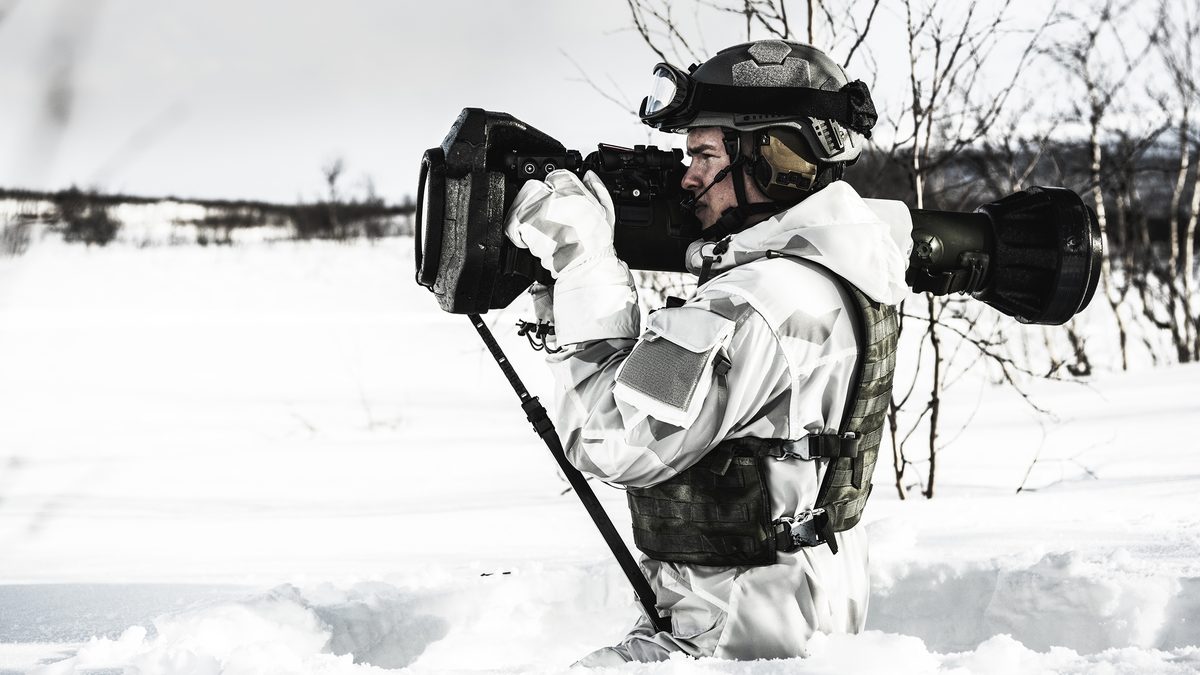
Image: NLAW — the overfly-top-attack shaped-charge warhead designed and manufactured at Thun — on winter trials. Photo © Saab AB. Sourced from the official Saab Brand Centre and reproduced for editorial use; the image is owned by Saab and is publicly available from the Saab media page.
A short walk from the Aare river in Thun, behind the discreet perimeter of Allmendstrasse 74, sits one of the most consequential warhead facilities in Western Europe. Saab Bofors Dynamics Switzerland Ltd (SBDS) is not a household name, even among defence specialists. Yet the shaped charges fired from NLAW launchers in Ukraine, the tandem precursors that defeat reactive armour at the head of the Carl-Gustaf 751 round, and the airburst mortar bombs marketed as THOR 120 mm all trace a substantial portion of their lineage to a single integrated site in the Canton of Bern.
This profile examines SBDS at three layers. The first is the capability layer: what is on the floor at Thun, who runs it, and how the operation is structured. The second is the strategic-industrial layer: where SBDS sits within the European warhead production base at a moment when NATO members are scrambling to rebuild ammunition output. The third is the technical layer: what makes shaped-charge and mortar performance at Thun distinctive, and how the quality and safety architecture (ISO 9001:2015 plus the NATO AQAP overlay) underwrites the claims.
1. Corporate identity and the Thun site
SBDS at a Glance
| Legal name | Saab Bofors Dynamics Switzerland Ltd |
| Legal form | Aktiengesellschaft (Swiss limited company) |
| Commercial register | CH-092.3.018.210-9 |
| UID | CHE-113.615.358 |
| NOGA sector | Manufacturing of weapons and ammunition |
| Headquarters | Allmendstrasse 74, CH-3600 Thun |
| Telephone | +41 (0)33 227 74 74 |
| Parent | Saab AB (publ), Stockholm |
SBDS is a wholly owned Swiss subsidiary of Saab AB. The corporate registration in the Swiss commercial register confirms the Thun seat, the share-capital structure typical of an Aktiengesellschaft, and the manufacturing scope covering weapons and ammunition. The address is independently corroborated by the Swiss Association for Quality (SAQ) auditor records and Saab’s own 2026 General Purchase Conditions, which list the Allmendstrasse premises as the contracting party for all SBDS procurement.
The historic “Boden” reference that appears in legacy 2007 documentation describes the broader industrial cluster at Thun rather than a separate site. The terminology has since been retired in favour of the Allmendstrasse address.
From RUAG Warhead Division to Saab subsidiary
SBDS was created on 1 July 2007, following an announcement on 9 May that year that Saab would acquire RUAG Technology’s Warhead Division. The transaction internalised a long-standing subcontractor relationship: RUAG had been producing warheads under contract for Saab’s anti-armour family for years, and the acquisition gave Saab control over an established European centre of excellence in shaped-charge technology.
Saab retained the bulk of the existing workforce, leased the Boden-area premises, and re-incorporated the operation as a Swiss subsidiary. RUAG initially held a minority stake, since divested. Subsequent annual reporting confirms SBDS as a fully owned subsidiary within the Saab Dynamics business area.
The strategic logic was clear. Saab’s anti-armour systems (AT4, Carl-Gustaf, NLAW, and BILL 2) depend on warhead performance for their tactical credibility. Rather than continue to source those warheads from a third party, Saab moved the design and manufacturing capability in-house and gave it its own corporate identity in a neutral jurisdiction known for precision manufacturing.
2. Vertical integration: what is on the floor
Saab’s public characterisation of the Thun site is a vertically integrated warhead and mortar ammunition hub. That phrase carries specific operational weight. Most warhead manufacturers in Europe outsource at least one stage (liner production, charge pressing, energetic-material formulation, fuze integration, or environmental qualification) to specialist subcontractors. SBDS performs all of these stages on a single secure site. The result is that a programme can move from concept simulation to qualified series production without the configuration-management risks that arise when half a dozen suppliers must be coordinated across multiple jurisdictions.
End-to-end capability stack
- Computational design: hydrocodes, neural-network optimisation of liner geometry, and quantum-mechanical modelling of energetic-material decomposition. The objective is to compress the design-to-product cycle by validating performance virtually before consuming test articles.
- Charge design and fuze integration: embedded pre-fragmented bodies, multi-mode fuzing, and shaped-charge precursor/main-charge tandem geometries.
- Industrial-scale isostatic pressing: the high-pressure consolidation step that produces uniform, void-free explosive bodies suitable for high-performance shaped charges.
- Shrink-fit assembly: mechanical jointing technique that maintains dimensional integrity across the full STANAG 4370 environmental envelope, including operability up to +63°C reported for the 81 mm MAPAM round.
- Series-production process control: statistical-process-control instrumentation supports the AQAP-2131 final-inspection and testing requirements that flow down from Saab’s government customers.
- Validation testing: instrumented arenas for fragmentation characterisation, penetration trials in rolled homogeneous armour (RHA) and equivalent, and IM (Insensitive Munitions) qualification per STANAG 4439.
All critical steps — from innovative warhead design through prototype development to series-process optimisation — occur at the single Thun location. That integration is the core distinction Saab emphasises in its current communications, and it is what makes the site difficult to replicate.
3. Strategic-industrial context: Europe’s warhead bottleneck
SBDS occupies an unusual position in the European industrial map. Switzerland is not a NATO member and operates under one of Europe’s most restrictive export-control regimes (the War Materiel Act and associated ordinances administered by the State Secretariat for Economic Affairs, SECO). Yet the Thun facility produces NATO-compliant warheads that are integrated into systems fielded by Sweden, the United Kingdom, the United States, and a long list of other Allies. That apparent paradox is mediated by Saab’s status as a Swedish parent, the bilateral arrangements that govern Swiss defence exports, and the technical alignment of SBDS quality and safety processes with NATO AQAP and STANAG requirements.
The 2022–2026 munitions reset
Russia’s full-scale invasion of Ukraine in February 2022 exposed the under-capacity of the European warhead and propellant base. Three years of depleted stockpiles, surge orders, and the European Defence Industry Reinforcement through Common Procurement Act (EDIRPA) and Act in Support of Ammunition Production (ASAP) have changed the demand picture but not eliminated the bottleneck. Capacity in liner production, isostatic pressing, and IM-compliant explosive formulation remains scarce.
Against that backdrop, SBDS is one of a small number of European facilities that combines all of these capabilities at a credible volume. That makes Thun a strategic asset for Saab and, by extension, for the customers depending on Saab anti-armour and indirect-fire systems. The vertically integrated model also offers some insulation from supply-chain shocks: SBDS is less exposed to a single subcontractor failure than a more distributed manufacturer would be.
Implications for European warhead sovereignty
The European debate about defence-industrial sovereignty has tended to focus on platforms (main battle tanks, fighter aircraft, naval vessels) rather than the energetic and mechanical sub-tier that determines whether those platforms can deliver effects. SBDS is a useful corrective. Without facilities of this kind, the sovereignty conversation is incomplete. The European warhead base is narrower than the platform base, and the consolidation of design, charge production, and qualification at Thun gives Saab a structural advantage that its competitors will find difficult to match in the short term.
4. Product portfolio
Mortar ammunition
- MAPAM® 60 mm and 81 mm — Mortar Anti-Personnel Anti-Material rounds. Saab’s public performance statements claim up to three times the effectiveness of conventional rounds in the same calibre. The 81 mm variant is qualified for operability up to +63°C and meets the highest declared IM safety levels. Pre-formed fragmentation bodies deliver a controlled fragment mass and velocity distribution.
- THOR 120 mm — airburst mortar round with proprietary ODIN fuzing technology. Saab claims approximately 200 percent of the lethality of a conventional 120 mm round, almost twice the target-area effect, a 15–20 percent reduction in fragmentation loss, IM-safe configuration, range above 8,000 m, and a payload of approximately 4,250 steel balls.
Warheads for Saab anti-armour systems
- AT4 — single-shot disposable launcher; warhead variants include HEAT, HEDP, and AST.
- Carl-Gustaf — recoilless rifle family. SBDS supplies the warhead family including the tandem HEAT 751, designed to defeat explosive reactive armour (ERA).
- NLAW; the overfly-top-attack shaped-charge warhead is designed and manufactured at Thun. The NLAW warhead is the technically most demanding product in the SBDS portfolio because of the precision required to deliver an effective top-attack jet at the moment of overfly.
- BILL 2; the Saab-developed top-attack anti-armour missile, with shaped-charge warhead optimised for downward jet projection.


SBDS also produces less-lethal warheads, energetic products for adjacent applications, and live-round-conversion artillery training grenades. The site offers custom warhead design and qualification services to OEMs that lack their own in-house energetic capability.
5. Technical deep-dive: shaped-charge performance
Shaped-charge (hollow-charge) technology is the dominant kinetic anti-armour mechanism in modern shoulder-launched and missile systems. The principle, first described by Charles Munroe in 1888 and weaponised in the Second World War, is that detonation pressures of the order of 200 GPa collapse a conical or hemispherical metallic liner inward, forming a high-velocity metallic jet. The jet penetrates target armour by hydrodynamic erosion rather than by conventional kinetic-energy mechanisms, with tip velocities typically in the range of 7–10 km/s.
Charge Diameters and the 10 CD threshold
Shaped-charge penetration is conventionally expressed in Charge Diameters (CD): the depth of penetration in homogeneous steel divided by the diameter of the charge. The metric is dimensionless and allows performance comparison across calibres. Modern high-performance shaped charges achieve 8–10 CD in steel. Saab’s public statements on the Thun warhead family claim “10 CD and beyond”.
Specialist reporting confirms that the European warhead state-of-the-art has moved beyond 10 CD. EDR Magazine’s November 2022 interview with the Milan ER programme team reported demonstrated penetration of CD 12, and the active development trend is toward CD 15. The trajectory is driven by liner-material refinement, computational design, and IM-compliant explosive formulations that maintain detonation efficiency without compromising safety.
Performance enablers at Thun
- Liner geometry and material: precision-machined copper, molybdenum, and tungsten-alloy liners; geometry validated by hydrocode and refined through iterative pressing.
- IM-compliant high explosives: PBXW-11, PBXW-17, and NTO-based formulations designed to pass STANAG 4439 thermal, impact, and shaped-charge-jet stimuli.
- Computational design: hydrocodes such as AUTODYN and LS-DYNA, increasingly augmented by neural-network surrogate models that explore liner-geometry parameter space at orders-of-magnitude lower computational cost.
- Integrated testing: the same site that designs and presses the charge also conducts the qualification trials, eliminating shipping-related ageing and configuration drift.
Technology variants in the SBDS portfolio
- Conical HEAT — the baseline configuration in AT4 and Carl-Gustaf rounds.
- Explosively Formed Penetrators (EFP), used in NLAW top-attack engagements; the liner forms a coherent slug rather than a stretching jet, optimised for thinner top armour at extended standoff.
- Tandem charges — precursor charge defeats ERA, main charge engages base armour. Carl-Gustaf 751.
- Multi-purpose / fragmenting designs: MAPAM and THOR families combine shaped-charge or pre-formed fragmentation effects against personnel, materiel, and light structures.
6. Quality assurance and safety case
Performance claims at the “10 CD and beyond” level are credible only when underwritten by a quality and safety architecture that can detect, prevent, and document the variance that destroys shaped-charge performance. SBDS operates within an exceptional compliance envelope built on three superimposed layers: ISO 9001:2015, the NATO AQAP-2110 Edition D overlay, and the WOME-specific safety regime governed by STANAG 4439, STANAG 4170, and the AASTP series.
ISO 9001:2015 — the foundation
SBDS is certified to ISO 9001:2015 by the Swiss Association for Quality (SAQ), an accredited certification body. The standard is risk-based and process-oriented, requiring documented evidence of leadership commitment (Cl. 5), planning addressing risks and opportunities (Cl. 6), competence and awareness (Cl. 7.2), operational planning and control (Cl. 8), performance evaluation (Cl. 9), and continual improvement (Cl. 10). For a warhead facility, the demanding clauses in practice are competence (Cl. 7.2), operational planning and control (Cl. 8.1), control of externally provided processes (Cl. 8.4), and identification and traceability (Cl. 8.5.2). All four are critical when a small dimensional or compositional drift can move a product from compliant to non-compliant against an IM threshold.
AQAP-2110 Edition D — the NATO overlay
NATO procurement of warheads and munitions requires suppliers to operate to AQAP-2110 (NATO Quality Assurance Requirements for Design, Development and Production), Edition D, the workhorse publication owned by the Life Cycle Management Group (AC/327) of the Conference of National Armaments Directors. AQAP-2110 is fully aligned with ISO 9001:2015 and adds defence-specific obligations including risk management, configuration management, software quality (when invoked), Government Quality Assurance (GQA) interface requirements, and reliability and maintainability planning.
For SBDS, AQAP-2110 compliance flows through Saab’s prime-contract obligations to government customers: the Swedish Defence Materiel Administration (FMV), the UK Defence Equipment and Support (DE&S) organisation for NLAW, and the customers of the AT4 and Carl-Gustaf families. Where mutual GQA is invoked, SBDS is subject to AQAP-2070 process visits by the host-nation Government Quality Assurance Representative (GQAR).
STANAG 4439 and the IM regime
Insensitive Munitions (IM) compliance is the safety standard that determines whether ammunition is acceptable for storage, transport, and use under modern hazard policies. STANAG 4439 (NATO Policy for Introduction and Assessment of Insensitive Munitions) sets the framework; six stimuli tests (fast cook-off, slow cook-off, bullet impact, fragment impact, sympathetic reaction, and shaped-charge jet impact) benchmark the response. Saab’s public performance statements for THOR and MAPAM cite the highest declared IM safety levels, which in the AOP-39 framework correspond to Type V (no reaction more violent than burning) for the most challenging stimuli.
Achieving Type V responses in pre-fragmented or shaped-charge configurations is technically difficult: the same explosive formulation features that maximise warhead performance often degrade IM behaviour. The SBDS approach (isostatic pressing, IM-compliant binders, and integrated testing under STANAG 4370 environmental envelopes) reflects a design philosophy that treats IM compliance as a primary design parameter rather than a downstream qualification hurdle.
Storage and life-cycle frameworks
Warhead and mortar production at Thun also operates under the AASTP (Allied Ammunition Storage and Transport Publication) series for facility safety and quantity-distance management, and the broader Swiss explosives-safety regime (Sprengstoffgesetz and SprstG-related ordinances). The site’s Inhabited Building Distance (IBD), Inter-Magazine Distance (IMD), and Process Building Distance (PBD) calculations are made against AASTP-1 quantity-distance principles. None of this is publicly disclosed in detail, but the regulatory architecture is well established and is one of the reasons Switzerland is a credible jurisdiction for high-energy manufacturing.
SBDS’s compliance posture — ISO 9001:2015, AQAP-2110 Edition D, STANAG 4439 IM, AASTP-1 storage — is the architectural reason the “10 CD and beyond” performance claims are credible rather than aspirational.
7. Leadership and contact
Jean-Baptiste Couchoud serves as Director and Head of Marketing & Sales at SBDS, the published primary contact on Saab’s Warheads and Mortar Ammunition product page. The general enquiry email is [email protected].
8. Assessment
SBDS Thun is a strategic asset within the European warhead industrial base. Three features make it distinctive. First, vertical integration on a single secure site materially reduces configuration risk and shortens the design-to-qualification cycle. Second, legacy expertise inherited from RUAG’s Warhead Division provides a deep institutional memory of shaped-charge engineering that is exceptionally difficult to recreate in a greenfield facility. Third, the compliance envelope(ISO 9001:2015, AQAP-2110 Edition D, STANAG 4439 IM, AASTP-1 storage) is exceptional in its breadth and is the architectural basis for the high-performance, IM-safe products in the SBDS portfolio.
The strategic implication is that Saab’s anti-armour and indirect-fire portfolios depend on a single Swiss site whose capacity, by industry standards, is finite. Whether that concentration is a strength (control, configuration management, quality) or a vulnerability (single-site exposure) depends on perspective. For Saab and its customers, the present answer is that the strengths outweigh the risks. For the broader European warhead production reset, SBDS is one of the few facilities in which the entire value chain for high-performance shaped charges sits behind one perimeter, and that scarcity is itself a strategic fact.
References & External Reading
- Saab AB, “Saab becomes established in Switzerland,” press release, 9 May 2007. saab.com
- Saab AB, “Warheads and Mortar Ammunition,” current product page (accessed May 2026). saab.com
- Swiss Federal Commercial Register / Moneyhouse company record for Saab Bofors Dynamics Switzerland Ltd, CH-092.3.018.210-9. moneyhouse.ch
- Saab AB, “General Purchase Conditions 2026,” SBDS contracting reference. saab.com/suppliers
- Valpolini, Paolo, “Saab Dynamics: Innovation in shaped-charge and warhead technology,” EDR On-Line / EDR Magazine, 14 November 2022. edrmagazine.eu
- Walters, William P., An Introduction to Shaped Charges, US Army Research Laboratory, ARL-SR-150 (DTIC reissue, 2007). apps.dtic.mil
- NATO Standardization Office, AQAP-2110 Edition D, “NATO Quality Assurance Requirements for Design, Development and Production,” current edition. nso.nato.int
- NATO Standardization Office, STANAG 4439 / AOP-39, “Policy for Introduction and Assessment of Insensitive Munitions (IM),” current edition. nso.nato.int
- Saab AB, Saab Brand Centre — official Digital Asset Management portal (source of all product imagery in this article). brand.saab.com
ISC Commentary
The SBDS profile illustrates a feature of the European defence-industrial base that platform-level analysis tends to obscure: the warhead and energetic-material sub-tier is narrower than the platform tier, and concentration in that sub-tier has compounding effects on programme delivery. NLAW production rates, Carl-Gustaf round availability, and the throughput of any future Saab anti-armour development are all dependent, in part, on a single facility in the Canton of Bern.
For NATO procurement officers, the relevant question is not whether SBDS can meet its current commitments (the AQAP-2110 audit trail and ISO 9001 SAQ certification say it can) but whether the European warhead base has sufficient redundancy to absorb a sustained surge in demand or a disruption at any single site. The honest answer is that it does not. Investment in additional vertically integrated capacity, ideally with explicit IM-compliant pressing capability, is the missing piece in the post-2022 ammunition-production reset.
For analysts tracking the European industrial response to the war in Ukraine, SBDS is a case study in how a 2007 acquisition, executed for narrowly commercial reasons, can become two decades later a piece of strategic infrastructure. The acquisition logic was internalisation of a subcontractor; the strategic dividend is sovereign control over the warhead capability that defines Saab’s anti-armour portfolio.