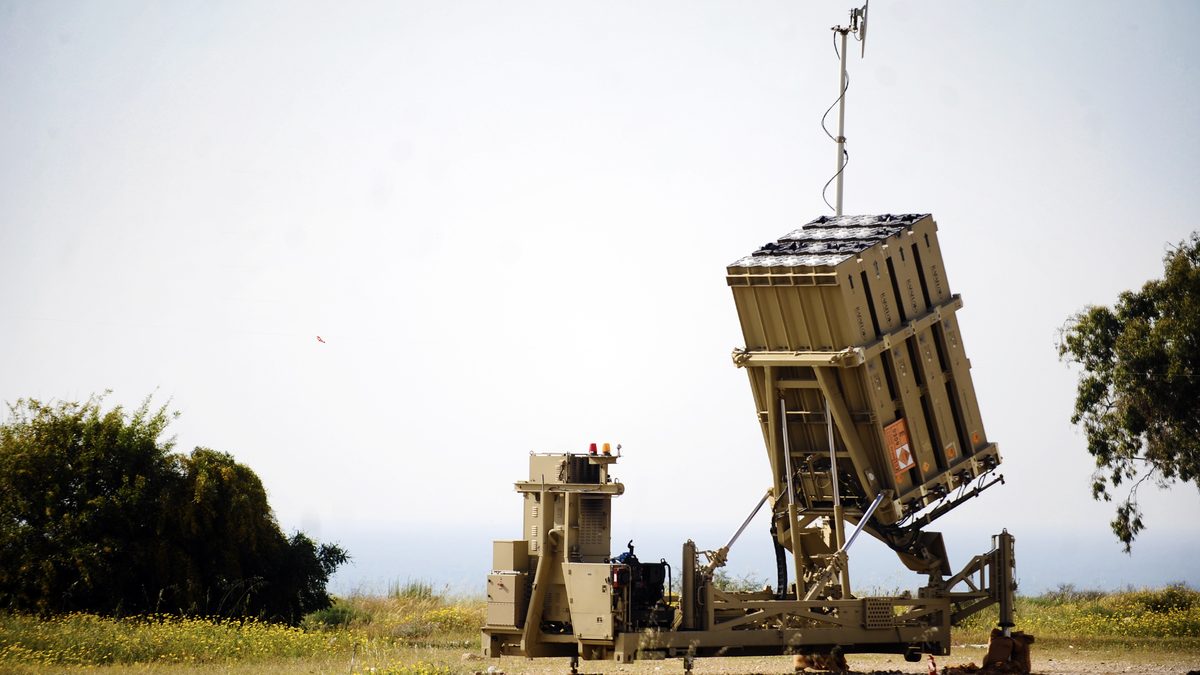
Rafael Acquires Volkswagen Osnabrück: Iron Dome Subsystems to Roll Off German Lines from 2027
On 30 April 2026, Rafael Advanced Defense Systems signed a Letter of Intent (LOI) to acquire Volkswagen’s Osnabrück plant — converting a 2,300-worker car factory into a third Iron Dome production node alongside Israel and Arkansas. The deal explicitly carves out warheads and final round assembly. ISC analyses the technical scope, the regulatory pathway, and the German short-range air and missile defence (SHORAD) gap the deal is engineered to close.
What was signed, and what it covers
Rafael’s LOI — first reported by Reuters on 30 April 2026 and corroborated within 48 hours by Haaretz, the Jerusalem Post, the Financial Times and Anadolu Agency — commits the Israeli state-owned prime to acquiring Volkswagen’s Osnabrück plant in Lower Saxony for conversion to defence manufacturing. The site, formerly the Karmann coachbuilding works, currently produces the T-Roc Cabriolet on a low-volume specialist line. Cabriolet production runs out in 2027. Without the Rafael deal, the 2,300-strong workforce was facing redundancy.
The agreed scope is narrow and deliberate. Rafael will take over the existing in-house value chain — technical development, tooling, body shop, paint shop and final assembly — and redirect it to four Iron Dome subsystem families:
- Heavy-duty transport platforms. Prime movers and reload trucks for the Missile Firing Unit (MFU) and ammunition resupply, sized for the existing 8x8 / 6x6 chassis class used by Iron Dome batteries.
- Launcher structures and parts. The MFU canister rack, traverse and elevation drives, environmental enclosures, and electrical integration harnesses. Each MFU canister rack carries up to 20 Tamir interceptors.
- Power generation and distribution. Diesel generator sets and power conditioning equipment for the Battle Management & Weapon Control (BMC) station, ELM-2084 Multi-Mission Radar (MMR) and launcher servos.
- Solid rocket motor components. Motor cases, insulation lay-up, nozzles and structural integration. The Tamir solid rocket motor itself is a single-stage design approximately 3 m in length and 90 kg launch weight, with terminal-phase blast-fragmentation kill.
The exclusions matter as much as the inclusions. Warheads, final round filling, and energetic-material handling will not be performed at Osnabrück. Rafael has confirmed these activities will be sited at a separate German facility, not yet publicly disclosed. The Tamir warhead is a high-explosive blast-fragmentation device with proximity fuze; once integrated into the round it falls under Hazard Division (HD) 1.1 D for storage and transport. By keeping HD 1.1 work off the Osnabrück site, Rafael avoids triggering the most onerous tier of German Sprengstoffgesetz magazine licensing and ATEX (Atmosphères Explosibles, EU explosive-atmospheres directives) zoning, and sidesteps the political optics of high-explosive operations on a former Volkswagen footprint.
Production start is targeted at 12–18 months after final binding agreement — placing first Osnabrück-built subsystems in late 2027 or early 2028, on a workforce-retraining path that requires Betriebsrat (works council) approval and a regulatory pathway through the German Federal Office for Economic Affairs and Export Control (Bundesamt für Wirtschaft und Ausfuhrkontrolle, BAFA), the War Weapons Control Act (Kriegswaffenkontrollgesetz, KrWaffKontrG), and the Foreign Trade and Payments Act (Außenwirtschaftsgesetz, AWG).
Subsystem analysis: the technical pivot and the German SHORAD gap
Blume’s public framing — that Volkswagen itself will not produce weapons — is precise rather than evasive. The corporate vehicle is an asset sale: VW divests the plant, Rafael operates it. Within that envelope the four subsystem families above split cleanly into legacy automotive competencies and net-new defence work, and the ratio matters for plausibility.
Heavy chassis assembly, electrical integration, paint and final QC are direct lifts from the existing line. Karmann-era Osnabrück specialised in low-volume, high-complexity mechanical and electrical builds — convertibles with retractable hard tops, niche derivatives, and small-batch series. That skill set transfers cleanly to MFU launcher integration and to power-generation skid assembly. Truck variants for missile and launcher transport are well within the plant’s established competence; VW Osnabrück already presented military vehicle prototypes at the Enforce Tac defence trade fair in early 2026, indicating that internal preparation for a defence pivot was underway months before the LOI.
Solid rocket motor work is the harder transition. A complete Tamir motor combines a machined or composite case, internal insulation, a cast or extruded propellant grain, and a nozzle assembly. Composite-modified double-base or hydroxyl-terminated polybutadiene (HTPB) ammonium-perchlorate propellants typical for this class fall under HD 1.3 in their cured state, and require segregated, ATEX-classified casting facilities with explosives-licensed magazine storage. Nothing in the publicly disclosed scope suggests Osnabrück will undertake propellant casting. The realistic interpretation is that the plant will manufacture motor cases, insulation and nozzles as inert components, and ship them to the separate German facility (or to Israel) for energetic loading and final assembly. ISC assesses propellant work at Osnabrück as unlikely on the basis of the disclosed exclusions; this remains a data gap pending the final binding agreement.
The German SHORAD gap, in capability terms
Germany’s air and missile defence portfolio after the 2022 Zeitenwende rebuild is wide at the upper end and thin at the lower. Holzdorf received its first operational Arrow 3 battery in December 2025, covering exo-atmospheric ballistic-missile intercept. A €3 billion expansion approved in January 2026 brought total Arrow procurement to roughly €6.5 billion, with Arrow 4 (endo-atmospheric ballistic) selected in May 2025 to fill the layer between Patriot’s ceiling and Arrow 3’s exo-atmospheric domain. PAC-3 Patriot covers the medium-range air and ballistic tier. Diehl IRIS-T SLM provides medium-range surface-to-air. Rheinmetall’s Skyranger 30 covers gun-based very-short-range air defence (VSHORAD) against drones and helicopters.
The remaining gap is the rocket, artillery and mortar (C-RAM) and short-range counter-rocket niche — engagement of unguided 122 mm and 240 mm rockets, larger-calibre artillery, and saturation drone swarms at altitudes below ~10 km, at unit-cost per intercept low enough to match the threat. Iron Dome occupies that niche with a combat record that no European system can match at scale. The C-RAM-by-rocket role is the role Rafael is now industrialising in Germany.
| Tier | System | Status (Germany) | Threat envelope |
|---|---|---|---|
| Exo-atmospheric BMD | Arrow 3 | Operational Dec 2025; expansion approved Jan 2026 | IRBM/MRBM mid-course |
| Endo-atmospheric BMD | Arrow 4 | Selected May 2025; on order | SRBM terminal phase |
| Medium-range SAM | PAC-3 / IRIS-T SLM | In service | Aircraft, cruise missiles |
| VSHORAD (gun) | Skyranger 30 | In production (Rheinmetall) | Drones, helicopters <4 km |
| C-RAM / counter-rocket | Iron Dome (Tamir) | Production node from late 2027 | Rockets, artillery, saturation UAS <70 km |
Rheinmetall has no competing system in this niche. Existing Rafael–German industrial cooperation runs through two joint ventures: Eurospike GmbH (with Diehl and Rheinmetall) for the Spike anti-tank missile family, and EuroTrophy GmbH for the Trophy Active Protection System. The Osnabrück deal is qualitatively different: Rafael’s first wholly-owned major German production footprint, not a JV.
Plausibility check on production scaling
Iron Dome interceptor demand is at a structural high. The November 2025 Raytheon–Rafael joint venture secured an approximately USD 1.25 billion Israeli contract for Tamir and the US-licensed SkyHunter variant, with a USD 33 million production facility in East Camden, Arkansas, supporting US Marine Corps Marine Air Defense Integrated System (MADIS) deployment alongside Israeli replenishment after the 2024–2025 conflicts. Adding Osnabrück as a third subsystem node distributes geographic risk and aligns with a Bundestag procurement appetite that, on current evidence, assumes a multi-year German Iron Dome buy of its own.
ISC’s plausibility assessment: the four announced subsystem families fall within the demonstrated competence of the Osnabrück workforce, with motor work bounded by the explosives carve-out. The 12–18-month production-start target is tight but consistent with similar Rafael technology transfers (Eurospike took roughly two years from MoU to first German-assembled missile). The principal scheduling risks are Betriebsrat approval of role conversion, BAFA and KrWaffKontrG licensing of the new product mix, and identification — or construction — of the second German facility for warhead and propellant work.
Data gaps
- Acquisition price (LOI does not disclose).
- Annual production target in units per year for each subsystem family.
- Identity and location of the “separate German facility” for warhead and explosives operations.
- Exact propellant chemistry and Hazard Division for the Tamir motor in cured state (assessed HD 1.3 G; not publicly confirmed).
- Whether the first German Iron Dome battery purchase has been authorised by the Bundestag, or remains a hypothetical demand signal.
- Betriebsrat approval status for the conversion plan.
ISC Commentary
Industrial geometry. Rafael now has Iron Dome subsystem capacity on three continents — Israel for prime production, Arkansas for US-licensed SkyHunter, and (from 2027/8) Lower Saxony for European-built launchers, prime movers, generators and motor structures. That geometry hardens the Iron Dome supply chain against regional disruption and establishes a European political base for follow-on systems — David’s Sling, Iron Beam, and the broader Rafael air-defence family — without requiring further plant acquisition. The deal is structured to be repeatable.
Regulatory pathway, not regulatory risk. The German licensing architecture is well understood: BAFA licensing under AWG/AWV for export-relevant subsystems, KrWaffKontrG approval for war-weapons-classified items, and standard Störfallverordnung and ATEX compliance for the inert-component work at Osnabrück itself. The deliberate exclusion of HD 1.1 operations from the site keeps the Osnabrück regulatory burden firmly within the moderate band. The political question — Israeli state-owned acquisition of a German civilian plant for missile-defence work — is now ahead of the regulatory question, and current Berlin policy direction supports it.
The Volkswagen position is internally consistent. Blume’s “we will not produce weapons” line is true at the corporate level: VW divests, Rafael operates. From a Volkswagen group perspective, this is a controlled exit from a stranded production asset that preserves the workforce and the Lower Saxony industrial base, while delegating the politically sensitive activity to a buyer better placed to carry it. The optics line and the legal line align, which is part of why the deal was negotiable at all.
Rheinmetall is squeezed at one end of the SHORAD spectrum, not the whole. Rheinmetall remains the dominant German prime in armoured vehicles, large-calibre ammunition, and gun-based VSHORAD. What it does not have, and is not credibly close to having, is a combat-proven counter-rocket interceptor in the Tamir tier. The Osnabrück deal does not reverse Rheinmetall’s current trajectory, but it does cap the upper bound of what an indigenous German solution could capture in the C-RAM / counter-rocket segment over the next five years. Procurement officers in the Bundeswehr now have a German-built option in a niche where, twelve months ago, only imports existed.
Analysis & Evidence References
Source ratings: NATO STANAG 2022 Reliability A–F / Accuracy 1–6. A2 = reliable source / probably true; B2 = usually reliable / probably true; B3 = usually reliable / possibly true.