Saab’s Sovereignty Model: SCSCC Year-One Review and NATO Platform Footprint
Australia’s Sovereign Combat Systems Collaboration Centre (SCSCC) is widely framed as a bilateral procurement success — but the more consequential finding from its first twelve months is what the facility reveals about the structural gap between platform ownership and genuine engineering sovereignty across NATO-aligned acquisition programmes.
The Sovereign Combat Systems Collaboration Centre — Twelve Months of Output
On 5 March 2025, Australian Deputy Prime Minister Richard Marles opened the Sovereign Combat Systems Collaboration Centre (SCSCC) at Saab Australia’s expanded headquarters in Mawson Lakes, South Australia. The facility was capitalised through a A$22.6 million grant under the Modern Manufacturing Initiative (MMI), part of a wider ~A$77 million project investment. Twelve months on, the SCSCC has moved from ribbon-cutting to operational delivery — and the early evidence is substantive enough to warrant attention from European NATO planners examining their own capability sovereignty gaps.
The SCSCC is purpose-built around three functional pillars: rapid software iteration on combat management system (CMS) architecture; full-scale simulation and validation environments for systems integration testing; and quick-turn prototyping of next-generation capability modules. At its operational core sits the Australian Combat Management System (AusCMS) — the sovereign interface that gives the Royal Australian Navy (RAN) the ability to independently modify, adapt, and upgrade combat system software across its surface fleet without requiring full-scope support from the original equipment manufacturer (OEM).
That distinction matters. Previous RAN CMS configurations required vendor-controlled upgrade cycles, with limited Australian access to the software architecture underlying sensor fusion, weapon control logic, and tactical data link interfaces. The AusCMS layer changes that dependency relationship at its root. Whether Australia fully exploits that access depends on workforce depth — which is why the SCSCC’s training function is as significant as its engineering one.
Year-One Milestones
Two outputs in the first twelve months stand out. In April 2026, the Hobart Australian Interface Reference Site was established within the SCSCC — a dedicated pre-installation test environment for advanced CMS upgrades on the Hobart-class air warfare destroyers (AWDs). This facility operates through the Combat Systems Integration-Integrated Project Team (CSI-IPT), a trilateral arrangement involving Saab, BAE Systems, and Lockheed Martin. The model is relevant to any NATO nation attempting to manage multi-vendor CMS integration without creating permanent vendor dependency at the integration layer.
The second milestone was the delivery of Saab’s Introduction to Combat Systems Engineering programme, with the first mixed external cohort — industry engineers and Defence personnel — completing the 10-day course in February 2025. This addresses a systemic problem: the shortage of engineers who understand combat systems at the integration level rather than at individual component level. Workforce bottlenecks of this type are endemic across NATO allies; the UK’s Type 26 and Type 31 programmes have both encountered similar constraints in the DE&S project team.
Saab’s NATO Platform Footprint: Depth Underestimated
Saab’s presence across the NATO alliance is more extensive than is commonly represented in industrial analysis. The company’s product reach spans eight operational domains: air (Gripen multirole fighter, GlobalEye airborne early warning), land (Carl-Gustaf recoilless rifle, NLAW anti-tank weapon, RBS 70 ground-based air defence, Barracuda signature management), naval (9LV Combat Management System, Torpedo 62/67, A26 Kockums-design submarine), electronic warfare (AREXIS jamming pod), radar (Giraffe family), C2 and CMS (9LV, AusCMS, TIDLS), signature management (Barracuda land and maritime), and underwater (TORPED 62, A26 submarine).
The 9LV CMS has accumulated more than 250 deliveries and operates on the warships of at least 8 NATO navies — including the Royal Norwegian Navy, the Finnish Navy, and the Australian surface fleet. The Carl-Gustaf M3 and M4 recoilless rifle systems are in service with more than 40 nations, including at least 14 NATO allies; the UK’s order for Carl-Gustaf M4 in 2023 brought the system into British Army service as a crew-served anti-armour capability. NLAW (Next-Generation Light Anti-Armour Weapon), co-developed with Thales, is in production at a rate of approximately 400,000 units per year following demand acceleration driven by the Ukraine conflict. Barracuda signature management is deployed by ground forces of most major NATO armies, though confirmation of specific national contracts is frequently commercially restricted.
The Gripen Pipeline: Firm Orders, Open Questions
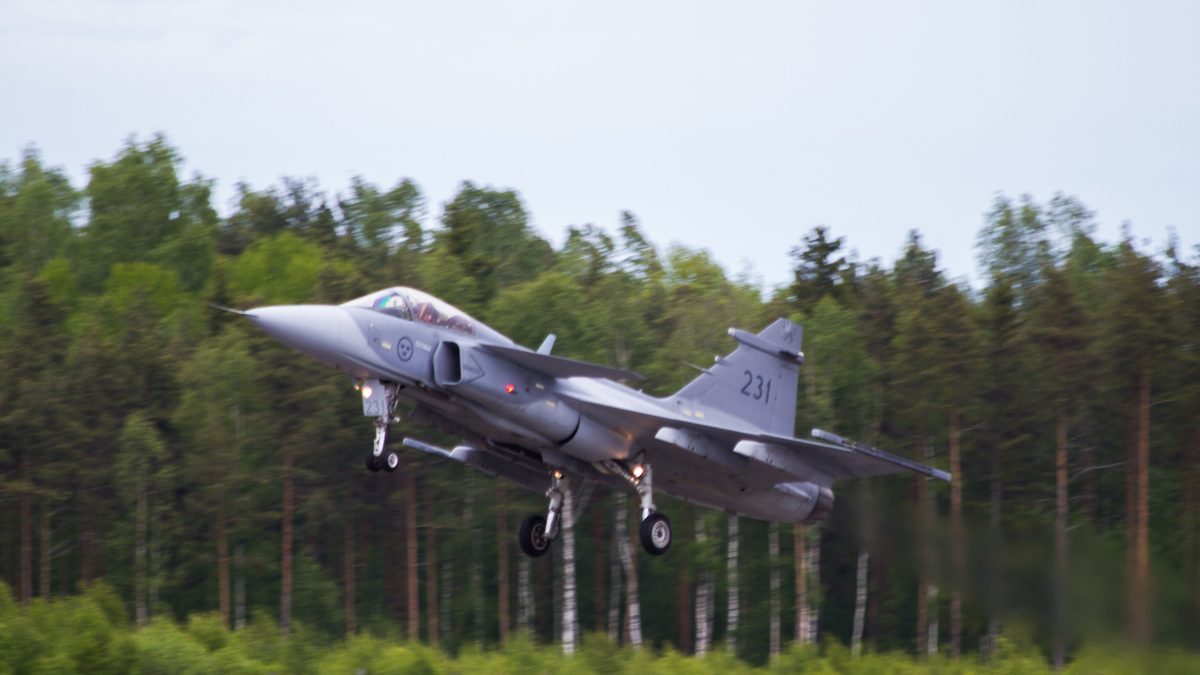
The Gripen E/F programme’s order position as of April 2026 presents a mixed picture. The Colombia contract, signed November 2025, covers 17 aircraft at approximately €3.1 billion — this is firm. The French order for two GlobalEye airborne early warning (AEW) aircraft at SEK 12.3 billion, announced in late 2025, is also confirmed and represents a significant breakthrough: France is the first non-UAE, non-Swedish GlobalEye customer, opening a potential pipeline into NATO Europe. Sweden has confirmed receipt of a SEK 2.6 billion order for a mobile counter-unmanned aerial system (C-UAS) capability and a SEK 1.5 billion Trackfire remote weapon station (RWS) order, both from the Swedish Armed Forces.
The Peru situation illustrates the political fragility inherent in fighter export campaigns. The Peruvian selection of 24 Gripen E/F, reported as firm in July 2025, is now uncertain following a presidential transition in March 2026 that signalled possible reorientation toward the F-16 Block 70. Peru has not formally cancelled the selection; the status should be treated as uncertain rather than lost. The Ukrainian Letter of Intent (LoI) for up to 150 Gripen has progressed to a Memorandum of Understanding (MoU), with potential delivery of legacy C/D-variant aircraft in 2026, though full-scale E/F production for Ukraine depends on production capacity constraints of approximately 20 to 30 airframes per year and financing arrangements that remain unresolved.
The A26 Submarine and Undersea Implications
Saab Kockums’ A26 Blekinge-class submarine programme for the Swedish Navy, and the confirmed order from Poland covering three boats, represent a strategic development that is underweighted in most Saab coverage. Poland’s selection of the A26 validates Kockums as a credible export submarine builder for NATO allies — the first confirmed export order for a Saab-design submarine since the Cold War era. The programme’s relevance to AUKUS Pillar II advanced capability conversations, and to Baltic Sea undersea warfare planning in the post-Swedish-NATO-accession environment, is significant and warrants a dedicated assessment.
Industrial Capacity Constraints and Risk Factors
Execution risk is the primary analytical concern. Saab is simultaneously scaling Gripen E/F production, building A26 submarines, ramping NLAW to industrial volumes, expanding US manufacturing infrastructure across ten facilities (including the new Grayling, Michigan plant opening in 2026), developing the A26 for Poland, and integrating the MDA SHIELD programme contract awarded in January 2026. The company’s workforce has grown to approximately 27,000, against revenues of SEK 79.1 billion in 2025 — a 24% growth rate — and a record order backlog of SEK 275 billion, roughly 3.5 times annual sales. That backlog is the strongest in the company’s history; it also means commitments substantially exceed current production capacity.
Recruitment of skilled engineers in combat systems integration and submarine construction remains a structural bottleneck. Supply chain constraints in semiconductors, advanced composites, and energetic materials (propellants and warhead fill for the Gripen weapons load, torpedo sections, and NLAW propulsion systems) affect all primes at current production tempos; Saab is not immune. The SCSCC training pipeline is one partial response to the workforce problem, but it operates at the level of a single programme’s requirements. Systemic workforce shortfalls in the Swedish and European defence-industrial base remain unaddressed at the policy level.
Strategic Implications for NATO Industrial Planning
Sweden’s accession to NATO in March 2024 transformed Saab’s political position within the alliance. The company’s status shifted from “vendor from a neutral country” to a fully integrated NATO prime with all the interoperability, procurement channel, and classified programme access that entails. Several implications follow for alliance planners.
First, the 9LV CMS, already embedded in multiple NATO naval architectures, now has a direct path to NATO certification processes and interoperability frameworks that previously required political workarounds. Second, the SCSCC model — government-backed co-location of development, integration, and training under sovereign mandate — offers a replicable template for European nations seeking to reduce their own CMS dependency on US prime contractors. No equivalent open-ecosystem facility exists in Europe; British, German, and French integration laboratories all operate within the commercial constraints of a single prime, not as national assets. Third, Saab’s willingness to establish genuine production and engineering presence in partner nations (Brazil, Australia, the United States, Poland) rather than simply exporting finished systems differentiates its commercial model from the dominant US and French acquisition frameworks.
The ISC confidence assessment on Saab’s strategic position is high, based on open-source evidence across multiple Tier 1 and Tier 2 sources. The SEK 275 billion order backlog is confirmed against audited financial reporting. The SCSCC delivery milestones are confirmed against Saab Australia press releases and independent trade reporting. The Peru Gripen status has been downgraded from “on order” to “uncertain” based on Aerospace Global News reporting of the March 2026 presidential transition. All other fighter order data is sourced from either Saab press releases (rated B1: Usually Reliable / Confirmed) or specialist defence media (rated B2: Usually Reliable / Probably True) per NATO STANAG 2022 methodology.