Framework architecture
NSPA framework agreements are not contracts. They are pre-negotiated procurement vehicles that allow NATO member states to issue call-off orders against agreed terms without re-tendering each requirement. The administrative compression matters: a national defence ministry placing a fresh order for AT4 munitions in 2024 against the 2023 framework avoided the procurement timeline that originally took months to navigate. For systems where demand can spike inside a single budget cycle — as European anti-armour stocks have done since February 2022 — that compression is the entire point of the instrument.
The Saab–NSPA frameworks signed on 30 March 2023 covered two distinct systems with different procurement characteristics. The AT4 framework agreement is valid until 2026 and addresses the disposable shoulder-launched weapon line: a single launcher containing a single warhead, fired once, then discarded. The Carl-Gustaf agreement is valid until 2027 and addresses both the M4 weapon system itself and its 84mm ammunition family. Initial call-off orders placed alongside the framework signature totalled approximately SEK 350 million (roughly €31 million at signing).[1]
Most NSPA framework agreements separate weapon system procurement from consumable munitions. The 2023 Carl-Gustaf instrument bundles both. A NATO member ordering an M4 launcher under this framework can also order 84mm rounds — HEAT 551, HEDP 502, HE 441D, ASM 509, smoke 469, illumination 545 and target practice variants — without a separate procurement vehicle. For a weapon family whose operational utility depends entirely on ammunition availability, the bundled structure is administratively rational and operationally significant.
Saab’s public position at signing was that the agreements would “facilitate the order process for Carl-Gustaf and AT4 for [NATO] members”.[1] What followed bore that out. By March 2024 NSPA had placed an additional order valued at approximately €60 million (SEK 700 million) for Carl-Gustaf systems and ammunition on behalf of four NATO member nations, with deliveries running through 2027.[2] Subsequent reporting indicates that since the establishment of the wider Saab–NSPA framework relationship in 2022, NSPA has placed orders totalling approximately €176 million on behalf of seven NATO member states.[3]
Carl-Gustaf M4: weapon system and ammunition family
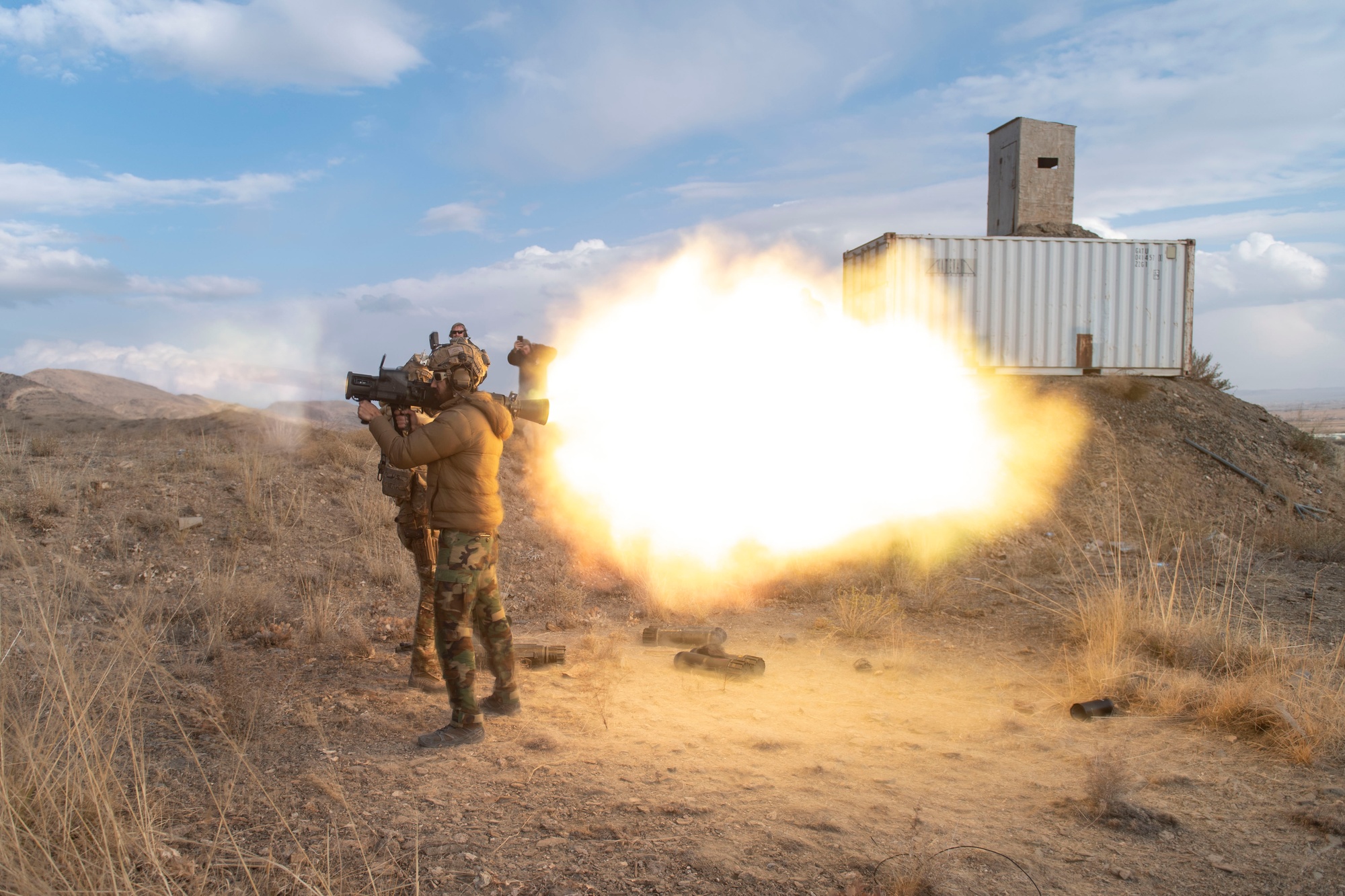
The Carl-Gustaf M4 is the fourth-generation variant of a Swedish 84mm shoulder-fired recoilless rifle whose ammunition family has remained backward-compatible across all weapon generations. The M4 launcher itself is shorter than one metre and weighs under seven kilograms — a deliberate reduction from the M3 to permit more agile dismounted carriage. The operational utility of the system is determined by its ammunition. A summary of the principal natures held against the 2023 framework follows.
| Nature | Role | Effective range / penetration | Notes |
|---|---|---|---|
| HEAT 551 | Anti-armour, primary | 700 m (400 m moving target); >400 mm RHA | Rocket-assisted projectile (RAP). 3.2 kg round mass; 255 m/s muzzle velocity. |
| HEDP 502 | High-explosive dual purpose | 1,000 m soft target; 500 m static; 300 m moving | Impact or 0.1 s delay fuze. 15–40 m arming distance. Ground-skip airburst capability. |
| HE 441D | High-explosive anti-personnel | 1,000 m (lobbed) | Impact or airburst fuze. Effective against dispersed personnel in the open and behind cover. |
| ASM 509 | Anti-structure | Effective against reinforced structures and field fortifications | Tandem-warhead family. Designed for built-up area employment. |
| SMOKE 469 | Smoke screen | Used at 200–1,300 m | Hexachloroethane-free formulation in current production lots. |
| ILLUM 545 | Battlefield illumination | Up to 2,300 m range; 30 s burn | Parachute-deployed; supports night observation and target marking. |
| TPT 141 | Target practice tracer | Range-matched to HEAT 551 | Inert filling, ballistically matched to operational round for training economy. |
Hazard classification (HD) and Compatibility Group (CG) data for these natures are held by Saab and confirmed by national qualification authorities of operating states. ISC has not independently verified per-lot HD/CG markings; users should refer to current national ammunition data sheets and AC/326-compliant qualification records before transport or storage planning. Net Explosive Quantity (NEQ) values vary by nature and lot and are not consolidated in publicly available Saab marketing literature.
The Carl-Gustaf agreement is structurally unusual in bundling the weapon system and its ammunition under a single instrument — an arrangement that reflects how the system is actually used in service.
AT4: variant family and disposable architecture
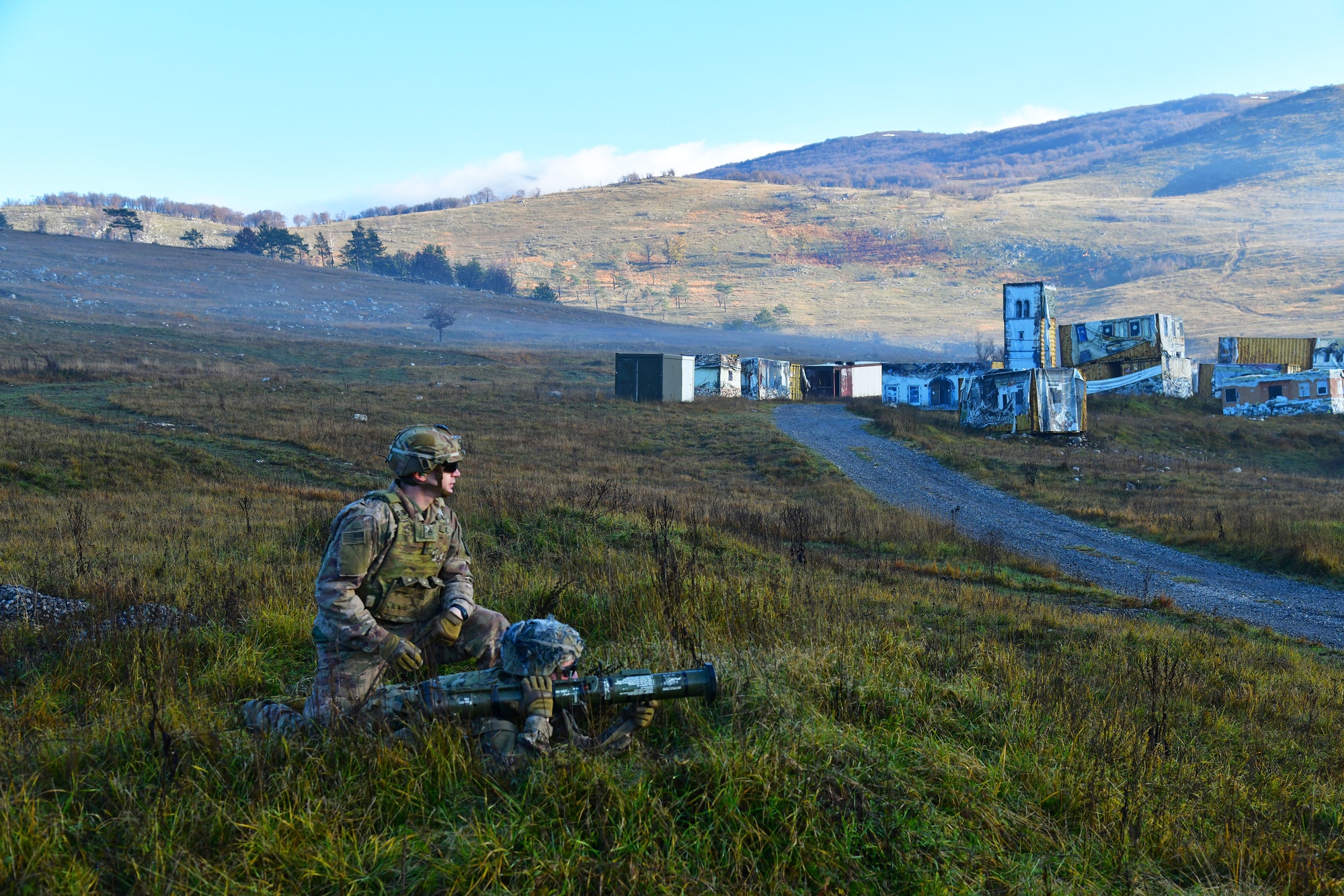
The AT4 is a single-shot, disposable, shoulder-fired 84mm recoilless weapon. Unlike the Carl-Gustaf, the launcher is consumed with the round. Procurement therefore tracks unit consumption directly — each engagement (live-fire or training) draws down stock. The weapon family has expanded substantially since the original 1980s HEAT variant; the 2023 NSPA framework covers the contemporary line.
| Variant | Role | Effective range / penetration | Notes |
|---|---|---|---|
| AT4 HEAT | Anti-armour, baseline | 300 m; >400 mm RHA | Original variant. Shaped charge of similar architecture to Carl-Gustaf HEAT 551. |
| AT4 HP | High penetration | 300 m; 420–600 mm RHA | Enhanced HEAT warhead for upgraded threat sets. |
| AT4 ER | Extended range HEAT | 600 m; up to 460 mm RHA | Range envelope doubled over baseline by warhead and propellant changes. |
| AT4 HEDP | High-explosive dual purpose | Effective against bunkers, light armour, infantry in cover | Impact or delay fuze. Skip-fire capable. |
| AT4 AST | Anti-structure tandem | Designed for urban combat entry | Tandem warhead: shallow-cone HEAT precursor plus follow-through high-blast. Two settings: bunker defeat or wall mouse-holing. |
| AT4 HE | High explosive anti-personnel | Up to 1,000 m | Impact or airburst fuze. Anti-personnel role. |
| AT4 CS | Confined space | Per warhead variant | Saltwater countermass replaces backblast venting. Permits firing from enclosed spaces. |
| AT4 RS | Reduced sensitivity | Per warhead variant | Insensitive Munitions (IM)-compliant warhead fill. Reduced reaction to thermal, impact and shaped-charge stimuli. |
The U.S. designations M136 (baseline AT4) and M136A1 AT4CS-RS (confined-space, reduced-sensitivity variant) reflect specific national qualification of the European originals. The M136A1 employs a bi-metal warhead architecture for enhanced behind-armour effects, with claimed penetration up to 500 mm RHA.[4] Several NATO members route their AT4 procurement through NSPA call-offs against the 2023 framework rather than via direct Saab orders, particularly where small annual quantities make individual national tendering disproportionate to the buy.
Three years of call-offs: what the demand curve shows
The framework was signed in March 2023. Within twelve months — by March 2024 — NSPA had placed a Carl-Gustaf call-off worth approximately €60 million on behalf of four member nations, with deliveries scheduled through 2027.[2] A separate AT4 order valued at approximately €63 million was subsequently placed against the framework, with deliveries scheduled for 2026–2027.[5] The cumulative figure of €176 million across seven member states quoted in defence trade reporting represents framework activity from the broader 2022 Saab–NSPA relationship through to the period covered by current reporting.[3]
Two observations arise from this pattern. First, the call-off rhythm has been steady rather than front-loaded; the 2024 Carl-Gustaf order does not exhaust the framework envelope, suggesting member-state procurement teams have used the instrument as a rolling vehicle rather than a one-shot acquisition. Second, the framework has demonstrably worked as a multi-nation pooling mechanism — seven member states drawing against a single agreement is precisely the procurement compression NSPA exists to deliver, and the alternative would have been seven national tenders.
What the framework expiry would mean operationally
If the AT4 framework lapses at end-2026 without renewal, NATO members wishing to acquire AT4 stocks revert to direct Saab orders or to national tenders. For larger buyers (Poland, the United Kingdom, Germany) this is administratively manageable. For smaller buyers — the Baltic states, the Netherlands, the Nordic neutrals now inside NATO — reverting to national procurement removes the cost and time benefit that motivated the framework in the first place. The 2027 Carl-Gustaf expiry would cascade further because of the bundled ammunition coverage: a member state running low on HEDP 502 or HEAT 551 would need a separate ammunition procurement vehicle in addition to any weapon-system order.
The renewal case
ISC assesses four structural reasons why NSPA should commence renewal negotiations on both frameworks now, with a target of replacement instruments in place before the 2026 AT4 expiry.
1. Demand has not contracted
Western European anti-armour stocks were drawn down significantly between 2022 and 2025 to support Ukraine and to refresh national reserves under post-2022 force-design assumptions. Reconstitution is incomplete in most NATO armies. Soldier-portable shoulder-launched anti-armour munitions are among the categories where reconstitution timelines run beyond the current framework expiry. A renewed framework would carry the procurement vehicle through the reconstitution period rather than terminate it mid-cycle.
2. The bundled structure is operationally rational
The Carl-Gustaf weapon-plus-ammunition bundling that distinguishes the 2023 instrument should be the template for any successor agreement. Soldier-portable shoulder-launched munitions are systems where the launcher is meaningless without the ammunition family, and where ammunition supply timelines (driven by energetic-material availability, fuze production and qualification cycles) typically exceed launcher production timelines. Procurement instruments that decouple the two introduce avoidable scheduling friction.
3. Multi-national pooling is the comparative advantage
The seven-member call-off pattern under the existing framework is the strongest indicator that the instrument fulfils a function national procurement cannot. NATO standardisation in this category has historically been undermined by varied national qualification timelines for warhead fills, fuzes and propellants. A successor framework that preserves multi-national call-off architecture — ideally with explicit Insensitive Munitions (IM) coverage and AT4 RS / Carl-Gustaf low-sensitivity natures within the agreement scope — would lock in the standardisation gains achieved since 2022.
4. Ukraine and Indo-Pacific operational lessons feed forward
Carl-Gustaf and AT4 employment in Ukraine since 2022, and in Indo-Pacific exercises with Australia, the Republic of Korea and Japan since 2023, has generated operational lesson-data on tandem warhead effectiveness against modern explosive reactive armour, and on confined-space firing in dense urban terrain. A renewed framework should be drafted with sufficient flexibility to accept ammunition variants developed in response to these lessons without requiring framework amendment for each new nature.
Data gaps
- Per-nature NEQ figures for the 84mm Carl-Gustaf family and AT4 variants are not consolidated in publicly available Saab marketing literature. Operating states should reference national ammunition data sheets.
- Hazard classification (HD) and Compatibility Group (CG) markings per lot have not been independently verified for this article. Refer to AC/326-aligned national qualification records.
- Renewal negotiations — ISC has not identified public reporting confirming that NSPA and Saab have entered framework renewal discussions as of late April 2026. The recommendation in this article is therefore prospective.
- Total framework envelope value for both 2023 instruments at signature was not made public. The €176 million cumulative figure spans the broader 2022 framework relationship, not solely the 2023 agreements.
Source evaluation
NATO STANAG 2022 reliability and accuracy ratings:
- Saab corporate press releases (refs 1, 2, 5): A–2 (reliable / probably true; manufacturer claims regarding own products).
- Defence trade press cumulative figures (ref 3): B–2 (usually reliable / probably true).
- Manufacturer technical data on AT4 and Carl-Gustaf variants (refs 4–7): A–2 (reliable manufacturer source for own products); independent verification recommended for operational planning.
References
- Saab. (2023, 30 March). Saab signs ground combat framework agreements with NATO Support and Procurement Agency. Saab Newsroom. https://www.saab.com/newsroom/press-releases/2023/saab-signs-ground-combat-framework-agreements-with-nato-support-and-procurement-agency
- Saab. (2024). Saab receives order for Carl-Gustaf from NATO Support and Procurement Agency. Saab Newsroom. https://www.saab.com/newsroom/press-releases/2024/saab-receives-order-for-carl-gustaf-from-nato-support-and-procurement-agency
- Defence Industry Europe. (2024). Saab signs framework agreement with NSPA for Carl-Gustaf and AT4 systems. https://defence-industry.eu/saab-signs-framework-agreement-with-nspa-for-carl-gustaf-and-at4-systems/
- Saab. (n.d.). AT4 Family. Saab products. https://www.saab.com/products/at4
- Saab Japan. (2024). Saab receives order for AT4 from NSPA. https://www.saab.com/markets/japan/review-2024/saab-receives-order-for-at4-from-nspa
- Saab. (n.d.). Carl-Gustaf Recoilless Multi-Purpose Weapon System. https://www.saab.com/products/carl-gustaf-m4
- Euro-SD. (2023, March). Saab signs weapon framework agreements with NSPA. European Security & Defence. https://euro-sd.com/2023/03/news/30867/saab-signs-weapon-framework-agreements-with-nspa/
This analysis is AI-assisted and based on open-source material. It does not constitute procurement, legal or commercial advice. Source ratings applied per NATO STANAG 2022. Hazard data should be verified against current national qualification records before transport, storage or operational planning.
ISC Commentary
The Saab–NSPA frameworks are unglamorous procurement instruments that have done a substantial amount of useful work since 2023. They have moved approximately €176 million of soldier-portable anti-armour and multi-purpose munitions to seven NATO member states without re-tendering, which is the procurement compression the alliance committed to after February 2022 and rarely achieves elsewhere.
The case for renewal is not contingent on the war in Ukraine continuing or on any particular Indo-Pacific scenario. It rests on the structural observation that this specific category — shoulder-launched, single-soldier-employed, 84mm recoilless — is one where multi-national call-off pooling delivers measurable benefit, and where letting the instrument expire would impose administrative costs that fall hardest on the smaller member states whose holdings most need refreshing.
The bundled weapon-plus-ammunition coverage of the Carl-Gustaf agreement should be preserved or extended in any successor instrument. ISC also notes that the AT4 framework expires first, in 2026, which means renewal negotiations should logically be sequenced AT4-first to avoid a coverage gap.