Marinette to Govan: US Warship Manufacturing Lessons and the Twenty-Year UK Record
Constellation's truncation and Aegis's survival identify one structural risk — production committed before the engineering baseline converges. Astute, the Type 45 destroyer, the Queen Elizabeth-class carriers, Type 26, Type 31 and Dreadnought have demonstrated the same pattern in Britain over two decades. The pathology is transatlantic, the bill is long, and the executive discipline the evidence demands is specific.
Executive framing
Naval procurement forces defence executives into a recurring dilemma: how to triage programmes at different stages of maturity, and how to commit capital and bids before the engineering baseline is fully set. The US Constellation-class frigate shows what happens when that baseline never converges — a programme conceived to reduce risk that reproduced the instability it was designed to avoid (GAO, 2024; CRS, 2025). The Aegis weapon system shows it is possible to survive a turbulent development phase and emerge with a durable, revenue-generating architecture (CRS, 2026; DOT&E, 2025). Taken together, the two cases suggest that executives should prioritise programmes with credible change-management processes and validated designs, and should treat premature production commitment as a pricing risk, not a programme-management detail.
The United Kingdom has been learning the same lesson in public for two decades. Astute, the Type 45 destroyer, the Queen Elizabeth-class (QEC) carriers, Type 26, Type 31 and Dreadnought each carry some version of the Constellation pathology. The National Shipbuilding Strategy (NSbS) in 2017 and its 2022 Refresh were the British attempt to fix it; the Terms of Business Agreement (TOBA) of 2009 was the industrial-base scaffolding around it. Both constructs are now visibly under strain (HM Government, 2022; HoC, 2022).
The Constellation pathology
The Constellation programme began with a sensible premise. After the Littoral Combat Ship's (LCS) shortcomings, the US Navy wanted a lower-risk small surface combatant built on an existing hull rather than another clean-sheet design (CRS, 2025). In 2020 the Navy selected the Italian European Multi-Mission Frigate (FREMM) specifically to reduce technical risk and accelerate delivery. The underlying logic was sound: a proven parent design should compress the time between contract award and a stable engineering baseline.
What followed undermined that premise. The Government Accountability Office (GAO) found that design instability stalled construction and compromised delivery; the lead ship, originally contracted for April 2026 delivery, was subsequently forecast to arrive roughly 36 months late (GAO, 2024; Defense News, 2024a). Workforce shortages at Fincantieri Marinette Marine compounded the problem, with Navy officials reporting in early 2024 that the yard was still several hundred workers short of requirements (Defense News, 2024b). The programme was ultimately truncated. As former Navy acquisition executive Nickolas Guertin observed in 2025, building ships quickly depends on extensive three-dimensional modelling, prototyping, and risk-reduction analysis, not simply on modifying an existing design and assuming speed will follow (USNI, 2025). A proven hull is insufficient. The programme also needs mature operator interfaces, adequate power and weight margin, and an integration plan validated before construction accelerates (GAO, 2024).
For industry, that sequence is not only a programme-management story. It is a margin story. The core failure was not that Constellation used a foreign design. That contributed, but it is an incomplete explanation in itself. Production began before the engineering baseline had converged (GAO, 2024). The consequence was that requirement changes propagated simultaneously through weight, power, software and survivability trades while the yard was trying to build the ship. Labour gets re-sequenced, parts already in work are redesigned, and capital is held against shifting specifications rather than productive output. Under fixed-price or incentive structures, those pressures become direct margin compression.
The Aegis counterpoint
Aegis offers the counterpoint — not as a story of flawless execution, but as one of a programme that absorbed early turbulence and built a durable commercial architecture out of it. A 1990 GAO report on the DDG-51 Aegis destroyer found that Bath Iron Works encountered design and construction problems, that Navy contract changes materially increased cost, and that the lead ship's delivery schedule slipped 17 months (GAO, 1990). The GAO also warned that concurrency risk was rising because follow-on ships were already under contract before the lead ship had been delivered. Many of the hurdles that eventually consumed Constellation were present at the start of Aegis.
What distinguishes Aegis is that it evolved a process for absorbing change rather than being destabilised by it. Over time, Aegis modernisation became a managed upgrade ecosystem with incremental releases, certification cycles, and repeatable integration points across ships, radars and missiles (CRS, 2026). The Congressional Research Service (CRS) describes the broader Aegis Ballistic Missile Defense (BMD) philosophy as “build a little, test a little, learn a lot.” The Director, Operational Test and Evaluation (DOT&E) FY2024 reporting shows that Aegis modernisation and AN/SPY-6(V) integration continue to advance through successive baselines rather than through one-off redesigns (DOT&E, 2025). That structure converts engineering work into recurring revenue and gives firms positioned at the integration layer disproportionate lifecycle value.
The difference between Constellation and Aegis is not that one programme changed and the other did not. Both changed substantially. The difference is that Aegis developed a durable mechanism to integrate change, certify upgrades and preserve enough interface stability for suppliers to plan around (CRS, 2026). Constellation entered production before that stability existed, so changes compounded rather than resolved.
The UK mirror: two decades of the same pathology
Set that framework against the United Kingdom's warship record since 2006 and the parallels are immediate. The pathology is not a foreign design issue and not a single-yard issue. It is a baseline-maturity issue, sharpened by political schedule compression, single-source industrial dependence, and the repeated assumption that a novel technology or a proven parent design will carry the programme through its engineering weakest point.
Submarines: Astute and Dreadnought
Astute is the UK's textbook Constellation-equivalent, and it is arguably worse. The National Audit Office (NAO) reported the programme at £4.3 billion for the first six boats in 2001. By 2009 the forecast had moved to £6.6 billion; by 2015 it was £9.6 billion, and by March 2024 the Cabinet Office Infrastructure and Projects Authority (IPA) reported whole-life cost of £11.26 billion, explained by “inflation and delivery cadence within the shipyard” (IPA, 2024; UKDJ, 2025). A House of Commons Defence Committee finding in November 2009 captured the early state bluntly: the class was 57 months late and 53 per cent over budget, at a forecast cost of £3.9 billion for the first three boats alone (HoC Defence Committee, 2009).
The mechanics were Constellation in extremis. BAE Systems absorbed Vickers Shipbuilding and Engineering Limited (VSEL), the nuclear-submarine design workforce had atrophied in the gap between Trafalgar and Astute, and the programme's transition of computer-aided design tooling between Intergraph and CATIA interrupted the design flow at precisely the worst moment. Production began with a design that had not converged. The result was sustained design iteration during build inside a single yard that had lost depth in its design workforce, on a schedule that could not be recovered.
Dreadnought inherits the downstream consequence. The programme is costed at £31 billion plus a £10 billion contingency, making an upper-end acquisition estimate of £41 billion (HoC Library, 2025). By March 2024, £3.37 billion of contingency had been drawn; the remainder is allocated to future years, which suggests the full ceiling will be spent. The Defence Nuclear Enterprise (DNE) now accounts for roughly 18 per cent of the Ministry of Defence (MoD) budget, with a ten-year forecast of about £130 billion. The keel was laid in March 2025; the first-in-class is expected early in the 2030s (MoD, 2025). Dreadnought is materially dependent on Astute throughput: any persistent slippage on Astute prolongs the period during which Barrow is running two overlapping submarine builds on a single industrial envelope. Executives pricing subcontract work into that envelope should treat Astute's current cadence as the single most informative forward indicator of Dreadnought risk.
Surface combatants: Type 45, the Queen Elizabeth-class, Type 26 and Type 31
The Type 45 destroyer is the UK's Aegis-inverse. The Royal Navy built six Daring-class destroyers against an original requirement of twelve. The reduced run meant the sunk cost of the novel integrated electric propulsion (IEP) architecture and the Rolls-Royce/Northrop Grumman WR-21 intercooled recuperated gas turbine (IRGT) could not be amortised across a viable production volume. In service, the WR-21 proved unable to maintain output under the high-humidity, high-temperature conditions encountered in the Gulf, triggering recurrent total electrical failures (Navy Lookout, 2024).
The response was Project Napier and within it the Power Improvement Project (PIP), a £160 million design-and-manufacture contract with BAE Systems, delivered with BMT Defence Services and Cammell Laird. Each destroyer has its two original diesel generators replaced with three larger units, with reinforced high-voltage distribution. Three ships — HMS Dauntless, HMS Daring and HMS Dragon — completed PIP by December 2025. HMS Defender and HMS Diamond are in refit; HMS Duncan is scheduled to enter PIP at her next docking. The MoD commits to full-fleet completion by 2028 (UKDJ, 2025b; Navy Lookout, 2024). The Aegis contrast is sharp: Aegis absorbed its early errors inside an upgrade ecosystem with interface stability; Type 45 absorbed its error through a bespoke £160 million retrofit on each hull, inside a closed production run of six.
The QEC carriers carry the lesson for political schedule compression. HMS Queen Elizabeth and HMS Prince of Wales were originally budgeted at about £3.9 billion and delivered at roughly £6.2 billion. A 2008 decision to slow production on affordability grounds added approximately £1.6 billion to cost alone (NAO, 2011). The Aircraft Carrier Alliance (ACA) distributed build across six yards — BAE Govan and Scotstoun, Babcock Rosyth, Cammell Laird, A&P Tyne, and Thales — with final assembly at Rosyth. The model reduced single-yard risk but introduced interface risk at the integration point. The propeller-shaft coupling failure on HMS Prince of Wales in 2022, traced to an installation misalignment of 0.8 to 1.0 mm, removed the ship from operational use for an extended period and is indicative of the residual integration risk in a distributed-build model (Maritime Executive, 2023).
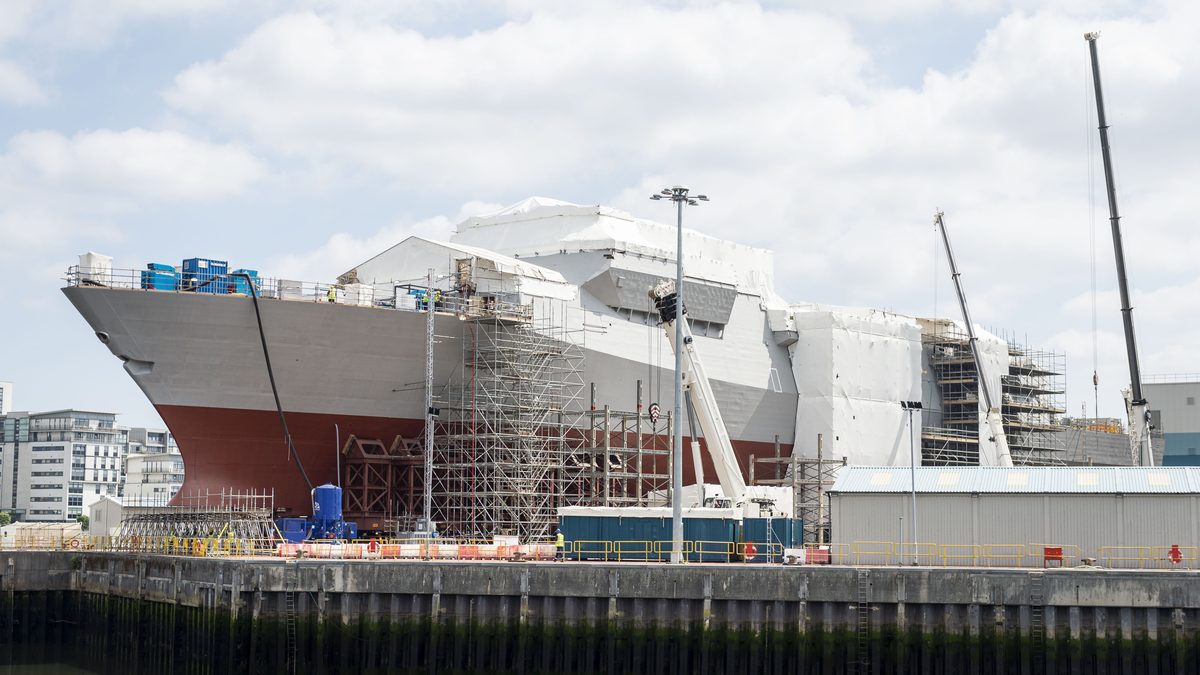
Type 26, the Glasgow-built City-class, is the British programme that most directly mirrors Constellation's premise and pathology. Lead-ship HMS Glasgow was originally scheduled for 2024. The Initial Operating Capability (IOC) date is now October 2028 — a confirmed 12-month slip signalled by joint Public Accounts Committee and Defence Committee leadership in February 2026, who warned the delay “risks sending damaging signals to adversaries” (UK Parliament, 2026; Navy Lookout, 2024b). A parliamentary answer in February 2025 confirmed £233 million of cost growth. BAE naval ships managing director Simon Lister has acknowledged publicly that labour shortages in steel trades mean build milestones are unlikely to be met until Ship 4 (Calibre Defence, 2026). That statement alone should reshape how supply-chain partners price labour-dependent Type 26 scope for the first three hulls.
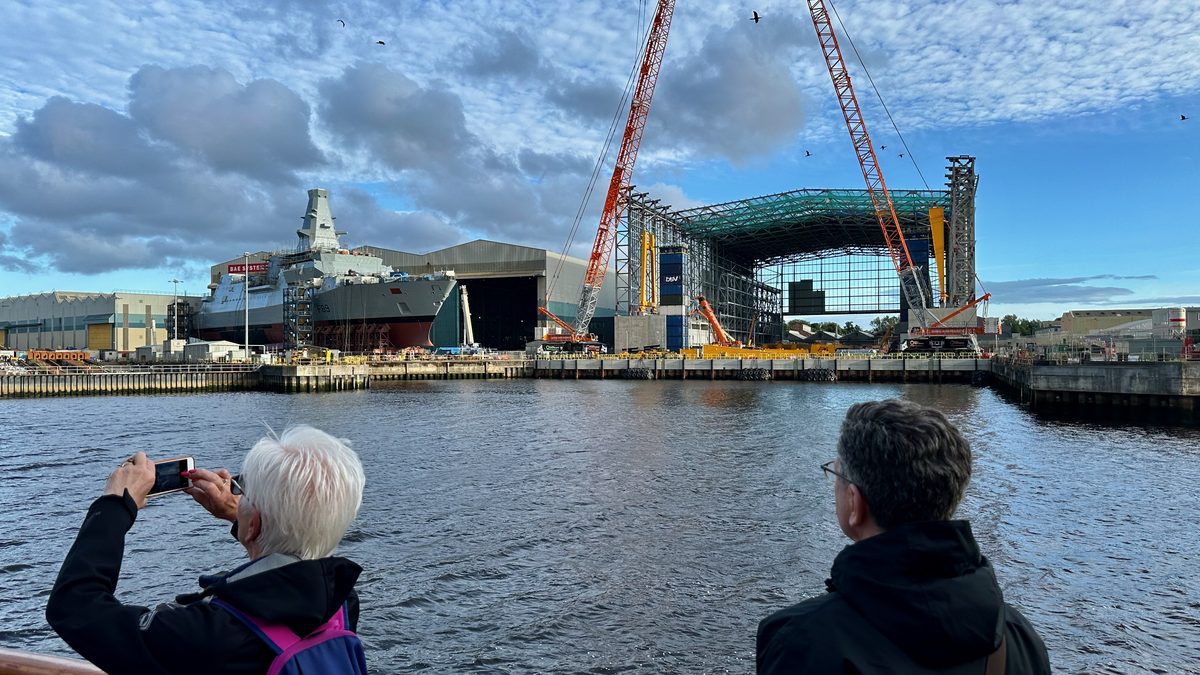
Type 31 is the British Constellation in the strictest parent-design sense. Babcock's Inspiration-class uses the Iver Huitfeldt / Arrowhead 140 design licensed from Denmark — proven hull, mature baseline — contracted on a £1.25 billion fixed-price basis for five ships in 2019. HMS Venturer launched in 2025; HMS Active rolled out of the Rosyth assembly hall and floated off in March 2026; fourth-of-class HMS Bulldog cut steel in early 2026 (Naval News, 2026a, 2026b). Delivery of HMS Venturer to the Royal Navy is now anticipated by 2028 rather than the original earlier target, with all five ships commissioned by the early 2030s.
Critically, Babcock initiated a formal dispute-resolution process with the MoD over programme cost liability, with a preliminary provision of £50–£100 million to cover the contract without recovery (Naval Technology, 2024). That number tells executives exactly what Constellation tells them: a proven parent design does not neutralise fixed-price exposure where the build environment, the supply chain and the integration baseline are not equally proven. Babcock was required to upgrade Rosyth to build Type 31 and to train into the work; those realities did not disappear because the hull came from Copenhagen.
The industrial-base layer: NSbS and TOBA
The UK attempted to fix all of this with industrial-strategy instruments rather than better programme discipline alone. The National Shipbuilding Strategy 2017 (Sir John Parker) recommended a drumbeat production cycle and competitive plurality beyond BAE Systems. The 2022 Refresh set out a thirty-year pipeline of more than 150 naval and civil vessels with £4 billion of government investment and established the National Shipbuilding Office (NSO) (HM Government, 2022). It is a credible answer to the demand-signal problem that repeatedly destabilises naval industrial bases.
The implementation has not held the line the refresh set. The 2022 pipeline has already, in the words of industry commentary, been “overtaken by subsequent developments,” including the broader MoD funding reconciliation now under way and the reported £16.9 billion funding gap the Ministry is managing across the equipment plan (Calibre Defence, 2026; Maritime UK, 2025). For executives pricing capital decisions against the NSbS pipeline, the operative question is no longer whether the pipeline exists but whether the funding envelope behind it is credible in any given financial year.
TOBA, signed in July 2009 as a 15-year agreement between the MoD and BAE Systems, guaranteed a minimum of about £230 million per year of ship-build and support activity, with cancellation penalties that at the 2010 Strategic Defence and Security Review (SDSR) stood at £630 million (HoC Library, 2013). TOBA was the attempt to do for UK surface shipbuilding what the Aegis ecosystem did commercially for US combat systems: stabilise the industrial base against demand shocks. It expired in July 2024 and has been progressively replaced by programme-specific contracts (T26, T31). The structural question that replaced TOBA has not closed: if the follow-on contracts do not themselves deliver stable volume at known margins, the British warship industrial base returns to the pre-2009 condition of being a hostage to single-programme cadence.
The US retains structural advantages the UK lacks. Multiple competing yards — Bath Iron Works, Ingalls, Fincantieri Marinette Marine, Huntington Ingalls Newport News — and a seventy-plus hull Arleigh Burke/Aegis production legacy have preserved design-workforce depth across programme gaps. UK surface construction is concentrated at Govan, Scotstoun and Rosyth, with Cammell Laird and Appledore as auxiliary nodes; submarine work is Barrow-exclusive. Slippage at any one site therefore cascades into national capacity constraint rather than being absorbed by competitive substitution. TOBA's 2009–2024 guarantee of roughly £230 million per year of minimum activity expired without a true volume-successor, returning the industrial base toward its pre-2009 position of single-programme dependency — precisely the vulnerability Constellation exposed when Marinette could not absorb design churn, and precisely the vulnerability Type 26 is exposing now when BAE Scotstoun cannot find steel trades at the pace the programme requires.
Set against that, Type 26 has delivered genuine export success once the design matured. Norway selected the platform on 31 August 2025 in a strategic partnership worth approximately £10 billion (US $13.5 billion) for at least five anti-submarine warfare frigates, built at BAE Scotstoun with first delivery from 2030 (Naval News, 2025; Breaking Defense, 2025). With Canada's fifteen Canadian Surface Combatants and Australia's nine Hunter-class frigates also Type 26-derived, the family now stands at roughly twenty-nine committed international hulls — the UK's largest warship export deal by value. The commercial implication is sharp: once a British warship design reaches a stable baseline, the platform is world-class. The domestic problem is the corridor between steel-cut and stable production, not the product.
The pattern, and what executives should take from it
For industry, the Anglo-American evidence converges on a single structural observation. Defence firms are not operating in a market that bad programmes occasionally disrupt. They are operating in a market where changing requirements, shifting service priorities and design-build concurrency are permanent features (CRS, 2025; GAO, 2024). The practical question is not how to avoid turbulence. It is how to survive the chaotic capability-development phase and reach the promised land of stable production, follow-on modernisation and recurring revenue.
Constellation is not isolated, and neither is Type 26. Zumwalt delivered innovation but could not reach scale, limiting supplier ability to amortise development (CRS, 2024). LCS fragmented supply chains and suffered recurrent requirement change (CRS, 2024). Zumwalt's UK conceptual analogue is Type 45, where innovation delivered six hulls, not twelve, and a £160 million per-fleet retrofit. LCS's analogue is the Aircraft Carrier Alliance interface-risk pattern. Constellation's analogue is Type 26 on the instability side and Type 31 on the parent-design-is-not-a-free-lunch side. Volume and price discipline, in other words, matter almost as much as technical discipline.
Key metrics at a glance
The comparison is easier to see in one place. Figures are verified against primary sources as at 24 April 2026.
| Programme | Original estimate | Latest / outturn | Slip | Core pathology | US parallel |
|---|---|---|---|---|---|
| Constellation (US) | ~$1.2 bn lead ship | Truncated Nov 2025; follow-on hulls terminated | ~36 months (to 2029) | Production committed before baseline converged; ~13% weight growth; yard workforce short | — |
| Astute (UK) | £4.3 bn (6 boats, 2001) | £11.26 bn WLC (IPA, Mar 2024) | 57+ months (early boats) | CAD transition (Intergraph→CATIA) + VSEL design-workforce atrophy during build | Constellation |
| Type 45 (UK) | 12-ship plan | 6 built; £160 m PIP retrofit per hull | In-service remediation to 2028 | Novel WR-21 IRGT unproven at fleet scale; no amortisation volume | Zumwalt / LCS |
| QEC (UK) | £3.9 bn (2 ships) | £6.2 bn outturn | 2+ years (2008 slowdown) | Political schedule compression + ACA distributed-build interface risk | — |
| Type 26 (UK) | ~£1.3 bn / ship | +£233 m growth (Parliament, Feb 2025) | 12-month IOC slip; HMS Glasgow Oct 2028 | Steel-trade labour shortage + on-going design iteration post-cut | Constellation |
| Type 31 (UK) | £1.25 bn fixed-price (5 ships) | £50–100 m Babcock provision / dispute | ~1–2 year delivery slip | Proven parent hull + unproven yard, training and integration baseline | Constellation (premise) |
| Dreadnought (UK) | £31 bn + £10 bn contingency | £3.37 bn contingency drawn by Mar 2024 | To be tested | Anticipatory industrial concentration at Barrow; Astute-dependent throughput | — |
Screening programmes: three questions, sharpened by evidence
For executives, the Anglo-American evidence points to a more realistic screening framework than asking whether requirements are frozen. In defence programmes, requirements rarely stay frozen. The better question is whether the programme has a credible mechanism to absorb change without destabilising the build. Before bidding aggressively or committing major capital, firms should screen for three things:
- Change-management discipline. A defined process for integrating evolving requirements — at contract, not by correspondence. The test is whether the customer has an engineering change control board with scheduled cadence and published backlog, and whether prime-to-subcontract flow-down is contractually tied to it.
- Credible design-maturity trajectory. Evidence that the design is converging, not still expanding. Useful proxies: weight margin trend, software line-of-code growth rate, interface-control-document release cadence, and whether operator interfaces are frozen or still iterating. Type 26 would have failed this test at steel-cut in 2017; Astute would have failed it during the Intergraph-to-CATIA transition. Labour data now suggests Type 26 is also failing the first criterion on hulls 1–3.
- Integration validation through land-based engineering, prototyping or modular test environments before production accelerates. This criterion emerged from Constellation itself. Naval Sea Systems Command (NAVSEA) built a land-based engineering site in Philadelphia, described as a “ship in a bottle,” precisely because the programme lacked a set engineering baseline (NAVSEA, 2023; NAVSEA, 2024). The UK equivalents are the AN/SPY-1 and AN/SPY-6 shore facilities in the United States, and, in the British case, the intermittent use of HMS Sultan and QinetiQ ranges for propulsion proving — neither of which replaced a Type 45-specific land-based integration facility at scale. Type 31 passed the parent-design test (Arrowhead 140 / Iver Huitfeldt) but failed this production-environment test: Rosyth required significant upgrade and workforce training that the fixed-price envelope did not fully absorb, which is the exact Constellation trap.
For sub-prime firms pricing Dreadnought exposure, the binding forward indicator of Barrow throughput risk is the Astute build record itself — 13-plus year build times and an £11 billion-plus outturn. It is the only informative dataset available, and it sits upstream of every Dreadnought sub-contract decision.
Contract strategy: price risk, do not deny it
Contract strategy follows the same logic. Where design risk remains elevated, fixed-price exposure should be treated as a deliberate pricing decision, not a signal of confidence in programme stability (GAO, 2024). Milestone payments should be tied to validated engineering outputs and integration readiness, not document completion. Where the customer insists on concurrent design refinement and construction — as on Astute and on Type 26 in its early years — firms should explicitly price in labour inefficiency, overhead absorption from schedule delays, and working-capital strain from inventory held against shifting specifications. The Type 31 dispute over £50–£100 million is a live reminder that fixed-price commitments under evolving technical conditions will be tested.
The pendulum should not swing to the other extreme. To eradicate programme risk would be unviable and counter-productive, and customers — both the Navy and the MoD — would not accept it. The goal is to avoid unknowingly subsidising customer instability through margin erosion.
Portfolio positioning: invest in what is portable
Portfolio strategy requires more nuance than a blanket policy against investing ahead of demand. Not all anticipatory investment carries the same risk profile. Investment in software, digital engineering tools, modular production methods, or electronics creates capabilities applicable across multiple programmes — the same additive manufacturing cell may serve one subcomponent on Monday and another on Tuesday. Expanding shipyard footprint or labour headcount against a single new-build programme carries much higher downside if funding, schedule or requirements shift (CBO, 2025; CSIS, 2026).
The Congressional Budget Office (CBO) estimates the US Navy's shipbuilding plan would cost roughly $40 billion annually, significantly above recent funding levels (CBO, 2025). The Center for Strategic and International Studies (CSIS) reports that the US industrial base continues to struggle to produce at required scale and speed (CSIS, 2026). The UK equivalent is the reported £16.9 billion equipment plan gap and the observable fact that TOBA's successor arrangements have not produced the drumbeat volume the 2022 refresh anticipated (Calibre Defence, 2026). Where firms consider heavy capital investment ahead of funded demand, the risk premium should be weighted considerably above that on anticipatory investment in portable, programme-agnostic capabilities.
Value sits at the integration layer
The final strategic implication concerns where value sits in naval markets. Control increasingly resides at integration layers: combat systems, radar architectures, software baselines and certification pathways (CRS, 2026). Firms that control interfaces influence supplier access and shape the cadence of follow-on work. Aegis demonstrates the payoff. Despite its turbulent early years, it matured into an ecosystem that supports long production runs, recurring modernisation contracts and strong supplier dependence on a stable architecture (CRS, 2026; DOT&E, 2025). That is a more durable commercial position than hull production alone.
The British equivalents of this logic are the Sea Viper / Principal Anti-Air Missile System (PAAMS) complex on Type 45, the Combat Management System (CMS) baselines on Type 26, and the Common Combat System architecture work across surface platforms. For sub-prime firms pricing decade-long positions, the Anglo-American evidence points in the same direction: hulls are cyclical and exposed to political schedule compression; integration pathways are less cyclical and compound in value.
For many firms, the right answer is not to chase every ship programme equally. It is to anchor the portfolio in stable programmes and upgrade ecosystems, and then to take selective positions in new platforms only where there is a credible plan — ideally developed with the customer — for navigating the bridge from capability development to stable production (GAO, 1990; GAO, 2024).
References
- Congressional Budget Office. An Analysis of the Navy's 2025 Shipbuilding Plan. January 2025. cbo.gov
- Congressional Research Service. Navy Aegis Ballistic Missile Defense (BMD) Program: Background and Issues for Congress. RL33745. 12 January 2026. crsreports.congress.gov
- Congressional Research Service. Navy Constellation (FFG-62) Class Frigate Program: Background and Issues for Congress. R46484. 4 March 2025. crsreports.congress.gov
- Congressional Research Service. Navy Force Structure and Shipbuilding Plans: Background and Issues for Congress. RL32665. 2024. crsreports.congress.gov
- CSIS. Outlining the Challenges to U.S. Naval Shipbuilding. 2026. csis.org
- Defense News. “U.S. Navy Ship Programs Face Years-Long Delays Amid Labor, Supply Woes.” 2 April 2024. defensenews.com
- Defense News. “Frigate Program Delayed as Shipyard is a ‘Few Hundred’ Workers Short.” 11 January 2024. defensenews.com
- Director, Operational Test & Evaluation. FY2024 Annual Report: Aegis Modernization. 2025. dote.osd.mil
- Government Accountability Office. Navy Frigate Program: Unstable Design Has Stalled Construction. GAO-24-106546. May 2024. gao.gov
- Government Accountability Office. Navy Shipbuilding: Cost and Schedule Problems on the DDG-51 AEGIS Destroyer Program. 17 January 1990. gao.gov
- HM Government. Refresh to the National Shipbuilding Strategy. CP 605. March 2022. gov.uk
- HM Government / MoD. Dreadnought submarine programme: factsheet. Updated May 2025. gov.uk
- House of Commons Defence Committee. Major Projects Report. 2009. Cited in subsequent NAO briefings.
- House of Commons Library. Replacing the UK's Nuclear Deterrent: Progress of the Dreadnought Class. CBP-8010. Updated 5 August 2025. commonslibrary.parliament.uk
- House of Commons Library. The cost of the UK's strategic nuclear deterrent. CBP-8166. commonslibrary.parliament.uk
- House of Commons Library. BAE Systems Terms of Business Agreement. Briefing notes 2013. commonslibrary.parliament.uk
- Infrastructure and Projects Authority. Annual Report on Major Projects 2023–24. March 2024. gov.uk
- Maritime Executive. “Cost Estimates for Repairs to HMS Prince of Wales Skyrocket.” 2023. maritime-executive.com
- Maritime UK. “British Industry Presses for Bolstered Action on Shipbuilding Strategy.” 2025. maritimeuk.org
- National Audit Office. Ministry of Defence: The Major Projects Report 2011. November 2011. nao.org.uk
- Naval News. “UK Type 31 Programme Rolls On with Roll-Out of Ship Two.” February 2026. navalnews.com
- Naval News. “Babcock Launches Second Type 31 Frigate — HMS Active.” March 2026. navalnews.com
- Naval News. “Norway selects British Type 26 frigates.” 31 August 2025. navalnews.com
- Breaking Defense. “Norway selects UK Type 26 frigates under $13.5 billion plan.” September 2025. breakingdefense.com
- RUSI. “Norway's Purchase of Type 26 Frigates.” 2025. rusi.org
- Naval Technology. “UK MoD and Babcock in dispute with Type 31 frigate programme in the red.” 2024. naval-technology.com
- NAVSEA. Constellation-Class Frigate Land-Based Engineering Site Announcement. 7 September 2023. navsea.navy.mil
- NAVSEA. NSWCPD Building a “Ship in a Bottle.” 24 May 2024. navsea.navy.mil
- Navy Lookout. In focus: The Power Improvement Project for the Royal Navy's Type 45 destroyers. 2024. navylookout.com
- Navy Lookout. Royal Navy frigate programme update. 2024. navylookout.com
- Calibre Defence. “Delay, Defer, Repeat: UK shipbuilding plans at risk as MoD scrambles to close £16.9 billion funding gap.” 2026. calibredefence.co.uk
- UK Defence Journal. “Astute boats 4-7 now more than £800m over budget.” 2025. ukdefencejournal.org.uk
- UK Defence Journal. “Half of Britain's destroyer fleet now have power issue fixed.” 2025. ukdefencejournal.org.uk
- UK Parliament / Public Accounts Committee joint statement. February 2026. committees.parliament.uk
- USNI News. “Navy's Plan for Frigate Parent Design Caused Delays, Former Acquisition Chief Says.” 19 February 2025. news.usni.org
ISC Commentary
The Anglo-American naval record since 2006 is not a story of bad luck repeated. It is the same industrial mechanism producing the same result across jurisdictions: capability ambition outruns engineering baseline maturity, concurrent build compounds changes rather than resolving them, and the prime contractor — or the customer — absorbs the resulting margin compression until an industrial intervention forces a reset.
The UK's attempt to fix this structurally — Parker 2017, NSbS Refresh 2022, TOBA 2009–2024 — has produced modest improvement in demand signal but has not altered the baseline-maturity problem at programme level. The US attempt to learn from the LCS experience by anchoring Constellation to a proven hull did not either, because the parent design addressed only one of the three variables (hull) and not the other two (integration baseline, production environment).
For defence executives and investors, the implication is clear. The highest-yielding positions in naval markets over the next decade are at the integration layer, in modernisation ecosystems, and in portable capabilities that service multiple programmes. Positions anchored to a single new-build hull programme — particularly one still in design convergence — should carry a materially higher risk premium than current bidding discipline across the sector suggests, whether the ship is being built in Marinette, Glasgow or Rosyth.