Mogami, MT30 and Accountability: Australia’s Frigate Selection Tested Against the Design-Before-Steel Framework
The Royal Australian Navy’s selection of the upgraded Mogami-class and the Rolls-Royce MT30 places three of three screening criteria in better shape than the US Constellation-class managed at contract award. A mature Japanese parent yard, a propulsion baseline already in service, and commonality with the Hunter-class Type 26 derivative. The Australianisation transition is where the framework predicts slip. The Australian programme is the live test of the thesis.
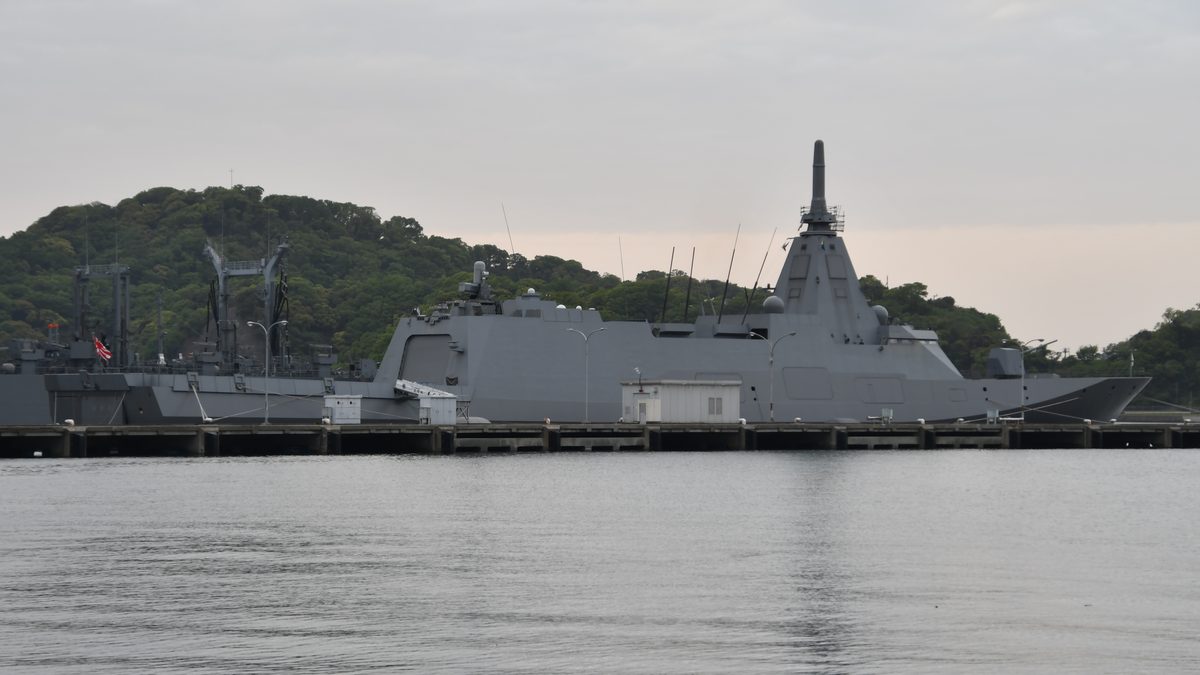
JS Mogami (FFM-1) at Yokosuka Naval Base, 22 April 2023. Lead ship of the Japan Maritime Self-Defense Force’s first-generation Mogami class. Australia has selected the upgraded (FFM-AAW) variant, with hulls one to three to be built by Mitsubishi Heavy Industries in Japan. Image: Hunini via Wikimedia Commons, CC BY-SA 4.0.
_right_rear_view_at_JMSDF_Yokosuka_Naval_Base_April_22,_2023.jpg)
Executive framing
On 24 April 2026, Rolls-Royce confirmed that its MT30 marine gas turbine has been selected to power up to eleven ships in the Royal Australian Navy’s new general-purpose frigate fleet, based on Japan’s upgraded Mogami-class design. The first three frigates will be built in Japan by Mitsubishi Heavy Industries (MHI), with first-of-class delivery to Australia scheduled for 2029 and operational service in 2030. Subsequent vessels are expected to transition to Australian production over time. Rolls-Royce Power Systems is also supplying the mtu Series 4000-based diesel generator sets via licensed partner Daihatsu InfinEarth: a dual role covering main propulsion and auxiliary power on the same hull (Rolls-Royce, 2026; Naval News, 2026a).
The announcement matters for three reasons, and they compound. First, it is the first live naval procurement of meaningful scale since the Constellation truncation in November 2025, and it tests the design-before-steel framework against a real programme in motion. Second, propulsion commonality with the Royal Australian Navy’s Hunter-class frigates (the Type 26 derivative, also MT30-powered) converts a single engine choice into a cross-fleet integration position. Third, the choice sits alongside AUKUS nuclear propulsion and the broader Rolls-Royce defence portfolio in a way that mirrors the Aegis integration-layer logic: the durable commercial value is at the modernisation ecosystem, not the hull (CRS, 2026; Rolls-Royce, 2026).
Against that read, the Australianisation transition is the risk horizon. The precedent is Type 31 at Rosyth, and behind that the Type 45 WR-21 story; a programme whose failure can now be traced through named ministerial decision, named specification failure and named testing truncation. That Type 45 trail is the cautionary spine of this analysis.
The Mogami selection in one paragraph
The Royal Australian Navy will acquire up to eleven general-purpose frigates based on the upgraded Mogami-class, a design already in service with the Japan Maritime Self-Defense Force (JMSDF) and already in series production at MHI. The MT30 is the same marine gas turbine that powers the in-service Mogami, the UK Type 26 City-class, the Australian Hunter-class (Type 26 derivative, in build), and the Canadian Surface Combatant (also Type 26-derived). First-of-class delivery is 2029, operational service 2030. Hulls one to three will be built in Japan; hulls four to eleven are planned to transition to Australian production, with detailed site and yard arrangements to be finalised. Rolls-Royce also supplies the Adour engine for the Hawk trainer, AE 2100 for C-130J and C-27J, AE3007H for MQ-4C Triton, BR710 for MC-55 Peregrine, and reactor technology for AUKUS nuclear submarines through Rolls-Royce Submarines Ltd (Rolls-Royce, 2026; Naval News, 2026a).
Where the Australian programme fits the thesis — and fits well
The design-before-steel framework screens on three criteria: change-management discipline, credible design-maturity trajectory, and integration validation before production accelerates. On all three, the Mogami selection is in better shape than Constellation was at equivalent contract signature.
1. Parent-design maturity is real, not nominal
Constellation’s FREMM premise unravelled because US Navy requirement changes drove roughly thirteen per cent weight growth after contract award. The parent effectively ceased to be the parent (GAO, 2024). Australia is buying the upgraded Mogami: a design Japan is already building and operating, with the MT30 integrated into the propulsion baseline from the outset. Interface-control documents, weight margin and power budget on a Japanese-built, Japanese-operated Mogami are converged in a way the FREMM baseline never was for Constellation. The Rolls-Royce framing that the engine is “a natural continuation of the platform’s existing propulsion architecture” is product-marketing language, but in framework terms it is exactly what Criterion 2 is designed to validate (Rolls-Royce, 2026).
2. Production-environment test is split, and the split is deliberate
Hulls one to three build at MHI, in the yard that already builds Mogamis. This is the opposite of the Type 31 trap at Rosyth, where Babcock was required to upgrade the yard and train into the work even though the hull was a licensed Iver Huitfeldt / Arrowhead 140 design. Those realities did not disappear because the hull came from Copenhagen (Naval Technology, 2024). Australia is letting MHI de-risk hulls one to three in a mature production environment, with Australian production phased in only once the first three ships are in the water. That is the precise Constellation-avoidance manoeuvre: build where the baseline is already stable, transition only once the change-rate has fallen.
3. Propulsion commonality with the Hunter-class is a genuine Aegis-style move
Running the MT30 across both the Hunter-class (Type 26-derived, UK-origin) and the general-purpose Mogami gives the Royal Australian Navy exactly the repeatable integration points and interface stability for suppliers to plan around that the companion analysis identified as the Aegis advantage (CRS, 2026). The effect is applied to propulsion rather than combat systems, but the compounding is the same: training pipelines, spare parts pools, sustainment contracts and depot-level knowledge accumulate across both fleet lines. This is a genuinely strategic industrial decision, not a press-release line. Commonality with the existing Mogami build in Japan extends the amortisation base further.
Where the Australian programme is exposed to the thesis
The screening framework is calibrated against Constellation precisely because sensible premises fail at predictable pressure points. Three such points are visible in the Australian programme as announced.
1. The Australianisation transition is the Constellation trap in miniature
The framework’s hardest test is the production environment, and this is where Australia is exposed. Hulls one to three are safe — Japanese yard, proven hull, integrated propulsion. Hulls four to eleven transition to Australian production. That transition is the precise class of risk Type 31 encountered at Rosyth: licensed hull, unproven local yard, training-the-workforce-while-building-the-ship pressure. Australia’s domestic naval shipbuilding base has known stress points at Osborne and Henderson. A platform transfer from MHI to an Australian yard will require interface-control-document handover, computer-aided design (CAD) environment translation, supply-chain re-location for long-lead items and trade-skill uplift on a schedule driven by political delivery dates rather than yard readiness. The Astute observation from the companion analysis is directly relevant: CAD transitions during build interrupt design flow at precisely the worst moment. The MHI-to-Australia transition carries the same class of risk (IPA, 2024; UKDJ, 2025).
2. First-in-class 2029, operational 2030 is a political schedule
Three ships in four years from a standing start at a Japanese yard that also has to continue JMSDF Mogami throughput is aggressive against any comparable industrial benchmark. If the lead ship slips, the commonality argument with Hunter-class weakens, because Hunter is itself subject to the Type 26 labour-shortage signal that BAE’s Simon Lister made explicit: build milestones on hulls one to three are unlikely to be met until Ship 4 (Calibre Defence, 2026; Navy Lookout, 2024b). Two frigate programmes running concurrently on tight schedules, sharing a propulsion supply chain, is a throughput-risk pattern the companion analysis’s Dreadnought-depends-on-Astute logic maps directly onto. The Queen Elizabeth-class case study adds the warning: the 2008 slowdown decision on affordability grounds added roughly £1.6 billion on cost alone (NAO, 2011). Schedule compression imposed from outside the yard is the single most predictable source of industrial cost growth in naval programmes.
3. Vendor claims are orthogonal to programme risk
Rolls-Royce describes the MT30 as “the world’s most power-dense marine gas turbine currently in service” (Rolls-Royce, 2026). The claim is accurate but also a marketing distinction, and the framework treats vendor superiority claims as a separate axis from programme risk. The WR-21 Intercooled Recuperated Gas Turbine (IRGT) on Type 45 was, in its time, described in similar terms for thermal efficiency. It still produced recurrent total electrical failures in the Gulf and required a £160 million per-hull Power Improvement Project (PIP) retrofit because novel technology met inadequate amortisation volume (Navy Lookout, 2024). The MT30 has a materially stronger track record (Type 26 in-build across four navies, Hunter in-build, Mogami in-service, and DDG(X) reference designs) and is not in the same risk class the WR-21 was in 2009. The rule is that most-power-dense framing belongs in the product brochure, not the programme risk register.
Rolls-Royce’s structural position: the Aegis playbook applied to propulsion
Step back from the Australian ship and the strategic picture is that Rolls-Royce is executing the Aegis playbook on marine propulsion (CRS, 2026):
- MT30 on Type 26. UK, Australia (Hunter), Canada (Canadian Surface Combatant), Norway (confirmed August 2025).
- MT30 on upgraded Mogami. Japan (in service), Australia (contract confirmed April 2026).
- Reactor IP into AUKUS submarines via Rolls-Royce Submarines Ltd.
- mtu Series 4000 diesel generator sets into the same Australian Mogami hull through Daihatsu InfinEarth.
That is a modernisation-ecosystem position, not a hull position. It compounds across programmes, survives political schedule compression on any single platform, and sits at the integration layer the companion analysis identified as the highest-yielding position in naval markets (CRS, 2026; DOT&E, 2025). Whatever the Australian build-transition risk turns out to be, Rolls-Royce is structurally insulated from it in a way the yards are not. For sub-prime firms pricing positions into the Australian programme, that insulation is not theoretical; it is observable in the pattern of contracts Rolls-Royce is now executing across four Type 26 navies, two Mogami fleets and AUKUS nuclear propulsion simultaneously.
Key-metrics comparison: the Australian Mogami against the twenty-year UK record
The framework is easier to see when the Australian programme sits on the same table as the UK programmes analysed in the companion piece. Figures verified against primary sources as at 24 April 2026.
| Programme | Parent design | Production environment | Propulsion baseline | Integration layer | Screening verdict |
|---|---|---|---|---|---|
| Australian Mogami (RAN) | Upgraded Mogami, Japan (in service) | MHI (hulls 1–3) → Australia (hulls 4–11) | MT30 + mtu Series 4000 (both on JS Mogami) | Commonality with Hunter-class (Type 26) | PASS on 1&2&3 at Japan build; Criterion 3 re-tested at Australianisation |
| Constellation (US) | FREMM (Italian) | Fincantieri Marinette Marine | CODLAG, LM2500 + electric | AEGIS baseline, still iterating | FAIL — ~13% weight growth, workforce short, truncated Nov 2025 |
| Type 31 (UK) | Arrowhead 140 / Iver Huitfeldt (Danish) | Rosyth (upgraded for programme) | 4 × MTU 20V 8000 M71L diesels | Babcock-led, bespoke to class | PASS on 2; FAIL on 3 (yard/training baseline) |
| Type 26 / Hunter (UK/AU/CA) | UK City-class (Type 26) | Govan, Scotstoun; Osborne (Hunter); Irving (CSC) | MT30 + MTU diesel-electric | CMS-family baselines | PASS on 1&2; in hulls 1–3 FAIL on workforce (Lister, 2026) |
| Type 45 (UK) | UK / post-Horizon clean-sheet IEP | Scotstoun, Govan | WR-21 IRGT + Wartsila W200 DGs (replaced) | Sea Viper / PAAMS | FAIL on all 3 — see accountability trail below |
The Type 45 engineering lesson that MT30 carries
The companion analysis set out Type 45 in its industrial-pattern form: novel Integrated Full Electric Propulsion (IEP), the Rolls-Royce / Northrop Grumman WR-21 Intercooled Recuperated Gas Turbine (IRGT) unproven at fleet scale, six hulls built against an original twelve-hull plan, and a £160 million per-hull Power Improvement Project (PIP) retrofit to correct it. The Australian Mogami selection inherits the engineering lessons from that programme through the Rolls-Royce side of the supply chain, and the lineage matters.
The WR-21 was optimised for part-load thermal efficiency across a cruise-heavy operating profile — a peacetime economic assumption rather than a warfighting availability assumption. The intercooler and recuperator recovered waste heat and flattened fuel burn at the lower power settings a warship spends most of its life at. What they could not handle was the tactical envelope: sustained high power for speed plus simultaneous electrical demand from Sampson, the S1850M long-range radar, Sea Viper fire control and the combat management system, under Gulf ambient conditions. The recuperator lost effectiveness; the engine tripped; when the diesel generators could not carry hotel plus propulsion load, the ship went dark (Navy Lookout, 2024). The MT30 is the opposite architectural choice: Rolls-Royce Trent aero-core derivative, simple-cycle, no intercooler or recuperator, designed for power density and availability at high-tempo demand. It is, in engineering terms, what the lessons learned on WR-21 look like when they are actually learned.
The failure behind Type 45 is not abstract. It sits at a named July 2000 MoD investment decision, a named ministerial sign-off by Geoff Hoon, a named specification gap (the ships were not specified to operate at full capacity for sustained periods in hot regions such as the Gulf), a named testing truncation after the recuperator redesign, and a named set of drivers (the Rolls-Royce marine exit threat, peacetime fuel-efficiency economics, Horizon-collapse schedule compression). That accountability trail (primary-source, verifiable against parliamentary written answers, House of Commons Defence Committee evidence and Navy Lookout technical commentary) is the subject of a separate ISC analysis: “The Type 45 Accountability Trail: Named Decisions, Named Failures, Named Costs” (ISC Defence Intelligence, 24 April 2026). The short version that matters here is that Type 45 failed the design-before-steel screening because political-industrial pressure at ministerial level overrode it. That is exactly the class of pressure the Australianisation transition is now being asked to resist.
What this means for the Australian programme
For the Royal Australian Navy, the MT30 selection therefore reduces the propulsion-specific risk that Type 45 now illustrates. The engine has been tested and validated at tactical loads on Type 26 in build, Hunter in build and Mogami in service; the architectural choice points in the opposite direction to the WR-21’s peacetime-efficiency optimisation. Programme-level risk sits elsewhere: at the Australianisation transition, at the political schedule, and at the concurrent throughput pressure a second frigate line imposes on a domestic industrial base already committed to Hunter.
The framework’s prediction is that if the programme slips, it will almost certainly be at the production-environment transition from MHI to an Australian yard, not at the hull or propulsion baseline. If the programme delivers on time, the framework predicts it. Either outcome strengthens the thesis; neither refutes it.
References
- Calibre Defence. “Delay, Defer, Repeat: UK shipbuilding plans at risk as MoD scrambles to close £16.9 billion funding gap.” 2026. calibredefence.co.uk
- Congressional Research Service. Navy Aegis Ballistic Missile Defense (BMD) Program: Background and Issues for Congress. RL33745. 12 January 2026. crsreports.congress.gov
- Congressional Research Service. Navy Constellation (FFG-62) Class Frigate Program: Background and Issues for Congress. R46484. 4 March 2025. crsreports.congress.gov
- Director, Operational Test & Evaluation. FY2024 Annual Report: Aegis Modernization. 2025. dote.osd.mil
- Government Accountability Office. Navy Frigate Program: Unstable Design Has Stalled Construction. GAO-24-106546. May 2024. gao.gov
- House of Commons Defence Committee. Restoring the Fleet: Naval Procurement and the National Shipbuilding Strategy. HC 221, November 2016. publications.parliament.uk
- Infrastructure and Projects Authority. Annual Report on Major Projects 2023–24. March 2024. gov.uk
- ISC Defence Intelligence. “Marinette to Govan: US Warship Manufacturing Lessons and the Twenty-Year UK Record.” 24 April 2026. integratedsynergyconsulting.com
- National Audit Office. Ministry of Defence: The Major Projects Report 2011. November 2011. nao.org.uk
- Naval News. “Rolls-Royce MT30 Selected to Power Australia’s New Frigate Fleet.” 24 April 2026. navalnews.com
- Naval News. “Norway selects British Type 26 frigates.” 31 August 2025. navalnews.com
- Naval Technology. “UK MoD and Babcock in dispute with Type 31 frigate programme in the red.” 2024. naval-technology.com
- Navy Lookout. In focus: The Power Improvement Project for the Royal Navy’s Type 45 destroyers. 2024. navylookout.com
- Navy Lookout. Putting the Type 45 propulsion problems in perspective. navylookout.com
- Navy Lookout. Royal Navy frigate programme update. 2024. navylookout.com
- Rolls-Royce. “Rolls-Royce MT30 selected to power Australia’s new frigate fleet.” Company announcement, 24 April 2026. rolls-royce.com
- UK Defence Journal. “Half of Britain’s destroyer fleet now have power issue fixed.” 2025. ukdefencejournal.org.uk
- UK Parliament. Written Question 66798: Type 45 Destroyers — Repairs and Maintenance. 30 June 2020. questions-statements.parliament.uk
- Breaking Defense. “Norway selects UK Type 26 frigates under $13.5 billion plan.” September 2025. breakingdefense.com
- RUSI. “Norway’s Purchase of Type 26 Frigates.” 2025. rusi.org
ISC Commentary
The Australian Mogami selection is the best available real-world test of the argument set out in our companion analysis. A mature parent design, built first in the parent yard, with propulsion commonality across fleet lines, and value anchored at the integration layer, is the route through the Constellation trap. The MHI-built hulls one to three place three of three screening criteria in better shape than Constellation managed at contract award. That is why this programme should be watched closely rather than filed under routine procurement news.
The Type 45 precedent sits alongside the Australian programme as a cautionary case, not a dominant one. The full accountability trail (named July 2000 investment decision, named ministerial sign-off, named specification gap, named testing truncation, named industrial-base drivers) is the subject of the companion analysis, The Type 45 Accountability Trail: Named Decisions, Named Failures, Named Costs. The reminder it offers here is that industrial-base preservation can be a legitimate strategic goal and still, at the same time, be the mechanism that overrides a technical screening the programme pays for over two decades. The MT30 is the engineering response to that lesson; the Australianisation transition is the industrial test.
For defence executives and investors, the implication is the same as in the companion piece, now sharpened by a live test. Positions anchored to single new-build hull programmes carry a materially higher risk premium than current bidding discipline across the sector suggests, whether the ship is being built in Marinette, Glasgow, Rosyth, Nagasaki or Henderson. The durable positions are at the integration layer (propulsion ecosystems, combat-system baselines, certification pathways) where Rolls-Royce is now visibly compounding across Type 26, Mogami and AUKUS simultaneously. That position survives whatever the Australianisation transition turns out to cost.