Raytheon $3.7bn Patriot GEM-T Contract Routes Through Schrobenhausen: Europe’s New Interceptor Production Node
RTX disclosed on 14 April 2026 that Raytheon has signed a $3.7 billion direct commercial sale to supply Patriot GEM-T interceptors destined for Ukraine. The contract is underwritten by Germany as part of an €11.5 billion FY2026 support package and will be substantially produced at the new Schrobenhausen, Bavaria facility operated by COMLOG — the Raytheon / MBDA Deutschland joint venture. It is the largest single GEM-T commitment to date and establishes Europe’s first full-rate Patriot interceptor line.
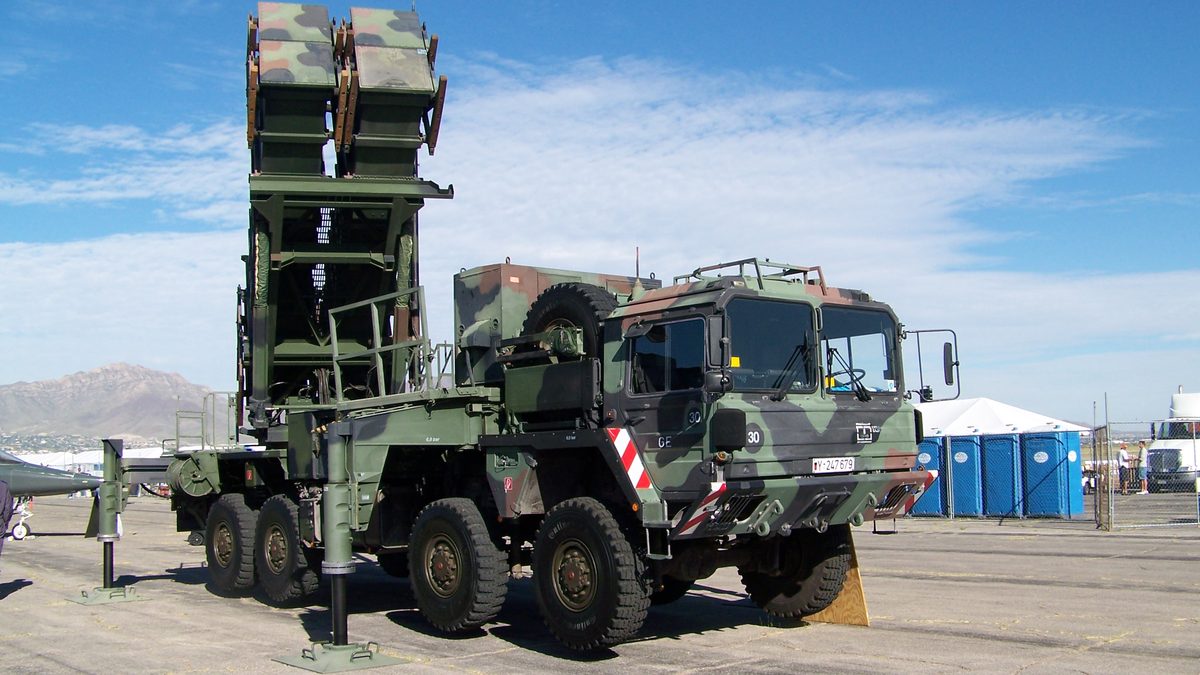
Figure 1. German Patriot launcher with MIM-104 canisters erect. The Schrobenhausen line will produce GEM-T interceptors of the same calibre class for delivery into Ukrainian Patriot fire units. Image: Mark Holloway (CC BY 2.0), via Wikimedia Commons.
Contract, funding and delivery route
On 14 April 2026 RTX published a news release confirming that Raytheon (the RTX business unit responsible for Patriot) has been awarded a $3.7 billion direct commercial sale (DCS) for Patriot Guidance Enhanced Missile–Tactical (GEM-T) interceptors for delivery to Ukraine [1]. The contract is funded as part of the German Federal Ministry of Defence’s 2026 Ukraine support package, which was itself announced through the Ukraine Defence Contact Group meeting in Berlin on 15 April 2026. Germany’s FY2026 Ukraine commitment is stated at €11.5 billion ($13.47 billion) and includes Patriot interceptors, IRIS-T SLM launchers and artillery ammunition [2][3].
RTX confirmed that a significant share of deliveries will originate from the new GEM-T production facility at Schrobenhausen, Bavaria. That line is operated by COMLOG, a 50:50 joint venture between Raytheon and MBDA Deutschland established in 1997 for European Patriot sustainment and now reconfigured as a full-rate interceptor assembly node. Public disclosures have not stated the quantity of rounds covered, the production split between Schrobenhausen and Raytheon’s continental US lines, or the delivery schedule.
The GEM-T round — WOME technical anatomy
The Patriot GEM-T is the latest-production variant of the MIM-104 Patriot interceptor family, and is the Alliance’s principal tactical surface-to-air missile for engaging aircraft, cruise missiles and, crucially, tactical ballistic missiles (TBMs) such as the Russian Iskander-M and SS-21 Tochka. It is distinct from the hit-to-kill PAC-3 MSE and PAC-3 CRI rounds produced by Lockheed Martin, which address the endo-atmospheric ballistic-missile defence envelope.
Key WOME parameters, drawn from open-source technical references: the GEM-T round is approximately 5.3 metres long and 410mm in diameter, with a launch weight of approximately 900kg. It uses a single-stage solid-propellant rocket motor and a 90kg class high-explosive fragmentation warhead initiated by a proximity fuze. Target engagement uses track-via-missile (TVM) guidance slaved to the AN/MPQ-65 radar, with semi-active terminal homing. Engagement range against aerodynamic targets is typically quoted at greater than 70km, and interception altitude envelope extends to approximately 24km. Against TBMs the usable envelope is more constrained and depends on threat re-entry profile [4].
Patriot GEM-T — Key WOME Parameters
Designation: MIM-104F / GEM-T (Guidance Enhanced Missile – Tactical)
Length / diameter / mass: approximately 5.3 m / 410 mm / 900 kg
Warhead: approximately 90 kg HE-FRAG; proximity fuze
Propulsion: single-stage solid rocket motor (HTPB composite)
Guidance: track-via-missile (TVM) + semi-active terminal homing; slaved to AN/MPQ-65 radar
Target envelope: aircraft, cruise missiles, tactical ballistic missiles
Range: >70 km (aerodynamic targets)
Altitude envelope: up to approximately 24 km
Hazard Division (all-up round): 1.1D (Class 1); rocket motor HD 1.3; warhead HD 1.1D
Quality assurance: AQAP-2110 Edition D; STANAG 4107 Edition 11 GQA
Why the Schrobenhausen route matters for the Alliance
Patriot production capacity has been the single most constrained Alliance air-defence line since 2022. Raytheon published annual output in the single hundreds of GEM-T-class rounds as recently as 2023, with an announced capacity upgrade path to 650 rounds per year by 2028. European national stockpiles have been drawn down substantially through transfers to Ukraine, Germany alone has donated or facilitated the donation of three complete Patriot fire units and associated interceptor inventory since 2022. Schrobenhausen’s full-rate activation is the first production-side response at scale, and materially changes the capacity picture [1][3].
Three Alliance-level implications follow. First, the contract eases the allocation tension between US Army GEM-T requirements, European national replenishment and Ukraine deliveries. Second, the COMLOG arrangement gives the European industrial base a substantive stake in Patriot sustainment that has not existed at this scale before. A precedent that European Sky Shield Initiative (ESSI) signatories will note. Third, Germany’s willingness to underwrite the $3.7 billion DCS for Ukraine-destined rounds, rather than route it through US Foreign Military Sales (FMS), signals a pragmatic channel preference that may recur for other high-priority munitions lines.
Implications for UK WOME practitioners
The UK operates no Patriot battery and is therefore not a direct recipient of GEM-T output. Indirect implications are nonetheless material. First, CAMM and Sea Ceptor stockpile replenishment under the Strategic Defence Review 2025 will benefit from reduced competition for insensitive munitions qualification testing capacity in Europe as Schrobenhausen absorbs its own testing burden internally. Second, AQAP-2110 Edition D QA oversight for European-produced Patriot rounds will be performed by Germany’s Bundesamt für Ausrüstung, Informationstechnik und Nutzung der Bundeswehr (BAAINBw) rather than the US Defense Contract Management Agency (DCMA); this is the first significant GEM-T GQA shift and sets a precedent for future European production of US-designed munitions. Third, ESSI (which the UK is not a signatory to) becomes more credible as a procurement instrument once Schrobenhausen is sustaining the interceptor side as well as the IRIS-T SLM launcher side.
Data gaps remain significant: interceptor quantity covered by the $3.7bn, the production split between Schrobenhausen and US lines, the delivery schedule, and the allocation split between Ukrainian transfer and replenishment of national donor stockpiles are all undisclosed. Open-source tracking of COMLOG output against the published capacity target will be a key indicator through 2026–2027.
References & Authorities
- [1] RTX News (14 April 2026): “RTX’s Raytheon to deliver Patriot interceptors to Ukraine.” rtx.com
- [2] NATO News (15 April 2026): “NATO Secretary General welcomes additional aid at Ukraine Defence Contact Group meeting.” nato.int
- [3] Aviation Week (14 April 2026): “Germany To Finance Ukrainian Patriot Interceptor, IRIS-T Deliveries.” aviationweek.com
- [4] RTX (product description): Patriot air and missile defense system. rtx.com/raytheon
- [5] NATO STANAG 4107 Edition 11: Mutual Acceptance of Government Quality Assurance and Usage of the Allied Quality Assurance Publications (AQAP). [Available through national defence authorities]