Australia Test-Fires First Domestically-Assembled GMLRS at Woomera: A 4,000-per-Year Indo-Pacific Production Node
Lockheed Martin’s Port Wakefield facility completed first-article acceptance of a Guided Multiple Launch Rocket System round at the Woomera Test Range on 9 April 2026, confirming Australia as the second GMLRS production site outside the United States. The bilateral agreement envisages up to 4,000 rockets per year and is timed to reinforce Alliance stockpiles as Camden, Arkansas output remains fully committed to US Army and PURL demand.
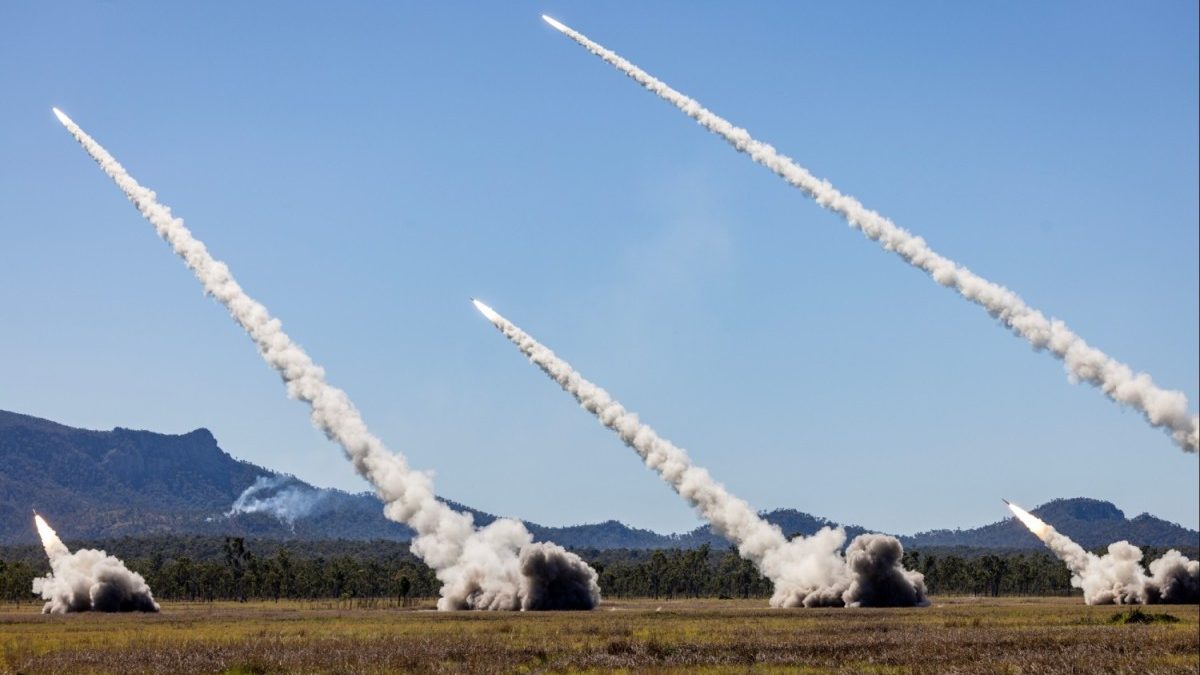
Figure 1. HIMARS live-fire on Australian territory, 2025. The Port Wakefield assembly line will feed similar M31-series rounds through Australian Army HIMARS launchers from 2026. Image: CPL Michael Rogers / U.S. Army (public domain), via Wikimedia Commons.
What was fired and what it activates
On 9 April 2026 the Australian Army test-fired, at the Woomera Test Range in South Australia, the first Guided Multiple Launch Rocket System (GMLRS) round assembled at Lockheed Martin Australia’s Port Wakefield facility. The firing was announced publicly on 14 April 2026 through a combined Australian Department of Defence and Lockheed Martin release, confirming first-article acceptance (FAA) of Australian-assembled M31-series rounds against the US Army qualification baseline [1][2].
Port Wakefield, opened in December 2025, is the second GMLRS production node outside the Camden, Arkansas plant. Under the bilateral Australian–United States Guided Weapons and Explosive Ordnance (GWEO) agreement, the facility is planned to produce up to 4,000 rockets per year once full-rate production is achieved. A volume that would place it at roughly one third of current global GMLRS output. Production ramp is scheduled across 2026, with an initial low-rate tranche feeding Australian Army HIMARS units (42 launchers on order) and subsequent allocations routed through Lockheed Martin’s integrated global supply chain.
Technical anatomy of the round
The GMLRS family, designated M30/M31 in the US classification system, is a 227mm guided rocket fired from the M270 MLRS and M142 HIMARS platforms. The baseline M31 unitary round carries a 200lb (approximately 90kg) unitary high-explosive warhead, typically fitted with the M932 multi-option fuze for height-of-burst, point-detonation or delay functions. Circular error probable is publicly stated at better than 10 metres at full range, dependent on GPS-aided inertial guidance. Effective range is approximately 70 kilometres for the baseline nature and up to 150 kilometres (approximately 93 miles) for the Extended-Range GMLRS (ER-GMLRS) variant now entering service [3].
For WOME practitioners the material points are the explosive fill and hazard classification. GMLRS warheads are loaded with PBXN-109 (an RDX-based polymer-bonded explosive) or equivalent insensitive high explosive (IHE), with UN Hazard Division 1.2.1 assigned to the all-up round. The rocket motor propellant is a composite HTPB formulation, Hazard Division 1.3. For Australian Defence Munitions and host-nation storage authorities, these classifications determine AASTP-1 Edition C quantity-distance arcs for transit storage at Port Wakefield itself, for rail and road movement to Woomera, and for any forward holdings at RAAF Base Edinburgh or the ADF’s eastern depots.
GMLRS M31 Unitary — Key WOME Parameters
Calibre and mass: 227mm rocket; all-up round approximately 307kg
Warhead: 200lb (approximately 90kg) unitary HE; PBXN-109 / IHE fill
Fuze: M932 multi-option (PD, delay, proximity, height-of-burst)
Guidance: GPS-aided inertial (SAASM/M-code); CEP <10m
Range: M31 approximately 70km; ER-GMLRS up to 150km
Hazard Division (warhead): 1.2.1 (UN Class 1); Compatibility Group E
Rocket motor: HTPB composite propellant; Hazard Division 1.3
Launch platforms: M270 MLRS, M142 HIMARS (six rounds per pod)
Why the 4,000-per-year figure matters
Published Lockheed Martin production data placed Camden, Arkansas output at approximately 10,000 GMLRS rounds per year as of late 2025, with a capacity upgrade programme aiming at 14,000 rounds annually from 2027. A fully-ramped Port Wakefield line contributing 4,000 rounds per year would lift total Alliance GMLRS output by roughly one third and provide the first genuinely distributed rocket artillery production base since the M270 entered service in 1983 [2].
The Indo-Pacific geography is deliberate. Current GMLRS shipments from Camden to Australia, Japan, the Republic of Korea and Taiwan must cross the Pacific on limited ammunition-certified shipping routes, with freight-forwarding constraints significantly extending delivery lead times. Port Wakefield removes that bottleneck for Indo-Pacific partners while allowing Camden output to continue to be routed almost entirely to US Army, Prioritised Ukraine Requirements List (PURL) and European FMS commitments.
Implications for UK and Alliance WOME practitioners
Three implications warrant attention. First, the UK’s own M270 fleet (a growing priority under the Strategic Defence Review 2025) will benefit indirectly: Camden output previously contested between US and UK requirements now faces a slightly easier allocation picture. Second, AASTP-3 hazard classification approvals for Australian-assembled rounds will need to be recognised by all receiving nations; Australian Defence Munitions is expected to rely on US Army joint certification rather than initiate a parallel qualification path, which is the only plausible route to preserving interchangeability. Third, the bilateral GWEO model (host-nation assembly of US-designed guided munitions under licence) is a template the UK Defence Support Organisation is watching closely for the Pacific Point Defence, SPEAR-3 and other UK-assembled NATO munitions programmes.
Data gaps remain. The split between Australian-consumed and export-routed rounds has not been disclosed. Initial low-rate production volumes for 2026 have not been quantified. Whether Port Wakefield will produce ER-GMLRS variants or only the baseline M31 is not yet public. These parameters will determine whether the facility is a genuine Alliance-wide production node or primarily an Australian national capability with surplus capacity.
References & Authorities
- [1] Defense News (14 April 2026): “Australia touts first GMLRS artillery rocket assembled Down Under.” defensenews.com
- [2] Defence-Blog (14 April 2026): “Australia test-fires first homemade GMLRS missile from HIMARS.” defence-blog.com
- [3] Lockheed Martin (product description): Guided Multiple Launch Rocket System (GMLRS). lockheedmartin.com
- [4] Australian Department of Defence: Guided Weapons and Explosive Ordnance (GWEO) Enterprise. defence.gov.au
- [5] NATO AASTP-1 Edition C: Manual of NATO Safety Principles for the Storage of Military Ammunition and Explosives. [Available through national WOME authorities]