XM204 Terrain-Shaping Munition: Explosively Formed Penetrator Submunition System Fielded to US Army Europe
Terrain-shaping munitions are commonly framed as next-generation landmines — but the XM204’s autonomous EFP submunitions, self-destruct compliance, and sensor-activated engagement represent a fundamentally different ordnance category with distinct EOD and ERW implications.
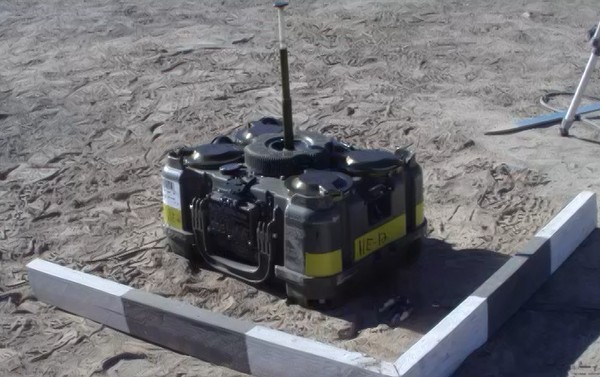
Technical Summary
The XM204 terrain-shaping munition, developed by Textron Systems of Wilmington, Massachusetts, is an anti-vehicle system designed to deny or delay armoured movement through autonomous area denial. Unlike conventional anti-tank mines that require direct vehicle contact for initiation, the XM204 employs a dispenser launcher module that autonomously deploys multiple submunitions, each equipped with onboard sensors for vehicle detection and an Explosively Formed Penetrator (EFP) warhead for target defeat.
The EFP mechanism operates on a well-established WOME principle: a concave metallic liner — typically copper or tantalum — is positioned at the open end of an explosive charge. Upon detonation, the expanding detonation wave plastically deforms the liner, collapsing it inward and projecting it forward as a high-velocity, aerodynamically stable penetrator slug. Unlike shaped-charge jets, which lose coherence beyond a few calibres of standoff, EFPs maintain their penetration capability at distances of tens to hundreds of metres, making them suited to standoff engagement of vehicle underbellies and roof armour.
Each XM204 submunition incorporates onboard sensors — the specific modality is not confirmed in open sources, though seismic, magnetic, and infrared detection are the standard approaches for this class of munition. The sensor suite discriminates between target signatures and non-combatant activity, enabling autonomous engagement without operator intervention after emplacement. The system includes a self-destruct timer that renders the munition inert after a pre-set period, addressing explosive remnants of war (ERW) risk and aligning with US anti-personnel landmine policy obligations. Tamper-resistant features and armed/safe indicators provide visual confirmation of fuze state for personnel operating in proximity to emplaced munitions.
Analysis of Effects
Penetration and Engagement Characteristics
EFP warheads in the class likely employed by the XM204 typically achieve penetration of 100–150 mm of Rolled Homogeneous Armour (RHA) equivalent at standoff distances. The top-attack engagement profile exploits the thinnest armour surface on most armoured fighting vehicles — roof plates on Infantry Fighting Vehicles (IFVs) and Armoured Personnel Carriers (APCs) are typically 15–40 mm, well within EFP defeat capability. Even Main Battle Tanks (MBTs), which carry substantially thicker frontal and turret armour, present vulnerable roof sections to top-attack munitions.
Beyond the primary EFP penetrator, secondary fragmentation effects from the submunition casing and dispenser module create a hazard radius around each engagement. Personnel in the open within the fragmentation envelope are at risk from casing fragments propelled by the detonation event. This fragmentation hazard is a relevant factor for both tactical employment planning and post-conflict clearance operations.
Hazard Classification Considerations
Classification of the XM204 under STANAG 4123 and AASTP-3 depends on the packaging configuration, fuze state, and the explosive content of both the individual submunitions and the dispenser module. In the packaged-for-transport configuration with fuzes unarmed, the system would likely fall under Hazard Division 1.1 or 1.2 depending on whether the submunition casings provide sufficient confinement to present a mass explosion hazard or a projection hazard. Compatibility Group assignment requires confirmation of the specific explosive fill and fuze design — data that is not currently available in open sources.
Personnel and Safety Considerations
EOD and UXO Hazard
The self-destruct timer is the primary risk mitigation for post-conflict ERW contamination, but self-destruct mechanisms have known failure rates. Any XM204 submunition where the self-destruct timer fails to function becomes a sensor-activated UXO item — armed, with an intact EFP warhead, and capable of autonomous initiation upon detection of a vehicle signature. This presents a qualitatively different UXO hazard from conventional mines or unexploded projectiles: the munition is actively seeking a target, not passively awaiting a contact event.
Render Safe Procedures (RSP) for sensor-activated munitions require specific approach protocols. Standard EOD approaches that rely on the assumption of a mechanically fuzed, contact-initiated device are not applicable. Operators must account for the sensor detection envelope and ensure that approach vectors, equipment signatures, and electromagnetic emissions do not trigger autonomous engagement. The armed/safe indicators provide visual confirmation of fuze state, which is operationally valuable for EOD teams conducting area clearance, provided the indicators remain readable after environmental exposure.
Cordon and NEQ Considerations
Cordon distances for emplaced or failed XM204 munitions depend on the net explosive quantity (NEQ) per submunition. This figure has not been published in open sources. Without confirmed NEQ data, EOD teams and range safety officers cannot calculate precise Quantity-Distance (QD) separations per AASTP-1 or national equivalents. This represents a practical gap for any allied force operating alongside US units employing the XM204 in European theatre.
Data Gaps
- NEQ per submunition — not published in open sources; required for QD calculations and EOD cordon planning
- Specific explosive fill — not confirmed; likely a polymer-bonded explosive (PBXN-series or similar insensitive fill)
- Submunition count per dispenser — exact number not disclosed in unclassified material
- Sensor detection range and discrimination criteria — modality (seismic/magnetic/IR) and effective detection radius not public
- Self-destruct timer duration — pre-set period not published; critical for ERW risk assessment and area clearance timelines
- Hazard Division and Compatibility Group — formal classification under STANAG 4123 not available in open sources
References & Source Evaluation
Source evaluation follows NATO STANAG 2022 Reliability/Accuracy ratings. This analysis is AI-assisted and based entirely on open-source material. It does not represent the views of any government, military service, or defence organisation.
AI-assisted technical assessment based on open-source material. Not a formal intelligence product.
ISC Commentary
The fielding of the XM204 to 2nd Cavalry Regiment at Rose Barracks, Vilseck, marks the first operational deployment of a sensor-activated, EFP-based terrain-shaping munition to the European theatre. The Urgent Materiel Release approved on 4 December 2025 — following First Article Testing completed in April 2025 — reflects the tempo of demand for area-denial capabilities in the current threat environment.
From a WOME perspective, the XM204 sits in an uncomfortable classification gap. It is not a mine in the conventional sense — it employs standoff engagement, autonomous target discrimination, and self-destruct compliance. It is not a loitering munition — it is emplaced, not launched. Current hazard classification frameworks under STANAG 4123 and storage/transport standards under AASTP-3 were not designed with this hybrid category in mind. Allied nations operating alongside US forces employing the XM204 will need to resolve classification, storage, and EOD procedural questions that the existing framework does not cleanly answer.
The absence of published NEQ data is a practical problem, not merely an academic one. Without it, allied EOD teams cannot calculate cordon distances, range safety officers cannot determine QD separations for temporary field storage, and logistics planners cannot confirm compatibility group assignments for mixed-load transport. These are routine WOME planning requirements that depend on data the manufacturer and programme office have not yet released to the broader coalition.