Hormuz Mine Clearance: Pentagon Assesses Six-Month Timeline as IRGCN Mine Inventory Remains Uncharted
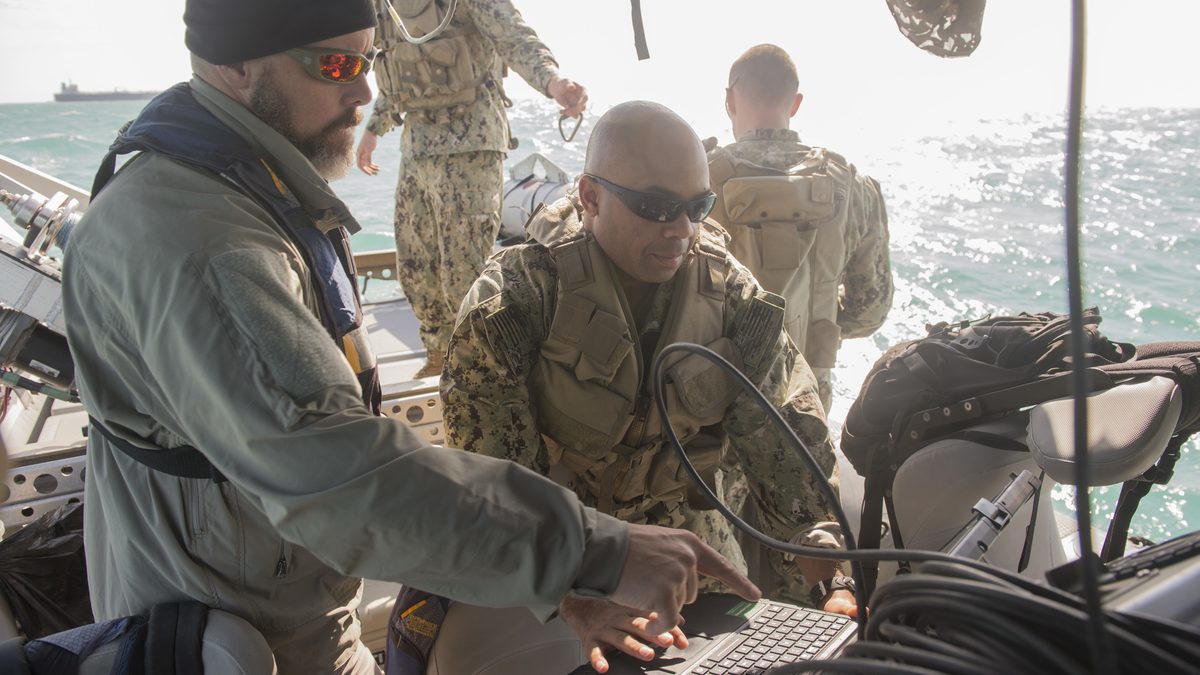
Mark 18 Mod 2 Kingfish UUV operations, CTG-56.1, Persian Gulf. Department of Defense contractor Chris Halford (left) and Aerographer’s Mate 2nd Class Hal Walls, both assigned to Commander, Task Group 56.1, send orders to a Mk 18 Mod 2 Kingfish unmanned underwater vehicle from a computer console aboard a rigid-hull inflatable boat. Image: U.S. Navy / Petty Officer 1st Class Christopher Blachly — Public Domain (via DVIDS 1688657).
Technical Summary
The United States Pentagon briefed members of the House Armed Services Committee on 22 April 2026 that clearing Iranian naval mines from the Strait of Hormuz (SoH) could require up to six months of dedicated mine countermeasures (MCM) operations. The assessment, first reported by the Washington Post and subsequently disputed in part by Pentagon spokespersons, underscores the severity of the Islamic Revolutionary Guard Corps Navy (IRGCN) mining effort and the material MCM capability gaps facing U.S. Central Command (USCENTCOM). No clearance operations are planned to commence until hostilities with Iran formally conclude. Iran is estimated to have placed between 20 and upwards of 6,000 naval mines across the strait and adjacent waters, with deployment reportedly conducted without systematic positional recording. A critical intelligence gap for any clearance operation.
Iranian Mine Systems: Technical Threat Assessment
| Designation | Type | Mass (approx.) | Activation | Depth Range | Threat Level |
|---|---|---|---|---|---|
| Mahan 3 | Moored contact / acoustic | 300 kg | Acoustic sensor (~3 m proximity); effective against non-magnetic hulls | Surface to mid-water column | HIGH — floats below surface, difficult radar acquisition |
| Maham-2 | Bottom influence mine | Not confirmed | Acoustic / magnetic / pressure signature (tri-influence) | Seafloor | HIGH — partially buried by sedimentation; sonar signature degraded |
| Maham 7 | Bottom mine | 220 kg | Unknown (likely influence) | 10–300 ft (3–91 m) | MODERATE–HIGH — targets smaller vessels and landing craft; export-catalogue system |
| EM-52 (Chinese origin) | Rocket mine (moored) | Not confirmed | Acoustic / magnetic; deploys rocket upward on detection | Up to 200 m | CRITICAL — kinetic warhead; attacks keel; no countermeasure by conventional sweep |
| M-08 pattern | Moored contact (legacy) | Not confirmed | Physical hull contact (horns) | Variable; moored | LOW–MODERATE — well-understood; conventional wire sweep effective |
The EM-52 rocket mine (a Chinese-origin system reportedly within the IRGCN inventory) represents the highest-complexity threat for clearance operators. The mine remains moored at depth, releases a rocket-propelled warhead on acoustic or magnetic detection, and attacks from below the keel. Conventional mechanical and magnetic sweeps are ineffective; the system requires individual identification and neutralisation by remotely operated vehicle (ROV) or dedicated mine neutralisation system (MNS). Depth ratings to 200 m extend the threat well beyond the shallow-water corridor where commercial shipping concentrates.
The Mahan 3 presents a separate detection challenge. Operating in the sub-surface water column rather than on the seabed, it is not reliably detected by bottom-scan sonar. Strong tidal currents in the SoH (which narrows to approximately 21 nautical miles at its tightest point) combined with heavy commercial vessel traffic and acoustic interference, further degrade classification performance for both hull-mounted sonars (AN/SQQ-89 suite on Arleigh Burke-class destroyers) and towed arrays.
Analysis: The Positional Intelligence Gap
Perhaps the most operationally significant finding from reporting on 22–23 April is the assertion that IRGCN minelaying was conducted without systematic positional recording. Small, fast craft operating under low-light conditions employed a mixture of commercial GPS receivers and manual bearings; in some cases, mine positions were not logged at all. If accurate, this eliminates any prospect of receiving an accurate Iranian mine chart under a ceasefire or armistice arrangement; a mechanism that historically accelerates post-conflict clearance operations substantially.
The consequence for USCENTCOM MCM planners is a full-area search requirement across the IRGCN-declared “danger zone” of approximately 1,400 km², rather than a targeted investigation of known positions. With bottom sediment accumulation rates in the SoH capable of partially burying influence mines within weeks of deployment, the detection probability per sweep pass will degrade progressively. Every month of delay increases clearance difficulty.
MCM Capability: Material Shortfalls
USCENTCOM faces the Hormuz clearance task at a point of historically low dedicated MCM inventory. The U.S. Navy decommissioned its final four Avenger-class (MCM-1) dedicated minesweepers earlier this year and phased out the MH-53E Sea Dragon helicopter, which provided airborne MCM (AMCM) capability via the AN/AQS-14 and AN/AQS-24 towed sonar systems. Regional availability rests on three Independence-class Littoral Combat Ships (LCS) configured for the mine countermeasures mission module (MCM MM), with at least two reportedly deployed outside the Gulf region.
Current MCM assets operating in the SoH include Arleigh Burke-class destroyers USS Frank E. Peterson and USS Michael Murphy (both under Commander Task Force 68), deploying Mk 18 family unmanned underwater vehicles (UUVs) for area survey. The Mk 18 Mod 2 Kingfish provides high-resolution synthetic aperture sonar imagery at ranges adequate for mine detection; however, classification accuracy in the complex SoH bottom environment will require analyst review of substantial sonar data before safe transit corridors can be designated.
The Pentagon disputed characterisation of the six-month figure as a definitive operational assessment, describing media reporting as “cherry-picking” from a broader Congressional briefing. The denial notwithstanding, the material and environmental factors underpinning a prolonged clearance timeline are independently verifiable and consistent with the technical complexity described above.
Personnel and Safety Considerations
MCM operations in the SoH carry elevated risk to clearance personnel and platforms. Standing orders should treat any uncharted bottom contact within the IRGCN danger zone as a potential mine pending positive classification. Mk 18 UUV operators should apply conservative re-inspection intervals given sediment mobility. Any mine of EM-52 type should be treated as a downed aircraft equivalent (controlled access, dedicated neutralisation system, no mechanical sweep) and reported immediately to USCENTCOM Intelligence Fusion Cell for cross-referencing against IRGCN export and production data.
Surface and subsurface transits through the SoH in advance of formal clearance certification should apply full magnetic and acoustic quietening protocols. Vessels with high magnetic signatures (poorly degaussed hulls) face elevated risk from Maham-2 and Maham-7 influence mines. The Mahan 3 acoustic activation threshold of approximately 3 m proximity provides limited margin for evasion at normal transit speeds.
Data Gaps
DATA GAP: Confirmed total mine count placed by IRGCN — open-source estimates range from 20 (House Armed Services Committee briefing figure) to 2,000–6,000 (broader stockpile/deployment estimate). Discrepancy may reflect different definitions of “active deployment in waterway” vs. total inventory committed. DATA GAP: Confirmed presence of EM-52 in IRGCN active deployment — credibly assessed but not officially confirmed. DATA GAP: Precise danger zone boundaries and bathymetric survey data for current IRGCN mining area. DATA GAP: Degradation state of deployed mines — time-in-water figures relevant to reliability and handling safety. DATA GAP: Any partial positional records held by IRGCN that may become available under a future negotiated settlement.
AI-assisted technical assessment based on open-source material. Not a formal intelligence product. Sources: Washington Post (22 Apr 2026), Al Jazeera (13 Apr 2026), Maritime Executive, Army Recognition, Covert Shores Iranian naval mines guide.