Iranian Ballistic Missile Cluster Warheads — Submunition Dispersal Mechanics and Explosive Remnants of War Hazard
Iran’s cluster warheads are widely characterised as ‘primitive’ — but the documented 27 km dispersal footprint, high dud rates, and limited technical data on bomblet fuzing create an ERW contamination hazard that defies the simplicity of the delivery mechanism.
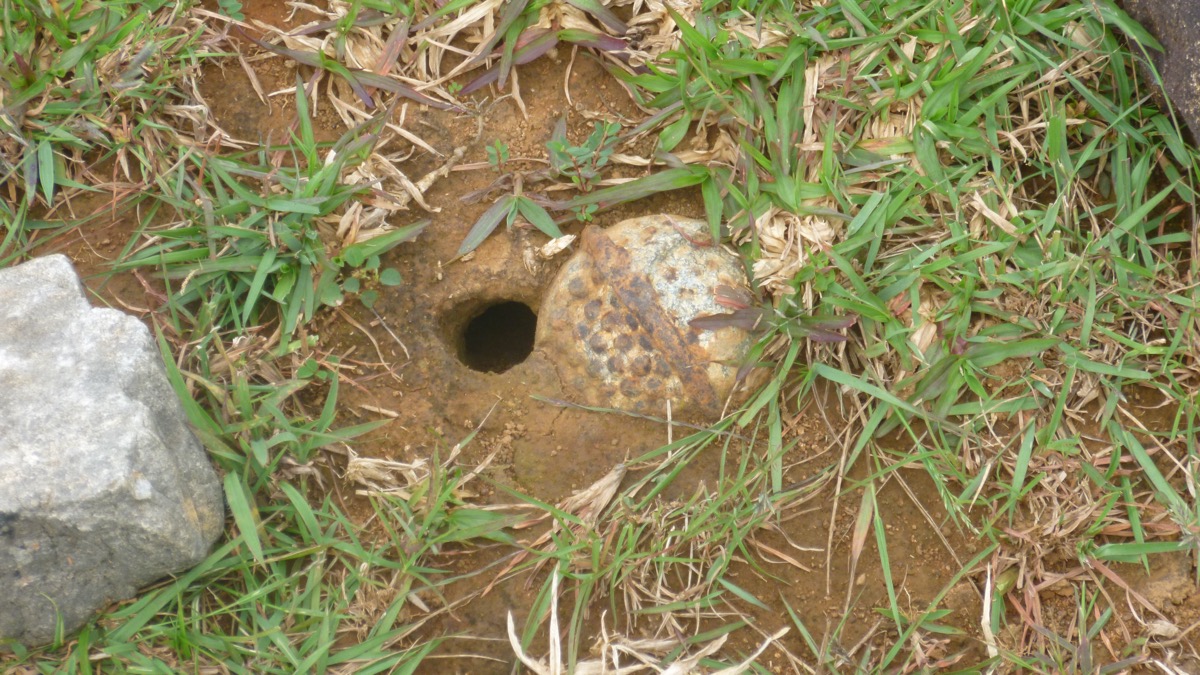
Technical Summary
Iran has integrated cluster warheads into its medium- and intermediate-range ballistic missile inventory, modifying re-entry vehicles to carry submunition payloads in place of unitary high-explosive warheads. The capability was first demonstrated in June 2025 and by 2026 has become a deliberate and integrated element of Iranian strike operations, with approximately 70% of missile launches now carrying cluster warheads.
The principal delivery systems are the Khorramshahr (carrying up to 80 bomblets), alongside the Ghadr and Emad families, which typically carry approximately 24 bomblets each. The dispersal mechanism is assessed as spring-ejection at approximately 7 km altitude: the re-entry vehicle separates and a mechanical spring system releases the submunition payload into the atmosphere, allowing individual bomblets to follow ballistic trajectories to the ground across a wide dispersal footprint.
Two submunition variants have been identified in open-source reporting. The heavier variant has an assessed total weight of approximately 20 kg with an explosive fill of around 4 kg. The lighter variant carries an estimated 2–3 kg explosive fill. Both are assessed as HE-FRAG (high-explosive fragmentation) designs, producing lethal fragments through either pre-formed or natural fragmentation of the casing upon detonation.
Net explosive quantity (NEQ) per submunition is estimated at 2–4 kg TNT equivalent. For the Khorramshahr variant carrying 80 bomblets at the upper fill estimate, this represents approximately 320 kg total NEQ dispersed across a wide area — a fundamentally different hazard profile from a unitary warhead, where the same explosive mass would detonate at a single point of impact.
Analysis of Effects
The defining characteristic of the cluster warhead is that it converts a point-effect weapon into an area-effect weapon. Open-source reporting documents one missile dispersing ordnance across a 27 km stretch from Peduel to Holon — a dispersal footprint that indicates wide circular error probable (CEP) at the individual submunition level, even if the parent missile achieves reasonable accuracy to the target area.
Fragmentation effects from individual bomblets are reported to produce high-velocity fragments lethal “for dozens of metres.” Penetration effects have been documented, with one crater penetrating a basement ceiling to a depth of 15 cm into reinforced concrete — indicating significant kinetic energy at impact even from relatively small submunitions.
| Missile Type | Bomblets | Est. Fill per Bomblet | Est. Total NEQ |
|---|---|---|---|
| Khorramshahr | Up to 80 | ~4 kg | ~320 kg |
| Ghadr / Emad | ~24 | 2–4 kg | 48–96 kg |
In the most recent documented engagement, 11 cluster missiles penetrated Israeli air defences out of approximately 100+ launched. The area-effect nature of these weapons means that even a small number of successful penetrations creates widespread contamination across civilian and military areas.
Personnel and Safety Considerations
The ERW and UXO hazard created by cluster warhead strikes is significant and demands immediate attention from WOME personnel involved in clearance operations. High dud rates — historically 5–30% for cluster munitions globally — mean that a single Khorramshahr strike could leave between 4 and 24 unexploded bomblets across the dispersal footprint. Across multiple strikes, the cumulative contamination is substantial.
EOD response to unexploded Iranian submunitions presents acute challenges. The fuze state of duds is likely armed, having completed the arming sequence during descent but failed to function on impact. Approach should be with extreme caution. The lack of published technical documentation on Iranian bomblet designs means that standard render-safe procedures cannot be confirmed against the specific fuzing mechanisms in use. Whether bomblets contain anti-handling devices — presenting a booby-trap risk to EOD operators — is not known from open sources.
Submunition identification in the field is complicated by the limited availability of recognition data. Unlike well-documented NATO or Soviet-legacy submunitions, Iranian bomblet designs have not been catalogued in standard EOD reference publications. Field operators may encounter items they cannot positively identify, requiring precautionary treatment as worst-case hazard.
Recommended cordon distances should be a minimum of 100 m CED (clearance evacuation distance) per submunition, based on the estimated NEQ of 2–4 kg. Public warning protocols equivalent to those used in historical cluster munition contamination scenarios are required, particularly in areas where submunitions have fallen in civilian environments.
Data Gaps
- Explosive fill composition: Not confirmed in open sources. Likely TNT or a Composition B analogue, but could be an Iranian domestic formulation.
- Fuzing mechanism: Not confirmed. Impact fuze is most probable, but multi-function (impact/proximity/delay) cannot be ruled out.
- Exact dud rate: Not published. Historical cluster munition dud rates range from 5% to 30% depending on design, age, and terrain.
- Casing material and fragmentation pattern: Not documented. Pre-formed fragmentation versus natural fragmentation affects both lethality radius and EOD recognition.
- Anti-handling devices: Unknown. The presence of any anti-disturbance mechanism would significantly elevate the risk to EOD personnel.
References & Source Evaluation
Source evaluation follows NATO STANAG 2022 Reliability/Accuracy ratings. This analysis is AI-assisted and based entirely on open-source material. It does not represent the views of any government, military service, or defence organisation.
This article was produced with AI assistance using open-source material. All facts have been verified against the cited sources. The analysis and commentary represent ISC Defence Intelligence editorial assessment.
ISC Commentary
The characterisation of Iranian cluster warheads as ‘primitive’ is technically accurate in terms of the delivery mechanism — spring ejection at altitude is not sophisticated by modern standards. But sophistication is irrelevant to the ERW hazard on the ground. A 27 km dispersal footprint littered with unexploded bomblets of uncertain fuze state and undocumented design creates exactly the kind of contamination problem that persists for years after the strikes themselves.
The data gaps are the real concern. Specific explosive fill, fuzing mechanism, anti-handling capability, dud rate, and casing fragmentation characteristics are all unconfirmed in open sources. EOD operators are being asked to approach and render safe items for which no technical data pack exists. That is not a theoretical risk — it is the operational reality in any area subjected to Iranian cluster missile strikes.
For the WOME community, this represents a requirement for urgent technical exploitation of recovered items and rapid dissemination of recognition and render-safe data through appropriate channels.