France’s Leopard Concession: Why Paris Is Studying a German Chassis for the First Time
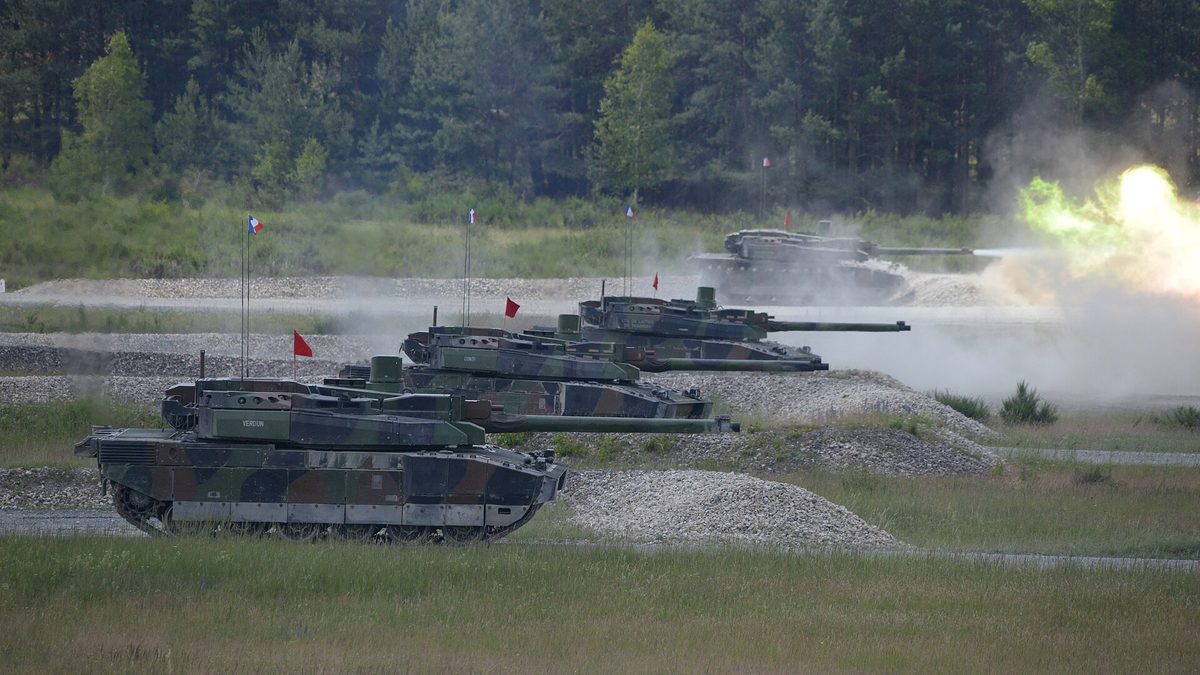
The Leclerc has been the symbol of French armoured sovereignty for more than three decades — but at a parliamentary hearing on 8 April 2026, Armed Forces Minister Catherine Vautrin confirmed Paris is studying a German Leopard-derived chassis as the basis for an interim Main Battle Tank. The decision, presented as engineering pragmatism in the face of the decade-late MGCS programme, is in fact one of the most consequential industrial concessions France has made in modern defence policy.
What Vautrin Actually Said
On 8 April 2026, French Armed Forces Minister Catherine Vautrin appeared before the National Assembly’s defence committee to present the government’s updated Military Programming Law (Loi de Programmation Militaire, LPM) for 2024–2030, including a proposed additional €36 billion (USD 42 billion) in defence spending across the four-year window. Within that broader package, the minister disclosed that France is now actively studying an interim Main Battle Tank to bridge the gap between the planned retirement of the Leclerc fleet and the entry into service of the Franco-German Main Ground Combat System (MGCS).
The minister’s key statements, captured by Defense News and corroborated across French and international defence press:
On the technical configuration, Vautrin confirmed the most likely option is a hybrid build — a KNDS Germany platform paired with a KNDS France turret. She emphasised that “the turret will be French in any case,” and noted that discussions between France’s Direction Générale de l’Armement (DGA) and prospective manufacturers are “just getting started.” The minister attributed the underlying MGCS delay to Germany’s parallel pursuit of its own national interim solution — the Leopard 3 programme — which she said had pushed the joint project “decades behind schedule.”
The MGCS Programme: A Decade Late
The Main Ground Combat System was launched in 2017 as a Franco-German effort to replace both the Leopard 2 and the Leclerc with a clean-sheet next-generation combat platform. The intent was to enter service in the 2030s. By April 2025, KNDS Deutschland, KNDS France, Rheinmetall, and Thales had finally established the MGCS Project Company (MPC) in Cologne as the programme’s industrial prime — eight years after launch. But MGCS remains a technology demonstration programme. There is no production contract, no agreed main gun calibre, no fixed unit price, and no firm delivery date.
Vautrin’s parliamentary intervention put a number on what defence analysts have suspected for months: MGCS is roughly ten years behind schedule, with operational delivery now slipping toward the early 2040s. The Leclerc reaches the end of its service life around 2037–2038. France is therefore facing a capability gap of three to seven years during which its armoured forces would have no modern Main Battle Tank in service unless an interim solution is fielded.
The parallels with Italy’s Ariete situation are instructive. Italy faced an analogous gap, withdrew from MGCS, and signed bilaterally with Rheinmetall for the KF51 Panther. Italy is now several years ahead of France in addressing its armoured renewal — a fact that will not have been lost on French defence planners watching the Leonardo Rheinmetall Military Vehicles (LRMV) joint venture take shape.
The Three Options on the DGA Table
Reporting by Defense News, The Defense Post, and the French specialist publication MetaDefense indicates that the DGA is examining three distinct configurations:
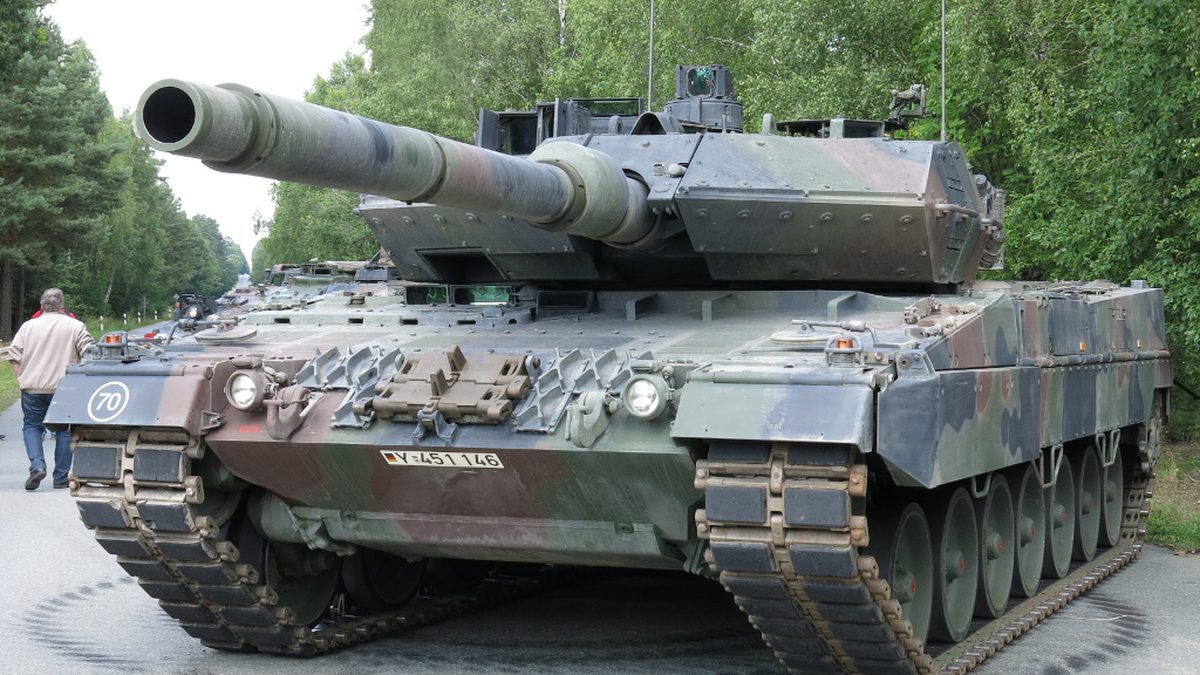
Option 1 — Hybrid Build (preferred). A KNDS Germany Leopard-derived chassis fitted with a French-designed KNDS France turret. This is the option Vautrin appears to be steering toward. The technical foundation already exists: the Enhanced Main Battle Tank Ascalon Demonstrator Turret (EMBT-ADT 140) demonstrator, unveiled by KNDS at Eurosatory 2024, mates a Leopard 2A7 hull with a remotely-operated turret carrying the 140 mm ASCALON gun. The hybrid approach delivers the fastest path to production while preserving French sovereignty over the most strategically significant subsystem — the gun, fire control, and battle management.
Option 2 — Fully Domestic. A French-only solution would centre on the Leclerc Evolution unveiled by KNDS France at Eurosatory 2024 — an upgraded Leclerc carrying the ASCALON gun in the modular ARX30 turret with Trophy Active Protection System (APS). KNDS France has reportedly been in discussions with several export customers about the Leclerc Evolution, but the absence of a domestic French order has weakened its commercial case. A French-only path would assert sovereignty but extends the timeline and increases per-unit cost.
Option 3 — Off-the-shelf Purchase. An outright procurement of approximately 200 Leopard 2 tanks from Germany, with no French industrial content. This is the fastest and cheapest path, but politically the most difficult: it would amount to a direct French acknowledgement that KNDS France cannot deliver an MBT in the required timeframe. Defence press reporting suggests this option is being kept open primarily as negotiating leverage.
The 140 mm ASCALON Question
If France selects the hybrid build, the most consequential downstream decision is the main gun calibre. The EMBT-ADT 140 demonstrator carries the KNDS-developed 140 mm ASCALON (Autoloaded and SCALable OutperformiNg) gun — a smoothbore weapon with a 22-round autoloader, designed from the outset for modular barrel exchange between 120 mm and 140 mm calibres on the same mount. Switching barrels reportedly takes under an hour.
The 140 mm ASCALON would deliver substantially greater armour penetration than any 120 mm gun and would allow France to field a tank with a calibre advantage over every Leopard 2 and Abrams in current NATO service. But it carries the same logistical penalty that Italy explicitly rejected when assessing Rheinmetall’s 130 mm: a French 140 mm round cannot be cross-loaded with allied 120 mm-armed MBTs in the field. The modular barrel system mitigates this by allowing operational reversion to 120 mm, but only as a deliberate pre-deployment choice, not as in-theatre flexibility.
Italy chose interoperability over lethality. France appears to be leaning the other way — toward asserting a national calibre advantage even at the cost of NATO ammunition standardisation. The two decisions, taken six months apart, signal divergent strategic logics within Europe’s two largest continental armoured forces.
The Industrial Logic and the Sovereignty Cost
France has not operated a foreign-built MBT chassis in significant numbers in the modern era. The Leclerc, designed by GIAT Industries (now KNDS France) in the late 1980s and entering service in 1992, was a deliberate national capability decision — an assertion that France would not depend on German or American armour for its heavy ground forces. The Vautrin proposal effectively concedes that this position cannot be sustained for the 2030s window.
The industrial logic is clear. KNDS France’s production line for new-build Leclercs has been closed for more than two decades. Restarting Leclerc Evolution production from scratch would require new tooling, supply chain rebuild, and qualification cycles that would push delivery well beyond the Leclerc retirement date. The Leopard 2 line, by contrast, is in continuous production at KNDS Germany’s Munich and Kassel facilities, with proven export performance and an active spares ecosystem. From a pure industrial-engineering standpoint, the German chassis route delivers earlier, cheaper, and with lower programme risk.
The sovereignty cost is the political dimension. By proposing a French turret on a Leopard-derived chassis, Vautrin is preserving control over the fire control system, command-and-control integration, and SCORPION battle management network — the components that determine how the tank fights. But the platform itself — the hull, powerpack, running gear, and structural protection — would be German. The main gun question is more complicated still: while the proposed French turret would be KNDS France work, any Leopard-derived hull historically comes paired with a Rheinmetall-supplied 120 mm smoothbore. France would either need to design and qualify a new gun within a French turret (a substantial development effort), select the KNDS-developed 140 mm ASCALON for the EMBT-ADT 140 demonstrator, or accept Rheinmetall content in the gun supply chain. For a country whose defence-industrial doctrine has historically privileged platform-level sovereignty, this is a significant rebalancing across multiple subsystems — not just the chassis.
The European Armour Convergence: Rheinmetall as the Common Denominator
Read alongside Italy’s KF51 Panther selection, the French study reveals an emerging European armoured vehicle landscape that no defence ministry would have predicted five years ago. Three of NATO’s four major continental armoured forces are converging on platform architectures in which Rheinmetall is either the prime contractor or a co-prime industrial partner:
- Italy — 380 KF51 Panthers (Rheinmetall prime, with Leonardo’s 120 mm L55 gun on selected vehicles via the LRMV joint venture)
- Germany — Leopard 3 as the national interim, formally a joint KNDS Germany / Rheinmetall programme via the PSM Projekt System & Management joint venture (German Cartel Office approved December 2025)
- France — studying a Leopard-derived chassis with a KNDS France turret, on a platform family in which Rheinmetall has historically supplied the turret and gun
- Hungary — producing KF51 derivatives at Zalaegerszeg via a Rheinmetall joint venture
This is the single most important industrial fact about the current European armoured renewal cycle, and it is rarely stated plainly in defence press coverage. The Leopard 2 itself is not a single-company product: KNDS Germany (formerly KMW) builds the hull and chassis, while Rheinmetall produces the turret and the smoothbore gun. The Leopard 3 programme formalises this co-manufacturing relationship into a structured joint venture. The KF51 Panther is wholly Rheinmetall’s. Either way, Rheinmetall sits at the centre of the production architecture.
The strategic implication for KNDS France is severe. The joint Franco-German holding company was structured around two national prime contractors with parity of capability. If the French interim tank uses a Leopard-derived chassis, KNDS France becomes a turret and electronics specialist supplier within its own national programme — not a platform prime. The MGCS programme, conceived as the unifying European armoured solution that would maintain that parity, has been overtaken by national interim solutions all flowing through the same German industrial ecosystem.
Italy vs France: Why the Same Industrial Family, Two Different Tanks
If the common denominator is Rheinmetall, why are Italy and France ending up with such different end-products? Italy is buying 380 KF51 Panthers — a clean-sheet Rheinmetall design with a 120 mm gun. France is studying a Leopard 2-derived chassis with a French turret, most likely carrying the 140 mm ASCALON gun in an unmanned remote-turret configuration. The divergence is not random. It reflects three distinct sets of constraints — political, industrial, and operational — that pulled each country toward a different point on the Rheinmetall-KNDS Germany product spectrum.
The Three Forcing Functions
Political: Italy withdrew from MGCS discussions in 2020 and was politically free to purchase from Rheinmetall directly. France remains the senior partner in MGCS and cannot openly buy a competitor product (KF51) without admitting the joint programme has failed. Selecting a KNDS Germany Leopard chassis preserves the diplomatic fiction that France is still “within the family.”
Industrial: KNDS France is half of the binational KNDS Group. Going to Rheinmetall’s KF51 would marginalise KNDS France inside its own national programme. A Leopard chassis with a KNDS France turret keeps the French half of KNDS as a meaningful prime contractor. Italy faced no equivalent constraint — Leonardo is not part of KNDS, so partnering with Rheinmetall via the Leonardo Rheinmetall Military Vehicles (LRMV) joint venture was the natural commercial fit.
Operational: Italy needed strategic mobility for Mediterranean and NATO eastern flank deployment — the lighter 59-tonne KF51 Panther wins on transportability. France operates from continental Europe with less weight pressure and prioritises raw lethality over deployability. The 140 mm ASCALON delivers calibre overmatch that the KF51’s 130 mm option (which Italy declined) was supposed to provide.
A Note on the Italian Gun Split
The comparison table below shows Italy fielding two different 120 mm L55 guns across the Panther-IT fleet — 82 tanks with the Leonardo L55 and 50 with the Rheinmetall L55A1. This unusual arrangement is not an accident of procurement. It reflects a deliberate four-way balance between risk management (the Leonardo gun is new; the Rheinmetall gun is combat-proven), industrial work-share (Leonardo gets 62% of gun-armed tanks, Rheinmetall keeps a meaningful 38%, preserving the LRMV balance), export positioning (Leonardo needs a domestic reference customer to market the L55 internationally), and ammunition commonality (both guns fire identical NATO 120 mm rounds, so the logistical penalty of operating two gun types is limited to barrel spares). The split works precisely because both weapons feed off the same ammunition stockpile — an option that disappears the moment any NATO army moves to 140 mm.
Side-by-Side Comparison
| Parameter | Italy — KF51 Panther (Panther-IT) | France — Leopard derivative (likely EMBT-ADT 140 lineage) |
|---|---|---|
| Platform origin | Clean-sheet Rheinmetall design (initial demonstrators on Leopard 2A4 hull; production hull expected to be new-build) | Mature Leopard 2A7/2A8 chassis from KNDS Germany; modified to accept new turret |
| Industrial prime | LRMV joint venture (Leonardo + Rheinmetall, 50:50) | KNDS Germany (chassis) + KNDS France (turret) — same KNDS Group, no Rheinmetall prime role |
| Main gun | 120 mm L55 (Leonardo, 82 tanks) + 120 mm L55A1 (Rheinmetall, 50 tanks) | 140 mm ASCALON (KNDS) with modular barrel allowing 120 mm reversion in <1 hr |
| Calibre vs NATO | Full NATO 120 mm interoperability | 140 mm cannot cross-load with allied 120 mm units (modular reversion possible but pre-deployment only) |
| Turret architecture | Manned three-crew turret with autoloader (commander + gunner + driver) | Unmanned remote turret required to fit 140 mm gun; crew of 3–4 in hull |
| Why unmanned (France)? | N/A — manned 120 mm turret fits Panther architecture by design | Leopard 2 turret ring constrained by 1979 hull design; 1990s manned 140 mm Leopard 2 upgrade was cancelled. Unmanned turret is the only viable route to 140 mm on this chassis |
| Combat weight | ~59 tonnes | ~67–70 tonnes (Leopard 2A7 baseline + heavier turret) |
| Power-to-weight | ~25.4 hp/tonne (1,500 hp / 59 t) | ~21.4–22.4 hp/tonne (1,500 hp / 67–70 t) |
| Strategic mobility | Road, rail, and air-portable in standard NATO heavy-lift configurations | Restricted by weight; many NATO bridges and rail wagons rated to 60 t maximum |
| Digital backbone | NATO Generic Vehicle Architecture (NGVA) digital-native design; 23-inch virtual windscreen; AI-ready | Leopard 2 architecture incrementally digitalised; KNDS France SCORPION integration adds modern C4ISR but on a legacy bus |
| Active protection | Rheinmetall StrikeShield (hard-kill) + Top Attack Protection System (TAPS) integrated from design stage | Likely Trophy APS (Rafael) or KNDS-developed equivalent retrofitted |
| Loitering munition | UVision HERO 120 launcher integrated as design feature | Possible add-on; not a baseline design feature |
| Counter-UAS | Natter Remote Weapon Station (RWS), 7.62 mm, −15° to +85° elevation | EMBT-ADT 140 includes 6 APS/anti-UAS radars + acoustic gunshot detector + 30 mm RCWS |
| Maturity / IOC | Already in advanced prototype; deliveries expected early 2030s | EMBT-ADT 140 demonstrator only; production design still to be specified; deliveries late 2030s |
| Programme value | €8.2 bn (MBT only); €30 bn combined with KF41 Lynx | Not yet costed; LPM 2026–2030 has €36 bn additional defence top-up across all programmes |
| Number of platforms | Up to 380 (132 gun-armed + recovery/engineer variants) | Approximately 200 to bridge to MGCS |
| Sovereignty position | Italian gun + Italian C4I + 60% Italian work share | French turret + French C4I + Leopard chassis from KNDS Germany; Rheinmetall in supply chain via existing Leopard 2 turret/gun heritage |
| Ammunition logistics | Plugs into existing NATO 120 mm production base | Requires new 140 mm production line; no NATO ammunition base for the calibre yet |
The UK Counter-Example: Challenger 3’s Opposite Choice
The clearest indictment of the French 140 mm direction comes from across the Channel. The United Kingdom made exactly the opposite strategic calculation on calibre standardisation — and the contrast is instructive.
In May 2021, the UK Ministry of Defence signed a £800 million (USD 1 billion) contract with Rheinmetall BAE Systems Land (RBSL) to upgrade 148 Challenger 2 tanks to the Challenger 3 standard. The single most significant change was the replacement of the Challenger 2’s 120 mm L30A1 rifled gun with the Rheinmetall 120 mm L55A1 smoothbore — the same gun fitted to the Leopard 2A7, and effectively the same weapon Italy has chosen for its Panther-IT fleet.
The UK decision cost Britain a genuine capability. The rifled L30A1 was unique within NATO for its ability to fire High Explosive Squash Head (HESH) ammunition — a round that uses spin stabilisation to shape its plasticised explosive filler on impact, producing structural effects (spalling, bunker destruction, reinforced-concrete breach) that smoothbore-fired rounds cannot replicate. HESH was a distinctively British capability developed over decades and refined across Chieftain, Challenger 1, and Challenger 2. Switching to a smoothbore permanently retires that option from the British Army’s heavy armour toolkit.
The UK gave it up anyway. The official rationale was explicit: NATO interoperability. The Ministry of Defence statement noted that the smoothbore L55A1 “brings the UK in line with its principal NATO allies, increasing our interoperability and ensuring access to the latest ammunition natures.” Domestic UK production lines for rifled 120 mm ammunition had already closed, and existing L30A1 stocks were finite. Britain concluded that a sovereign ammunition capability was not worth the logistical isolation in a high-intensity NATO ground war.
First pre-production Challenger 3 delivery took place in January 2024, live-firing began in April 2024, and the first firing of the L55A1 with crew in the turret was completed in early 2026. The platform is now tracking toward operational capability well ahead of France’s notional interim MBT.
Set this against France’s situation. If France selects the 140 mm ASCALON, it will be the only NATO army fielding a main battle tank gun calibre outside the 120 mm standard. Three of NATO’s four major continental armoured forces — Germany (Leopard 2A7/2A8), the UK (Challenger 3), and Italy (Panther-IT) — will all fire the same family of Rheinmetall 120 mm ammunition, interchangeable across platforms and cross-loadable between allied units in the field. France alone would fire 140 mm rounds that require a new production base, separate stockpiling, and a separate logistics chain. The modular barrel concept mitigates this by permitting 120 mm reversion, but only as a pre-deployment choice — not as in-theatre ammunition flexibility.
The contrast is particularly pointed because the UK is not a signatory to MGCS and had no political obligation to the joint programme when it made its calibre decision. Britain simply looked at the operational mathematics and concluded that NATO ammunition commonality mattered more than sovereign capability. France is looking at the same mathematics and appears to be concluding the reverse — despite being the country most deeply committed to the European joint-programme logic that would normally favour standardisation.
The Operational Verdict
Strip away the political theatre and the comparison is clearer than the defence press has acknowledged. On most metrics that matter for high-intensity combat in the 2030s, the Italian KF51 Panther solution is the operationally superior platform. Lighter weight delivers genuine strategic mobility advantage in a NATO context where heavy bridges, rail capacity, and air-lift are all constrained. The NGVA digital backbone gives Italy a tank designed for networked combat from the silicon up, rather than a legacy chassis with modern electronics retrofitted. Designed-in loitering munitions and the Natter counter-UAS station address the two threat geometries that have dominated operational learning from Ukraine. And the early-2030s in-service date matters: Italy will field a modern MBT before France’s Leclerc reaches end-of-life.
The French solution’s one decisive advantage is the 140 mm ASCALON gun — if France goes that way. The ASCALON delivers raw kinetic energy and behind-armour effects that no 120 mm round can match, and the modular barrel concept preserves NATO interoperability as a deliberate pre-deployment choice. But the cost of accommodating 140 mm on a Leopard chassis is the unmanned remote turret — a major architectural complication that introduces new failure modes (sensor dependency for situational awareness, complex turret mechatronics, software-driven crew interface) and reduces the tactile situational awareness that crews in manned turrets traditionally relied on. The 1990s German attempt to mount a manned 140 mm gun on the Leopard 2 hull was abandoned for exactly these structural reasons; that engineering verdict has not changed.
The honest operational verdict: Italy bought a better tank, faster, with cleaner industrial logic. France will field a more lethal gun on a less modern platform, later, with greater programme risk, primarily because it could not politically buy from Rheinmetall directly. The Leopard route is not the operationally optimal choice — it is the politically possible one.
Verdict at a Glance
Italy wins on: strategic mobility, digital architecture, NATO ammunition interoperability, design maturity, time-to-IOC, programme risk, integrated counter-UAS and loitering munition capability.
France wins on: raw main gun lethality (if 140 mm ASCALON is selected), industrial sovereignty within the KNDS Group framework, mature production base for the chassis.
Decisive trade: France is paying for calibre overmatch with platform-architecture compromise — an unmanned turret on a chassis not designed for the gun. Italy is taking lethality parity with NATO and gaining a fundamentally more modern combat system in return.
References and Sources
- Defense News, “France mulls fallback tank for delayed MGCS program in defense update,” 9 April 2026 — defensenews.com DEFENCE MEDIA
- The Defense Post, “France to Study Backup Tank Amid Leclerc Replacement Delays,” 13 April 2026 — thedefensepost.com DEFENCE MEDIA
- Army Recognition, “France May Develop New Interim MBT with 140mm ASCALON on Leopard Platform as MGCS Slips a Decade,” April 2026 — armyrecognition.com DEFENCE MEDIA
- MetaDefense, “EMBT, Leopard 3 or others: What options and constraints for the future French interim tank?” 7 April 2026 — meta-defense.fr SPECIALIST
- KNDS Group press release, “Towards MGCS: KNDS details the future of main battle tanks,” 2024 — knds.com INDUSTRY OFFICIAL
- Breaking Defense, “KNDS debuts Enhanced Main Battle Tank technology demonstrator,” June 2024 — breakingdefense.com DEFENCE MEDIA
- Rheinmetall BAE Systems Land (RBSL) press release, “First smoothbore weapons enter production ahead of schedule for Challenger 3 upgrade programme” — rbsl.com INDUSTRY OFFICIAL
- Forces News, “Challenger 3 fires live rounds from L55A1 main gun with crew in turret for first time,” 2026 — forcesnews.com DEFENCE MEDIA
ISC Commentary
Vautrin’s testimony was framed as engineering pragmatism — a sensible bridge to MGCS, not an abandonment of sovereignty. The framing is half right. The engineering logic is sound: a Leopard chassis with a French turret is genuinely the fastest credible route to a modern French MBT before the Leclerc retires. But the political optics are extraordinary. France is simultaneously blaming Germany for the MGCS collapse and proposing to mount a French turret on a German chassis whose turret and gun are themselves Rheinmetall products. Both positions can hold at once — the MGCS slippage is genuinely Germany’s doing, and the Leopard family is genuinely the best engineering option — but the contradiction is impossible to ignore.
The deeper signal is what this says about European defence industrial structure. The MGCS was supposed to demonstrate that European armies could field a sovereign next-generation combat platform without American or Israeli content. It has instead demonstrated the opposite: when national programmes diverge under operational pressure, the demand flows back to Rheinmetall — whether as KF51 Panther prime (Italy, Hungary), as Leopard 3 co-prime via PSM (Germany), as L55A1 smoothbore supplier to Challenger 3 (the UK), or as the inherited turret-and-gun manufacturer on any Leopard derivative France ultimately selects. Rheinmetall is the platform, gun, and turret common factor across every major continental interim MBT decision in 2025–2026. The United Kingdom has already joined that ecosystem, surrendering a sovereign HESH capability to do so. Italy understood the logic in 2024. France is understanding it in 2026 — but appears poised to reject the ammunition half of the equation by selecting 140 mm ASCALON, setting itself apart from three NATO allies all now converging on the same 120 mm round. Whether that is strategic vision or industrial self-isolation is the question French defence planners will be arguing for the rest of the decade.