The Marines’ Quiet Revolution: How HERO 120 Is Rewriting Close Fires Doctrine
The US Marine Corps has spent five years building an organic precision fires ecosystem around UVision’s HERO 120 loitering munition. Vehicle-mounted launchers, helicopter air-delivery, and mid-flight hand-off to ground troops; the Marines are fielding a system that gives small-unit commanders their own lethal ISR asset without a single Air Force tasking cycle.
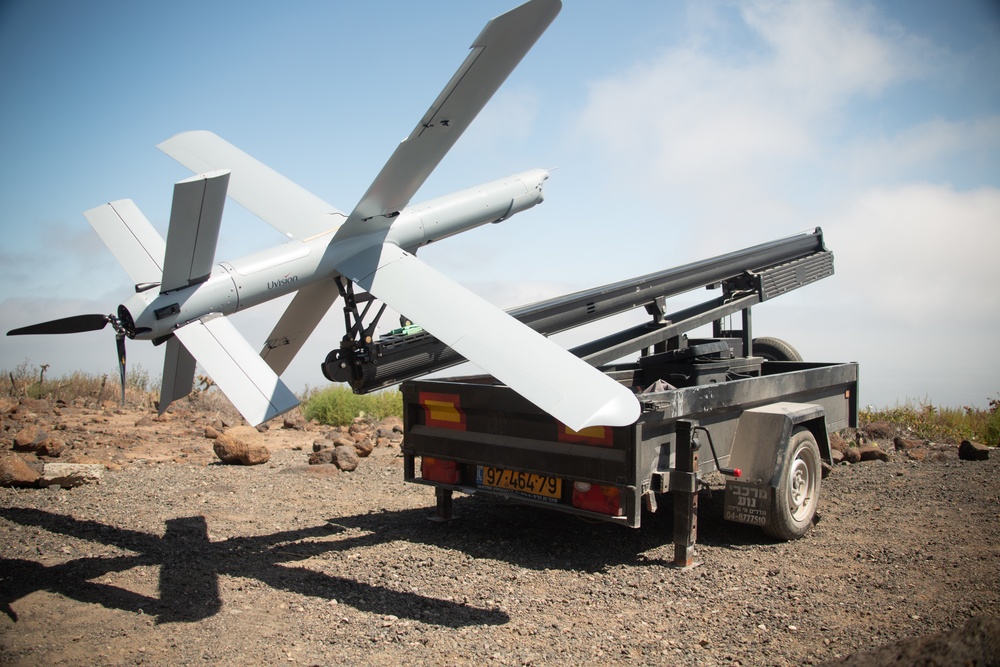
A Hero-400 loitering munition staged before flight on San Clemente Island, California, 25 May 2022. Marines from 3rd Marine Aircraft Wing conducted multi-platform hand-off training with the UVision system. (U.S. Marine Corps photo by Lance Cpl. Daniel Childs / DVIDS / Public Domain)
Section 1: OPF-M — The Programme That Changed Marine Fires
In June 2021, the United States Marine Corps awarded a multiyear contract to Mistral Inc. and UVision Air Ltd. for the HERO-120 Organic Precision Fires-Mounted (OPF-M) system. The contract was not a research experiment. It was a procurement decision that placed a man-in-the-loop loitering munition directly into the Marine ground combat element’s organic fires inventory.
The HERO 120 is a 12.5 kg expendable loitering munition produced by UVision Air Ltd. of Israel. It carries a multi-purpose warhead capable of engaging light armour, vehicles, and personnel. Its range of 40 km, endurance of 60 minutes, and circular error probable (CEP) of less than one metre make it a precision anti-armour weapon that fits inside a canister small enough to mount on a vehicle roof rack.
Platform Integration
OPF-M was designed from the outset to ride on existing Marine vehicles rather than requiring new platforms. The HERO 120 integrates onto three operational platforms through a modular Multi-Canister Launcher (MCL) architecture supporting four, six, or eight cells per configuration:
| Platform | Type | Integration | Operational Role |
|---|---|---|---|
| LAV-M | 8×8 Light Armoured Vehicle (Mortar variant) | 8-cell MCL roof-mounted | Mobile fire support, rapid repositioning |
| JLTV | Joint Light Tactical Vehicle | Modular 4/6/8-cell MCL | Expeditionary fire support, forward-deployed |
| LRUSV | Long-Range Unmanned Surface Vessel | 8-unit payload integration | Unmanned maritime fire support, littoral operations |
The LRUSV integration is the most doctrinally significant. An autonomous boat carrying eight HERO 120 loitering munitions can be pre-positioned in contested littoral waters, launching precision fires without exposing Marines to direct threat. The munitions can then be handed off to ground controllers ashore. This is the Expeditionary Advanced Base Operations (EABO) concept reduced to operational hardware.
HERO 120 Technical Baseline
| Parameter | Specification |
|---|---|
| Total weight | 12.5 kg |
| Warhead | Multi-purpose (anti-armour shaped charge, anti-personnel fragmentation, blast variants) |
| Range | 40 km (ground launch); extended via air delivery |
| Endurance | 60 minutes loiter |
| CEP | <1 metre |
| Sensor | Electro-optical/infrared (EO/IR), day and night capable |
| Guidance | GPS/INS with man-in-the-loop terminal guidance |
| Propulsion | Electric motor (low acoustic and thermal signature) |
| Launch | Pneumatic (low acoustic/visual signature) |
| Control | Portable Fire Control Unit with real-time video feed |
| Abort | Last-second abort and re-engagement capability |
Section 2: The Hand-Off — Why This Changes Everything
The HERO system’s defining tactical feature is not its warhead or its range. It is the ability to transfer control of the munition mid-flight from one operator to another across domains — land, air, and sea.
On 25 May 2022, Marine Aircraft Group 39 (MAG-39), attached to 3rd Marine Aircraft Wing (3rd MAW), conducted the first multi-platform control transfer exercise at San Clemente Island, California. Using a Hero-400EC variant (the larger, electrically-powered member of the HERO family), the Marines demonstrated a three-stage hand-off sequence:
- Land launch: Ground-based operators on San Clemente Island launched the munition and established control via the portable Fire Control Unit.
- Air transfer: Control was handed to crew members aboard a Bell UH-1Y Venom helicopter. Marine Corps Capt. Michael Ayala managed the system from the back of the hovering aircraft, operating the sensor payload and flight path via a laptop control unit linked by antenna to the ground control station.
- Sea transfer: The helicopter crew transferred control to Marines operating from small watercraft, who then conducted terminal attack sequences against floating hulks and metal CONEX containers on stilts.
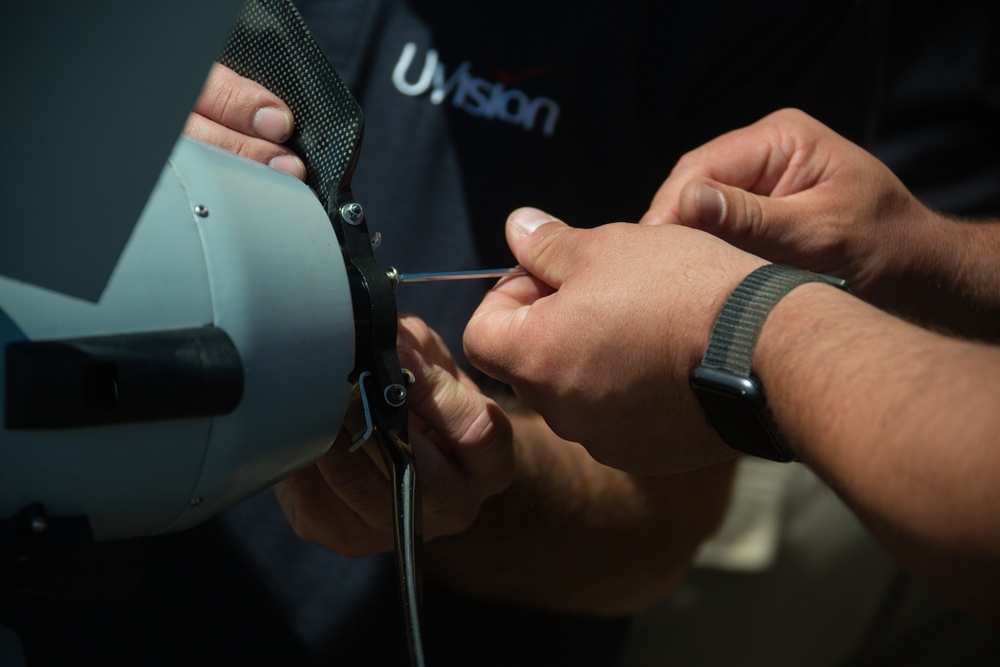
The exercise proved that ground personnel with minimal specialist training could assume direct control of a loitering munition mid-flight, redirect it to new targets based on real-time EO/IR feed, execute terminal attack sequences, and critically, abort strikes at the last second. The entire hand-off chain ran through a portable controller described in reports as resembling a video game interface.
The Doctrinal Inversion
The hand-off inverts seventy-five years of Close Air Support (CAS) doctrine. Under the traditional model, a ground commander identifies a threat, requests support through a Joint Terminal Attack Controller (JTAC), waits for an Air Force aircraft to be tasked and arrive on station, and then directs the pilot onto the target. A process that routinely takes five to fifteen minutes in a permissive environment and much longer under contested conditions.
Under the HERO hand-off model, the loitering munition is already overhead. The ground commander receives real-time EO/IR feed from a hovering munition, makes the targeting decision, controls the munition’s trajectory and timing, and engages at personal discretion. No Air Force tasking cycle. No inter-service coordination delay. No pilot making engagement decisions from altitude. The munition becomes an organic asset of the ground force.
Now extend this to the air-delivery model. A HERO 120 launched from a helicopter or light aircraft and released into the operational area can be handed off in flight to a forward ground operator. That operator, who may be a squad leader with a portable controller, now has overhead ISR and precision anti-armour capability without having carried or launched anything. The logistics chain shortens from “request, wait, coordinate, engage” to “receive, observe, engage.”
Section 3: Helicopter Air-Launch — The Next Step
On 5 June 2025, UVision announced a modular aerial launcher for the HERO 120 developed in collaboration with two American integrators: Fulcrum Concepts LLC and Mistral Inc. The launcher was showcased at the Paris Air Show 2025 and represents the first purpose-built system for deploying HERO 120 from rotary-wing aircraft.
Design Philosophy
The modular aerial launcher was designed to avoid the deep avionics integration that typically delays helicopter weapons programmes by years. The system mounts externally and does not require modification to the host aircraft’s fire control systems. UVision described it as compatible with a “wide range of legacy and next-generation NATO helicopters”; a deliberate choice that opens the door to integration on platforms already in service rather than waiting for future airframes.
Launch parameters for helicopter deployment call for approximately 100 feet (30 metres) altitude at speeds between 20 and 60 knots. The pneumatic launch system ejects the HERO 120 from the canister, after which the electric motor engages and the munition transitions to powered flight. The low-speed, low-altitude envelope is consistent with rotary-wing operations in the close fight rather than high-speed fixed-wing transit.
Prior Air-Launch Demonstrations
The helicopter launcher did not arrive without precedent. UVision had already demonstrated air-launch of HERO variants from US Army helicopters in 2024–2025 trials. Northrop Grumman separately developed a concept variant, the Hero ALE (Air-Launched Effect), based on Hero-400EC components but sized for Army aviation platforms including the AH-64 Apache, MQ-1C Grey Eagle, and future vertical lift aircraft. While Northrop Grumman announced in March 2021 that it would not proceed to manufacture, the concept validated the technical feasibility of helicopter-launched loitering munitions.
Separately, in August 2024, analysts reported a conceptual study for launching HERO 120 from C-130 Hercules transport aircraft. The concept exploits the C-130’s ability to operate from austere airfields, extending the delivery range of loitering munitions far beyond the 40 km ground-launch envelope. This remains at the conceptual stage — no formal programme or contract has been established.
Section 4: The Contract Trail
The HERO programme’s expansion across US military services can be tracked through three major contract awards that together represent more than a billion dollars in committed procurement:
| Contract | Service | Value | Date | System |
|---|---|---|---|---|
| OPF-M | US Marine Corps | Not disclosed (multiyear) | June 2021 | HERO-120 |
| SOCOM Loitering Munition | US Special Operations Command | $73.5 million | June 2024 | HERO-120SF |
| Lethal Unmanned System (LUS) | US Army | $982 million (IDIQ) | October 2025 | HERO-120 |
The Marines committed first in 2021, taking the risk on a relatively unproven Israeli system for their OPF-M requirement. SOCOM followed in 2024 with the Hero-120SF special forces variant, a $73.5 million contract covering munitions, spare parts, engineering changes, training, and conversion kits. Then the Army, which had been running its own Switchblade 600 programme and the separate LASSO programme for HERO-90, awarded the largest loitering munition contract in US history: a $982 million indefinite-delivery/indefinite-quantity (IDIQ) agreement for HERO-120 systems with initial deliveries beginning in early 2026.
The Army’s decision to procure the same HERO-120 system the Marines had already fielded is a significant validation. The two services arrived at the same munition through different programme paths: the Marines through OPF-M vehicle integration, the Army through the Lethal Unmanned System requirement. When two services independently select the same munition, the logistics tail shrinks and the production base gets the volume it needs to survive.
Domestic Manufacturing
Production is transitioning from Israeli manufacture to a domestic US supply chain. Mistral Inc., UVision USA, and SAIC announced a manufacturing partnership, with SAIC opening a new production facility in South Carolina in March 2024. The goal is a fully independent American supply chain for HERO systems, removing dependence on foreign production for a munition now procured across three service branches.
In August 2024, UVision and Mistral selected the Silvus StreamCaster SC4400 radio system to provide secure command-and-control communications for the HERO-120SF under the SOCOM contract. The StreamCaster uses frequency-hopping spread spectrum technology designed for contested electromagnetic environments; a direct response to the electronic warfare vulnerability that has devastated loitering munitions in Ukraine.
Section 5: Force Design 2030 — Why the Marines Built This
The HERO 120 adoption traces directly to Force Design 2030, the structural reform initiated by Commandant General David Berger in March 2020 to redesign the Marine Corps for naval expeditionary warfare in the Indo-Pacific.
Force Design 2030 envisioned small, distributed, lethal teams operating from austere, temporary locations across contested littoral zones — the concept known as Expeditionary Advanced Base Operations (EABO). These forward-deployed units would need organic precision fires that they could carry, launch, and control themselves, without relying on external air support that might not arrive in a contested anti-access/area-denial (A2/AD) environment.
The doctrinal vision called for a family of loitering munitions analogous to the range of ammunition calibres: from squad-level systems comparable to 60 mm mortars up to vehicle-mounted systems comparable to 155 mm artillery effects. HERO 120, mounted on LAV-M and JLTV platforms, fills the upper end of this spectrum for the OPF-M mounted requirement.
Marine Littoral Regiment
The Marine Littoral Regiment (MLR) is the new force structure unit designed specifically for EABO. Each MLR is intended to operate across Pacific island chains with organic fires, ISR, and anti-ship capability. OPF-M provides the precision ground-attack element: vehicle-mounted HERO 120 launchers that can deploy from expeditionary positions, engage armour and vehicles at 40 km range, and hand off control to forward observers or dismounted patrols.
The MLR also fields a complementary dismounted loitering munition capability designated OPF-L (Organic Precision Fires-Light), which uses lighter systems including Switchblade variants for squad-level infantry employment. OPF-M and OPF-L together give the MLR a layered organic fires capability from individual Marine to vehicle-mounted launcher to autonomous boat.
The LRUSV Dimension
The integration of HERO 120 onto the Long-Range Unmanned Surface Vessel adds a maritime fires dimension that no other service possesses. An LRUSV can be pre-positioned in contested waters, holding eight HERO 120 munitions ready for launch. The munitions can be fired autonomously or by remote operator and then handed off mid-flight to shore-based Marines who control the terminal engagement. The vessel itself remains unmanned, zero personnel at risk in the maritime launch platform.
This is sea denial through expendable precision rather than through expensive warships. An LRUSV with eight HERO 120s costs a fraction of a single anti-ship missile system but can engage eight separate targets with man-in-the-loop precision and last-second abort authority.
Section 6: The HERO Family in US Service
| Variant | Weight | Warhead | Range | Endurance | US Service |
|---|---|---|---|---|---|
| HERO-30 | ~3 kg | ~0.5 kg | ~10 km | 30 min | Training; IDF operational |
| HERO-90 | ~9 kg | ~2.5 kg | ~30 km | 45 min | US Army LASSO programme |
| HERO-120 | 12.5 kg | Multi-purpose | 40 km | 60 min | USMC OPF-M; US Army LUS; SOCOM (SF variant) |
| HERO-400EC | ~40 kg | 10 kg | 60+ km | 2 hours | USMC demonstration (San Clemente 2022) |
| HERO-900 | ~90 kg | 25 kg | 150 km | 2+ hours | Export/trials only |
The HERO-120 has become the common denominator. It is now procured by three separate US military customers (Marines, Army, and SOCOM) through three distinct programme paths. Each arrived at the same system independently, which suggests the HERO 120 occupies a genuine capability sweet spot: heavy enough to kill armour, light enough to mount on a vehicle or launch from a helicopter, and cheap enough to procure in volume.
NATO Adoption
The HERO family is also expanding through NATO allies via Rheinmetall, which serves as the European production and distribution partner. Hungary awarded a contract in the “low three-digit million euro range” for several hundred HERO systems with deliveries from early 2026. The Czech Republic is negotiating a pilot procurement of 10 kits. Italy, through RWM Italia, is a co-production partner. The Netherlands and Lithuania have expressed interest.
Combined US and allied procurement is building the kind of production volume that keeps unit costs down and gives the industrial base enough demand to sustain wartime surge capacity. NATO-wide adoption of a common loitering munition follows the same logic as 155 mm artillery standardisation: the more nations buy in, the more resilient the supply chain becomes.
References & Source Evaluation
This analysis is AI-assisted and based entirely on open-source material. It does not represent the views of any government, military service, or defence organisation. All acronyms expanded on first use. NATO STANAG 2022 source evaluation applied throughout.
ISC Commentary
The Marines did not wait for the Air Force to solve the close fires problem. They built their own solution. HERO 120 on LAV-M, JLTV, LRUSV, and now helicopter-launched platforms gives the Marine ground combat element an organic precision fires capability that the A-10 used to provide through Air Force tasking: except now it sits inside the ground commander’s own fires chain, responds in real time, and costs orders of magnitude less per engagement.
The hand-off capability is the critical discriminator. A HERO 120 launched from a helicopter, an autonomous boat, or a vehicle twenty kilometres away can be handed mid-flight to a squad leader with a portable controller. That squad leader now has overhead ISR and anti-armour precision without having requested a thing from the Air Force. The inter-service CAS dependency that has defined American ground combat since the 1948 Key West Agreement is being quietly circumvented, not through institutional reform, but through technology that sidesteps the institutional boundary entirely.
The Army’s $982 million HERO-120 IDIQ contract in October 2025 confirmed what the Marines demonstrated four years earlier: this works. Three service branches now procure the same Israeli loitering munition through different programme offices. If the political lesson of the A-10 retirement is that the Air Force will never prioritise close fires, the procurement lesson of HERO 120 is that the ground services have stopped asking.