Italy’s Panther-IT: Why Rome Rejected the 130 mm Gun and Built Its Own
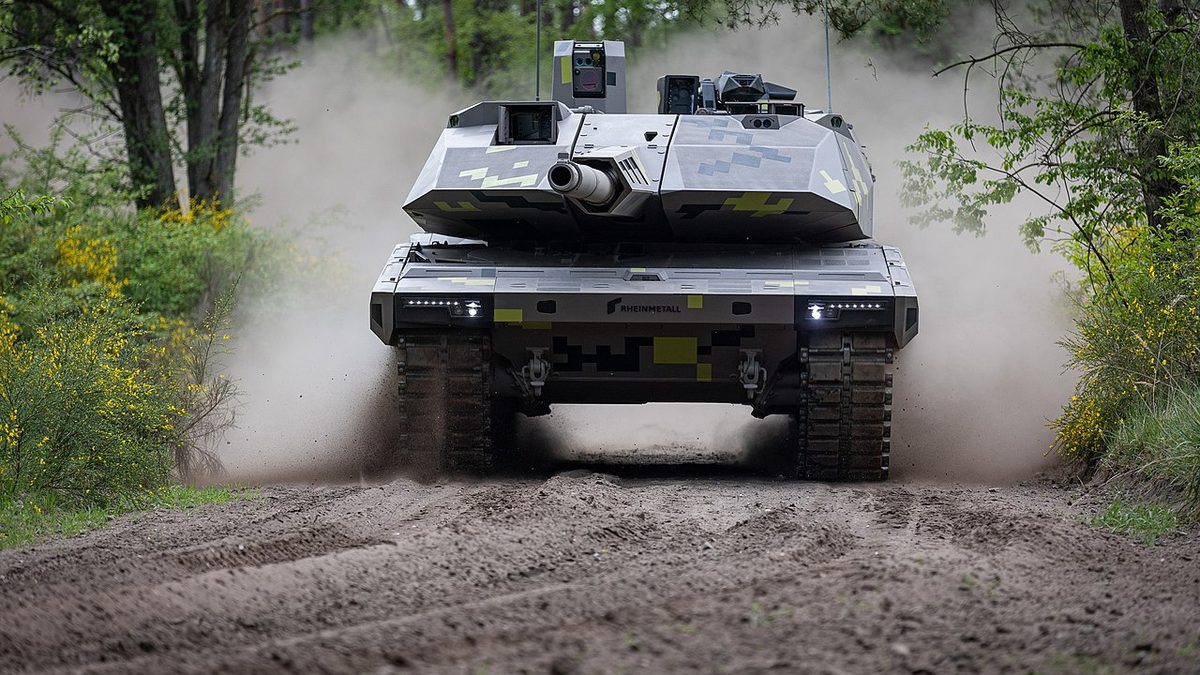
Rheinmetall designed the KF51 Panther around a 130 mm smoothbore that promised a generational leap in lethality — but Italy looked at the same gun system and saw a logistics liability. Rome’s decision to field the Panther-IT with a domestically developed Leonardo 120 mm L55, completed in just 18 months, tells a story about NATO ammunition interoperability, industrial sovereignty, and the growing distance between what armour manufacturers want to sell and what armies actually need to fight with.
The Programme: 380 Panthers, €8.2 Billion, and a New European Armour Axis
Italy’s plan to replace its obsolete C1 and C2 Ariete Main Battle Tanks (MBTs) with up to 380 vehicles based on the Rheinmetall KF51 Panther platform is the largest single armoured vehicle acquisition in Western Europe in decades. The Italian government approved an €8.2 billion investment plan spanning 2025 to 2038 for the MBT programme. Alongside it, approximately 1,050 KF41 Lynx Infantry Fighting Vehicles (IFVs) are being procured under the A2CS (Army Armoured Combat System) programme. With all options exercised, the combined armoured vehicle effort reaches approximately €30 billion, with export potential valued at up to €50 billion over fifteen years.
The industrial vehicle is Leonardo Rheinmetall Military Vehicles (LRMV), a 50:50 joint venture established in October 2024 with its registered office in Rome and operational headquarters in La Spezia. The structure gives Italy 60% of all activities: assembly, integration of mission systems, approval testing, delivery, logistical support, and portions of development and production. Rheinmetall contributes the platform architecture, running gear, and protection suite. Leonardo contributes C4I (Command, Control, Communications, Computers, and Intelligence) integration and a growing share of the weapons systems — most notably the main gun.
The first contract materialised in November 2025: 21 A2CS vehicles (five Lynx KF-41 with the Rheinmetall Lance turret and sixteen with Leonardo’s Hitfist 30 mm turret), plus an option for 30 more. Delivery of the first vehicle was expected by end of 2025. That is the IFV strand. The MBT strand — the Panther-IT — is a separate and later programme phase.
The Gun Decision: 120 mm, Not 130 mm
Rheinmetall’s original KF51 concept, unveiled at Eurosatory 2022, was built around the Rh-130 L/51 130 mm smoothbore gun — a weapon delivering 18–20 megajoules of muzzle energy and claiming 50% greater effective range than the L/55A1 120 mm system fitted to the Leopard 2A7. The 130 mm was marketed as the future of NATO tank armament, with a 20-round autoloader eliminating the loader and reducing the turret crew to three.
Italy said no.
According to reporting by Rivista Italiana Difesa and subsequent industry disclosures, the Italian assessment concluded that the 130 mm calibre offered “negligible operational advantages in terms of range” while introducing substantial interoperability and logistical complications within the NATO framework. Every Leopard 2, M1 Abrams, K2 Black Panther, Leclerc, and Challenger 3 in Allied service fires 120 mm × 570 mm ammunition. An Italian armoured brigade operating alongside German or American formations on NATO’s eastern flank needs to cross-load rounds from allied supply points. The 130 mm makes that impossible. Rome judged the lethality increment did not justify the logistical isolation.
Instead, the Panther-IT will carry 120 mm guns in two variants. Eighty-two tanks will receive Leonardo’s newly developed 120 mm L55, and fifty will be fitted with Rheinmetall’s established 120 mm L55A1. Both fire all existing NATO-standard 120 mm rounds, including APFSDS (Armour-Piercing Fin-Stabilised Discarding Sabot), HEAT (High-Explosive Anti-Tank), and — critically — programmable airburst munitions that require a muzzle programming interface. Full cross-loading with every 120 mm-armed MBT in NATO is preserved.
Leonardo’s 120 mm L55: An 18-Month Industrial Sprint
The more quietly significant element of Italy’s gun decision is that Leonardo built a new 120 mm L55 tank gun from scratch — and did it in 18 months. That development timeline, compressed through software-based simulations capable of replicating the firing phase under different conditions, produced a weapon with specifications that exceed what Italy currently fields on the Ariete.
The Leonardo L55 delivers a 5% increase in muzzle velocity over the L45 gun on the Ariete C1, pushing the effective engagement envelope outward without changing calibre. The barrel weighs approximately 500 kg more than the L45 — a consequence of the longer tube and the autofrettage process used to pre-stress the barrel for higher chamber pressures. Recoil stroke is approximately 550 mm, managed by a dual hydraulic cylinder recoil brake system with an oil-gas accumulator. Forecasted barrel life is 1,200 rounds.
The gun is designed to fire the Leonardo 120 mm Vulcano round — a guided munition with a range of 30 kilometres, enabling beyond-line-of-sight (BLOS) engagement of armoured vehicles, rocket launchers, and air defence systems. At 30 km, the Vulcano provides a tank-fired indirect engagement capability that partially compensates for the lethality increment the 130 mm was supposed to deliver, but through precision rather than raw energy. The round can also inflict “functional damage” to tanks at extended range by destroying optics, antennas, and exposed subsystems without requiring a direct armour penetration.
Leonardo completed test-firing in 2025 and is conducting qualification trials on five units over the following twelve months. The programme is on track for integration into the Panther-IT production line at La Spezia.
Why Two Gun Variants?
The decision to split the fleet between 82 Leonardo L55 guns and 50 Rheinmetall L55A1 guns is unusual and worth examining. In most MBT programmes, a single gun system is selected to simplify logistics, training, and maintenance. Italy’s split suggests several factors at work.
First, risk management. The Leonardo L55 is new and unproven in service. The Rheinmetall L55A1 is a mature, combat-validated weapon system already in production for the Leopard 2A7. Fitting 50 tanks with the Rheinmetall gun provides a fallback if the Leonardo gun encounters qualification delays or in-service issues. Second, the split may reflect the LRMV work-share negotiation: Leonardo gets the majority of guns (62% of the MBT fleet), preserving the 60% Italian content target, while Rheinmetall retains a meaningful armament role. Third, both guns fire identical NATO 120 mm ammunition, so the logistical cost of operating two gun types is limited to barrel spares and maintenance procedures rather than ammunition supply — a manageable burden for a force of 132 gun-armed MBTs.
The remaining vehicles in the “up to 380” figure include recovery, rescue, and engineering variants built on the Panther platform chassis, which do not carry the main gun.
The Ariete Bridge: C2 Upgrade Buys Time
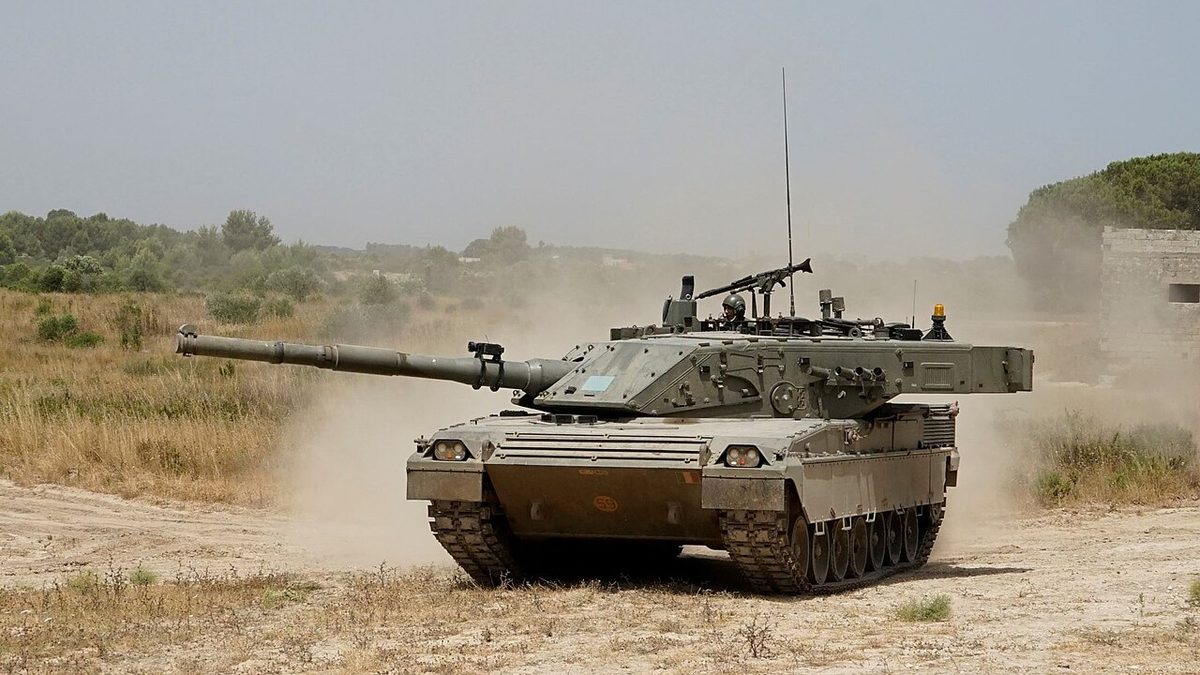
Italy cannot wait for the Panther-IT to reach full operational capability. The C1 Ariete entered service in 1995 with the 132nd Armoured Brigade “Ariete” and was already behind the Leopard 2A5 in armour and fire control at delivery. The hull cannot accommodate contemporary composite armour suites, the FIAT MTCA V-12 producing 1,250 hp is underpowered by current standards, and the TURMS fire control system lacks the digital integration expected of a networked battlefield.
To bridge the gap, Italy authorised an €848.8 million contract in 2023 to upgrade 90 tanks to the C2 standard, with an option for 35 more. The first C2 was delivered in July 2025. The upgrade provides a new 1,500 hp V12 MTCA powerpack from Iveco with improved transmission, additional armour modules, and modernised electronics. It is a practical solution: it sustains Italian armoured capability through to the early 2030s when Panther-IT deliveries should begin at volume. But the C2 does not alter the fundamental reality that the Ariete platform has exhausted its growth potential.
Protection, Mobility, and the KF51 Platform
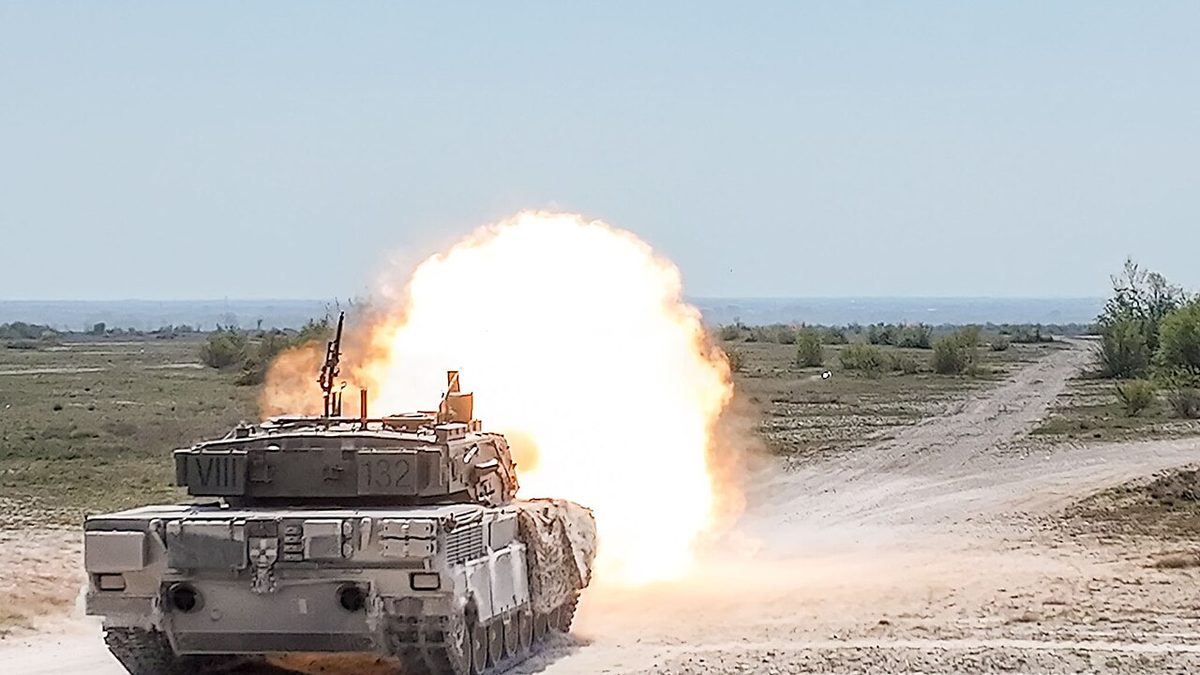
Whatever sits in the turret, the Panther platform brings genuine generational improvement. At a combat weight of 59 tonnes, it is substantially lighter than the Leopard 2A7 (approximately 67 tonnes) and the M1A2 SEPv3 (approximately 73 tonnes). The 1,500 hp engine delivers a power-to-weight ratio of approximately 25.4 hp/tonne. Operational range reaches 500 kilometres.
Protection relies on a layered concept that shifts emphasis from passive armour mass toward active and reactive systems. The StrikeShield Active Protection System (APS) detects and defeats incoming ATGMs (Anti-Tank Guided Missiles) and RPGs (Rocket-Propelled Grenades) before impact. A Top Attack Protection System (TAPS) addresses the growing threat from top-attack munitions — NLAW, Javelin, and the expanding family of First-Person View (FPV) strike drones targeting thin roof armour. The weight savings from reduced passive armour mass are what allow the KF51 to stay at 59 tonnes while incorporating these active systems.
Secondary armament includes a coaxial 12.7 mm machine gun and an optional Rheinmetall Natter Remote Weapon Station (RWS) armed with a 7.62 mm gun elevating from −15° to +85°. The +85° elevation is purpose-built for counter-UAS (Uncrewed Aerial System) engagement — drones directly overhead, a threat geometry that Ukraine has made lethally familiar. The platform can also integrate the UVision HERO 120 loitering munition, fired from a rear-turret launcher, giving the Panther-IT a BLOS strike capability against high-value targets beyond the main gun’s line of sight.
European Context: The MGCS Shadow
Italy’s bilateral deal with Rheinmetall must be read against the stalled Franco-German Main Ground Combat System (MGCS). Launched in 2017 to replace both the Leopard 2 and the Leclerc, MGCS has slipped from a 2030s target to a 2040–2045 timeframe. In April 2025, KNDS Deutschland, KNDS France, Rheinmetall, and Thales established the MGCS Project Company (MPC) in Cologne. But MGCS remains a technology demonstrator programme with no production contract, no confirmed calibre, and no unit price.
Italy withdrew from MGCS discussions and chose a platform that exists in prototype today. Hungary has taken a parallel path with its own Rheinmetall joint venture at Zalaegerszeg. The result is a European armoured vehicle landscape splitting into two camps: a Franco-German axis pursuing a clean-sheet design for the 2040s, and a Rheinmetall-led coalition fielding an evolved platform in the early 2030s. Italy’s insistence on 120 mm, rather than waiting for whatever calibre MGCS eventually adopts, actually reinforces NATO coherence during the transition — Italian Panthers will cross-load ammunition with every existing NATO MBT from day one of service entry.
References and Sources
- Army Recognition, “Leonardo to equip Italian KF51 Panther tanks with new 120mm L55 gun to hit targets farther and harder,” 2025 — armyrecognition.com DEFENCE MEDIA
- The Defense Post, “Leonardo Rolls Out 55-Caliber Gun for Future Italian Main Battle Tank,” 22 July 2025 — thedefensepost.com DEFENCE MEDIA
- Leonardo Press Release, “New player in European tank production: Leonardo and Rheinmetall establish Joint Venture,” 15 October 2024 — leonardo.com INDUSTRY OFFICIAL
- Leonardo Press Release, “First contract to supply armoured vehicles for the Italian Army,” 5 November 2025 — leonardo.com INDUSTRY OFFICIAL
- Army Recognition, “Italian Army to replace its Ariete tanks with up to 380 German KF51 Panthers in a €10 billion program,” February 2025 — armyrecognition.com DEFENCE MEDIA
- TURDEF, “Italy Opts for 120 mm L55A1 Gun on Its Future KF51 MBTs,” 2025 — turdef.com DEFENCE MEDIA
ISC Commentary
The gun decision is the story. Italy had the option to field the most powerful tank gun in NATO and chose not to. That decision, reported without much analysis in the defence trade press, reveals a hard-headed operational calculus: in a high-intensity war on NATO’s eastern flank, the ability to refuel from a German bowser and reload from a Polish ammunition supply point matters more than an incremental range advantage at 4,000 metres. The Vulcano 120 mm round at 30 km range provides the extended-range engagement capability through precision guidance rather than brute muzzle energy — a more elegant solution that keeps Italy inside the NATO ammunition ecosystem.
Equally telling is what Leonardo achieved in 18 months. Italy did not simply buy Rheinmetall’s 120 mm L55A1 off the shelf for all 132 tanks. It developed a domestic gun, qualified it, and secured the majority of the fleet for Italian production. That is an industrial sovereignty play: when the next generation of European tank guns is debated, Leonardo will have a seat at the table as a proven gun manufacturer rather than as a systems integrator dependent on German barrel supply. For WOME practitioners, the programme’s ammunition implications are clear — Italy’s commitment to 120 mm secures demand for existing NATO-standard tank ammunition families, including the new generation of programmable airburst and precision-guided rounds, rather than fragmenting the market with a niche 130 mm calibre that lacks an established production base outside Rheinmetall.