Technical Summary
On 8 April 2026, Indian Army security forces detected and neutralised a radio-controlled improvised explosive device (RCIED) during routine route sanitisation operations on the Zainapora–Chitargam road in Shopian district, South Kashmir, Jammu & Kashmir. The device, classified per AJP-3.15 (Allied Joint Doctrine for Countering Improvised Explosive Devices) and ATP-3.15.2 (Counter-IED Procedures) as an RCIED — Category: victim-operated by proxy via RF command link — was recovered intact following render-safe procedures conducted by a dedicated bomb disposal squad [1][2].
The recovered device comprised a main charge weighing 14.5 kg packed with high explosives. The explosive composition has not been confirmed in open-source reporting; however, based on regional precedent in Jammu & Kashmir, the main charge is assessed as likely ammonium nitrate-based (ANFO or ANAL variant using ammonium nitrate and aluminium powder) or, if sourced from diverted military stocks, a composition such as RDX or PE-4 (91/9 RDX/plasticiser). The estimated Net Explosive Quantity (NEQ) is 14.5 kg TNT equivalent assuming a conventional HE fill, though this figure would increase if the charge comprised military-grade RDX (RE factor 1.60 relative to TNT) — yielding an effective NEQ of approximately 23.2 kg TNT equivalent [1][2].
The triggering mechanism was confirmed as a remote-controlled initiation system — an RF receiver connected to an electric detonator within the main charge. Regional RCIED construction in J&K typically employs COTS (Commercial Off-The-Shelf) electronics: mobile telephone handsets, two-way radios (PMR446 or similar), or dedicated RF transmitter/receiver pairs operating in the VHF/UHF spectrum. The device was emplaced in a roadside position consistent with anti-vehicle targeting, indicating the intended victims were security force vehicle patrols conducting routine movement along the Zainapora–Chitargam axis [1][2].
Analysis of Effects
A 14.5 kg HE main charge emplaced as a roadside RCIED presents significant anti-vehicle and anti-personnel effects. Based on Kingery-Bulmash blast prediction models and standard WOME effects calculations:
Blast Effects (Unconfined, Ground-Level Detonation)
At 5 metres standoff, the estimated peak incident overpressure from a 14.5 kg TNT-equivalent charge is approximately 200–400 kPa — well in excess of the threshold for vehicle structural defeat (approximately 70 kPa for light-skinned vehicles) and significantly above the lethal overpressure threshold for exposed personnel (approximately 100 kPa). The estimated lethal radius for exposed personnel is approximately 25–35 metres, with a casualty-producing radius extending to approximately 50–75 metres, dependent on confinement, emplacement depth, and the presence of any fragmentation jacket [3].
Fragmentation Effects
If the device incorporated a fragmentation enhancement — such as a metal container, pre-formed fragments (nuts, bolts, ball bearings), or natural fragmentation from a steel pipe or pressure vessel casing — the casualty radius would extend significantly beyond the blast-only envelope. Pre-formed fragmentation from a steel casing of 14.5 kg NEQ could project fragments at initial velocities exceeding 1,500 m/s with a dangerous fragment radius of 100–200 metres depending on casing thickness and fragment mass distribution.
RCIED Initiation Characteristics
The use of remote-controlled initiation confirms the presence of a device operator (triggerman) positioned within RF transmission range of the device. Typical RCIED initiation ranges in the J&K theatre are 100–500 metres, dependent on terrain (mountainous terrain in Shopian reduces effective RF range), antenna configuration, and transmitter output power. COTS mobile telephone-based RCIEDs in the region have demonstrated effective ranges of 200–300 metres in direct line-of-sight conditions. The command-initiated nature of the device indicates target selection capability — the operator could select the specific vehicle or patrol element for attack [4].
Personnel and Safety Considerations
The render-safe operation conducted by the Indian Army bomb disposal squad would have followed IEDD (Improvised Explosive Device Disposal) procedures broadly consistent with ATP-3.15.2 and national equivalents. Key procedural considerations for WOME professionals operating in comparable threat environments include:
Electronic Counter-Measures (ECM)
Deployment of ECM to defeat RF initiation is the first-priority action upon identification of a suspected RCIED. CREW (Counter-RCIED Electronic Warfare) systems — whether vehicle-mounted or man-portable — must provide broadband RF jamming across the likely initiation frequencies (typically 30 MHz to 3 GHz for COTS-based RCIEDs) to prevent the device operator from initiating the device during approach and render-safe operations [4][5].
Cordon and Evacuation Distances
For a 14.5 kg NEQ device, the minimum recommended cordon distance per AASTP-1 Quantity Distance tables (adapted for IED scenarios) is 200 metres in all directions. In urban or semi-urban environments along the Zainapora–Chitargam road, this cordon must account for inhabited buildings, vehicle traffic, and civilian population density. JSP 482 (UK MOD EOD/IEDD procedures) recommends a minimum evacuation distance of 200 metres for charges in the 10–25 kg NEQ range, with extension to 400 metres where fragmentation enhancement is suspected [5][6].
Render-Safe Procedures
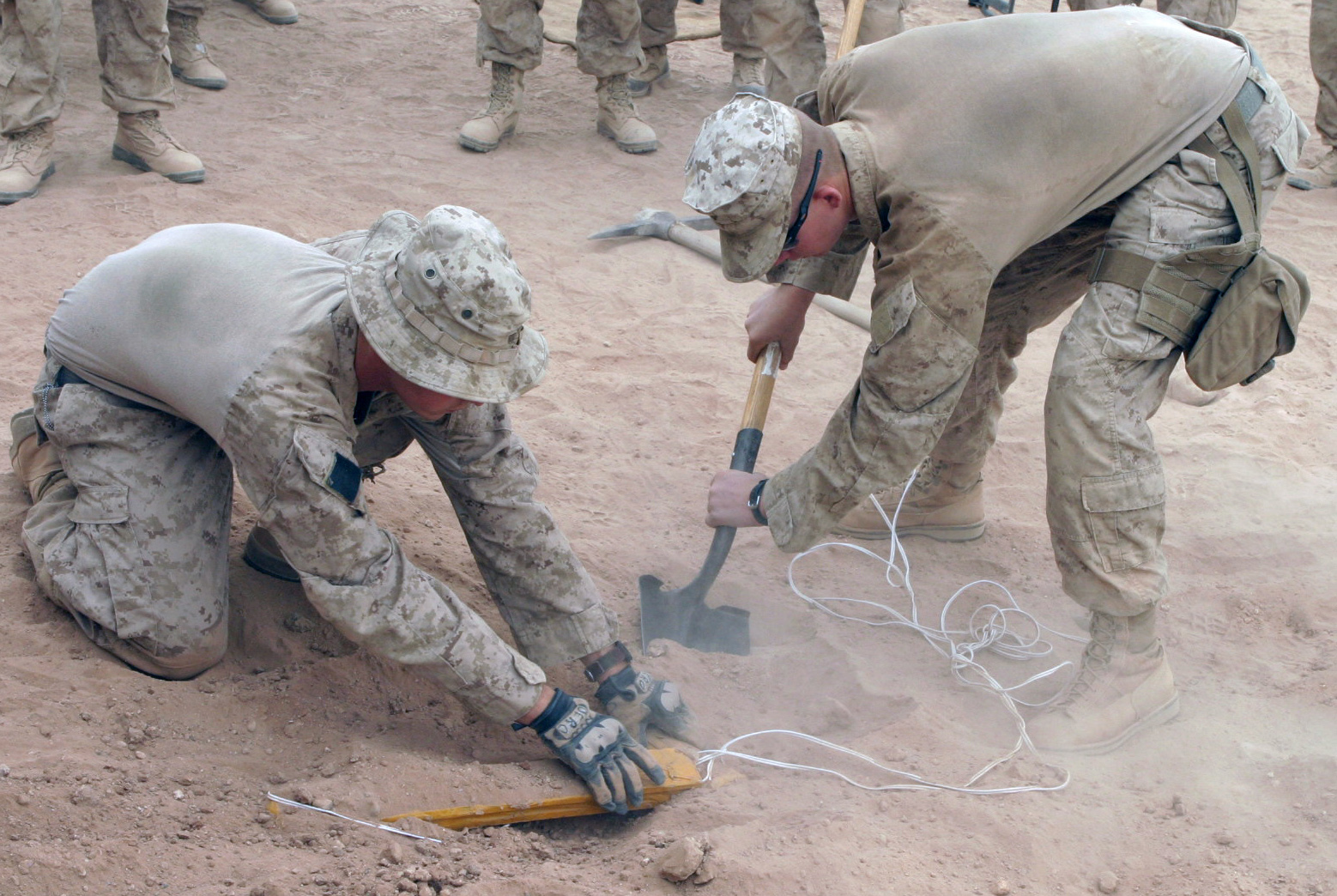
Render-safe options for an RCIED of this configuration include: remote disruption using a projected water disruptor (e.g., Pigstick or equivalent) delivered by EOD robot; manual approach under ECM cover for component-level disruption; or controlled detonation in situ if the device cannot be rendered safe for exploitation. Post-render-safe, all device components should be retained for technical exploitation and forensic analysis to support the intelligence cycle per IMAS 09.30 (International Mine Action Standards — EOD) [5][6].
Separate Incident: Rajouri IED-Type Device
In a separate but related incident on 10 April 2026, security forces in Sunderbani belt, Thandipani area, Rajouri district, recovered an IED-type box containing two grenades near a water body. While details of this device remain limited, the discovery of pre-positioned ordnance caches in the wider J&K region indicates a sustained C-IED threat requiring continued route sanitisation and area clearance operations [2].
Data Gaps
DATA GAP: Explosive composition — unknown whether main charge comprised diverted military explosive (RDX/PE-4) or homemade explosive mixture (ANFO/ANAL). Composition directly affects NEQ calculation and blast/fragmentation effects assessment.
DATA GAP: Fragmentation jacket — no reporting confirms whether the device included pre-formed fragmentation (nuts, bolts, ball bearings) or natural casing fragmentation (steel pipe, pressure vessel). This significantly affects casualty radius estimation.
DATA GAP: RF initiation system specifics — operating frequency, effective range, and COTS component identity (mobile telephone, PMR radio, or dedicated transmitter/receiver) have not been disclosed in open sources.
DATA GAP: Render-safe procedure employed — whether neutralisation was achieved by remote disruption (robot/disruptor), manual approach, or controlled detonation in situ has not been confirmed.
Source reliability: B–2 (Multiple credible media sources, independently corroborated).
References & Sources
- Counter-IED Report – Jammu & Kashmir: Security Forces Recover & Defuse IED in Shopian – Tier 2 (Credible specialist media)
- Zee News – Major IED Attack Foiled in South Kashmir: 14 kg Explosive Neutralised by Army – Tier 2 (Credible media)
- Kingery, C.N. & Bulmash, G. (1984) – Airblast Parameters from TNT Spherical Air Burst and Hemispherical Surface Burst, ARBRL-TR-02555 – U.S. Army Ballistic Research Laboratory
- AJP-3.15 – Allied Joint Doctrine for Countering Improvised Explosive Devices; ATP-3.15.2 – Counter-IED Procedures
- JSP 482 – MOD Explosives Regulations (UK) – EOD/IEDD Procedures
- IMAS 09.30 – Explosive Ordnance Disposal (International Mine Action Standards); AASTP-1 – NATO Guidelines for the Storage of Military Ammunition and Explosives
Disclosure: This analysis is AI-assisted and based on open-source material. No classified information. For professional use only.