Saab’s Giraffe 1X Baltic Expansion: US Army Procurement Reveals the Sensor Gap NATO Cannot Afford to Ignore
Western air defence discourse fixates on shooters — Patriot batteries, NASAMS launchers, IRIS-T launchers. But on NATO’s northeastern flank, the more urgent deficit has been in sensor coverage: the ability to detect low-altitude threats early enough for those systems to engage at all. A USD 23.9 million US Army contract modification for ten Saab Giraffe 1X radars bound for Estonia, Latvia, and Lithuania addresses exactly this blind spot.
Contract Anatomy and Procurement Context
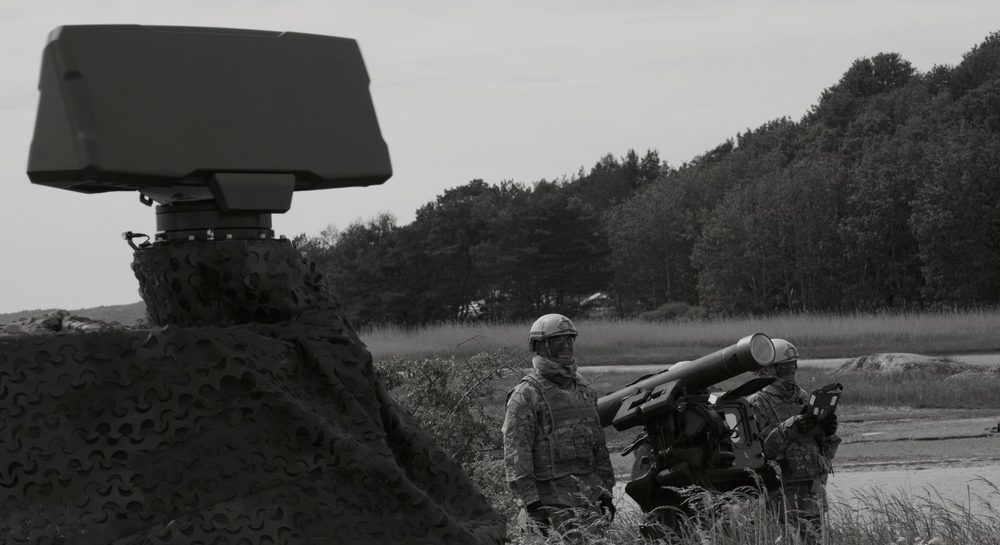
The US Department of Defense awarded Saab a USD 23.9 million contract modification on behalf of the governments of Estonia, Latvia, and Lithuania for ten Giraffe 1X 3D multi-mission radar systems. Work will be conducted at Saab’s facility in East Syracuse, New York; completion is scheduled by February 2027. The cumulative US Army contract value for Giraffe 1X now stands at approximately USD 70 million.
The contract was awarded under the Foreign Military Sales (FMS) framework — a significant detail. FMS procurement routes sensor acquisitions through the US Defense Security Cooperation Agency (DSCA), which manages interoperability requirements and ensures NATO-standard integration from the outset. For the Baltic states, this means the Giraffe 1X systems arrive pre-configured for integration into the NATO Integrated Air and Missile Defence (IAMD) architecture rather than operating as standalone national assets.
Saab has built a dedicated radar integration and sustainment footprint in Syracuse, reflecting a broader pattern of European defence manufacturers establishing US production lines to access FMS pipelines. The location positions Giraffe 1X sustainment within the US Army’s organic logistics framework — a practical consideration for long-term maintenance and software upgrades that is frequently overlooked in procurement analysis.
Technical Assessment — What the Giraffe 1X Brings to the GBAD Picture
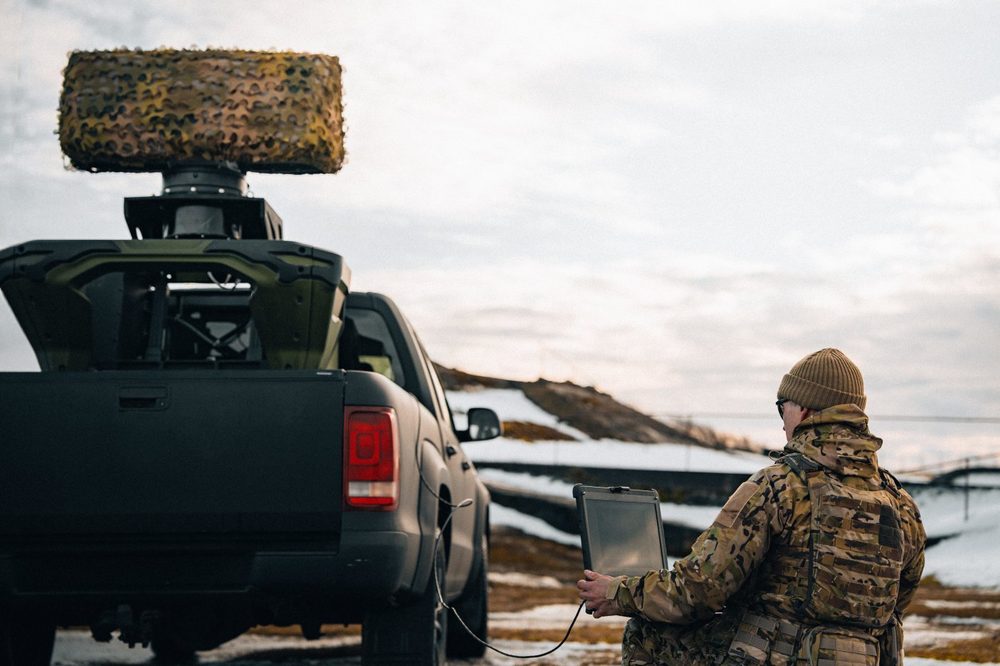
The Giraffe 1X is a compact 3D Active Electronically Scanned Array (AESA) radar operating in the X-band (NATO I-band). Weighing under 150 kg topside and less than 300 kg in total system weight, it can be mounted on a light vehicle, towed on a trailer, or carried by helicopter. The system scans the full 360° search volume every second and detects air targets at ranges exceeding 75 km, with small UAS (Uncrewed Aerial System) detection capability out to approximately 4 km.
Three capabilities matter for the Baltic Ground-Based Air Defence (GBAD) mission. First, the system provides engagement-quality target data — not merely surveillance tracks. This distinction is critical: GBAD commanders need weapon-quality coordinates to direct RBS 70 NG or NASAMS fire units, not degraded radar returns that require further sensor fusion before engagement. Second, the Giraffe 1X incorporates Counter-Rocket, Artillery, and Mortar (C-RAM) sense-and-warn as an integrated function rather than requiring a separate sensor. In a Baltic littoral environment where Russian and Belarusian multiple launch rocket systems sit within range, this dual capability reduces the sensor inventory required per defended area. Third, the system’s low-slow-small (LSS) target detection addresses the UAS threat that has dominated operational learning from Ukraine — tactical drones operating below conventional radar coverage that have proven devastatingly effective against static positions.
Strategic Context — The Baltic Sensor Architecture Gap
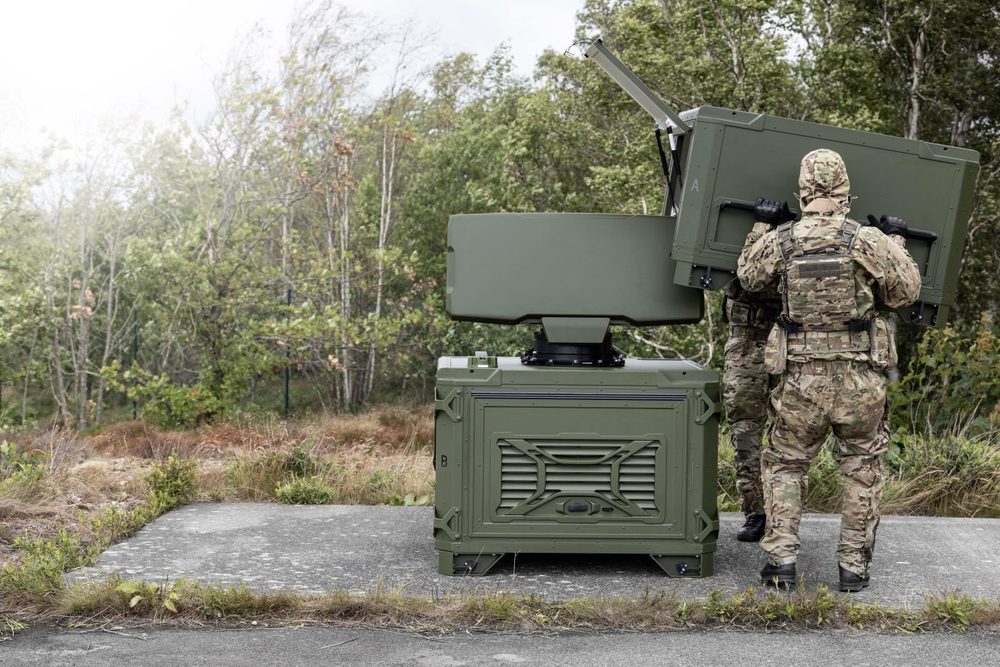
The Baltic states occupy NATO’s most exposed territory. Estonia, Latvia, and Lithuania share a collective land border of over 1,300 km with Russia and Belarus. Airspace in the region is characterised by low-altitude vulnerability: the flat terrain offers minimal natural radar shadow, but legacy sensor networks inherited from Soviet-era infrastructure were designed for high-altitude intercept rather than detecting cruise missiles and tactical UAS at tree-top height.
All three nations have invested substantially in Saab’s air defence ecosystem. Latvia ordered RBS 70 NG ground-based air defence systems alongside Giraffe 1X radars in 2022. Lithuania placed a third order for Saab’s Mobile Short-Range Air Defence (MSHORAD) system in late 2025 — a contract worth approximately SEK 1.4 billion with deliveries running through 2030. Estonia has fielded Giraffe 1X as part of its national SHORAD (Short-Range Air Defence) architecture. The ten additional radars under this US Army contract represent a quantitative expansion of an existing sensor network rather than the introduction of a new capability.

The operational significance is in the numbers. Ten additional radar systems across three countries may appear modest, but in the GBAD context they function as gap-fillers between strategic long-range radars and point-defence systems. Each Giraffe 1X provides a 75 km detection bubble with one-second refresh — sufficient to give SHORAD operators the 30–60 seconds of warning needed to acquire and engage a low-flying cruise missile or kamikaze drone. Without that sensor layer, the air defence chain breaks at exactly the point where it matters most: the transition from detection to engagement.
The FMS Framework and NATO Integration
The use of the FMS mechanism reveals an important structural shift in Baltic procurement strategy. Rather than each nation procuring independently through national defence ministries, the three Baltic governments coordinated through the US Army to obtain radars configured from day one for NATO IAMD architecture. This approach eliminates the gap-bridging integration work that frequently consumes time and budget when disparate national systems must be harmonised post-delivery.
The Giraffe 1X systems will integrate into the NATO-wide air defence picture through standardised data-link protocols (Tactical Data Link J, Link 16, or equivalent NATO-standard messaging). This means Baltic air operations centres receive engagement-quality radar tracks from these ten systems with no translation or interpretation required, and those tracks feed automatically into the targeting solutions available to all regional air defence units across the NATO footprint.
For Saab, the FMS route offers sustained volume. The current contract modification brings total Giraffe 1X FMS procurement to approximately USD 70 million. For the US Army, it reflects confidence in the system’s integration maturity and operational utility. For the Baltic states, it signals that NATO’s collective decision-making on equipment standards is functioning: the three nations are purchasing equipment that will operate seamlessly with Polish, German, and Romanian air defence assets rather than operating as national silos.
ISC Assessment: The Sensor-Shooter Gap
NATO air defence discourse frequently emphasises shooter systems: the flashy high-profile contract for a Patriot battery or an IRIS-T system generates headlines and political attention. But the limiting factor in actual air defence capability is rarely the shooter. It is the sensor. An air defence force armed with high-quality shooters but poor sensor coverage cannot engage threats it cannot detect. Conversely, a force armed with modest shooters but excellent sensor coverage can achieve a high engagement rate.
The Baltic region has historically suffered from exactly this imbalance: legacy Soviet-era sensors designed for a different threat environment, and modern shooters installed but unable to operate at full effectiveness because the sensor picture was incomplete. The Giraffe 1X contract corrects that imbalance incrementally. Ten radars will not solve the problem entirely, but they will reduce the blind spots in the low-altitude envelope and improve the refresh rate of the overall air defence architecture.
References and Sources
- Saab Press Release, “Saab receives order for Giraffe 1X radars from U.S. Army,” 28 October 2025 — https://www.saab.com/newsroom/press-releases/2025/saab-receives-order-for-giraffe-1x-radars-from-u.s.-army SAAB OFFICIAL
- Saab Product Page, “Giraffe 1X,” accessed April 2026 — https://www.saab.com/products/giraffe-1x SAAB OFFICIAL
- Army Recognition, “U.S. Army Selects Swedish Saab Giraffe 1X Radar in $46M Deal,” October 2025 — https://www.armyrecognition.com/news/army-news/2025/u-s-army-selects-swedish-saab-giraffe-1x-radar-in-46m-deal-to-strengthen-allied-air-defense DEFENCE NEWS
- European Security & Defence, “US Army orders Saab Giraffe 1X radars,” October 2025 — https://euro-sd.com/2025/10/major-news/47444/us-army-orders-saab-giraffe-1x/ DEFENCE MEDIA
- Saab Press Release, “Saab receives order for mobile air defence from Lithuania,” December 2025 — https://www.saab.com/newsroom/press-releases/2025/saab-receives-order-for-mobile-air-defence-from-lithuania SAAB OFFICIAL
- NATO Standardisation — STANAG 4107: NATO Quality Assurance, Edition 11, 15 January 2019 — https://www.nato.int/nato_static_fl2014/assets/pdf/pdf_2019_01/20190115_STANAG4107.pdf NATO OFFICIAL
ISC Commentary
This contract is worth watching for what it reveals about NATO procurement priorities rather than its headline value alone. The USD 23.9 million modification is modest by defence procurement standards, but it extends a sustained pattern: the US Army is systematically equipping Baltic allies with a common sensor architecture rather than allowing each nation to procure independently and hope for interoperability after the fact. The FMS route ensures NATO-standard integration from day one. As Ukraine has demonstrated, the ability to detect a threat is frequently the difference between an effective air defence engagement and a successful strike on a defended position. Sensors do not shoot — but they determine who gets to shoot first. The Baltic states are learning this lesson in real time, and this contract reflects the strategic priority they now place on sensor coverage over shooter quantity.