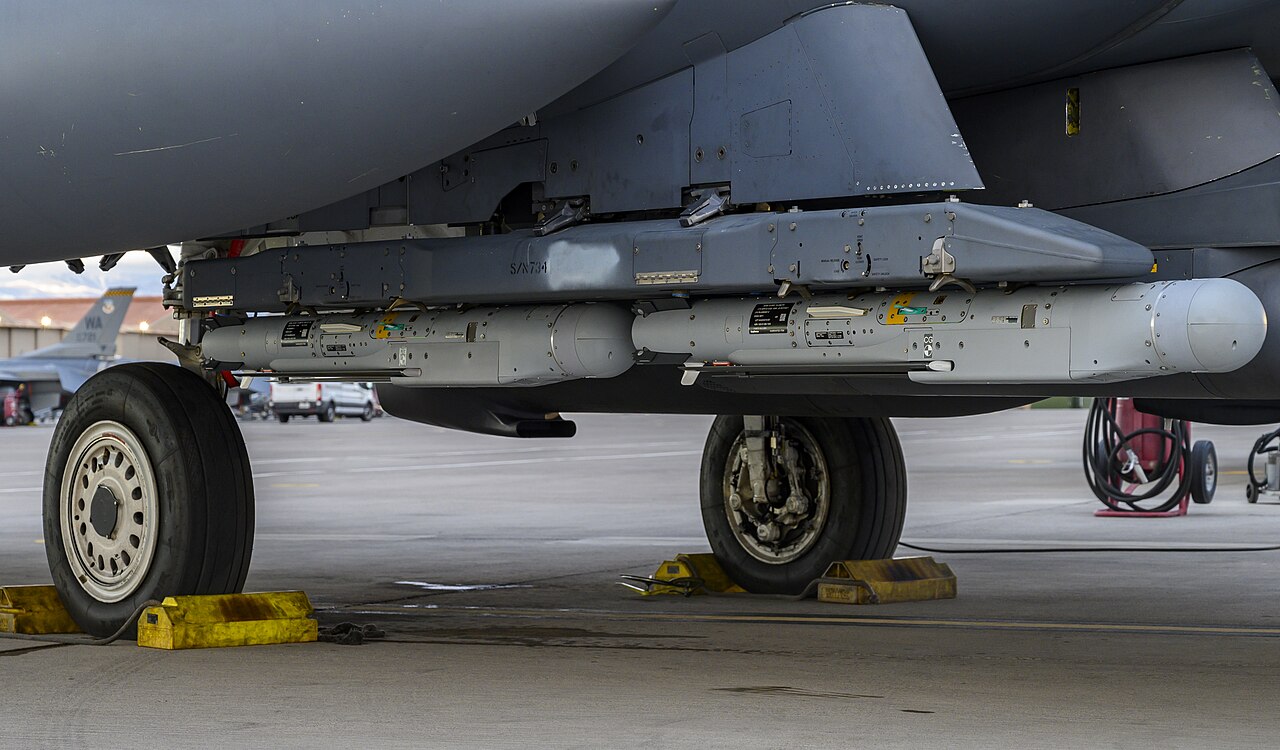
Photo: U.S. Air Force / Public Domain via Wikimedia Commons
Technical Summary
The U.S. Department of Defense announced on 6 April 2026 the award of a $708,939,863 not-to-exceed firm-fixed-price contract to Raytheon Company (Tucson, Arizona) for GBU-53/B Small Diameter Bomb Increment II (SDB II), designated StormBreaker, Lot 12 production. The contract covers all-up rounds (AURs), shipping containers, test equipment, and spares, with work completion scheduled for 6 March 2030 [1].
The GBU-53/B StormBreaker is a 93 kg (205 lb) precision-guided glide munition employing a tri-mode seeker combining millimetre-wave radar, uncooled imaging infrared, and semi-active laser guidance. This tri-mode capability enables engagement of moving and stationary targets through adverse weather conditions, including cloud cover, dust, and smoke; a significant capability gap addressed by the SDB II compared to its GPS/INS-only predecessor, the GBU-39/B SDB I [2].
The weapon incorporates a multipurpose warhead with blast-fragmentation and shaped-charge liner effects, designed for anti-armour, anti-vehicle, and anti-personnel applications. Published sources indicate an NEQ of approximately 15.9 kg (35 lb) of AFX-757 insensitive explosive fill, an IM-compliant formulation based on DNAN (2,4-dinitroanisole). HD/CG classification depends on packaging configuration and fuze state, refer to STANAG 4123 / AASTP-3 for assessment criteria [3].
The contract includes Foreign Military Sales (FMS) to eight nations: Belgium, Canada, Denmark, Finland, Germany, Italy, the Netherlands, and Norway — indicating broad NATO adoption of the system.
Analysis of Effects
Concurrently, the DoD awarded Rockwell Collins Inc. (Cedar Rapids, Iowa; Fairfield, California) a $25,899,097 indefinite-delivery/indefinite-quantity contract for detonation transfer assemblies (DTAs) and thin layer explosive (TLE) lines. This is a sole-source acquisition with work completion scheduled for 5 April 2033 [1].
Detonation transfer assemblies are critical initiation train components that transfer the detonation impulse from the fuze to the main explosive charge. TLE lines serve as the detonating cord equivalent within miniaturised precision munitions, providing the explosive signal path between the electronic safe-and-arm device (ESAD) and the warhead booster. The sole-source nature of this procurement indicates that Rockwell Collins holds the only qualified production capability for these components; a single-point-of-failure in the munitions supply chain.
For WOME professionals, the DTA/TLE supply chain presents a vulnerability. Qualification of a second source for these initiation components would require compliance with STANAG 4187 (fuzing safety design) and AOP-7 (qualification testing of explosive materials), a process typically requiring 18–24 months [5]. Until second-source qualification is achieved, any disruption to the Rockwell Collins production line would directly impact GBU-53/B, and potentially other precision munitions sharing common initiation components.
Personnel and Safety Considerations
Storage of GBU-53/B AURs requires compliance with AASTP-1 (NATO Guidelines for the Storage of Military Ammunition and Explosives) Quantity Distance calculations. With Lot 12 production supplying eight FMS nations in addition to U.S. forces, receiving nations must ensure their Potential Explosion Sites (PES) have adequate QD separation distances for the incoming stockpile quantities. The IM-compliant AFX-757 fill may qualify the munition for reduced QD requirements under AASTP-1 if sympathetic reaction testing under STANAG 4439 (AOP-39) demonstrates No Reaction or Burning results [3][4].
Transport of GBU-53/B AURs internationally requires ADR/RID classification for European road/rail transport and IMDG Code compliance for maritime shipment to FMS nations. The IM-compliant fill may facilitate less restrictive transport conditions compared to conventional RDX/TNT-based fills.
Data Gaps
DATA GAP: Exact AFX-757 composition and published VoD data — manufacturer specifications not available in open sources.
DATA GAP: GBU-53/B AUR packaging configuration for Lot 12 — HD/CG classification cannot be confirmed without packaging details.
DATA GAP: DTA/TLE compatibility across other precision munition programmes — extent of sole-source vulnerability unknown.
DATA GAP: FMS nation storage readiness — whether receiving nations have completed AASTP-1 QD assessments for incoming stockpiles.
Source reliability: A–2 (Official U.S. Government source, independently confirmed).
References & Sources
- U.S. Department of Defense – Contracts for April 6, 2026 – Tier 1 (Official)
- NAVAIR – Small Diameter Bomb Increment II (SDB II) Program Overview – Tier 1 (Official)
- STANAG 4123 / AASTP-3 – Hazard Classification of NATO Ammunition and Explosives
- STANAG 4439 / AOP-39 – Policy for Introduction and Assessment of Insensitive Munitions
- STANAG 4187 – Fuzing Systems Safety Design Requirements
Disclosure: This analysis is AI-assisted and based on open-source material. No classified information. For professional use only.