XM8 Carbine Enters Production: Inside the US Army’s $4.5 Billion Bet on 6.8mm Lethality
The Next Generation Squad Weapons programme was sold on the premise that overmatch against peer adversaries demanded a wholesale calibre change, the XM8 carbine’s first delivery to troops suggests the Army is now quietly admitting that the M7 rifle it fielded two years ago was too heavy and too long for the soldiers who actually carry it into buildings.
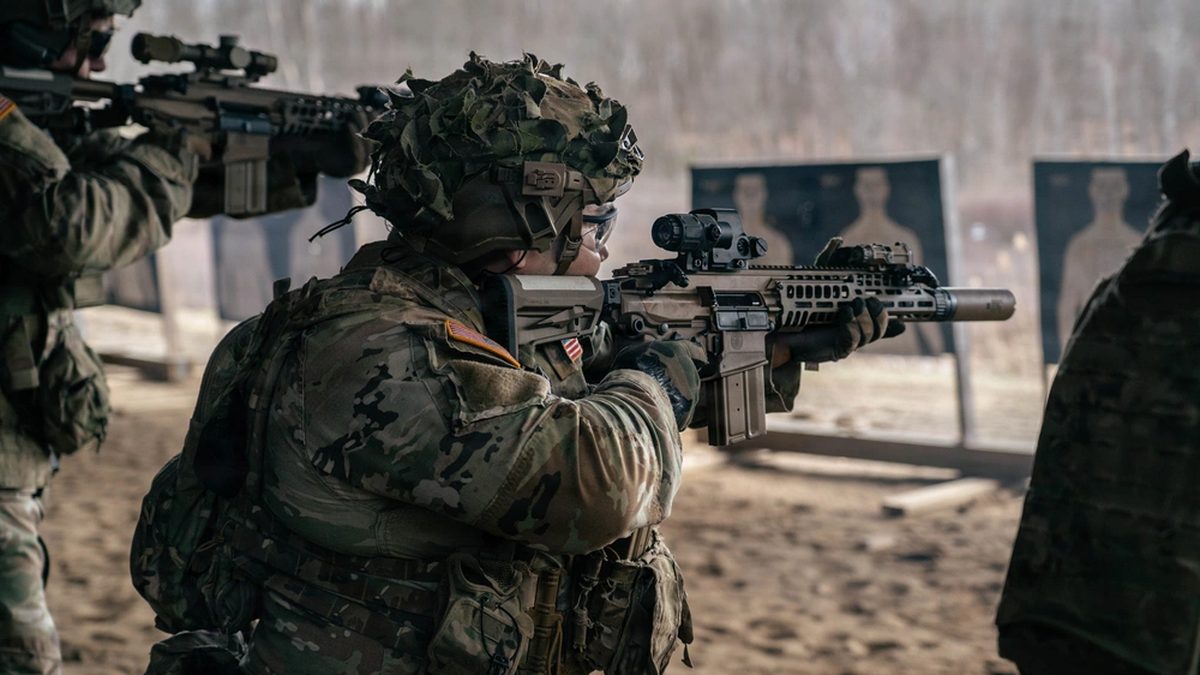
A soldier from 1-32 INF, 1st BCT, 10th Mountain Division fires an M7 rifle during NGSW familiarisation training at Fort Drum, New York, 16 March 2026. Spc. Samuel Shomento / 10th Mountain Division / DVIDS / Public Domain
First Delivery Accepted: What the Army Has Bought
On 3 April 2026, Capability Program Executive Ground (CPE Ground) at Picatinny Arsenal, New Jersey, announced that the US Army had accepted the first delivery of the XM8 Carbine from SIG Sauer. The initial delivery order includes carbines, essential accessories, spare parts, and contractor support, though the Army has not disclosed how many weapons were included in the first consignment. The XM8 is a shortened, lightened variant of the M7 Rifle (formerly designated XM7) developed under the Next Generation Squad Weapons (NGSW) programme, and is destined to replace the M4A1 Carbine in the Close Combat Force (CCF).
The procurement decision was formalised on 10 December 2025, when the Army approved advancing the carbine variant into production. That decision followed a full developmental verification test and a dedicated Soldier Touch Point held in September 2025, during which troops from the 101st Airborne Division, US Army Special Operations Command (USASOC), and other units provided direct feedback on the weapon’s handling, carried load, and integration with the M157 NGSW-Fire Control (NGSW-FC) optic system. Early testing units are expected to receive XM8 carbines as soon as October 2026, according to Army spokespeople.
SIG Sauer was originally awarded the NGSW production contract in April 2022; a ten-year Indefinite Delivery/Indefinite Quantity (IDIQ) agreement with a ceiling value of $4.5 billion for weapons and ammunition. The initial delivery order under that contract was valued at $20.4 million, covering the first tranche of M7 rifles, M250 automatic rifles, and 6.8mm Common Cartridge ammunition for testing. The XM8 carbine falls under this existing IDIQ umbrella rather than a separate contract vehicle. A parallel contract worth up to $2.7 billion was awarded separately to Sheltered Wings Inc., trading as Vortex Optics, for production of up to 250,000 XM157 NGSW-FC fire control systems, bringing the total programme investment to approximately $7.2 billion over the next decade. At full production, the implied per-unit cost of the M157 optic runs to approximately $10,800; a figure that reflects the extraordinary technological density packed into what the Army describes as a “smart optic.”
Technical Profile: Shorter, Lighter, Same Calibre
The XM8 retains the M7’s core operating system (a short-stroke gas-operated piston with rotating bolt) and chambers the same 6.8×51mm (.277 SIG Fury) composite-case cartridge. The critical differences are dimensional. Where the M7 carries a 13.5-inch barrel and weighs 8.38 lb (3.80 kg) unloaded, the XM8 shortens the barrel to approximately 11 inches (280 mm) and drops unloaded weight to around 7.3 lb (3.31 kg). With suppressor and heat shield fitted, the XM8 weighs roughly 8.8 lb (4.0 kg), placing it at approximate parity with the M4A1 it replaces. Overall length with stock collapsed and suppressor attached runs to approximately 32.8 inches (833 mm), compared to the M7’s 37 inches.
| Parameter | M4A1 | M7 Rifle | XM8 Carbine |
|---|---|---|---|
| Calibre | 5.56×45mm NATO | 6.8×51mm | 6.8×51mm |
| Barrel Length | 14.5 in (368 mm) | 13.5 in (343 mm) | ~11 in (280 mm) |
| Weight (unloaded) | 6.4 lb (2.9 kg) | 8.38 lb (3.80 kg) | ~7.3 lb (3.31 kg) |
| Weight (w/ suppressor) | N/A (no integral) | 9.84 lb (4.46 kg) | ~8.8 lb (4.0 kg) |
| Magazine Capacity | 30 rounds | 20 rounds | 25 rounds |
| Muzzle Velocity | ~2,970 ft/s (905 m/s) | ~3,000 ft/s (915 m/s) | ~2,800–2,900 ft/s (est.) |
| Fire Control | Various optics | M157 NGSW-FC | M157 NGSW-FC |
| NSN | 1005-01-231-0973 | — | 1005-01-737-3402 |
The barrel reduction carries a predictable trade-off. Muzzle velocity drops to an estimated 2,800–2,900 feet per second, compared to the M7’s 3,000 ft/s. For the 6.8×51mm cartridge (which generates chamber pressures of approximately 80,000 psi, well above the 5.56mm NATO’s 62,000 psi) this velocity reduction is modest and the Army states the XM8 still exceeds its lethality requirements at operationally relevant ranges. The tapered barrel profile also reduces forward mass, improving balance during rapid target transitions in confined spaces such as vehicles and urban structures.
Counterintuitively, the shorter barrel appears to have improved mechanical accuracy. Testing indicates approximately a 1 MOA improvement over the M7, attributable to the stiffer, shorter tube producing less barrel whip during firing. This is a significant finding for a weapon intended for close-quarters engagements where rapid follow-up shots are critical.
The suppressor has been redesigned accordingly: the XM8’s unit measures 6 inches in length and weighs 1.31 lb, compared to the M7’s 7-inch, 1.46 lb suppressor. A thermal shield has been added that extends thermal signature concealment from the M7’s 5–7 rounds to approximately 100 rounds before the suppressor becomes visible to thermal imaging. A tactically significant improvement for sustained engagements. Soldier feedback drove several further refinements: a lightened upper receiver, a slightly slimmer barrel profile, a rigid handguard that eliminates the M7’s takedown link, and a fixed stock that still collapses in the manner of the M4 with a one-screw folding option available. The overall handling balance was cited as a priority throughout the September 2025 Soldier Touch Point evaluations.
SIG Sauer has confirmed that initial XM8 units began shipping at the end of March 2026, with “significant quantities” of the M7 rifle already delivered to the force. The company has also indicated plans for commercial sales of the XM8, potentially within the next year; an unusual step that would make the latest US military small arms technology available to civilian markets while production for the armed forces is still ramping up.
The NGSW Financial Landscape
The NGSW programme represents the most significant US small arms procurement investment since the M16 family entered service in the 1960s. The combined programme cost of approximately $7.2 billion encompasses weapons, ammunition, and fire control, but the full cost picture extends further when ammunition sustainment, training, fielding support, and logistics are included.
The $4.5 billion weapons and ammunition IDIQ contract with SIG Sauer is structured to procure up to 107,000 rifles and 13,000 automatic rifles over the next decade for close combat forces. The contract also provides a mechanism for other Department of Defense services and Foreign Military Sales (FMS) customers to purchase NGSW weapons, potentially expanding the production volume and reducing per-unit costs over time.
The ammunition economics are particularly noteworthy. The 6.8×51mm round uses a hybrid-case design (a steel base bonded to a brass body) which is substantially more expensive to manufacture than conventional brass-cased 5.56mm NATO. While the Army has not published per-round costs for operational procurement, the composite-case technology represents a manufacturing premium that will persist throughout the programme’s life. Soldiers currently carry 140 total rounds in seven 20-round magazines, weighing 9.8 lb, approximately 70 fewer rounds and 2 lb heavier than the equivalent M4A1 combat load in 5.56mm.
The XM8 ships with a 25-round magazine as standard — a direct response to soldier criticism. US Army Captain Braden Trent’s May 2025 assessment described the M7’s 20-round capacity as a “liability,” and the XM8’s larger magazine partially offsets the capacity gap with the M4A1’s 30-round standard. A seven-magazine combat load now provides 175 rounds at 12.3 lb, compared to the M7’s 140 rounds at 9.8 lb. Lightweight ammunition development is also underway to reduce the per-round weight penalty of the 6.8mm cartridge.
Fielding: Who Gets the Weapons and When
The M7 rifle’s fielding trajectory provides the roadmap for XM8 distribution. Initial M7 fielding began in March 2024 with 1st Battalion, 506th Infantry Regiment, 101st Airborne Division at Fort Campbell, Kentucky. Prior to that, operational testing involved Alpha Company, 2nd Battalion, 502nd Infantry Regiment (also 101st Airborne) and members of 1st Battalion, 75th Ranger Regiment during late 2023.
By January 2026, the 25th Infantry Division at Schofield Barracks, Hawaii, had begun M7 training with support from the US Army Marksmanship Unit (USAMU), which deployed NCO-focused instructors to cascade expertise into line units. The Army formally achieved Type Classification–Standard for the M7 Rifle and M250 Automatic Rifle in May 2025, clearing both systems for unrestricted fielding across the CCF.
The NGSW programme targets fielding across a defined set of Military Occupational Specialties (MOS) within the CCF: infantry, scouts, combat medics, forward observers, combat engineers, and special forces. In FY26, the Army is issuing the latest commercial-off-the-shelf (COTS) optics and aiming lasers to six Mobile Brigade Combat Teams for assessment and soldier feedback. A parallel effort that indicates the breadth of the modernisation push.
The XM8 carbine is likely to follow a similar fielding pattern: initial distribution to high-readiness units (airborne, ranger, special operations) followed by broader fielding to infantry brigade combat teams. The compact dimensions make it particularly suited to vehicle crews, urban warfare specialists, and personal security details where the full-length M7 presents handling challenges in confined spaces. However, the Army has not published a specific XM8 fielding schedule or identified which units will receive the carbine first beyond confirming October 2026 as the target date for early test units.
Notably, the United States Marine Corps has opted out of the NGSW programme entirely, electing to continue with the M27 Infantry Automatic Rifle (a 5.56mm HK416-based platform) as its primary infantry weapon. This decision means the 6.8×51mm calibre transition is an Army-only initiative rather than a Joint service undertaking, limiting production volumes and eliminating any economy-of-scale benefit that cross-service procurement would have provided. It also creates an interoperability divergence at the calibre level between the two ground combat services; a logistics consideration that becomes significant in combined Army–Marine operations.
The M157 Fire Control: A $2.7 Billion “Smart Optic”
If the XM8 carbine represents the kinetic half of the NGSW programme, the M157 NGSW-FC represents the cognitive half, and at $2.7 billion over a decade, it is arguably the more consequential investment. Awarded to Sheltered Wings Inc. (d/b/a Vortex Optics) of Barneveld, Wisconsin, in January 2022 as a ten-year Firm Fixed Price Follow-on Production Other Transaction Agreement (P-OTA), the contract covers production and delivery of up to 250,000 fire control units. The minimum guaranteed value is $20 million; the ceiling is $2.7 billion, with actual spend determined by delivery orders over the contract period.
Vortex beat L3Harris Technologies (the only other company selected to provide a prototype) following a competitive evaluation that assessed optical performance, electronic integration, durability, and soldier usability. The award represented a notable upset: Vortex, better known in the hunting and precision shooting markets, defeated a defence electronics incumbent with decades of military optics heritage.
The M157 is built around a 1–8×30mm Low Power Variable Optic (LPVO) with glass-etched reticle lenses manufactured entirely in the United States. What distinguishes it from any conventional combat optic is Vortex’s proprietary Active Reticle® technology: a digitally projected aiming point injected into the first focal plane of the optic, overlaying the traditional etched reticle. The system integrates the following capabilities into a single weapon-mounted package:
| Capability | Detail |
|---|---|
| Variable magnification optic | 1–8× with 30mm objective; backup etched reticle functional without power |
| Laser range finder (LRF) | Ranges target, feeds distance to ballistic solver automatically |
| Ballistic calculator | Computes trajectory correction and displays adjusted aim point in real time |
| Atmospheric sensor suite | Temperature, pressure, humidity — feeds environmental data to ballistic solver |
| Digital compass | Bearing data for target reference points and fire support requests |
| Visible & IR aiming lasers | Integrated aiming lasers for day/night target designation |
| Digital display overlay | Active Reticle® projects computed aim point into first focal plane |
| Intra-Soldier Wireless (ISW) | External wireless comms to soldier-mounted subsystems and network devices |
The operational concept is straightforward but transformative: a soldier ranges a target through the optic, the M157 automatically calculates the ballistic solution accounting for range, ammunition type, atmospheric conditions, and weapon cant, then projects an adjusted aim point into the field of view. The soldier places the projected dot on the target and fires. This collapses the marksmanship skill chain (range estimation, manual holdover calculation, environmental correction) into a single automated sequence. For the 6.8×51mm cartridge, which has a flatter trajectory and greater energy retention than 5.56mm, the M157 theoretically extends the effective engagement range of every soldier equipped with the system.
The M157 replaces three legacy optics simultaneously: the Close Combat Optic (CCO), the Rifle Combat Optic (RCO), and the Machine Gun Optic (MGO). Universal compatibility across both the M7 rifle and the XM8 carbine is confirmed; the same optic mounts and functions identically on either weapon platform, simplifying logistics and training.
Product Improvement: The MOSA Roadmap
CPE Ground’s announcement emphasised that the XM8 is one element of a broader NGSW product improvement programme. Additional efforts underway include lightweight ammunition to reduce carried load, 25-round magazines to increase the UBL, alternate optics configurations to provide unit commanders with flexibility, and enhancements to the M157 Fire Control for integration into Army network infrastructure.
The network integration pathway is where the M157’s true long-term value becomes apparent. Planned upgrades include integration into Soldier Borne Mission Command (SBMC) and Nett Warrior devices, which would enable soldiers to create target reference points and request fire support with greater precision directly from their weapon optic. The M157’s compass and laser range finder data, combined with GPS from the soldier’s Nett Warrior device, could generate grid coordinates for indirect fire missions without the soldier needing to consult a separate targeting system.
A thermal imager is also under development to substitute the AN/PAS-35 Family of Weapons Sight-Individual (FWS-I) currently mounted on NGSW platforms. The Army states this would reduce both cost to the government and weight carried by the soldier. The M157’s Modular Open Systems Approach (MOSA) with front and rear industry-standard open-source enabler ports is the architectural key to all of these upgrades: new sensors, communications modules, and software updates can be integrated without replacing the core optic body. This is a deliberate design choice intended to future-proof the $2.7 billion fire control investment against evolving technology; the Army buys the optical platform once and upgrades the digital capabilities incrementally over the decade-long production run.
In FY26, the Army is issuing the latest commercial-off-the-shelf (COTS) optics and aiming lasers to six Mobile Brigade Combat Teams in parallel with NGSW fielding. This parallel assessment suggests the Army is keeping its options open on whether the M157 will be the sole fire control solution or whether lighter, cheaper COTS alternatives might complement it in certain unit configurations. A pragmatic hedge against the $10,800-per-unit cost of the full M157 system.
Standardisation Gap: Where Is MSIAC?
The introduction of a fundamentally new calibre into the NATO small arms ecosystem raises an obvious question: where is the allied standardisation review? The Munitions Safety Information Analysis Center (MSIAC) (NATO’s clearing house for munitions safety, performance data, and interoperability analysis) has not, to ISC’s knowledge, published a technical assessment of the 6.8×51mm cartridge’s performance characteristics, insensitive munitions compliance, or logistics compatibility with existing NATO ammunition standards.
The 6.8×51mm round operates at chamber pressures of approximately 80,000 psi, roughly 29% above the 5.56mm NATO maximum average pressure of 62,000 psi. It uses a hybrid steel-brass composite case that is fundamentally different from any cartridge in the current NATO inventory. The energetic fill, propellant characteristics, barrel erosion profile, and storage classification of this cartridge all warrant independent analysis under the frameworks that MSIAC exists to provide. STANAG 4172 governs the 5.56×45mm NATO round; no equivalent STANAG exists for 6.8×51mm, and none appears to be in development.
ISC Defence Intelligence assesses that MSIAC should be actively reviewing the 6.8×51mm cartridge’s performance envelope, initiating work towards a new standard or STANAG amendment, and publishing guidance for allied nations considering whether to adopt, evaluate, or maintain interoperability with US forces fielding this calibre. The absence of this work represents a standardisation gap that will widen as NGSW fielding accelerates through 2027–2029.
The Real Question: Peer-on-Peer Infantry Overmatch
The US Army justified the entire NGSW programme on the premise that 5.56×45mm NATO was insufficient to defeat modern body armour and achieve overmatch against peer adversaries at extended ranges. The 6.8×51mm cartridge was specifically designed to penetrate Level IV body armour plates at combat distances where 5.56mm cannot. That premise invites a question the programme office has been careful not to answer directly: what advantage does the NGSW weapon system actually provide against other infantry forces?
There are two comparisons that matter. The first is peer-on-peer within NATO itself. Twenty-nine of the thirty-two NATO member states still field 5.56×45mm as their standard infantry calibre. A US infantry squad armed with the M7/XM8 and M157 fire control now carries a fundamentally different weapon system to its British, French, German, Canadian, Polish, or Norwegian counterparts. In a combined NATO operation, the US Close Combat Force cannot share ammunition with any allied infantry unit. The M157’s fire control capabilities (integrated laser range finding, ballistic computation, atmospheric correction) give the individual US soldier a technological advantage in target engagement that no allied 5.56mm platform currently matches. The question NATO must answer is whether this creates a two-tier alliance where US infantry operates at one level of capability and everyone else operates at another, and whether that gap enhances or degrades coalition interoperability.
The second comparison is against the Eastern Bloc standard: 5.45×39mm. Russian and former Soviet-equipped forces field the AK-74M and derivatives chambered in 5.45×39mm: a cartridge that produces approximately 1,328 joules of muzzle energy from a standard-length barrel. The 6.8×51mm produces approximately 3,900–4,000 joules — roughly three times the energy. Against Russian 6B45 body armour (rated to stop 7.62×54mmR at close range), the 6.8mm round offers a theoretical penetration advantage that 5.56mm cannot reliably achieve beyond 100–150 metres. At 300 metres and beyond, the energy differential is decisive: the 6.8×51mm retains sufficient energy to defeat Level IV equivalent protection where both 5.56mm and 5.45mm have fallen below their respective penetration thresholds.
But overmatch is not measured in muzzle energy alone. The 5.45×39mm platform allows a Russian infantryman to carry 360 rounds in twelve 30-round magazines at approximately 7.5 kg. A US soldier armed with the XM8 carries 175 rounds in seven 25-round magazines at 5.6 kg of ammunition, but with a weapon and optic system that weighs significantly more. The total fighting load comparison(weapon, optic, ammunition, suppressor) is where the advantage becomes less clear-cut. A lighter, simpler weapon with twice the ammunition count has tactical utility in a sustained engagement that raw ballistic superiority cannot always offset.
References and Sources
- CPE Ground — Army Approves XM8 Carbine, 26 March 2026. cpeground.army.mil US ARMY OFFICIAL
- CPE Ground — U.S. Army Announces XM8 Carbine Delivery Order, 3 April 2026. innovation.army.mil US ARMY OFFICIAL
- US Army — Army Awards Next Generation Squad Weapon Contract, April 2022. army.mil US ARMY OFFICIAL
- US Army — USAMU Builds Soldier Lethality During M7 Fielding with 25th Infantry Division, 2026. army.mil US ARMY OFFICIAL
- Soldier Systems Daily — Army Approves XM8 Carbine & 25 Round Magazines for NGSW, 2 April 2026. soldiersystems.net DEFENCE MEDIA
- Army Recognition — US Army Designates M7 Carbine Variant as XM8, March 2026. armyrecognition.com DEFENCE MEDIA
- Breaking Defense — Army Awards $2.7B Fire Control Systems Contract for NGSW, January 2022. breakingdefense.com DEFENCE MEDIA
- The Firearm Blog — Vortex Win US Army NGSW-FC Contract, January 2022. thefirearmblog.com DEFENCE MEDIA
- The Firearm Blog — Army Testing Shorter, Lighter XM8 Carbine (Revised), 19 March 2026. thefirearmblog.com DEFENCE MEDIA
- MSIAC — Munitions Safety Information Analysis Center. msiac.nato.int NATO ORGANISATION
ISC Commentary
The XM8’s arrival tells a story the programme office would rather frame as “responsive modernisation” than “corrective action.” When the M7 first reached the 101st Airborne in 2024, it weighed nearly two pounds more than the M4A1 it replaced and gave soldiers 70 fewer rounds to fight with. Troops asked for something shorter and lighter almost immediately. Two years on, the Army has produced exactly that; a weapon that matches the M4A1’s weight while retaining 6.8mm terminal performance.
The broader concern for WOME practitioners is ammunition logistics. The US military is simultaneously running two small arms calibres across the force, 5.56mm for non-CCF units and 6.8×51mm for the Close Combat Force. That dual-calibre logistics burden will persist for a decade or more, and the 6.8mm composite-case round is both heavier and more expensive than 5.56mm. At 107,000 rifles planned, the NGSW is not replacing the entire Army armoury; it is creating a two-tier small arms ecosystem that ammunition supply chains will need to sustain indefinitely. The Marine Corps’ refusal to adopt the system compounds this problem: the US now fields three distinct infantry calibres across its ground forces (5.56mm USMC and non-CCF Army, 6.8mm CCF Army, and 7.62mm for designated marksman and machine gun roles).
The real test of the NGSW programme is not whether the XM8 is a better weapon than the M4A1 — it almost certainly is. The real test is whether a $7.2 billion, Army-only calibre transition that creates interoperability gaps with both the Marine Corps and twenty-nine NATO allies delivers sufficient overmatch against peer adversaries to justify the logistics complexity it introduces. That question demands the kind of independent, multinational technical assessment that MSIAC was created to provide. Its silence on 6.8×51mm is, itself, a data point worth noting.