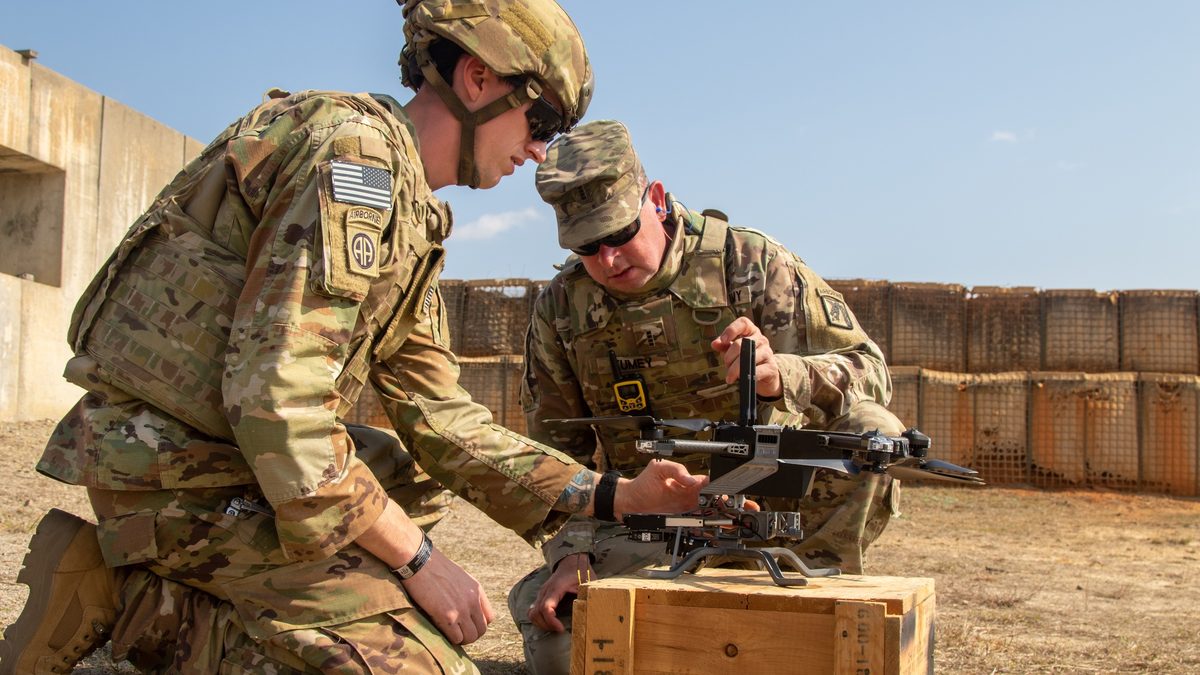
The Announcement
On 9 March 2026, the National Armaments Consortium (NAC) announced the addition of a new technical annex to its Master Cooperative Research and Development Agreement (CRADA) with the United States Army Combat Capabilities Development Command (DEVCOM) Armaments Center (AC), based at Picatinny Arsenal, New Jersey. The annex, effective immediately, focuses on the research, development, and prototyping of common UAS fuzing architectures, with the stated objective of demonstrating standardised interfaces, safety architectures, and designs that can be transitioned to the US munitions industrial base for scaled production.
The expansion is not a standalone contract. It sits within a “Master CRADA” framework signed in May 2022 that was specifically designed to bypass the slow, case-by-case negotiation of traditional Cooperative Research and Development Agreements. Under this structure, NAC and DEVCOM AC pre-negotiated terms and conditions covering intellectual property, licensing, and data-sharing obligations. New technical challenges are addressed by adding annexes: each spun up rapidly without renegotiating the base agreement. The first annex, established in 2022, targeted an application-specific integrated circuit (ASIC) for tri-service munitions. This UAS fuzing annex represents a significant broadening of scope.
Why Fuzing Standardisation Matters for UAS
Fuzing (the system controlling the arming, safety, and detonation timing of a munition) is governed in US military practice by MIL-STD-1316F (Design Criteria Standard: Fuze Design, Safety Criteria For). That standard mandates at least two independent safety features in every fuze, each capable of preventing unintentional arming, with functionally isolated control of safety features from other munition subsystems. It was written for conventional delivery systems: artillery rounds, aerial bombs, torpedoes, and missiles with well-understood flight envelopes and launch dynamics.
Weaponised UAS introduce variables that MIL-STD-1316F did not anticipate. A first-person-view (FPV) drone carrying a warhead may be built from commercial off-the-shelf (COTS) components, modified in the field, or even 3D-printed. The platform may carry droppable munitions released at low altitude, or function as a one-way attack system where the entire airframe is the delivery vehicle. Safe-and-arm devices (S&A) must function reliably across a much wider range of flight profiles, vibration spectra, and acceleration forces than conventional munition fuzing was designed to accommodate, and must do so on platforms that lack the standardised mechanical and electrical interfaces of legacy delivery systems.
The result, as Ben Harris, NAC Executive Director, framed it in coverage of the announcement, is a need for “some type of common standard so that it’s safe for the soldiers to be able to mount munitions onto these platforms.” Harris drew an explicit analogy to the Picatinny rail (the MIL-STD-1913 accessory mounting interface that became a universal standard for rifle attachments) as a model for what UAS fuzing standardisation could achieve.
The Picatinny CLIK Precedent
This UAS fuzing CRADA does not exist in a vacuum. DEVCOM AC has been building the architecture for standardised lethal UAS integration through a parallel initiative: the Picatinny Common Lethality Integration Kit (CLIK). Publicly released in September 2025, the CLIK specification defines the physical interface (mechanical attachment points), electrical interface (power delivery, network protocols, messaging), and safety-critical architecture between ground control stations and UAS carrying lethal payloads.
CLIK is, in essence, the platform-side standard. It tells manufacturers how to attach payloads and how to communicate between the drone and the munition. What it does not fully address is the internal fuzing architecture of those payloads: the safe-and-arm sequence, the environmental sensing logic, the arming delay criteria, and the detonation decision chain. That is the territory the new CRADA annex occupies.
Two payload systems already demonstrate the CLIK approach in practice. AUDIBLE uses quick-change adapters to deploy existing munitions, including the M67 fragmentation grenade, from small UAS platforms. Shank (formerly Project Shiv) equips FPV drones with an explosively formed penetrator (EFP) warhead and integrated safety measures for one-way attack missions. Both systems rely on DEVCOM AC-developed fuzing solutions, precisely because the commercial drone industry does not produce MIL-STD-1316-compliant safe-and-arm devices.
The NAC Consortium Model
NAC brings a particular kind of breadth to this problem. Described in its own materials as “one of the largest collaborative organizations working with the Department of Defense to develop armaments technologies in support of national security,” the consortium now counts more than 1,200 member organisations, up from roughly 970 when the Master CRADA was signed in 2022. Over 75% of those members are small or non-traditional defence firms, alongside universities and non-profit research institutions. NAC’s stated mission encompasses rapidly transitioning technology to the warfighter, strengthening the defence industrial base, and driving participation by nontraditional defence contractors through Other Transaction Agreements (OTAs), CRADAs, and future capability development pathways. Membership is restricted to US entities, though foreign technology can enter via subcontracting arrangements.
The consortium model matters here because the UAS fuzing challenge is not one that the traditional prime contractor ecosystem is well positioned to solve alone. The proliferation of drone designs means that fuzing solutions must work across platforms produced by dozens of manufacturers, many of them small companies or even field-modification workshops. NAC’s structure (with pre-negotiated IP protections and a low barrier to participation) is designed to pull exactly this kind of distributed innovation into a coordinated development effort.
“This expanded CRADA is about delivering standardized UAS capabilities that are both effective and adaptable to a battlefield that is constantly evolving. By pairing DEVCOM Armaments Center’s technical depth with the integration, prototyping, and production expertise of NAC members, we are enabling adaptable, manufacturable fuzing solutions that can be rapidly integrated, scaled, and fielded.” — Ben Harris, NAC Executive Director
The CRADA annex specifically enables participating NAC members and DEVCOM AC to exchange technical data on UAS fuzing design architectures currently under development across DEVCOM AC and partner Department of War (DoW) laboratories. The mechanism is bidirectional: government provides feedback on design approaches and safety requirements, while industry and academic partners feed back on technology gaps, interfaces, use cases, and manufacturability—the practical constraints that determine whether a safe design can actually be produced at the volumes the Pentagon’s drone strategy demands.
Buzzett, also of NAC, reinforced the tempo objective: “Together, we will keep accelerating scalable UAS solutions to deliver decisive capability to the warfighter.”
Safety Architecture: The Core Technical Challenge
The phrase “standardised safety architectures” in the CRADA announcement is doing significant work. For WOME practitioners, it signals an effort to define how safe-and-arm devices for UAS munitions should behave, not just in terms of MIL-STD-1316 compliance, but in the specific operational context of drone-delivered ordnance.
Consider the safety challenge. A conventional artillery fuze experiences a known acceleration profile during gun launch (setback forces of several thousand g), followed by a predictable spin rate that drives a centrifugal rotor to the armed position. The environments-in-sequence requirement (a cornerstone of fuze safety design since the 1960s) relies on these distinct physical signatures to separate the “safe” state from the “armed” state.
A UAS-delivered munition may experience none of these signatures. An FPV drone carrying a warhead at 30 m/s does not generate setback acceleration. A droppable munition released from 50 metres altitude has a fall time measured in seconds, not the fractional-second flight times of projectiles. The environmental sensing that triggers arming must rely on different physical phenomena: airspeed, GPS-derived altitude, time-of-flight, or electronic signals from the ground control station. Designing these alternative arming criteria while maintaining the two-independent-safety-feature requirement of MIL-STD-1316F is the central engineering problem this CRADA was built to address.
Harris and DEVCOM AC officials have acknowledged the tension between government safety requirements and industry’s focus on producibility at scale. The CRADA structure is intended to bridge this by narrowing the design space to proven-safe concepts that can also be manufactured rapidly, filtering out approaches that meet safety criteria but cannot be produced in volume, or that are producible but fall short on safety.
Timeline and Industrial Implications
Harris indicated in press coverage that modifications to existing fuzing systems for UAS application could reach operational use within 12 months. New fuze designs built from scratch will take longer, consistent with typical fuze development cycles of 24–36 months from concept through qualification testing.
A briefing on the UAS Fuzing CRADA was delivered on 5 March 2026 during a Department of War (DoW) Fuze Integrated Product Team (IPT) meeting, four days before the public announcement. Nick Cali of the US Army Fuze Division at DEVCOM AC presented the scope, schedule, and participation pathway for NAC members. The IPT briefing included a notional kickoff timeline, suggesting that the collaborative research phase is expected to begin promptly.
The industrial base implications extend beyond the United States. If DEVCOM AC and NAC produce a de facto standard fuzing interface for weaponised UAS, it is likely to shape allied procurement requirements and potentially influence NATO standardisation efforts. The Picatinny CLIK specification has already attracted international attention. A common fuzing architecture sitting beneath CLIK would create a layered interoperability framework (mechanical and electrical interfaces at the platform level, fuzing safety architecture at the munition level) that allied nations could adopt or adapt.
Data Gaps and Confidence Assessment
- Annex technical scope: The public announcement describes objectives in general terms. Specific performance requirements, target environments, and arming criteria for the standardised fuzing architecture are not public. Confidence: LOW—derived from press release language only.
- MIL-STD-1316 revision: Whether the CRADA outcomes will feed into a formal revision of MIL-STD-1316 to address UAS-specific fuzing requirements, or produce a separate UAS fuzing standard, is not stated. Confidence: LOW—inferred from the “safety architectures” language.
- CLIK integration: The relationship between the CLIK specification’s safety-critical architecture layer and this CRADA’s fuzing-specific work is not explicitly defined in public materials. Confidence: MODERATE—inferred from overlapping DEVCOM AC personnel and complementary scope.
- NATO interoperability: Whether the standardised fuzing architectures will be shared with allied nations or proposed for NATO standardisation (e.g., via STANAG) is not addressed. Confidence: LOW—speculative based on precedent.
- Participating NAC members: The specific companies and institutions contributing to the UAS fuzing annex have not been publicly identified. Confidence: LOW.