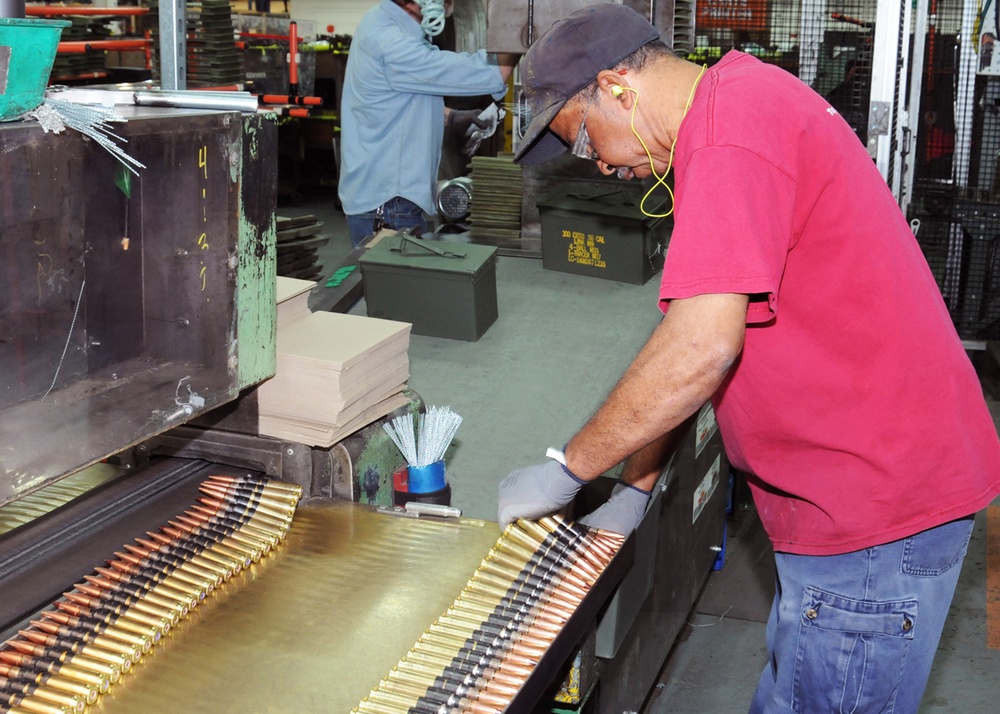
.50 calibre ammunition undergoing quality inspection at Lake City Army Ammunition Plant, Missouri. Photo: Dori Whipple / DVIDS, 11 May 2022. US Government work, public domain. VIRIN 220511-A-YZ466-050.
The Unsung Heroes of NATO Quality Assurance: Ensuring Munitions Perform from Factory to Front Line
NATO munitions quality rests on AQAP-2110 Edition D, the contractual standard mandated by STANAG 4107, and on the Government Quality Assurance Representatives who enforce it inside supplier plants. Both inherit ISO 9001:2015, whose 2026 revision (publication expected September 2026) reopens the entire Allied Quality Assurance Publication suite. Neither layer defines the explosives-specific competence a representative needs to catch a dangerous defect.
Why a Quality Failure Is an Operational Failure
A munition that does not function as specified is not a paperwork problem. It is a dud round in a fire mission, a fuze that arms when it should not, or a propellant lot that burns outside its pressure envelope. The consequences are measured in lost engagements, damaged platforms, and casualties.
Failures of this kind rarely begin on the battlefield. They begin years earlier, on a production line, where a process drifted from specification, a subcomponent was accepted without adequate verification, or a quality management system existed on paper but not in practice. The Allied Quality Assurance Publication 2110 (AQAP-2110) is NATO's primary instrument for stopping those failures before the product reaches a user.
The publication does not enforce itself. Between the written requirement and a conforming shell on a gun line sits a human layer: the Government Quality Assurance Representative (GQAR), the individual with unrestricted access to supplier facilities, the authority to reject nonconforming product, and the job of confirming that what a supplier says it made is what it actually made. How that system works, and where it does not, matters to anyone touching NATO procurement, Weapons, Ordnance, Munitions and Explosives (WOME) safety, or Allied interoperability.
The AQAP Architecture: Eight Publications, One Governance Body
AQAP-2110 does not stand alone. It sits inside a suite of eight Allied Quality Assurance Publications, all mandated by one treaty instrument and all owned by one committee. The mandate is STANAG 4107 Edition 11 (15 January 2019), which obliges Allied nations to use AQAPs in defence contracts where Government Quality Assurance (GQA) is specified. Every publication in the suite is aligned to ISO 9001:2015.
Ownership is precise, and getting it wrong signals unfamiliarity with the structure. The suite belongs to AC/327, the Life Cycle Management Group (LCMG) within the Conference of National Armaments Directors, and specifically to its Working Group 2 on Quality. It does not belong to AC/326, the Conventional Ammunition Safety Group (CASG), which owns a separate body of ammunition safety standards. The two committees run in parallel. No STANAG connects their remits for the purpose of personnel competence, and that quiet fact is the pivot of this article.
| Publication | Edition | Scope |
|---|---|---|
| AQAP-2110 | D | Design, development and production. The principal contractual standard. |
| AQAP-2310 | B | Aviation, space and defence suppliers. |
| AQAP-2131 | C | Final inspection and testing only. |
| AQAP-2105 | C | Deliverable quality plans. |
| AQAP-2210 | A | Supplementary software quality assurance. |
| AQAP-2070 | B | Mutual Government Quality Assurance process. |
| AQAP-2000 | 3 | Integrated systems approach. Strategic policy, not contractual. |
| AQAP-4107 | A | Implementation guidance for STANAG 4107. |
Common error to avoid
Three publications still cited in circulation, AQAP-2009, AQAP-2120 and AQAP-2130, were cancelled by STANAG 4107 Edition 11. Naming them as current in a tender or a quality assessment creates compliance ambiguity and marks the author as working from stale references.
The GQAR: Mandate, Authority and Daily Function
The GQAR is the Alliance's on-site assurance mechanism. Under AQAP-2110, the supplier must grant the representative unrestricted access to the facilities, processes, records and personnel tied to the contract. That access is a contractual obligation, not a courtesy. The core duties, as set out in Edition D, run as follows.
- Review, approve or reject the supplier's Quality Management System, Quality Plans, Risk Management Plans and Configuration Management Plans as they apply to the contract.
- Plan and run risk-based surveillance, including process audits, product verification and oversight of sub-suppliers across the supply chain.
- Disposition nonconforming product, concessions and corrective actions. The representative may reject a rework, repair or "use as is" decision.
- Witness final inspection and acceptance, and support issue of the Certificate of Conformity when contractual requirements are met.
- Liaise with the supplier's appointed quality management representative, require notice of organisational changes affecting quality, and attend post-award meetings.
- Coordinate cross-border surveillance through the Mutual Government Quality Assurance process under AQAP-2070 when a supplier or sub-supplier sits in another Allied nation.
Surveillance activities should only be undertaken by a registered GQAR. — UK MoD, Government Quality Assurance: A Functional Framework for Acquisition, Edition 2, December 2017
The Mutual GQA Mechanism
When a British prime contractor sources from a German sub-supplier, or a Dutch representative needs surveillance at a Belgian plant, the bilateral machinery of AQAP-2070 Edition B activates. The Mutual Government Quality Assurance process lets one nation's representative act on behalf of another, cutting duplication and using in-country expertise. For WOME procurement the value is high, because ammunition production is spread across the Alliance and the host-nation representative is often the only person physically close enough, and familiar enough with the national regulatory setting, to do the job. The legal framework is mature. The competence-assurance dimension of that delegation is much less developed, and delegation only transfers assurance if the person receiving the task is competent to perform it.
How the UK Trains and Licenses Its Representatives
The UK holds the most structured national approach to GQAR competence in NATO, which makes it the fairest place to test whether the framework closes the WOME gap. Three layers govern it. Joint Service Publication 940 sets the policy requirement. The Government Quality Assurance Functional Framework, Edition 2 (December 2017) provides the operating detail and is aligned to JSP 940 Part 2 Chapter 4 (updated March 2025). The MOD Quality Practitioner Licensing Scheme is the mechanism that assesses, records and authorises competence.
The SQEP baseline
All GQA staff must be Suitably Qualified and Experienced People (SQEP). That is a standing MoD requirement across technical domains, and GQA is not exempt. SQEP is the floor. The Licensing Scheme sits above it.
Licence, then registration
To hold a GQA Licence, a practitioner demonstrates competence across the majority of activities in all six stages of the acquisition lifecycle: planning, requirements preparation, supplier selection and contract award, contract execution, delivery, and acquisition conclusion. The assessment tool is the Skills Footprint, a granular description of what a competent practitioner looks like at each level. Skills Footprints live on a Defence Intranet resource and are not publicly accessible, which limits outside scrutiny of the standards being applied.
A second gate is easy to miss because the Framework buries it inside Stage 4. Surveillance may only be conducted by a registered GQAR. Registration is a distinct authorisation from the Licence: a licensed practitioner who is not registered cannot lawfully conduct supplier surveillance. Conflating the two, in commentary or in contract management, introduces real risk. Before any practitioner course, two prerequisites apply, Introduction to Defence Acquisition and QA Awareness On-Line Training, both delivered around a core offer from the Defence Academy. They are entry gates, not qualifications.
The Competence Gap: What the Framework Does Not Address
Read the GQA Functional Framework end to end and one absence stands out. The word "ammunition" does not appear. Neither do "ordnance", "explosives" or "energetic materials". The Licensing Scheme assesses competence in GQA process: surveillance technique, requirements management, supplier performance. It says nothing about the technical knowledge needed to judge quality in a high-hazard energetics environment. That is the single most important finding from the document.
The cause is structural, and it is a loop. AQAP-2110 inherits ISO 9001:2015 Clause 7.2, which requires an organisation to determine the competence its people need, ensure they have it, act on any gaps, and keep records as evidence. Clause 7.2 never defines competence for any sector. It delegates that to the contracting nation. For ammunition, the technical knowledge base that would define what a representative must understand about energetic materials belongs to AC/326, not AC/327. AC/327 demands competence but does not specify it for a product domain. AC/326 defines the technical knowledge but has no authority over procurement personnel. Each committee reasonably assumes the loop is closed on the other side. It is not.
The gap, stated plainly
A fully licensed and registered UK GQAR can lawfully oversee production at an ammunition plant. Whether that person holds enough knowledge of energetic materials, hazard classification or initiation systems to recognise a meaningful quality deviation is not assessed by the Licensing Scheme and not required by AQAP-2110. The gap is structural, not incidental, and the most developed national framework in NATO does not close it.
The ISO 9001:2026 Reset: A Window, Not a Threat
The whole AQAP suite is pinned to ISO 9001:2015. That anchor is about to move. The Draft International Standard for the next edition, ISO 9001:2026, was released on 27 August 2025, the Final Draft went forward in mid-April 2026, and publication is expected in September 2026 with a three-year transition to September 2029. When ISO 9001 changes, AC/327 Working Group 2 faces a re-alignment cycle across all eight publications, exactly as it did when the 2008 edition was withdrawn in 2018.
The headline changes are real: a requirement to assess the relevance of climate change, stronger language on quality culture, ethics and leadership behaviour, and the first explicit acknowledgement that artificial intelligence and digital tools sit inside the management system. What the Draft does not do is redefine competence. Clause 7 still asks the organisation to determine and evidence competence without saying what competent means for any sector. The delegation that created the WOME gap survives the revision intact.
That is precisely why the re-alignment is an opportunity. The suite is going to be reopened and re-issued anyway. A re-issue is the cheapest moment in a standard's life to add a sector-competence hook, because the drafting, ratification and national-implementation machinery is already turning. Miss this window and the gap is locked in for the life of the 2026 edition.
The European Blind Spot
NATO and the UK look strong only until the comparison widens. The European Union has no sector-specific competence framework for ammunition and explosives personnel at all. The European Defence Standards Reference System (EDSTAR) catalogues applicable standards but does not define competences. Its most substantial recent output, the EDSTAR Expert Group on Ammunition Technologies Final Report of 6 November 2024, reviews design, testing, qualification, certification and surveillance in depth, and recommends a stack of technical standards. It never asks who should be competent to apply them. The European Network of National Safety Authorities on Ammunition harmonises testing, not competence. EU Directive 2014/28/EU on explosives for civil uses explicitly excludes military ammunition. Each member state handles WOME competence nationally, against no common benchmark. Set beside that, the UK licensing model is not the laggard of the story. It is the leading edge that still stops short.
Frameworks That Could Close the Gap
The remedy does not need a new STANAG. Two ready-made competence architectures already exist. At the international level, IATG 01.90 (Personnel Competences, Version 3, 2021), the UN International Ammunition Technical Guidelines module on competence, sets out generic role levels for ammunition personnel, from handler and operator through processor, supervisor, manager, inspector and regulator, with a specialist field explosives safety role at Annex L. It is outcome-based, measuring demonstrated capability rather than classroom hours, and it maps one-to-one onto the UK sector standards. At national level, ESA National Occupational Standard Key Role 6 (Procurement) defines nine units of explosives-sector procurement competence and is mandated under DSA 02.OME Version 3.0 (July 2024). Either could be folded into the MoD Skills Footprint for WOME-relevant contracts, or referenced from a WOME annex to AQAP-2110, without disturbing the wider framework.
There is precedent for NATO closing a gap of exactly this shape. Explosives Safety and Munitions Risk Management was institutionalised into the Alliance through ALP-16, under STANAG 2617, after Afghanistan exposed organisational gaps between the logistics committee and AC/326. A dedicated panel was created to bridge them and embed the discipline into planning and operational doctrine. The Alliance has bridged a structural governance gap before, when operational experience made the cost of leaving it open too visible to ignore. The competence gap is the same kind of problem, waiting for the same kind of decision.
An institutional route already exists, too. The Munitions Safety Information Analysis Centre (MSIAC), NATO's technical advisory body under AC/326, already produces the hazard-classification guidance and munitions lifecycle analysis that would form the substrate of any WOME competence standard. MSIAC holds no amendment authority over the AQAPs; that stays with AC/327 Working Group 2 under the STANAG 4107 process. What MSIAC can do is define what technical knowledge a representative overseeing energetics actually needs, and hand AC/327 criteria ready to drop into a revised Skills Footprint or a dedicated note under AQAP-4107. That route asks neither committee to cede authority. It asks only for the will to commission the work and the discipline to act on it, and the ISO 9001:2026 re-alignment is the moment to try.
Key Questions
What is AQAP-2110 and who has to use it?
AQAP-2110 is NATO's Quality Assurance Requirements for Design, Development and Production, currently Edition D. STANAG 4107 requires Allied nations to apply it in defence contracts where government quality assurance is specified. It layers NATO-specific traceability, configuration and surveillance rules on top of ISO 9001:2015.
What is a Government Quality Assurance Representative?
A Government Quality Assurance Representative, or GQAR, is the state's on-site assurance officer. Under AQAP-2110 they hold unrestricted access to supplier facilities, can reject nonconforming product, and verify that what a supplier claims to have built matches what actually left the line. Surveillance may only be conducted by a registered representative.
Does NATO quality assurance require explosives-specific competence?
No. AQAP-2110 inherits ISO 9001:2015 Clause 7.2, which demands competent staff but never defines competence for any sector. Ammunition safety knowledge sits with a separate NATO body, AC/326. No standard bridges the two, so a fully licensed representative can oversee a munitions line without assessed energetic-materials knowledge.
References
Source-evaluated under NATO STANAG 2022 (Reliability A–F / Accuracy 1–6). Tier 1 = government or primary standards source; Tier 2 = specialist body or quality media; Tier 3 = authoritative encyclopaedia.
- T1NATO Standardization Office / Italian MoD mirror – AQAP-2110 Edition D: NATO Quality Assurance Requirements for Design, Development and Production, 2016 (PDF). (Reliability A / Accuracy 1)
- T1Bundeswehr (BAAINBw) – AQAP quality assurance requirements (NATO), STANAG 4107 and the AQAP suite, accessed 2026. (Reliability A / Accuracy 2)
- T1UK Ministry of Defence – JSP 940 Part 2: MOD policy for Quality (guidance), updated March 2025 (PDF). (Reliability A / Accuracy 1)
- T1UN Office for Disarmament Affairs – International Ammunition Technical Guidelines, IATG 01.90: Competence, Version 3, 2021. (Reliability A / Accuracy 2)
- T1UK Defence Safety Authority – DSA 02.OME / DSA 03.OME, on-site manufacture of explosives and ESA NOS Key Role 6, Version 3.0, July 2024. (Reliability A / Accuracy 2)
- T2TUV Rheinland – Revision of ISO 9001 coming in 2026: schedule and key changes, 2025 (DIS 27 August 2025, publication expected September 2026). (Reliability B / Accuracy 2)
- T2European Defence Agency / EDSTAR – Expert Group on Ammunition Technologies (EG AMMO) Final Report, Brussels, 6 November 2024 (JMG CR 00339; EDSC CR 00374). (Reliability B / Accuracy 2)
- T3Wikipedia – Allied Quality Assurance Publications, accessed 2026. (Reliability C / Accuracy 3)
Corrections & updates welcome. If you hold open-source data that refines or corrects any claim in this article, please contact [email protected] citing the specific claim and your source. Verified corrections will be incorporated and credited in the revision history. AI-assisted technical assessment based on open-source and publicly available material. Not legal, regulatory or formal quality-assurance advice.