Dstl Trials AI-Powered UAS for Automated Explosive Ordnance Detection with 33 Engineer Regiment (EOD&S)
AI-assisted ordnance detection is widely presented as a force multiplier that will transform Explosive Ordnance Disposal (EOD) operations — but the Dstl trial with 33 Engineer Regiment reveals that the critical capability is not detection accuracy alone, but the speed at which AI models can be retrained to recognise previously unseen threat types in operationally relevant timescales.
Technical Summary
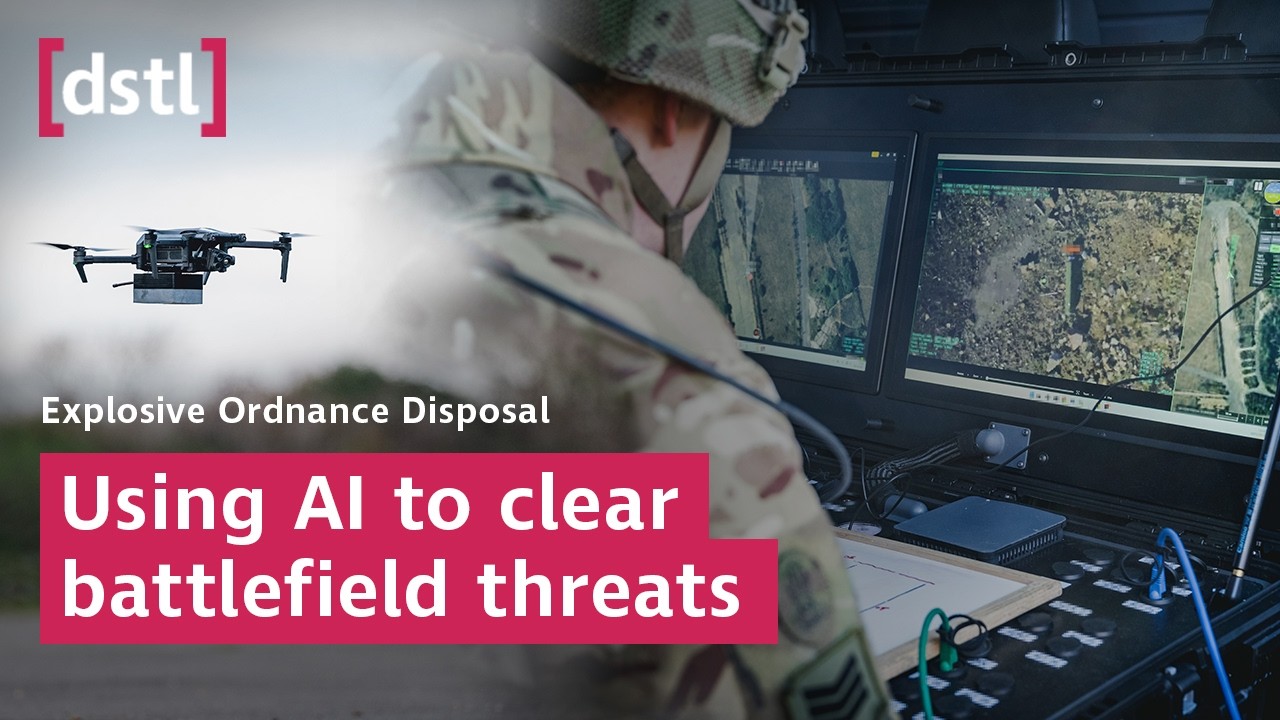
The Defence Science and Technology Laboratory (Dstl) conducted trials over several weeks with 33 Engineer Regiment (Explosive Ordnance Disposal and Search) at Carver Barracks, Essex, deploying AI-integrated small Uncrewed Aerial Systems (sUAS) for detecting landmines and explosive ordnance (EO). Dozens of replica mines and ordnance items were placed across varied terrain types to replicate operationally realistic conditions.
Multi-spectral sensor payloads captured data and transmitted it in near-real-time to ground operators, where AI processing built a threat picture without personnel entering the Potential Explosion Site (PES). The trial was conducted on behalf of the British Army, with Defence Minister Luke Pollard MP attending the demonstration.
The UK Government has committed to doubling autonomous platform funding from £2 billion to £4 billion under the Strategic Defence Review (SDR), positioning this trial within a broader transformation programme. Further trials are planned for the remainder of 2026 to mature the technology and guide the procurement of a deployable capability that can be placed directly into soldiers’ hands. New in V2
Analysis of Effects
The operationally significant finding is not that AI can detect ordnance in controlled conditions — this has been demonstrated in laboratory and field settings since approximately 2019. The critical capability revealed by the Dstl trial is rapid AI model retraining: the ability to retrain AI classifiers to recognise new and emerging threat types and adapt to different environmental conditions within operationally relevant timescales.
This adaptability is particularly important for Counter-IED (C-IED) operations, where threat types evolve quickly. An adversary deploying a previously unseen Victim-Operated Improvised Explosive Device (VOIED) design or employing novel concealment techniques requires detection models that can be updated in the field — not returned to a laboratory for weeks of recalibration.
Key implications for Weapons, Ordnance, Munitions, and Explosives (WOME) practitioners include reduced operator exposure time within cordons and Potential Explosion Sites, improved threat pattern recognition enabling informed Hazard Division (HD) and Net Explosive Quantity (NEQ) assessment for Personal Protective Equipment (PPE) selection and Render Safe Procedure (RSP) planning, and genuine human-machine teaming where AI cueing accelerates mission completion while keeping qualified operators in the decision loop.
Strategic Context: Ukraine Lessons and the Tenfold Lethality Goal New in V2
The official MoD announcement frames this trial explicitly within lessons drawn from the conflict in Ukraine, where drones and explosive ordnance are reshaping battlefields at unprecedented pace. The Strategic Defence Review identifies autonomy and AI as central pillars of the UK’s defence transformation.
The British Army has stated a goal of achieving a tenfold increase in lethality over the coming decade, driven by enhanced firepower, persistent surveillance, autonomous systems, digital connectivity, and data exploitation. The Dstl Counter-EO UAS trial sits squarely within this ambition — not as a standalone technology demonstration, but as part of a systemic shift toward sensor-shooter integration and reduced human exposure in high-threat environments.
Minister Pollard positioned the trial as “exactly the kind of innovation the Strategic Defence Review calls for,” signalling political alignment between the SDR’s procurement priorities and front-line experimentation with end-users.
Official Voices New in V2
The Dstl technical lead (unnamed in official releases) stressed Dstl’s role in understanding the underpinning science and technology alongside specialist industry suppliers, and in testing and adapting capabilities with end-users for modern battlefield competition. Major Fetters’ comment on sensor miniaturisation points toward a trajectory where increasingly capable sensor suites — potentially including ground-penetrating radar (GPR), thermal infrared (TIR), and hyperspectral imaging — are packaged into smaller, more deployable airframes.
Personnel and Safety Considerations
It is essential to frame AI-UAS detection within existing UK doctrine. The system functions as a detection and cueing tool only — it is not a replacement for manual Confirmation and Clearance procedures. Under DSA 03.OME (which replaced JSP 482, now withdrawn), Explosive Ordnance Disposal (EOD) operators remain responsible for assessing fuze state, ordnance condition, energetic stability, and selecting appropriate Render Safe Procedures (RSP).
Current NATO and humanitarian demining standards — including STANAG 2389 (NATO EOD doctrine) and IMAS 09.30 (International Mine Action Standards for clearance) — lack established validation methodologies for AI-assisted detection systems. There is no agreed standard for what constitutes an acceptable Probability of Detection (Pd) for an AI classifier in an operational EOD context, nor how such a system should be certified for use alongside manual clearance procedures. This doctrinal gap will need to be addressed as the capability matures toward fielded deployment.
Procurement Trajectory New in V2
The official MoD statement confirms that further trials will take place during the remainder of 2026 with the explicit purpose of maturing the technology and guiding procurement. This language marks a shift from pure experimentation toward an acquisition pathway. The phrasing “a deployable capability that can be placed directly into soldiers’ hands” suggests the intent is a Programme of Record or Urgent Operational Requirement (UOR), rather than continued laboratory demonstration.
For industry, this signals an emerging requirement that may appear on Defence Equipment & Support (DE&S) or Defence and Security Accelerator (DASA) procurement channels within 12–18 months. Companies with mature sUAS platforms, multi-spectral sensor integration, edge AI processing, and rapid model retraining capabilities should be monitoring this space closely.
Data Gaps and Confidence Assessment
Four critical information gaps remain across all public sources. These are consistent across official releases, Forces News, LBC, Anadolu Agency, and wider coverage — and are likely intentional for security reasons:
- Detection performance metrics: Probability of Detection (Pd), Probability of False Alarm (Pfa), and classification accuracy for the AI system have not been disclosed. Without these, operational confidence in the system’s reliability cannot be independently assessed.
- Sensor modality: The specific sensor type or types (electro-optical, infrared, ground-penetrating radar, magnetometry, or multi-spectral combination) have not been identified beyond the inference of multi-spectral payloads.
- Retraining timescale: The duration required to retrain the AI model to recognise new threat types has not been quantified. Whether this is measured in hours, days, or weeks has significant operational implications for deployability.
- Ordnance types tested: The specific replica ordnance types used in the trial, their Hazard Divisions (HD), and Compatibility Groups (CG) have not been disclosed. This limits assessment of whether the system was tested against a representative threat set.
Source evaluation (NATO STANAG 2022): GOV.UK press releases — Reliability: A (Reliable) / Accuracy: 2 (Probably True). ISC analytical assessment — Reliability: B (Usually Reliable) / Accuracy: 2 (Probably True).
References & Evidence Record
- GOV.UK — “AI-powered drones to detect explosive threats and protect military personnel,” 2 April 2026. [GOV.UK]
- GOV.UK — “Drones using AI to spot explosive dangers and help keep soldiers safe,” 2 April 2026. [GOV.UK]
- British Army — 33 Engineer Regiment (EOD&S) unit page. [Army.mod.uk]
- DSA 03.OME — Defence Ordnance, Munitions and Explosives Regulations (replaced JSP 482).
- STANAG 2389 — NATO Standardization Agreement: EOD Principles and Minimum Standards of Proficiency.
- IMAS 09.30 — International Mine Action Standards: Clearance Requirements, Second Edition 2019.
- UK Ministry of Defence — “Explosive Ordnance Disposal Using Drones and AI to clear threats,” YouTube, 2 April 2026. [YouTube] New
- HM Government — Strategic Defence Review, 2025. Referenced £4 billion autonomous platform commitment.
The Dstl trial represents a meaningful step in Counter-EO capability development, but the public narrative should be read carefully. The absence of performance metrics is notable and consistent with early-stage technology demonstrations where headline figures could set unrealistic expectations or reveal capability limitations to adversaries. The emphasis on retraining speed rather than raw detection accuracy suggests Dstl and 33 Engr Regt understand that the operational environment — not the laboratory — is where AI-EO systems will succeed or fail. This is an encouraging sign of doctrinal maturity.
The procurement pathway language in the official statement marks a shift. Watch for Defence Equipment & Support (DE&S) or Defence and Security Accelerator (DASA) notices referencing counter-EO UAS within the next 12–18 months. The trial aligns with the Army’s tenfold lethality goal and the £4 billion autonomous systems commitment — both of which create institutional momentum behind fielding this type of capability.