SixPAC: The Army Rebuilds Small-Calibre Ammunition Packaging Around 6.8 mm
Picatinny has replaced the wood wirebound overpack with steel and polymer. The engineering case is sound. The programme case is more complicated than the announcement suggests, and a NATO ally has been fielding a codified polymer equivalent for years.
The US Army has unveiled SixPAC, replacing the wood wirebound overpack with a steel outer pack and two polymer inner containers, and describes it as the first overhaul of small-calibre ammunition packaging since the Second World War. A Danish polymer equivalent, the PPD LWAC M2A1, has been in Danish Army service and codified with NATO Stock Numbers for years.
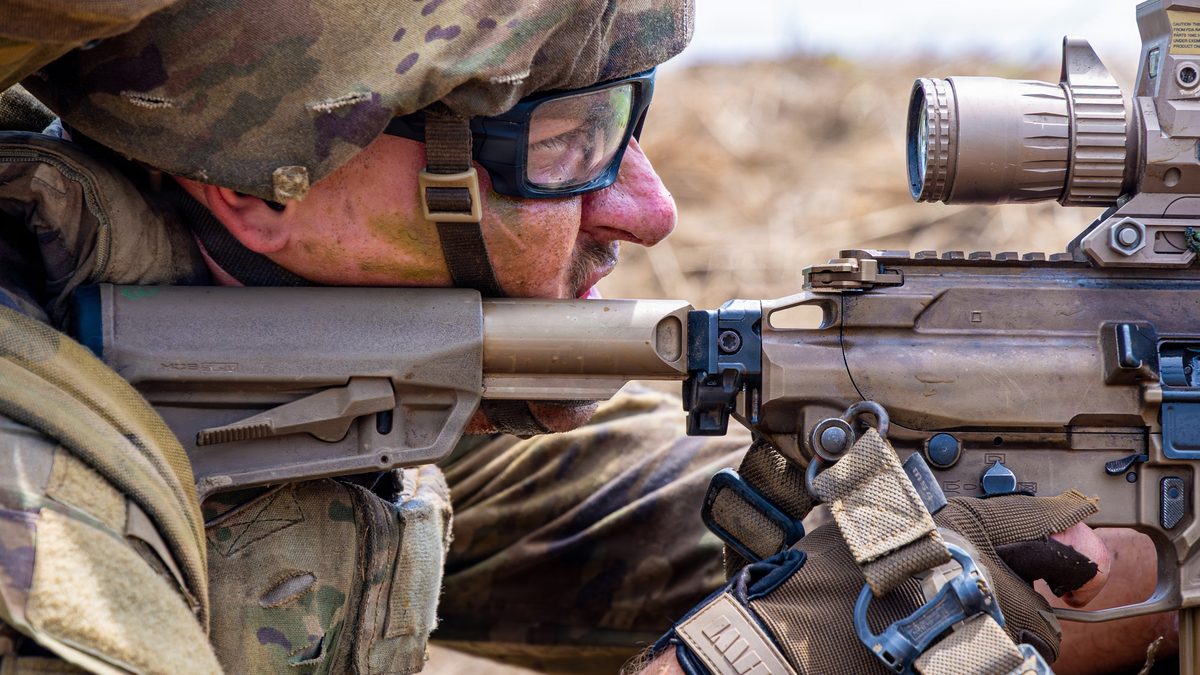
A soldier of the 2nd Battalion, 35th Infantry Regiment, 3rd Mobile Brigade, 25th Infantry Division sights through the optic of an M7 rifle during squad live fire training on exercise Salaknib 2026, Fort Magsaysay, Nueva Ecija, Philippines. US Army photo by Pfc. Jose Nunez, 28th Public Affairs Detachment, 4 June 2026. VIRIN 260604-A-QQ238-2569, released via DVIDS (image 9738834). Public domain work of the US Government. Its use does not imply endorsement by the US Department of War, the US Army or DVIDS.
Ammunition packaging is one of the least glamorous and most consequential parts of the munitions enterprise. The container determines how much a soldier can carry, how many rounds fit on a pallet, how the natures survive a decade in a humid depot, and, through the packaged configuration submitted for classification, how the ammunition may lawfully be stored and moved. It is also the part of the system that changes least often, which is why an announcement from Picatinny Arsenal on 26 August 2026 is worth more attention than its subject matter would normally attract.
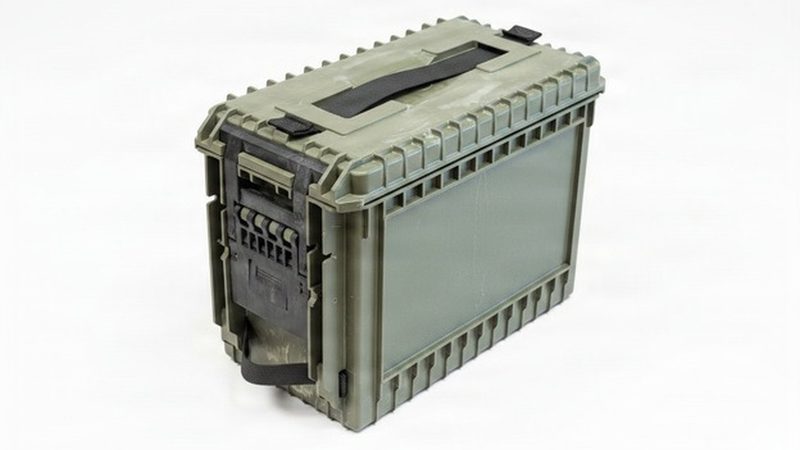
The US Army Combat Capabilities Development Command (DEVCOM) Armaments Center has unveiled SixPAC, a packaging architecture that removes the traditional wood wirebound box overpack and replaces it with a steel outer pack containing two polymer ammunition containers, abbreviated by the programme as PACs. The name derives from the 6.8 mm cartridge it was designed around. The Armaments Center describes it as the first major overhaul of small-calibre ammunition packaging since the Second World War, and states that the architecture is intended for phased adaptation across multiple legacy small-calibre production lines once it has been proven on 6.8 mm.
This assessment separates what the release establishes from what it does not. The engineering rationale is coherent and the industrial-base argument is the strongest part of the case. The weaker part is timing: SixPAC is being optimised around a cartridge whose weapon programme is currently in visible flux, and the announcement contains no fielding date, no production decision and no contract.
What the release establishes
The legacy configuration being displaced is the wood wirebound box used as an overpack. According to the Armaments Center, it required manual assembly, was susceptible to mould, and frequently required remediation. It also depends on chemical wood preservative treatments, which the Army identifies as both an environmental burden and a supply-chain exposure in its own right. Removing the wooden overpack therefore removes a labour-intensive assembly step, a degradation mode and a treatment-chemical dependency in a single change.
Two claims in the release are quantified. The first is weight: inner tactical polymer containers are expected to weigh about half of the legacy steel M2A2. Note the tense. The Armaments Center says several designs are in development and the figure is an expectation attached to designs still being refined, not a measured result from a type-classified container. The second is the supplier base: the Army states that more than 800 injection moulders within the United States are likely capable of producing these packs.
The second figure is the more strategically interesting of the two. Injection moulding forms most components in a single custom mould without a dedicated fabrication line, and the same press can be switched to other products by swapping moulds. The consequence is that packaging capacity stops being a specialised defence-industrial asset and becomes something close to a commodity service, purchasable from a large and geographically distributed commercial base. For a munitions enterprise that has spent the period since February 2022 discovering exactly how thin its specialised supplier tiers are, that is a meaningful structural change.
The steel outer pack carries the logistics argument. The Armaments Center states it permits more containers and more ammunition per pallet than the wood counterpart, and that it draws on a notably larger supply base. Pallet density is not a trivial gain. It propagates through container fill, airlift chalk planning and the number of vehicle movements required to push a given tonnage forward.
The soldier load argument, and its limits
Soldiers handled SixPAC through 2024 and 2025. The reported feedback was largely positive, and the specific observation the Armaments Center chose to publish concerns weight-sensitive platforms: on watercraft and aircraft, in the soldiers' phrasing, every ounce counts. The Army extends this to the dismounted case, arguing the saving allows troops to carry more ammunition.
That extension deserves a caveat that the release does not offer. Weight released from a soldier's load is not reliably converted into more ammunition. It is at least as often absorbed by water, batteries, protective equipment or communications. The documented long-run pattern is that infantry loads have risen as protective and communications capability has been added, which is not the same as demonstrating that a saving on any single item is reliably reallocated, and ISC does not claim that it is. The platform argument is the firmer of the two, because launch mass on light watercraft and rotary-wing aircraft is a hard constraint rather than a discretionary one. ISC assesses the aviation and maritime lift case as the more defensible justification, and would treat the dismounted claim as plausible but unproven pending load-carriage trials.
The packaging is not an accessory to the cartridge. It is part of the configuration in which the cartridge is classified, stored and moved, and changing it reopens questions that the announcement does not address.
What the announcement does not address
Hazard classification of the new configuration
Small-arms ammunition of this type is ordinarily assigned to Hazard Division 1.4, Compatibility Group S. That assignment is not a property of the cartridge alone. Under the joint US procedures issued as TB 700-2 and its service equivalents, and under the NATO regime in STANAG 4123 with AASTP-3, ammunition is classified in the configuration in which it is packaged. The packaging is one of the things being tested. Substituting a polymer inner container and a steel outer pack for a steel can inside a wooden box is therefore a change to the classified article, not merely to its wrapping, and the classification has to be established for the new configuration.
This matters most for the 1.4S determination. Compatibility Group S requires that the hazardous effects of accidental functioning stay inside the package, and that a package degraded by fire produce no blast or projection significantly hindering firefighting. Those properties are established through the UN Test Series 6 sequence, including the external fire test, so substituting polymer and steel for steel and timber reopens Series 6 rather than a drop and stack suite alone. Polymer and steel do not respond to a fire scenario the way steel and timber do. ISC makes no assessment of the outcome, and none should be inferred: the point is that the testing burden exists, sits on the critical path to fielding, and is not mentioned in the release. The same applies to the transport classification under UN provisions.
Ageing, surveillance and the storage life question
The Armaments Center is candid on the underlying issue. Its own framing is that polymer is not yet as proven in US military service as it is elsewhere, and that containers must hold up across widely varying climates even after years in storage. Polymer ageing is the substantive technical risk in this programme. Polymers embrittle, take a compression set at gasket interfaces, creep in latch geometry and lose impact performance under combined thermal and ultraviolet exposure, on timescales that are difficult to compress into an accelerated trial with confidence. A container that performs correctly at type classification and degrades at year twelve in a hot, humid depot is a stockpile surveillance problem, not a packaging problem, and it is discovered late.
The Armaments Center's stated approach is to keep material selection open rather than lock to a single formulation, and to publish performance requirements, dimensional constraints and lessons learned to industry. That is a reasonable posture for a design still in refinement. It is not yet a qualified storage life.
The 6.8 mm programme is moving underneath it
SixPAC is designed around 6.8 mm, and here the wider programme context complicates the picture. The M7 rifle was type classified in May 2025. The Army decided on 10 December 2025 to advance procurement of a carbine variant designated the XM8, announced it publicly on 26 March 2026, and states explicitly that the carbine is not a replacement for the M7. Reporting on the FY2027 budget request indicates the near-term buy shifts to roughly 15,000 XM8 carbines, while the Army retains an M7 acquisition objective. The often-repeated statement that no M7 rifles are procured in FY2026 comes from secondary reporting rather than a figure printed in the budget justification. Secondary reporting records a national stock number for the XM8; the official announcements do not publish one. The US Marine Corps has declined to adopt the rifle, retaining the M27. Ammunition production is meanwhile transitioning: Olin Winchester has been producing and delivering 6.8 mm from an interim capability at Lake City Army Ammunition Plant, and construction of the purpose-built facility on schedule with production equipment installation anticipated to begin in 2028. Army public affairs gives the floor area as 450,000 square feet; the main contractor's topping-out notice of January 2026 gives 508,345 square feet across two structures, and both figures remain in circulation.
None of this makes SixPAC misconceived. The weapons continue to share the 6.8x51 mm family regardless of which variant is bought, so cartridge volume is not in question in the way rifle volume is. But it does mean the packaging architecture is being proven against the smallest and newest of the Army's small-calibre lines. ISC assesses that the substantive prize is the stated follow-on: adaptation to legacy 5.56 mm and 7.62 mm production, where annual volumes are far higher and where the wood wirebound box and the M2A2 remain entrenched. On that reading, 6.8 mm is the pathfinder and the legacy natures are the payoff.
The European equivalent is already in service
The Armaments Center presents SixPAC as the first major overhaul of small-calibre ammunition packaging since the Second World War. That claim holds for the United States. It does not hold for the alliance. A NATO member has had a polymer replacement for the steel ammunition can in service, codified with NATO Stock Numbers and certified against alliance packaging standards, for several years.
PPD ApS, formerly PlastPack Defence, of Allerød, Denmark, produces the Light Weight Ammunition Case (LWAC) M2A1, designed as a full drop-in replacement for the steel M2A1 can rather than as a new architecture requiring new handling equipment. PPD states that the case is already in operational service with the Danish Army. The design was shown publicly at DSEI in September 2015 as a United Nations approved lightweight small-arms case, and PPD attributes its development to a DKK 273 million offset agreement concluded with NAMMO in 2013. In March 2026 PPD announced a production partnership with Skawplast A/S of Skagen, under which production is to take place wholly within Denmark. The release states the intention; it does not establish that series production had transferred by the time of writing. Denmark is recorded as the user in the NATO codification data under the code ZS, and the case is offered under the manufacturer's NATO Commercial and Government Entity (NCAGE) code R8083.
Codification and certification
For a NATO ammunition staff the significant part is not the product but its paperwork. The LWAC M2A1 is classified as NATO Packaging Level 1 under STANAG 4280, covering storage for one year outdoors in NATO worldwide conditions and open or enclosed movement by land, air or sea under operational conditions with multiple handling. It is separately classified as Class J under UK Defence Standard 81-41, covering a minimum of two years' worldwide storage with full weather protection. It holds Danish type approvals for United Nations dangerous goods packaging, issued by the Danish Technological Institute and valid until 30 January 2028. Three certificates are published, carrying four distinct marks. ETi-18003 covers 4H2V/X5.5/S, a special packaging at a maximum gross mass of 5.5 kg in packing groups I, II and III. ETi-15003 covers 4H2/Y21.5/S and 4H2/X13/S, at 21.5 kg in packing groups II and III and 13.0 kg in packing groups I, II and III. ETi-18004 covers 4H2/Y18.5/S and 4H2/X13/S, at 18.5 kg and 13.0 kg. All three were reissued on 30 January 2023 and run to 30 January 2028.
Two points of precision matter here, because the shorthand in circulation gets both wrong. The V is part of the packaging code identifying a special packaging, not a performance level standing alongside X and Y. Those letters denote the packing group the design has been tested to, and the figure following them is the maximum gross mass in kilogrammes. PPD's own product page also renders the middle approval as 13.5 kg, where certificate ETi-15003 states 13.0 kg. ISC follows the certificate.
A further point follows from the certificates that the marketing material does not address. Both name the manufacturer as Promens AS of Rõngu, Estonia, and were last reissued on 30 January 2023. The March 2026 move to Skawplast in Skagen is therefore a change of moulding site relative to the approvals as published. A UN type approval attaches to a specified packaging design, manufactured and tested under quality-assurance arrangements acceptable to the competent authority, and the certificates name both the manufacturer and a requirement for periodic control. Whether Skawplast-produced boxes fall inside the approved design and control arrangements is therefore the open question; certificate reissue is one administrative route to that, not necessarily the only one, and the published documents do not settle it either way. ISC records this as a data gap rather than a deficiency, and notes that it also gives the supply-security framing in the March release a more specific meaning: the partnership repatriates moulding that was previously performed outside Denmark, though still within NATO.
Five variants are codified, distinguished by colour:
| Colour | NATO Stock Number (NSN) |
|---|---|
| Green | 8140-22-630-8524 |
| Blue | 8140-22-630-8525 |
| Yellow | 8140-22-630-8527 |
| Red | 8140-22-630-8528 |
| Beige | 8115-22-631-9402 |
Two features of the codification stand out. The digits 22 are the National Codification Bureau code, identifying Denmark as the codifying nation; the ZS against the user entry is a separate code in a different part of the system, and the two should not be conflated. Four variants sit in Federal Supply Class 8140, which covers ammunition boxes, packages and special containers, while the beige variant is codified in class 8115, general boxes and crates. Supporting data published by the manufacturer gives item identification guide A06600 and Common Procurement Vocabulary code 44619000-2. PPD lists six colour options against five stock numbers, and the type approval certificates resolve the difference: they name blue RAL 5012, red RAL 3013, yellow RAL 1016, green RAL 6007, beige RAL 1001 and black, and it is black that carries no published stock number.
Physical characteristics and claimed benefits
PPD gives a net weight of 750 g and external dimensions of 305.5 by 154.7 by 190 mm, dimensionally interchangeable with the steel M2A1. The stated weight reduction against the steel box varies across PPD's own publications: more than 68 per cent on the product page, 69 per cent in the March 2026 partnership release, and approximately 65 to 70 per cent in a July 2026 post. The product page illustrates it with packaging for one million rounds of 12.7 mm, where the saving is given as 16.5 tonnes. These are manufacturer figures and ISC has not independently verified them. The comparison rests on a steel M2A1 mass of about 2.5 kg, which is PPD's own stated comparator rather than an independently established figure.
The claimed handling benefits are cross-stacking at 90 degrees as well as vertical stacking, reduced heat transfer, provision for embedded radio-frequency identification (RFID) tags, reduced noise on contact with steel surfaces, no spark risk, full compatibility with existing steel boxes, and recyclability. The March 2026 partnership release adds a 66 per cent lower carbon footprint against the steel box, together with reduced radar and noise signatures.
The application extends beyond small-arms ammunition, though not in the direction the M2A1 envelope might suggest. In February 2026 PPD announced delivery of LWAC M2A1 cases for fuzes for 155 mm projectiles, rendered in PPD's Danish-English as grenades. The case is carrying a component rather than a large-calibre round: a 155 mm projectile will not fit an envelope of 305.5 by 154.7 by 190 mm, whereas a quantity of fuzes will. The significance is that a qualified small-arms envelope is being reused for fuze packaging, not that the design scales to medium or large calibre.
What the comparison does and does not establish
The two systems are not the same thing and should not be set against each other as though they were. The LWAC M2A1 substitutes one item, the steel can, with a polymer article of the same external envelope. SixPAC restructures the stack above the can as well, removing the wood wirebound overpack and replacing the arrangement with a steel outer pack holding two polymer inner containers. The Danish case is a substitution; the US programme is a re-architecture. The comparators differ too, and the difference is instructive rather than disqualifying. The M2A1 and M2A2 share the same external envelope, roughly 11.75 by 6 by 7.5 inches, the M2A2 adding latch and hinge reinforcement that protects the gasket under stack load. Empty steel mass in open sources runs about 2.3 to 2.5 kg. So PPD's 750 g figure is a saving on the can alone, of the order of 65 to 70 per cent, whereas the Armaments Center's expectation of half the weight of an M2A2 refers to the inner pack only and remains unmeasured. The two numbers are not measuring the same object.
What the Danish precedent establishes is narrower than it first looks, and still useful. A polymer case of the M2 envelope has passed United Nations packaging design testing for specified solids at stated gross masses and packing groups, and PPD asserts NATO Packaging Level 1 and DEF-STAN 81-41 Class J status. Those are packaging and preservation qualifications. None of them is a hazard classification and none establishes a qualified stockpile life. STANAG 4280 governs packaging and preservation, whereas classification of the packaged configuration runs through TB 700-2 in US practice and STANAG 4123 with AASTP-3 in NATO practice. The two military-standard claims also rest on manufacturer assertion, since no independent test report is published, while the UN approvals are documented. What the precedent does show is that a polymer envelope of these dimensions can pass drop, stack and environmental testing to recognised transport standards. That moves the SixPAC question from whether polymer can be qualified at all to whether this particular configuration can be. It does not answer the 1.4S determination, and it does not answer the ageing programme.
PPD has since made a claim bearing directly on the first of those questions. In a post dated late June 2026 the company states that the LWAC M2A1, loaded with .338 Lapua Magnum ammunition, completed bonfire testing and achieved a 1.4S classification. It is reproduced below in PPD's own words. Two cautions attach. No test report or competent-authority document is published alongside it, so the statement rests on the manufacturer's account. And a hazard classification is conferred rather than achieved: 1.4S is assigned by a competent authority, through TB 700-2 in US practice or the national authorities operating STANAG 4123 with AASTP-3 in NATO practice, and a bonfire test is evidence submitted toward that assignment rather than the assignment itself. Read with those cautions, it is still the closest thing in the public record to a polymer small-arms case addressing the classification question SixPAC has not yet reached.
The interoperability point follows. 6.8x51 mm is a US nature with no NATO standardisation agreement behind it. The legacy lines earmarked for later adaptation are a different matter: 5.56x45 mm and 7.62x51 mm are NATO natures held, packaged and stored by allied inventories under alliance arrangements. If US small-calibre packaging migrates to a new architecture, allied stockpiles, magazine planning assumptions, materials-handling equipment and mixed-storage rules eventually encounter it, whether or not those allies adopt it. ISC assesses the open question as whether the US programme engages with the NATO-codified polymer solution that already exists, or arrives independently at a parallel one. A converted outer pack would also have to be absorbed by the quantity-distance and mixed-storage rules in AASTP-1, which govern how allied stockpiles are sited and how natures may be stored together. The Armaments Center's stated intention to publish performance requirements and dimensional constraints to industry is the mechanism by which that engagement would happen, if it happens.
Assessment
| Claim or issue | Status | ISC confidence |
|---|---|---|
| Wood wirebound overpack eliminated; steel outer pack plus two polymer PACs | Stated by DEVCOM Armaments Center, 26 Aug 2026 | High |
| Inner tactical container at approximately half the weight of the legacy steel M2A2 | Expectation attached to designs still in refinement, not a measured type-classified result | Moderate |
| More than 800 US injection moulders likely capable of production | Stated by the Army; basis for the estimate not published | Moderate |
| Improved pallet density via standardised steel outer pack | Stated, unquantified. No figures released | Moderate |
| Hazard classification of the new packaged configuration | Not addressed in the release. DATA GAP | Not assessable |
| Qualified storage life and polymer ageing performance | Not addressed. Acknowledged as the open technical question | Not assessable |
| Fielding date, production decision or contract award | None announced. DATA GAP | Not assessable |
| Timeline for adaptation to 5.56 mm and 7.62 mm lines | Stated as an intention only, no schedule | Not assessable |
| Polymer M2A1-equivalent case already codified and in NATO service (PPD LWAC M2A1, Denmark) | Five NATO Stock Numbers assigned, Denmark listed as user nation ZS, NCAGE R8083 | High |
| LWAC M2A1 net weight 750 g; weight reduction against steel stated variously as more than 68, 69, and approximately 65 to 70 per cent | Manufacturer figures, inconsistent between PPD's own publications, against PPD's own 2.5 kg steel comparator. Not independently verified | Moderate |
| LWAC M2A1 in operational service with the Danish Army | Stated directly by PPD, March 2026, and consistent with Danish codification as user nation ZS | High |
| LWAC M2A1 supplied for fuzes for 155 mm projectiles | PPD release, 18 February 2026. Component packaging within the M2A1 envelope, not large-calibre round packaging | High |
| UN type approvals: three certificates, four marks (4H2V/X5.5/S, 4H2/X13/S, 4H2/Y18.5/S, 4H2/Y21.5/S), all valid to 30 January 2028 | Danish Technological Institute certificates ETi-15003, ETi-18003 and ETi-18004, published in full by PPD | High |
| NATO Packaging Level 1 (STANAG 4280) and DEF-STAN 81-41 Class J status | Asserted by PPD. No independent test report or certification document published. Distinct from hazard classification | Moderate |
| LWAC M2A1 completed bonfire testing and achieved 1.4S loaded with .338 Lapua Magnum | Manufacturer statement, PPD LinkedIn, late June 2026. No test report or competent-authority document published. Classification is conferred by a competent authority, not by the manufacturer | Low to moderate |
| PPD founded 2012, two to ten employees, five NSNs, Danish Army service | PPD LinkedIn company profile and codification data | High |
| Whether the UN type approvals have been reissued against Danish production at Skawplast | Certificates name Promens AS, Estonia, and were last reissued 30 January 2023. DATA GAP | Not assessable |
| Whether the US programme engages with the existing NATO-codified polymer solution | Not addressed in the release. DATA GAP | Not assessable |
References
- Barth, T. "Armaments Center unveils SixPAC, first major overhaul to small-caliber ammo packaging since WWII", US Army, 26 August 2026. army.mil
- "Army Armaments Center Unveils New Ammo Packaging System", US Department of War news, August 2026. war.gov
- "US Army unveils new lightweight packaging for small-calibre ammunition", Army Technology, 27 August 2026. army-technology.com
- "Delivering tomorrow's small caliber ammunition lethality today", US Army, April 2026 (Lake City interim 6.8 mm capability, Olin Winchester production). army.mil
- "Army breaks ground on state-of-the-art 6.8 mm ammunition production facility", US Army, February 2025. army.mil
- "US Army designates M7 carbine variant as XM8", Army Recognition, 17 March 2026 (XM8 designation and NSN). armyrecognition.com
- "LWAC®-M2A1", PPD ApS (PlastPack Defence), Allerød, Denmark. Product technical data, packaging classifications, NATO Stock Numbers, NCAGE and UN certificates. ppddk.dk/products/m2a1
- "Light Weight Ammunition Cases for which benefits tactical and logistical purposes", PPD ApS. Weight saving, stacking and total cost of ownership claims. ppddk.dk/products
- "PPD and Skawplast Enter Strategic Partnership on Danish-Produced Plastic Ammunition Boxes", PPD ApS, 10 March 2026 (production at Skawplast A/S, Skagen; operational service with the Danish Army; NAMMO offset agreement of 2013; 69 per cent weight and 66 per cent carbon reduction claims). ppddk.dk
- "PPD Successfully Delivers LWAC®-M2A1 Cases for 155 mm Grenades", PPD ApS, 18 February 2026 (cases delivered for fuzes for 155 mm projectiles). ppddk.dk
- "A Lighter Future for Ammunition Logistics", PPD ApS, LinkedIn, late June 2026 (bonfire test and 1.4S classification claim; manufacturer statement, embedded in this article). linkedin.com
- PPD ApS company profile, LinkedIn (founded 2012; two to ten employees; Solvang 25, Allerød). linkedin.com
- Type Approval No. ETi-15003, Danish Technological Institute, Plastics and Packaging Technology, reissued 30 January 2023 (packaging type 4H2; marks 4H2/Y21.5/S and 4H2/X13/S; gross masses 21.5 kg and 13.0 kg; manufacturer Promens AS, Estonia; valid to 30 January 2028). Certificate PDF
- Type Approval No. ETi-18003, Danish Technological Institute, Plastics and Packaging Technology, reissued 30 January 2023 (packaging type 4H2V; mark 4H2V/X5.5/S; gross mass 5.5 kg, packing groups I, II and III; valid to 30 January 2028). Certificate PDF
- Type Approval No. ETi-18004, Danish Technological Institute, Plastics and Packaging Technology, reissued 30 January 2023 (packaging type 4H2; marks 4H2/Y18.5/S and 4H2/X13/S; gross masses 18.5 kg and 13.0 kg; valid to 30 January 2028). Certificate PDF
- "Army Approves XM8 Carbine", Capability Program Executive Ground, US Army, 26 March 2026 (procurement decision of 10 December 2025; XM8 stated as not a replacement for the M7). cpeground.army.mil
Key questions
What is SixPAC?
SixPAC is a US Army small-calibre ammunition packaging architecture unveiled on 26 August 2026. It removes the wood wirebound box overpack and replaces it with a steel outer pack containing two polymer ammunition containers. It is designed around the 6.8 mm cartridge, with adaptation to legacy production lines intended later.
Is there a European equivalent to SixPAC already in service?
In part. The Danish PPD LWAC M2A1 is a polymer drop-in replacement for the steel M2A1 can, in Danish Army service and codified with five NATO Stock Numbers. It substitutes the can only, whereas SixPAC also replaces the wirebound overpack, so the two are not equivalent in scope.
Does changing the packaging change an ammunition hazard classification?
It can. Hazard classification attaches to the ammunition in its packaged configuration, not to the cartridge alone, under TB 700-2 in US practice and STANAG 4123 with AASTP-3 in NATO practice. Changing the container therefore reopens the classification, which must be established for the new configuration.
Source ratings follow NATO STANAG 2022 conventions (reliability A to F, credibility 1 to 6). Governing publications referenced for classification practice are TB 700-2 and its service equivalents (US) and STANAG 4123 with AASTP-3 (NATO). This article is open source and unclassified, and draws solely on published material. It contains ISC analytical judgement, which is identified as such and distinguished throughout from sourced fact. This is an AI-assisted product under human editorial control. Corrections are welcomed and will be published.
ISC Commentary
The most quoted number in this announcement is the weight saving. The most important one is 800.
A packaging line that requires purpose-built tooling and a specialist supplier is a single point of failure that sits quietly in the background until the day surge production is ordered, at which point it becomes the constraint nobody modelled. Moving small-calibre packaging onto an injection-moulding base that already exists in commercial industry, in numbers, converts a defence-specific bottleneck into something that can be competed, dual-sourced and scaled. That is a more durable gain than half a kilogram off a tactical container, and it is the part of this programme that would survive a change of cartridge, a change of rifle or a change of administration.
The second point is that the alliance did this first, and quietly. While the release reaches for the phrase "since the Second World War", a Danish firm has been supplying a polymer drop-in replacement for the steel can, with five NATO Stock Numbers, STANAG 4280 Level 1 packaging classification and UN dangerous goods approval, into a NATO army. That does not diminish SixPAC, which is attempting something structurally more ambitious than a like-for-like can substitution. It does reframe the risk. The open questions on certification and polymer ageing are not questions nobody has ever faced; a NATO ally has answered a narrower version of them and has been running the result in service. How much Danish experience exists in a form the American programme could actually use is not something the public record settles, and neither is whether anyone has asked.
Denmark is the existence proof, and its scale is the striking part. PPD was founded in 2012 and lists between two and ten employees. A company that size holds five NATO Stock Numbers, Danish Technological Institute type approvals and a case in service with the Danish Army. That is possible only because injection moulding is a commodity industrial capability rather than a specialist defence asset, which is the Army's own argument for the 800 figure, demonstrated a decade early and on the other side of the Atlantic.
The caution is that the announcement is a development milestone presented with the vocabulary of an achievement. There is no fielding date, no production decision and no qualified storage life. The classification testing for the new packaged configuration is not discussed at all, and on current evidence it is the item most likely to govern the schedule. ISC would treat SixPAC as a credible and well-argued design direction that has not yet cleared the gates that decide whether it reaches a depot.