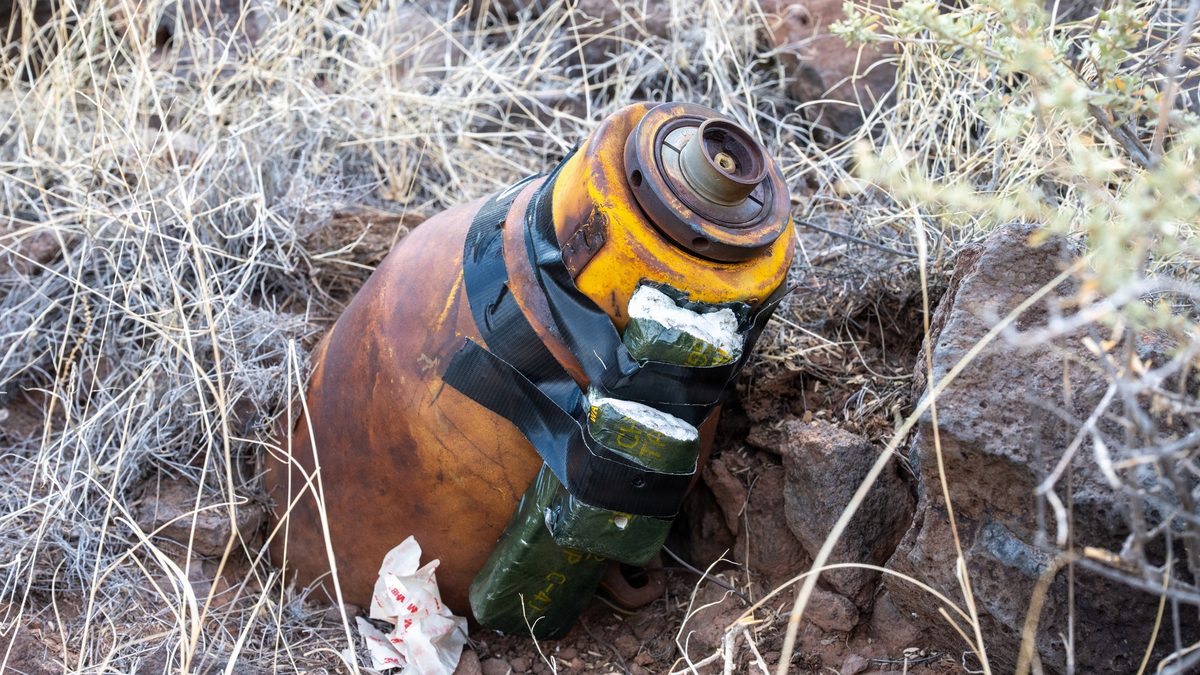
Kirtland EOD Clears WWII-Era UXO from Pueblo of Acoma Land After Year-Long Effort
Technical Summary
Explosive Ordnance Disposal (EOD) technicians from the 377th Air Base Wing, working with New Mexico State Police EOD, environmental specialists, New Mexico Fish and Wildlife officials and Pueblo of Acoma representatives, cleared World War II-era Unexploded Ordnance (UXO) embedded in Badger Butte on Pueblo of Acoma land on 20 May 2026. United States Air Force imagery of the operation shows the teams located and disposed of two World War II-era ordnance items. The work closed a year-long effort; the 377th EOD section lead, Master Sergeant Scott Underdahl, dated the start of the Acoma eagle-nest permit and clearance task to March 2025. Large tracts of the New Mexico desert were used as training ranges during the war, and the 377th EOD flight works with neighbouring Pueblos to locate, render safe and extract residual items. The unit reported the operation complete with no incidents.
“Everything went smoothly, and most importantly, it was a safe operation.”Master Sergeant Scott Underdahl, 377th EOD section lead

Analysis of Effects
This is range-legacy clearance rather than a single emergency call-out, which changes the technical problem. Items recovered from former training ranges are typically Abandoned Explosive Ordnance (AXO) or fired-but-failed UXO, so condition is variable and fuze state cannot be assumed. Local reporting (KOB-TV) described the items as World War II-era practice bombs; the official United States Air Force releases referred only to “ordnance items” and gave no designation, calibre or filling. Practice bombs of the period were generally inert-filled, commonly with sand or concrete, with provision for a small pyrotechnic spotting charge to mark the point of impact. If that pattern holds here the net explosive quantity would be low, but the fill, fuzing and any spotting-charge residue are not confirmed for these specific items. The reported choice to render safe and extract, rather than dispose by detonation in place, suggests the items were assessed as movable and any disposal arranged to limit blast, fragmentation and ground shock near the protected eagle nest cited as a constraint.
Personnel and Safety Considerations
The task illustrates the planning load that environmental and cultural constraints add to clearance work. Because the Pueblo of Acoma sits near migratory routes for protected bald and golden eagles, the team worked to fixed environmental parameters: checking for active nests before operations, shifting flight paths away from nesting areas, and upgrading local power poles so birds can perch safely. In the United States that protection rests on the Bald and Golden Eagle Protection Act (16 U.S.C. 668) and the Migratory Bird Treaty Act, which is why a specific eagle-nest permit shaped the timeline. Restrictions of this kind narrow the disposal options and can rule out the simplest Blow-in-Place (BIP) solution. Underdahl noted the operation also gave the team realistic training across complex and rugged terrain. For Weapons, Ordnance, Munitions and Explosives (WOME) planners the point recurs: standoff, demolition charge sizing and the choice between render-safe-and-extract and in-situ disposal must be reconciled with site-specific environmental and stakeholder limits before any approach to the item.

ISC Assessment
Acoma is not an isolated case. The 377th EOD flight runs a continuing programme with New Mexico’s Pueblos to clear wartime legacy ordnance; in a comparable recent task the same flight removed 115 decades-old munitions with the Pueblo of Isleta. The pattern is the operational story here. Legacy range clearance on tribal and culturally sensitive land is becoming deliberate, repeatable work in which environmental permitting, tribal coordination and disposal engineering are planned together rather than in sequence, and the timeline is set as much by a wildlife permit as by the ordnance itself.
Data Gaps
DATA GAP: the official releases gave no ordnance designation, calibre, filling or fuze state; local reporting characterised the items as practice bombs, but this is not confirmed in the United States Air Force account. The Net Explosive Quantity (NEQ) is unstated, as is whether final disposal used a demolition charge or a controlled move to a separate site, and the render-safe method and any donor-charge data are unknown. United States Air Force imagery indicates two items; no official total was stated in the written release.
Sources
- DVIDS, “Kirtland EOD partners with Pueblo of Acoma to clear WWII-era ordnance,” story by Senior Airman Donnell Schroeter, 28 May 2026. Reliability A, Accuracy 2. dvidshub.net/news/566218
- Kirtland Air Force Base, “Kirtland EOD partners with Pueblo of Acoma to clear WWII-era ordnance,” 27 May 2026 (official imagery captions confirm two items located and disposed of). Reliability A, Accuracy 2. kirtland.af.mil (Article 4501872)
- KOB-TV, Jonathan Fjeld, “Explosive experts clear WWII-era practice bomb near protected eagle nest,” 27 May 2026 (practice-bomb characterisation; March 2025 start, quoting Underdahl). Reliability B, Accuracy 3. kob.com
- DVIDS, “Kirtland EOD partners with Pueblo of Isleta to remove 115 decades-old munitions,” comparator task. Reliability A, Accuracy 2. dvidshub.net/news/553133
Source reliability and accuracy rated per NATO Standardization Agreement (STANAG) 2022 (Reliability A to F, Accuracy 1 to 6).
AI-assisted technical assessment based on open-source material. Not a formal intelligence product.