Disarmco’s Thermite EOD Tools: Class 4.1 Logistics Edge, Independent-Validation Gap
UK SME Disarmco Limited has built a credible niche supplying thermite-based, non-detonative tools for the disposal of landmines, unexploded ordnance and explosive remnants of war. The headline procurement attraction is regulatory: classification as UN 4.1 Flammable Solid rather than UN Class 1 explosive removes a substantial slice of import, transport and storage friction. The headline procurement risk is evidential: most performance data is company-generated, and the independent quantified record on outcome consistency remains thin.
The Company in One Paragraph
Disarmco Limited (Companies House registration 07695406) is an active UK private company incorporated on 6 July 2011, with its registered office at Victoria House, 50 Alexandra Street, Southend-on-Sea, Essex, SS1 1BN. Its declared SIC code is 74909 (other professional, scientific and technical activities). The company is held by Disarmco Holdings Limited (08580065). The current sole listed director is Arpana Gandhi, following the resignation of Richard Bryant in March 2025 [1].
Trading website: www.disarmco.com. The product line is narrow and specialised: thermite and thermal-deflagration tools for explosive ordnance disposal (EOD), demilitarisation and the clearance of explosive remnants of war (ERW), supported by consultancy and training. The corporate footprint is small — characteristic of UK defence small and medium enterprises (SMEs) operating in humanitarian and niche-military markets — and most published technical material originates from the company itself or from its end-user partners.
What the Technology Actually Is
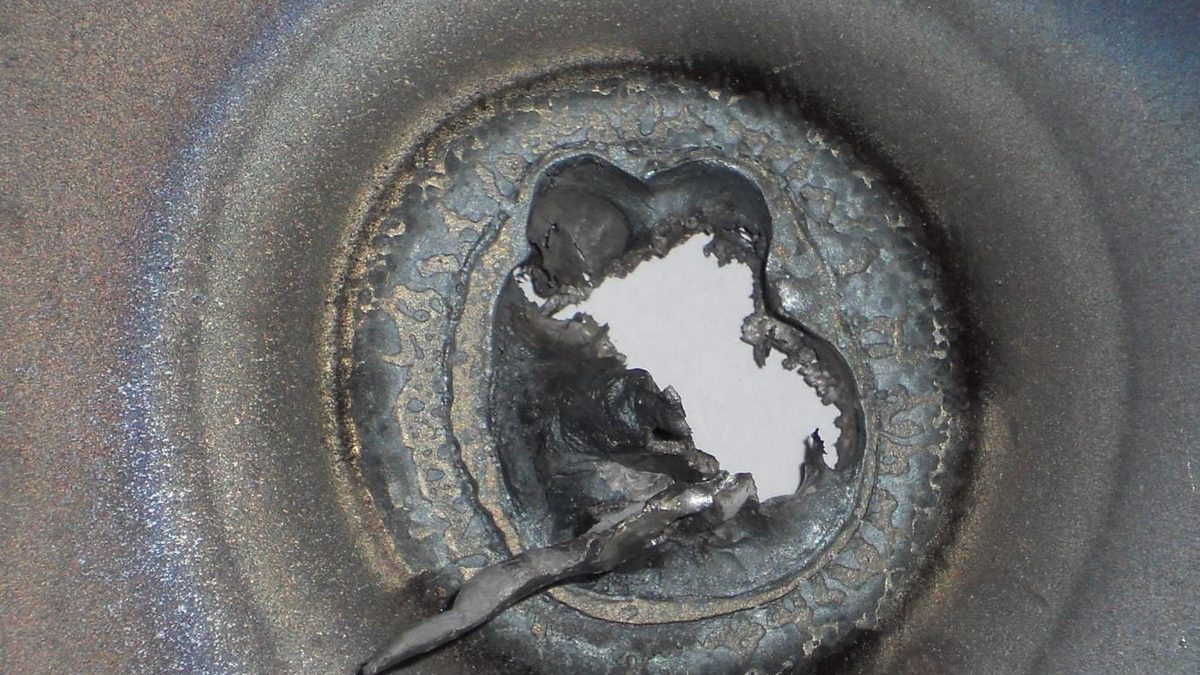
Thermite is the intermetallic reaction between a metal oxide (typically iron(III) oxide) and a reactive metal powder (typically aluminium), producing molten iron and aluminium oxide at temperatures in the order of 2,500°C. Hans Goldschmidt patented the reaction between 1893 and 1895, and it was used industrially long before defence applications — principally for thermitic welding of rail and as a denial charge for artillery breeches in both world wars [2].
Modern EOD use is doctrinally different. Where traditional disposal relies on a donor explosive charge to drive a target munition to high-order detonation (or on open burning / open detonation, OBOD, for bulk demilitarisation), Disarmco’s approach drives the target to low-order deflagration — a sustained but subsonic combustion that consumes the high-explosive (HE) fill without transition to detonation. The result is a substantial reduction in blast overpressure, fragmentation hazard and acoustic and seismic signature, at the cost of a small but non-zero residual probability of high-order outcome.
The direct precursor to the current commercial systems was the “Dragon” thermal lance trialled by Cranfield University in Lebanon in 2005 under UK Department for International Development (DfID) funding, and similar work conducted independently by Alford Technologies and others. Adoption broadened across the 2010s as humanitarian operators — notably Mines Advisory Group (MAG) and HALO Trust — pushed for tools that could be moved into restricted environments without the licensing burden of Class 1 explosives [3][4].
The Product Family
Disarmco’s catalogue is built around a small number of distinct thermite or thermite-initiated tools. NATO Stock Numbers (NSNs) are present for most lines, indicating prior NATO codification — a useful but not conclusive indicator of formal qualification. The principal items are summarised below.
| Product | NSN | Function | Indicative Target |
|---|---|---|---|
| Dragon™ MK8 / Dragon Lance | 1375-99-670-9905 | Stand-off thermite lance, pre-loaded turn-key system | Thin-skinned steel (≤13 mm) and plastic-cased ordnance |
| Hot Drop Kit | — | Stand-off crucible deposition system | Thicker steel casings (up to ~10 mm) |
| BHD8 | 1385-99-589-3626 | One-shot deflagration system | Landmines and thin-cased UXO (≤4 mm steel) |
| Low Temperature Thermite (LTT) | 1375-99-928-3696 | Slow-burning thermite for HE fill ignition with reduced detonation transition risk | Various HE fills |
| Thermal Shock Induced Deflagration (TSID) A/B/C | 1385-99-489-1337 / 959-3846 / 302-4229 | Thermal-shock initiation of HE fills | Larger HE-filled munitions |
| Thermit Destructor (TD-A) | 1375-99-859-2300 | High-temperature thermite for casing penetration | Hardened or thicker casings |
| Thermite Initiated Starter (TIS) | 1377-99-615-8825 | Electric, non-explosive initiator for all of the above | Universal initiation for the family |
All listed products are described by the manufacturer as UN 4.1 Flammable Solid, typically against UN 3178 (Flammable solid, inorganic, n.o.s.) at Packing Group III. Some configurations may also fall under more restrictive 4.1 entries depending on test classification and packaging. Procurement files should record the exact UN number, proper shipping name and packing group per product configuration, not by reference to the catalogue at large [5].
The Doctrinal Position
Low-order deflagration is a complement to traditional EOD, not a replacement. It is most useful where (a) explosive licensing is restricted or impossible, (b) blast, fragmentation or environmental signatures must be minimised, and (c) the target is amenable — thinner casings, accessible HE fill and known condition. It is least useful where the casing is heavily reinforced, the fuze state is unknown and unstable, or where high-order outcome is operationally required (e.g. some battlefield render-safe procedures).
Why Class 4.1 Is the Real Selling Point
Most procurement and operations staff who encounter Disarmco’s catalogue for the first time fixate on the technology. The procurement edge is elsewhere — in the regulatory differential between Class 1 and Class 4.1.
Road (ADR 2025)
UN 3178 PG III flammable solids ship under packing instruction P002 / IBC08 / LP02, with limited-quantity (1.0 kg in inner packagings, 30 kg total) and excepted-quantity provisions available for small consignments. Vehicle marking, driver training (ADR certificate), tunnel category and routing are all materially less restrictive than for Class 1 (Division 1.1 explosives in particular) [6].
Sea (IMDG)
Class 4.1 is widely accepted and routinely transported, with stowage and segregation requirements specified in Section 7.1.4 and the segregation table at 7.2 of the IMDG Code. Self-reactive subdivisions of 4.1 may require temperature control, but the Disarmco baseline products do not fall in those subdivisions on the manufacturer’s published characterisation. This should be verified against the actual UN test certificate [7].
Air (IATA DGR 67th Edition, 2026)
Air is the most restrictive mode. Many UN 3178 entries are Cargo Aircraft Only, with net quantity per package limits typically in the 25–100 kg range, and limited-quantity (“Y”) packing instructions capped at 30 kg gross. Carrier approval is essential and not all carriers accept the line items even where the regulatory ceiling permits [8].
Storage and Licensing
The downstream regulatory benefit follows the transport advantage. Class 4.1 storage does not engage the Manufacture and Storage of Explosives Regulations (MSER) 2014 licensing regime applicable to Class 1 in the United Kingdom. End-users in jurisdictions that maintain de-facto explosive import bans for humanitarian or counter-IED operators are often able to import Class 4.1 stock where Class 1 stock would not clear customs [9].
The cumulative effect is that a humanitarian demining operator working in a country with restrictive explosive import controls, or a counter-IED responder needing to forward-deploy in a Schengen-internal lift, can plausibly move thermite-based tooling on substantially shorter notice and at lower cost than an equivalent Class 1 capability. That is the procurement advantage Disarmco is selling. It is real, and it is independently verifiable from the regulatory texts.
The Evidence Base — What Is Solid, What Is Thin
A reliability assessment of the publicly available evidence on Disarmco’s offering, conducted by ISC against the NATO STANAG 2022 source-rating framework, scored the file at 72 out of 100. The breakdown is instructive.
What is solid (Reliability A–B, Accuracy 1–2): the corporate identity (Companies House registers verify it directly), the existence of the product line and its principal NATO Stock Numbers (verifiable through NSN lookups), the regulatory classification under UN 4.1 (confirmed by the published Safety Data Sheets, where available, and by the regulatory texts themselves), and the broad doctrinal position that low-order deflagration reduces blast and acoustic signature relative to high-order detonation (which is supported by independent peer-reviewed work on underwater EOD acoustics and on bulk demilitarisation environmental impact) [10][11].
What is thinner (Reliability C–D, Accuracy 3–4): the quantified outcome reliability of each individual product across each declared target set. Most of the headline performance evidence on the company website is presented as case studies — for example, MAG Lebanon’s reported destruction of more than 1,000 M15 anti-tank mines using the Dragon Lance, or MAG Vietnam’s reported use of TSID against a Mark 82 500 lb bomb. These are credible operationally but they are sourced from the manufacturer and from end-user partners with whom the manufacturer has commercial relationships. There is, in the publicly available record, very limited independent third-party quantitative work that compares (for example) low-order versus high-order outcome rates by target type, casing thickness and energetic condition.
What is missing (data gaps): independent batch quality assurance data, independent shelf-life testing under the climatic envelopes typical of demining theatres (Sahel, South-East Asia, Caucasus), documented user-organisation competence baselines tied to International Mine Action Standards (IMAS) EOD and Stockpile Destruction series, and a clear public position on export control treatment under the UK Export Control Order 2008 and equivalent regimes. None of these gaps are unusual for a UK defence SME of this scale; all of them are nonetheless legitimate procurement questions.
Procurement Due Diligence — the Ten Questions
The questions below are the minimum set ISC would expect to see in a procurement file before a positive buy decision on any Disarmco product line, particularly for first-time customers and for forward-deployed humanitarian or counter-IED applications. They map to standard NATO Allied Quality Assurance Publication (AQAP) competence expectations and to IMAS EOD doctrine.
- Full UN classification per product configuration — UN number, proper shipping name, packing group, packing instruction, and the UN test series (Series 1–4 as applicable) certificates. Not the catalogue, the actual configuration to be procured.
- Independent test reports — ideally from a national defence test authority or an accredited third-party laboratory, not solely from the manufacturer or commissioning end-user.
- Outcome statistics — declared low-order outcome probability by target type, casing thickness band, and energetic condition (sound, exuded, sensitised, corroded). With the underlying sample size.
- Batch quality assurance data — control of metal powder particle size and oxide ratio, ignition reliability across temperature envelope, and serialisation back to the production lot.
- Shelf-life and storage envelope — declared shelf-life, recommended storage temperature and humidity, and demonstrated re-test data at end-of-life.
- Operator competence baseline — declared minimum training standard, mapping to IMAS EOD Levels 1–3 or to an equivalent NATO competence framework, and the duration and content of any manufacturer-delivered course.
- Export control treatment — the company’s position on UK Export Control Order 2008 dual-use and military list categorisation for each product, and the typical Open General Export Licence (OGEL) or Standard Individual Export Licence (SIEL) path.
- End-use certification — the standard end-user undertaking required, and the company’s policy on re-export to third parties.
- Field-failure register — the company’s declared process for capturing, investigating and reporting field failures and high-order outcomes, and the customer’s right of access to that register.
- Carrier and customs feedback — documented import success across the customer’s expected operational geography, including any countries where import has been refused, delayed or required additional licensing despite the Class 4.1 classification.
None of these questions is exotic. All of them should already be answerable on the company side. The point of formalising the list is to ensure the procurement file is built in advance of need, not assembled in response to an incident.
ISC Commentary
Disarmco occupies a genuinely useful position in the WOME ecosystem. The Class 4.1 logistics differential is real, the doctrinal case for low-order deflagration is established in the open literature, and the company has been delivering into the humanitarian demining community for long enough to have a track record that several substantial operators are willing to put their names against. None of that is in dispute.
The realistic procurement framing is therefore not whether to engage but how. The Class 4.1 advantage will pay back the procurement investment quickly in any operational profile that involves repeated movement across borders, deployment into restrictive jurisdictions, or storage at locations that cannot economically be licensed for Class 1 explosives. Against that, the buyer should accept that the independent quantitative record on outcome consistency is thinner than it would be for a Class 1 demolition store with decades of national ammunition technical evaluation behind it — and should price that into procurement terms, particularly around batch acceptance, training currency and field-failure reporting.
For a NATO national authority, a humanitarian demining operator running in a paragraph-restricted jurisdiction, or a counter-IED responder with a forward-deployment requirement, the headline answer is “yes, but with the procurement file built out properly first”. For a buyer who needs guaranteed high-order outcome at scale — bulk demilitarisation of legacy stockpiles in a permissive environment, for example — traditional OBOD and high-order detonation methods will usually remain more cost-effective and the Class 4.1 advantage will be marginal. The two approaches are complementary, not competing. The mistake in either direction is to treat them as substitutes.
Recommended next steps for any procurement organisation considering Disarmco: request the full evidence pack, run the ten-point checklist as a formal pre-contract gate, confirm exact UN numbers and packing instructions per configuration with the relevant national competent authority for transport of dangerous goods, and engage at least two reference customers from the company’s installed base with a structured interview against IMAS EOD and AQAP competence expectations. None of that should take more than four working weeks.