The MBCT Provisional Rifle Squad: Ammunition Logistics, Fire Envelopes, and the NATO Comparison
The U.S. Army’s experimental Mobile Brigade Combat Team rifle squad — nine soldiers, one Infantry Squad Vehicle, three Sig Sauer Next Generation Squad Weapons, and a Designated Marksman’s 7.62 mm precision rifle — trades mass for sensors, signature, and lethality at range. ISC examines what the squad actually carries, what it can engage, and how it stacks up against four NATO peers: the British Army Section, the Royal Marines Close Combat Troop, the Bundeswehr Infanteriegruppe, and the French Armée de Terre Section.
1. Why the MBCT, and Why a New Squad
The Mobile Brigade Combat Team is the central force-design output of the 2025 Army Transformation Initiative (ATI). Under FY2026 funding, the Active Component will convert all 14 Infantry Brigade Combat Teams (IBCTs) and the Army National Guard will convert all 20 of its IBCTs to MBCT structure on a phased timeline running through FY2028. The CRS describes the MBCT as a deliberate “technological densification” trade: the new brigade fields roughly 1,900 soldiers against an IBCT’s ~4,500, deletes the cavalry squadron and brigade military intelligence (MI) company, and replaces them with a Multifunctional Reconnaissance Company (MFRC) and a Multipurpose Company providing organic loitering munitions, first-person-view (FPV) one-way attack drones, small uncrewed aerial systems (sUAS), and electronic warfare at brigade level.
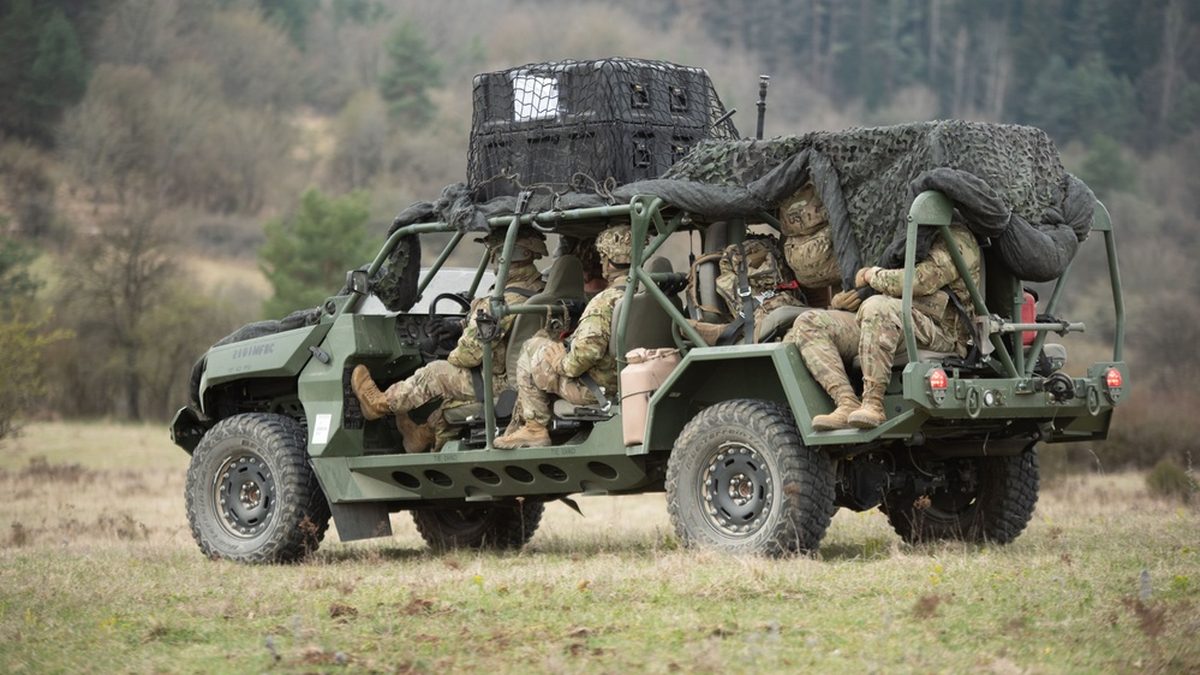
What makes the MBCT relevant to Weapons, Ordnance, Munitions, and Explosives (WOME) practitioners is not the brigade headquarters; it is the squad. Three things change at the lowest tactical level. First, mass: the rifle squad dismounts from a single GM Defense M1301 Infantry Squad Vehicle (ISV) rather than a Mine-Resistant Ambush Protected (MRAP) or Stryker, with no organic ballistic protection. Second, calibre: the rifle and automatic-rifle slots transition from 5.56 × 45 mm NATO to the Sig Sauer 6.8 × 51 mm Common Cartridge (commercial “.277 Fury”) hybrid brass-steel round. Third, sensors: every NGSW carries the Vortex M157 fire-control optic with integrated laser rangefinder, atmospheric suite, and ballistic computer, and every soldier is networked through Intra-Soldier Wireless and (on lead units) IVAS 1.2 helmet-mounted display.
The lead conversions are concentrated in three light-infantry divisions: 1st Brigade (“Bastogne”) and 2nd Brigade (“Strike”) of the 101st Airborne Division (Air Assault) at Fort Campbell; 2nd Brigade (“Commando”) of the 10th Mountain Division at Fort Drum, currently deploying to Operation Inherent Resolve (OIR); and 2nd Brigade (“Warrior”) of the 25th Infantry Division at Schofield Barracks, Hawaii, the lead Indo-Pacific MBCT. The 75th Ranger Regiment received ISVs first, in 2021, but its NGSW and TO&E posture is regiment-specific and not part of the MBCT pilot.
2. The Squad as Drawn — Composition and Roles
The Battle Order v2.0 graphic, cross-checked against DVIDS imagery from 1-506 IN (1st MBCT, 101st Airborne) at Fort Campbell, the May 2025 Operation Lethal Eagle large-scale long-range air assault (L2A2), and 25th ID NGSW New Equipment Training (NET) at Schofield Barracks in January 2026, depicts a nine-soldier dismounted squad built around a Squad Leader and two four-soldier fire teams designated “Alpha” and “Bravo”. All nine ride in a single ISV.
| Slot | Role | Primary Weapon | Optic / FCS | Secondary & Special |
|---|---|---|---|---|
| 1 | Squad Leader (SL) | M7 Rifle, 6.8 mm | Vortex M157 NGSW-FC | M17 9 mm pistol; squad radio; 1 SLM |
| 2 | Alpha Team Leader | M7 Rifle, 6.8 mm | Vortex M157 | MAWL-X1 IR/visible laser; 1 SLM |
| 3 | Alpha Auto Rifleman | M250 LMG, 6.8 mm | Vortex M157 | M17 pistol; 4 × 100-rd belts |
| 4 | Alpha Grenadier | M7 + M320A1 (40 mm) | M157 + Wilcox RAAM GSS | 24 × 40 mm mixed; 1 SLM |
| 5 | Alpha Rifleman / AT | M7 Rifle, 6.8 mm | Vortex M157 (or Nightforce ATACR 1–8×) | FGM-148 Javelin LTA + ammunition bearer |
| 6 | Bravo Team Leader | M7 Rifle, 6.8 mm | EOTech EXPS3 + G43 magnifier | Wilcox RAID Xe laser; 1 SLM |
| 7 | Bravo Auto Rifleman | M250 LMG, 6.8 mm | Vortex M157 | M17 pistol; 4 × 100-rd belts |
| 8 | Bravo Grenadier | M7 + M320A1 (40 mm) | M157 + Wilcox RAAM GSS | 24 × 40 mm mixed; EOTech OGL |
| 9 | Bravo Designated Marksman (DM) | M110A1 SDMR, 7.62 mm | Sig TANGO6 1–6×24 LPVO | M17 pistol; M80A1 / M1158 ammunition; OSS SRM6 suppressor |
The retention of the Heckler & Koch M110A1 Squad Designated Marksman Rifle (SDMR) in 7.62 × 51 mm NATO is the single most important indicator of doctrinal continuity. The 6.8 × 51 mm Common Cartridge in the M7 is ballistically capable of defeating modern Level 3 ceramic body armour at range, but the M7’s 13.5-inch barrel and 1–8× M157 LPVO are not configured as a precision-rifle envelope. Open-source PEO Soldier reporting indicates the M110A1 will remain doctrinally distinct through at least the FY2030 budget horizon, with no announced replacement; transition is expected only when a 6.8 × 51 mm DMR variant (a Sig MCX-Spear DMR analogue with longer match barrel and folding stock) is fielded.
The original Battle Order “MBCT Provisional Rifle Squad v2.0” infographic (29 April 2026), which formed the structural baseline for this analysis, is hosted at the source link below. ISC has not embedded the graphic directly because Battle Order is a privately operated analytical project whose graphics are copyright-protected; readers should consult the original at battleorder.org/post/mbct-rifleco. Figure 1 above is original ISC artwork constructed from PEO Soldier programme materials and DVIDS imagery and is licensed under the same terms as the rest of this article.
Two other organisational signals are worth flagging. First, the squad fields one FGM-148 Javelin Command Launch Unit (CLU) and one or two Launch Tube Assemblies (LTAs), mounted on the ISV. The Javelin team is nominally two soldiers (gunner plus ammunition bearer / spotter), drawn from the Alpha rifleman and Alpha Team Leader; the rest of the squad provides local security. Second, the squad carries a doctrinal minimum of two shoulder-launched munitions (SLMs) — M136 / M136A1 AT4-CS, M72A4–A7 LAW, or M141 Bunker Defeat Munition (SMAW-D) — with one SLM per rifleman as the upper bound. This tracks ATP 3-21.8 Appendix G Section G-2 to G-16 and the Maneuver Center of Excellence (MCoE) doctrine supplement.
Two emerging programmes are likely to alter this AT picture during the FY2026–FY2028 codification window. The FGM-148G Javelin (“Spiral 3”), in low-rate production at the Lockheed Martin / Raytheon joint venture, introduces an uncooled imaging-infrared seeker, a redesigned LTA, and an estimated ~20% missile-mass reduction against the legacy FGM-148F Multi-Purpose Warhead variant. Combined with the Lightweight CLU (LW CLU) already entering U.S. Army inventory, the system mass for the gunner drops from ~49 lb “ready to engage” toward the low 40s. The minimum engagement range is expected to remain at ~65 m; the principal benefits are reduced soldier load and improved seeker performance against cold targets.
Separately, the Carl Gustaf M4 (M3E1 in U.S. service) 84 mm recoilless rifle appears in several MBCT concepts of operation as a candidate platoon-level multi-role weapon to fill the 0–500 m gap between the Javelin’s 65 m minimum and the unguided SLM family. The M3E1 is type-classified for U.S. Army close-combat formations, weighs ~7 kg, and fires HEAT, HE, smoke, illumination, and bunker-defeat rounds — effectively replicating the role-set of the M141 BDM, M72 LAW, and AT4 in a single reusable launcher. Whether the MBCT MTOE codifies the M3E1 at squad or platoon level remains open through FY2028; current Battle Order graphics show it as a platoon weapon, not a squad item, but DVIDS imagery from 1st MBCT 101st Airborne 2025 training cycles shows squads cross-loading it during the L2A2 deployment.
3. Per-Soldier Ammunition Profile and Squad Total
The numbers below assume the standard combat load published in ATP 3-21.8 with the NGSW transition adjustments described in PEO Soldier briefings: seven magazines per rifleman, transitioning from 20-round to 25-round 6.8 mm Sig SR-25-pattern magazines as the new standard; four 100-round belts for the M250 automatic rifle; six 20-round magazines for the M110A1 SDMR; and the doctrinal 40 mm grenade load. Pistol magazines are M17 standard 17-round capacity. All weights below are open-source figures, rounded to one decimal where possible.
3.1 Individual ammunition profiles
| Slot | Role | Rifle / LMG ammo | 40 mm | Pistol | Grenades | SLM / ATGM | Approx ammo wt (lb) |
|---|---|---|---|---|---|---|---|
| 1 | Squad Leader | 175 × 6.8 mm (7×25) | – | 51 × 9 mm | 2 frag, 2 smoke | 1 × M72A7 LAW | ~21 |
| 2 | Alpha Team Leader | 175 × 6.8 mm (7×25) | – | – | 2 frag, 1 smoke | 1 × M136A1 AT4-CS | ~26 |
| 3 | Alpha Auto Rifleman | 400 × 6.8 mm linked (4×100) | – | 51 × 9 mm | 2 frag | – | ~30 |
| 4 | Alpha Grenadier | 175 × 6.8 mm (7×25) | 24 (12 HEDP, 6 HE, 4 smoke, 2 illum) | – | 2 frag | 1 × M72A7 LAW | ~28 |
| 5 | Alpha Rifleman (AT bearer) | 175 × 6.8 mm (7×25) | – | – | 2 frag, 1 smoke | 1 × Javelin LTA (35 lb) | ~48 |
| 6 | Bravo Team Leader | 175 × 6.8 mm (7×25) | – | – | 2 frag, 1 smoke | 1 × M141 BDM | ~28 |
| 7 | Bravo Auto Rifleman | 400 × 6.8 mm linked (4×100) | – | 51 × 9 mm | 2 frag | – | ~30 |
| 8 | Bravo Grenadier | 175 × 6.8 mm (7×25) | 24 (12 HEDP, 6 HE, 4 smoke, 2 illum) | – | 2 frag | 1 × M72A7 LAW | ~28 |
| 9 | Bravo DM | 120 × 7.62 mm (6×20 M80A1/M1158) | – | 51 × 9 mm | 2 frag | – | ~13 |
| Squad total (dismounted load) | 1,850 × 6.8 mm | 48 × 40 mm | 204 × 9 mm | 18 frag, 5 smoke | 5 SLM + 1 Javelin (1 LTA) | ~252 | |
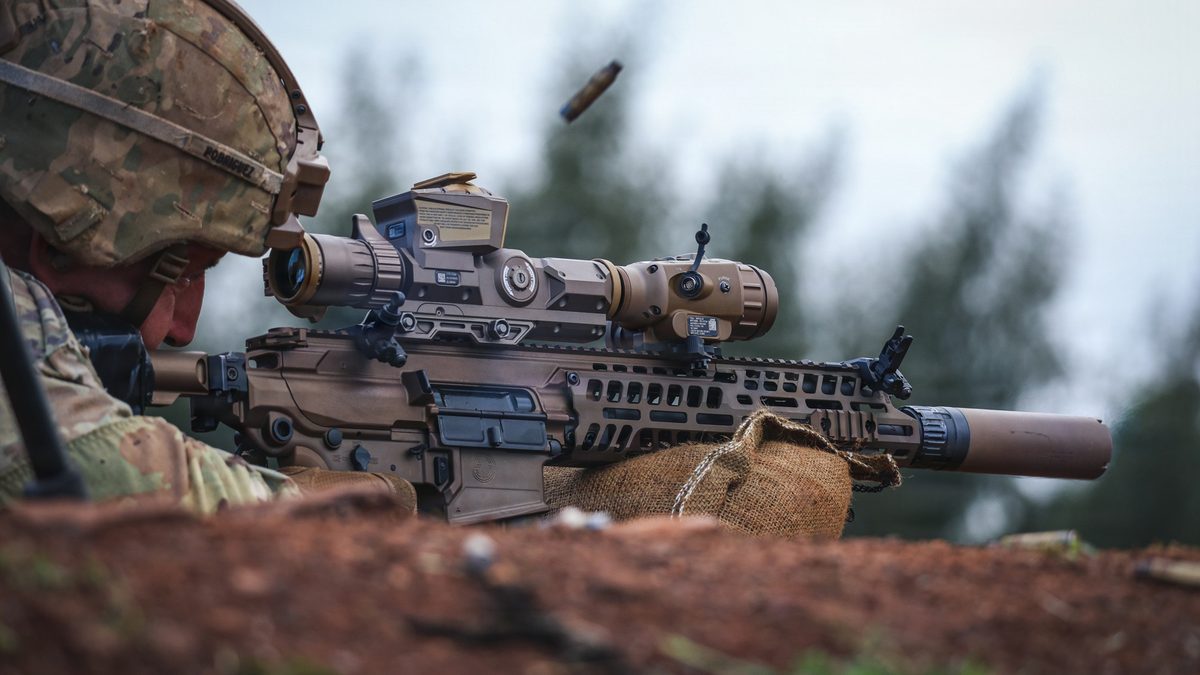
A few logistical observations follow directly from this table. First, the squad carries roughly 1,850 rounds of 6.8 × 51 mm Common Cartridge distributed across six rifle slots and two LMG slots. Compared with a legacy IBCT squad (nine soldiers carrying ~210 × 5.56 mm each plus two M249 SAW gunners with ~600 rounds of belted 5.56 mm), this is roughly a 40–45% reduction in rounds-per-squad: trading volume of fire for terminal effect at range. The PEO Soldier rationale — defeat of Level 3 ceramic plate at 600 m — is well-attested, but the logistical implication is that resupply must be more frequent or more efficient to sustain the same engagement tempo.
Second, the squad carries one 7.62 mm chain in the M110A1 DM: 120 rounds of M80A1 Enhanced Performance or M1158 Advanced Armor-Piercing. This is a separate logistic SKU from the 6.8 mm and from the M240 series and complicates resupply at the platoon level (more on this below).
Third, the Alpha Rifleman is the single heaviest-loaded soldier at roughly 48 lb of ammunition and ATGM equivalent (175 rifle rounds plus a 35-lb Javelin Launch Tube Assembly). With the Command Launch Unit on the gunner and a second LTA on the ISV, the team can prosecute one credible top-attack engagement to 2,500 m and one direct-attack engagement on a follow-on target. The new Lightweight CLU (LW CLU) and the FGM-148G “Spiral 3” missile in development reduce both system mass and missile mass, but the LTA itself remains the dominant logistical penalty.
3.2 Squad ammunition net explosive quantity (NEQ) and resupply cycle
Aggregating the explosive payload — not the propellant in cartridges, but the warhead and grenade fillings — gives a rough Net Explosive Quantity (NEQ) for the squad’s organic munitions. ATP 3-21.8 Appendix G and the United Nations Recommendations on the Transport of Dangerous Goods are the doctrinal references; the figures below are open-source estimates and should be flagged as indicative only — not for safety-case use.
| Munition | Qty | Filling (typical) | NEQ each (kg TNTe) | Squad NEQ (kg TNTe) | HD · CG |
|---|---|---|---|---|---|
| 40 mm M433 HEDP | 24 | RDX/Wax composition | ~0.032 | ~0.77 | 1.2 · D |
| 40 mm M381/M383 HE | 12 | Composition B | ~0.032 | ~0.38 | 1.2 · D |
| 40 mm M713/M715 smoke / illum | 12 | Pyrotechnic | n/a | trace | 1.3 · G |
| M67 fragmentation grenade | 18 | Composition B (~180 g) | ~0.18 | ~3.24 | 1.1 · D |
| M83 / AN-M8 smoke grenade | 8 | HC pyrotechnic | n/a | trace | 1.3 · G |
| M72A7 LAW (66 mm) | 3 | Octol-based HEAT | ~0.30 | ~0.90 | 1.2 · H |
| M136A1 AT4-CS (84 mm) | 1 | Octol HEAT | ~0.44 | ~0.44 | 1.2 · H |
| M141 BDM (83 mm HEDM) | 1 | HEDM dual-mode | ~1.36 | ~1.36 | 1.2 · H |
| FGM-148 Javelin (1 LTA) | 1 | Tandem HEAT (8.4 kg warhead) | ~3.4 | ~3.4 | 1.2 · H |
| Squad estimated total NEQ (excluding small-arms propellant) | ~10.5 kg TNTe | mixed | |||
The squad therefore moves with approximately 10.5 kg TNT-equivalent of explosive payload distributed across 1.1, 1.2, and 1.3 hazard classifications, including incompatible compatibility groups (D, G, H). For ammunition technicians and EOD planners, this is the practical compatibility matrix that constrains how the squad’s Class V is broken out for resupply.
The applicable NATO publication is AASTP-05 Edition B Version 1 (STANAG 4657, July 2024) — NATO Guidelines for the Storage, Maintenance and Transport of Ammunition on Deployed Missions or Operations, not AASTP-01, which governs static fixed-installation storage. AASTP-05 Chapter 7 paragraph 4 (“Transport of Munitions”) sets out the operative rule for in-transit movement: “Generally, during actual lines-of-communication munitions movements, transportation conveyances (e.g., trucks, ships and barges, aircraft, trains) do not require the application of QD.” Quantity Distance is re-engaged only for specific exceptions — cargo ships and aircraft at stops (airfields, ports, anchorages), formal handling / staging / temporary storage, and unplanned delays during movement that are expected to exceed 18 hours (Chapter 7 paragraph 4c). Below that threshold the conveyance is treated as in-transit and QD is not invoked.
For an MBCT squad operating under operational tasking, this matters in two practical ways. First, the deliberately variable in-transit period gives the operational commander flexibility: an ISV halt for tactical pause, refuel, or short hide does not trigger a QD recalculation, and AASTP-05 Chapter 2 paragraph 1 explicitly authorises the operational commander to deviate from AASTP-01 and AASTP-05 with documented specialist advice, providing the formal mechanism for relaxation under operational tasking. Second, when the platoon CTCP or company combat trains aggregate ammunition for a deliberate halt expected to exceed 18 hours — a divisional staging area, a logistics resupply point, a retrograde collection point — the publication is unambiguous that QD then applies, with HD 1.1 / 1.2 / 1.3 separation and Compatibility Group D / G / H segregation calculated against AASTP-01 storage tables. The competence implication for the platoon sergeant is therefore not an unbroken QD obligation, but a working understanding of when the operational tasking exempts the platoon from QD and when a halt has lasted long enough to re-engage it.
3.3 Resupply support — the pull from squad to platoon to company
The MBCT’s deliberate dispersion increases the resupply burden at the same time it reduces the brigade footprint. The squad’s organic ISV holds roughly 3,200 lb of payload, of which the dismounted combat load consumes ~2,300 lb. Additional ammunition can be cached on the ISV, but doctrinally the squad does not resupply itself; it pulls from platoon stocks, which in turn pull from the company combat trains.
| Echelon | Asset | Typical Class V holding (per squad supported) | Resupply cycle |
|---|---|---|---|
| Squad | 1 × ISV (M1301) | 1 basic load on the soldier; 1 cached on vehicle (~50% of basic) | Self-replenish from platoon every 12–24 hr |
| Platoon | 2–3 × ISV-U (utility) variants | 1.5–2 basic loads of all squad SKUs; spare Javelin LTAs; M250 spare belts | Pull from company trains every 24–48 hr |
| Company | Combat Trains Command Post (CTCP) with FMTV/LMTV | 3–5 basic loads; bulk 6.8 mm linked; 7.62 mm DM; 40 mm; SLM stock; CLUs in armoury bag | Pull from BSA every 48–72 hr |
| Battalion / BSA | Brigade Support Area, Distribution Co, Modular Ammunition Platoon | 10+ basic loads; theatre stocks; field-storage QD-compliant | Pull from theatre every 5–10 days |
The ISV’s rated 3,200 lb (1,500 kg) payload is the binding capacity constraint for the squad’s mounted ammunition cache. With the dismounted combat load consuming roughly 2,300 lb across nine soldiers, water, rations, batteries, and the squad’s sUAS / Skydio X10D / Black Hornet / Vesper kit, the residual capacity for a Class V cache aboard the vehicle is approximately 800–1,200 lb depending on water and fuel posture. That equates to roughly two basic loads of 6.8 mm linked plus a second Javelin Launch Tube Assembly, or one full resupply iteration for the squad. Air-mobility constraints stack on top: the UH-60 Black Hawk’s ~9,000 lb external sling-load limit covers the ISV with combat-loaded squad; the CH-47 Chinook accepts the ISV internally with full kit. The May 2025 Operation Lethal Eagle (L2A2) deployment from Fort Campbell to JRTC Fort Johnson, in which 82nd Combat Aviation Brigade UH-60s slingloaded 1st MBCT 101st Airborne ISVs over ~500 nautical miles in a single period of darkness, validated this concept at brigade scale.
For the WOME planner, the practical compatibility consideration is that the ISV cargo box must accommodate a mixed Hazard Division (HD) load — HD 1.1 fragmentation grenades, HD 1.2 HEAT munitions, HD 1.3 pyrotechnic 40 mm illum / smoke, and 6.8 mm and 7.62 mm small-arms (HD 1.4 S) — without the Quantity Distance (QD) separation a fixed magazine would impose. DoD 6055.09-M permits this for transport, but the platoon CTCP must still apply QD calculations when ISVs and resupply trucks aggregate during a halt. Cross-load, segregation, and Compatibility Group D / G / H separation become a junior-leader responsibility that the legacy IBCT delegated to the company executive officer. The competence implication is real: the platoon sergeant in an MBCT now needs a working understanding of AASTP-1 storage principles that the IBCT platoon sergeant did not.
3.4 Two practical complications — SKU diversity and a single source
First, the introduction of three small-arms calibres in a single squad — 6.8 × 51 mm Common Cartridge (rifle and LMG), 7.62 × 51 mm NATO (M110A1 DM), and 9 × 19 mm NATO (M17 pistol) — doubles the SKU complexity at the platoon CTCP relative to a legacy 5.56 / 7.62 squad. Until the M250 displaces the M240B at company support level (which it does not, in the current TO&E), the company combat trains additionally hold 7.62 × 51 mm linked for medium machine guns. The MBCT therefore increases small-arms calibre diversity at the company level, contrary to the common assumption that NGSW simplifies the supply chain.
As of April 2026 the 6.8 × 51 mm Common Cartridge with hybrid brass-steel case is sole-sourced from Sig Sauer’s New Hampshire production line. Lake City Army Ammunition Plant is the designated second source; open-source PEO Soldier reporting and the FY2024 NDAA $115 million congressional earmark target Lake City full operating capability in 2027, with limited-rate qualification through 2026. Until that milestone is reached, every 6.8 mm round in an MBCT squad’s combat load is indirectly dependent on Sig Sauer’s hybrid-case supplier chain. ISC rates this a Tier 2 industrial-base risk that NATO partner planners considering 6.8 mm interoperability should treat as a five-to-seven-year transition uncertainty, not an accomplished fact. The risk is mitigated for the U.S. Army by the partial fielding profile (only the lead MBCTs and 75th Rangers carry M7 / M250); it is not mitigated for any allied nation that adopts 6.8 mm without negotiating supply-chain access.
4. Effective Fire Envelopes — Cones of Fire to Scale
The two diagrams below depict the squad’s fires arranged as planar cones from a notional firing point looking out to maximum effective range. Cone width represents typical sector of engagement under doctrinal employment (between roughly 30° for precision and 60° for area suppression), not the maximum traverse of the weapon. Range bands are scaled in metres; point-target effective range is rendered solid, area-suppression range is rendered translucent. Diagram 1 (gold/navy palette) shows individual weapons; Diagram 2 (crimson/amber) shows squad and platoon support weapons. The diagrams are deliberately overlaid on a shared scale so the relative reach of the M7 against the FGM-148 Javelin is visible at a glance.
Diagram 1 — Individual weapons (M4A1 reference, M7, M250, M110A1, M320)
Scale 1 px ~ 1.5 m. Cones are doctrinal sectors of engagement, not weapon traverse limits. M7 / M250 area-suppression range (1,200 m) is a NGSW programme requirement, not a single-soldier hit-probability claim.
Diagram 2 — Squad and platoon support weapons (Javelin, AT4, M141 BDM, M72 LAW)
Note the scale change. Diagram 2 is plotted at 1 px ~ 2.5 m to fit the FGM-148 Javelin’s 2,500 m effective range. The Javelin’s 65 m minimum engagement distance — the soft-launch motor’s arming envelope — is a critical doctrinal limitation: closer than 65 m, the squad must cycle to AT4, M72 LAW, or M141 BDM.
4.1 Fire-control and the sensor layer — what the cones do not show
The diagrams above plot effective range against doctrinal sector. They do not capture the first-round hit probability the M157 fire-control optic delivers across that envelope, nor the cueing layer that platoon and company assets bring to bear above the squad. Both are central to the MBCT’s “technological densification” rationale and warrant separate treatment.
The Vortex M157 NGSW-FC pairs a 1–8×30 mm first-focal-plane LPVO with an active-reticle digital overlay, integrated laser rangefinder (LRF), atmospheric sensor suite (temperature, pressure, optionally wind via paired sensor), digital compass, and a ballistic computer running cartridge-specific drag profiles. The PEO Soldier programme target is a first-round hit probability of greater than 70% at 500 m on an E-type silhouette under daylight and benign atmospherics, with degraded but still-improved performance at 600–800 m and under marginal optics conditions. Independent open-source assessments (Soldier Systems Daily, The War Zone) report Army Marksmanship Unit (USAMU) trainer-cadre demonstrations consistent with that goal, though formal Operational Test & Evaluation (OT&E) data for line units is not yet public.
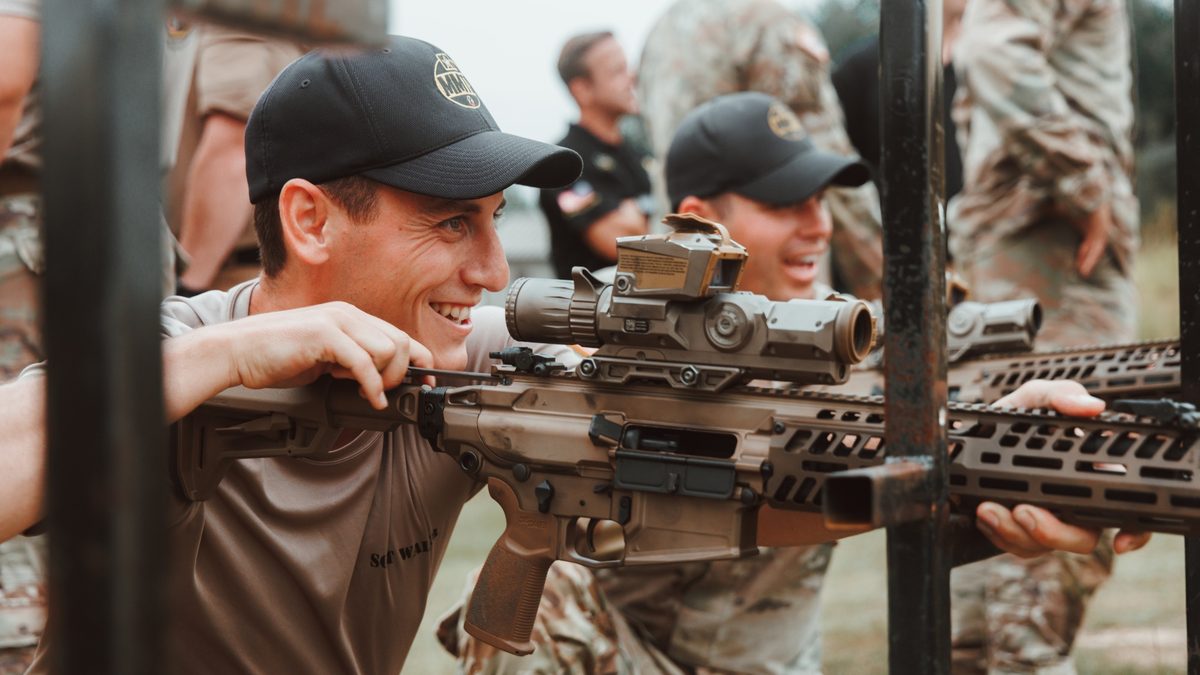
What the M157 does not do is suppress, illuminate, or cue beyond the soldier’s field of view. That layer comes from Intra-Soldier Wireless (ISW) — the M157’s data link to the soldier’s helmet-mounted display — and from IVAS (Integrated Visual Augmentation System) version 1.2, which is fielded with the lead MBCTs and provides a Microsoft HoloLens-derived see-through display with rangefinder overlay, friendly-force tracking, and digital compass. IVAS 1.2 has been controversial across its development cycle but the version fielded to 1st MBCT 101st Airborne and 25th ID is the third major hardware iteration and is reported (CRS, Army Times) as substantially improved over the IVAS 1.0 prototype that drew the 2021 DOT&E objections.
Above the squad, the platoon and the brigade contribute three additional sensor and engagement layers that effectively extend the squad’s envelope:
| Echelon | System | Engagement / sensor envelope | Function |
|---|---|---|---|
| Squad / platoon | Skydio X10D, FLIR Black Hornet, Anduril Ghost-X, Teal 2 sUAS | ~2–5 km recce; 30–90 min endurance | Local situational awareness, route recce, battle damage assessment |
| Platoon | Vesper / NEROS Archer FPV one-way attack drone | 3–10 km strike; ~5 kg payload | Precision strike against light vehicles, MG positions, ATGM teams |
| Company / Multipurpose Co | AeroVironment Switchblade 300 / 600 loitering munitions | 10–40 km strike; 15–40 min loiter | Stand-off precision against vehicles, hardened targets |
| Brigade | Anduril ALTIUS-600M, brigade-organic Multipurpose Co | 40–100+ km strike; multi-hour loiter | Operational-depth precision strike, extended ISR |
The combined effect is that the dismounted squad with M7 and M250 fires to about 1,200 m as drawn in Diagram 1, but the networked squad calling platoon Vesper FPV strikes and company Switchblade loitering munitions effectively engages out to 40 km — without expending its own organic ammunition. This is the analytical core of the MBCT’s “mass for sensors” trade. The risk is real and ISC has flagged it (10th Mountain MFRC sUAS sustainment, December 2025): the brigade-organic strike layer is only as dependable as the maintenance pipeline keeping its drones flying. When 85% of the brigade’s Vespers are non-mission-capable, the squad reverts to its 1,200 m organic envelope plus one Javelin LTA — a substantially less capable formation than the matrix above implies.
5. The British Comparison — Section, Fire Team, and Royal Marines Troop
The MBCT structure is most usefully compared with two British equivalents: the British Army Infantry Section (the standard rifle company sub-unit of the regular army) and the Royal Marines Close Combat Troop fire team (the Future Commando Force baseline organisation that has progressively absorbed lessons from the Royal Marines’ 2021–2023 trials with smaller, more dispersed sub-units). Both differ from the U.S. MBCT model in one fundamental dimension: they retain a heavier dismounted establishment with a smaller vehicle footprint, reflecting British doctrinal emphasis on dismounted close combat in restricted terrain (Northern Ireland, Iraq, Afghanistan, Estonia, and the projected operating areas of the integrated Strike Brigade and the Future Commando Force).
5.1 British Army Infantry Section (Mark IV, 2025 establishment)
The standard British Army Section is an eight-soldier sub-unit comprising a Section Commander (typically a Corporal) and two four-soldier fire teams (“Charlie” and “Delta”). Each fire team is built around a Light Machine Gunner with the L7A2 General Purpose Machine Gun (GPMG) in the Light Role, plus a Sharpshooter with the L129A1 7.62 mm rifle and three riflemen with the L85A3 individual weapon. Following the 2024 introduction of the KS-1 (a Knight’s Armament KS-1 derivative, NSN UK-issued in limited numbers) into Special Operations Brigade rotations, the British Army has begun considering a 5.56 mm refresh, but this has not displaced the L85A3 in standard rifle companies. The doctrine reference is British Army Field Manual Volume 1 Part 1 — The Battle Group, Battalion and Company in Operations (with the supporting Infantry Battle School pamphlets at Brecon).
| Slot | Role | Primary Weapon | Optic / Aux | Anti-Armour |
|---|---|---|---|---|
| 1 | Section Commander | L85A3 (5.56 mm) + UGL | Specter SU-230 4× or ELCAN; UGL ladder sight | 1 NLAW (allocated) |
| 2 | Charlie Team Leader | L85A3 (5.56 mm) | Specter SU-230 | – |
| 3 | Charlie LMG (GPMG light role) | L7A2 GPMG (7.62 mm) | Specter / Trijicon ACOG | – |
| 4 | Charlie Sharpshooter | L129A1 (7.62 mm) | Trijicon ACOG TA648 6× (replacing earlier 5×) | – |
| 5 | Charlie Rifleman | L85A3 (5.56 mm) | Specter SU-230 | 1 NLAW (cached) |
| 6 | Delta Team Leader | L85A3 (5.56 mm) | Specter SU-230 | – |
| 7 | Delta LMG (GPMG light role) | L7A2 GPMG (7.62 mm) | Specter / ACOG | – |
| 8 | Delta Rifleman | L85A3 (5.56 mm) | Specter SU-230 | – |
Several structural points distinguish the British Section from the MBCT squad. First, the British Section retains medium machine guns at section level: two L7A2 GPMGs in 7.62 × 51 mm NATO. The L7A2 in the light role gives each fire team a sustained-fire capability the MBCT M250 cannot match (the M250’s lack of a quick-change barrel constrains sustained suppression). Second, the British Section concentrates 7.62 mm precision in the Sharpshooter rather than a Designated Marksman: the L129A1 is issued to one soldier per fire team, not one per section, meaning a British rifle platoon fields six L129A1s versus a U.S. MBCT platoon’s three M110A1s. Third, the British anti-armour solution is the NLAW (Next-generation Light Anti-tank Weapon), a Saab Bofors Dynamics 150-m to 600-m predicted-line-of-sight ATGM with a top-attack mode and a one-shot disposable launcher. NLAW is genuinely man-portable at 12.5 kg system mass and demands no Command Launch Unit, displacing the U.S. doctrinal Javelin’s reusable CLU model.
5.2 Royal Marines Close Combat Troop — Future Commando Force
The Royal Marines Close Combat Troop, as evolved under the Future Commando Force programme since 2021, is built around a fire team of four with a multiple of three teams forming a 12-soldier troop. The Commando’s individual weapon is the L403A1 KS-1 in 5.56 mm (the Knight’s Armament-derived rifle adopted under the Future Soldier programme), supported by the L7A2 GPMG, the L131A1 Glock 17 Gen 4 sidearm, and an emerging spread of guided weapons including the Spike SR (Israel Aerospace Industries / Eurospike) man-portable medium-range ATGM and the Anduril ALTIUS-600M loitering munition under trial within 40 Commando.
The defining feature of the Royal Marines fire team relative to both the MBCT squad and the British Army Section is its integrated reconnaissance posture. Future Commando Force fire teams routinely operate as four-soldier units across the entire spectrum of close combat, intelligence collection, and littoral strike, with the team leader empowered to call brigade-organic strike (Spike, ALTIUS-600M, organic uncrewed surface vessels, and Royal Air Force Typhoon-delivered Brimstone 3). The closer analogue to the MBCT squad is therefore not a single Royal Marines fire team but a Close Combat Troop pair operating jointly — a 12-soldier echelon with mobility provided by Polaris MRZR, Polaris Pro XD, or zodiac F470 (in maritime role).
5.3 Bundeswehr Jäger / Fallschirmjäger Infanteriegruppe (8–10)
The German Army’s standard light-infantry sub-unit is the Infanteriegruppe, typically 8–10 soldiers fielded under a Gruppenführer (Sergeant-equivalent) and structured around a deliberate crew-served weapons axis: an MG5 (Heckler & Koch HK121) general-purpose machine gun in 7.62 × 51 mm NATO with a quick-change barrel, a Panzerfaust 3 (Pzf 3) anti-armour weapon, and where allocated the MELLS (Mehrrollenfähiges Leichtes Lenkflugkörper-System) — the German designation for the Eurospike/Spike LR Anti-Tank Guided Weapon. The standard rifleman carries the HK G36 (in service through the Bundeswehr’s G95-K and G95A1 transition programme) or the Heckler & Koch HK416 A8 (under FY2024–FY2026 Sturmgewehr-Bundeswehr replacement); platoon weapons typically include 60 mm light mortars and the 40 mm AG36 underbarrel grenade launcher.
Three structural features distinguish the German Gruppe from both the U.S. MBCT squad and the British Section. First, the MG5 with quick-change barrel is fielded at squad level, not platoon level — one or two MG5s per Gruppe depending on role, providing genuine sustained-fire capability the M250 cannot match. Second, the German light infantry is habitually mounted in Puma Schützenpanzer (IFV) or Boxer Gepanzertes Transport-Kraftfahrzeug (GTK); pure dismounted operations are the exception, not the rule, even in the Gebirgsjäger (mountain) and Fallschirmjäger (airborne) brigades. Third, networking is delivered through the IdZ-ES (Infanterist der Zukunft — Erweitertes System / Future Soldier — Extended System), a soldier-system integrating helmet display, laser rangefinder, and platoon network — broadly comparable to U.S. IVAS but more mature in fielding terms across the regular force.
For multinational planners the operationally relevant point is that German Gruppen routinely provide the sustained-fire base of fire in NATO formations. In a combined U.S. MBCT – German Panzergrenadier task-organisation, the German element typically anchors the support-by-fire position with MG5s while the U.S. MBCT element manoeuvres dispersed under M157-cued precision fires — a genuine doctrinal complementarity that exercises such as Combined Resolve, Defender Europe, and Dragon 24 have repeatedly validated.
5.4 Armée de Terre Section — 8–12 soldiers, three Groupes de Combat
The French Army Section d’Infanterie is built around three Groupes de Combat (combat groups) of 3–4 soldiers each, plus a section command element — total strength typically 8–12 soldiers. Each Groupe is led by a Caporal-Chef and includes a Tireur d’élite (marksman, with HK417 or under-trial Scorpion DMR), a FM (Fusil-Mitrailleur, the Minimi 5.56 mm Para or M249 derivative) gunner, and one or two Voltigeurs (riflemen with the HK416F or its successor under the AIF programme). At section level the standard support weapons include a 40 mm UGL on the section commander’s rifle, the Eryx short-range ATGM (300–600 m, being replaced) or the MMP (Missile Moyenne Portée, MBDA’s Akeron MP) at longer range.
The French Section operates under the SCORPION programme — Synergie du Contact Renforcé par la Polyvalence et l’Infovalorisation — an integrated land-combat modernisation that fields VBCI infantry-fighting vehicles, Griffon and Serval armoured personnel carriers, the Scorpion Combat Information System (SICS), and the FELIN (Fantassin à Équipements et Liaisons Intégrés) soldier system. The doctrinal centre of gravity is the Groupement Tactique Interarmes (GTIA) at battalion level — a genuinely combined-arms task force in which the infantry section’s organic firepower is supplemented routinely by attached fires, engineering, and EW elements.
Compared with the U.S. MBCT squad, the French Section is more centralised in command structure — the section chief retains direct control over three Groupes rather than the U.S. fire-team / squad-leader autonomy model — and is more vehicle-integrated, with the VBCI and Griffon delivering a level of armoured mobility and integrated fires that the unarmoured M1301 ISV cannot replicate. The recent French focus on littoral and urban operations under the SCORPION 2030 evolution aligns with the Royal Marines Future Commando Force in tactical philosophy, but the French Section retains heavier vehicle integration than the pure light-role MBCT.
5.5 Capability comparison matrix — five-force overview
The table below extends the original three-force comparison to include the German Infanteriegruppe and the French Section. Read across rows to compare; read down columns to see the doctrinal coherence (or lack of it) within each national approach.
| Capability dimension | U.S. MBCT Squad (9) | UK Army Section (8) | RM CCT (4–12) | DE Gruppe (8–10) | FR Section (8–12) |
|---|---|---|---|---|---|
| Primary rifle calibre | 6.8 × 51 mm CC | 5.56 × 45 mm NATO | 5.56 × 45 mm NATO | 5.56 × 45 mm NATO | 5.56 × 45 mm NATO |
| Primary rifle | M7 | L85A3 | L403A1 KS-1 | G36 / HK416 A8 | HK416F |
| Effective rifle range (point) | ~600 m | ~400–500 m | ~400–500 m | ~400–500 m | ~400–500 m |
| Squad LMG / GPMG | 2 × M250 (6.8 mm) | 2 × L7A2 GPMG (7.62 mm) | 1–2 × L7A2 (per troop) | 1–2 × MG5 (7.62 mm) | 1 × FM Minimi (5.56 mm) per Groupe |
| Sustained-fire (QCB) at squad? | No (M250 not QCB) | Yes (L7A2) | Yes (L7A2) | Yes (MG5) | Limited (Minimi has QCB) |
| DM / Sharpshooter density | 1 × M110A1 per squad | 2 × L129A1 per section | 0–1 per troop | 1 × G28 (HK417) per Gruppe | 1 × HK417 per Groupe |
| Anti-armour (organic, squad/section) | 1 × Javelin + 2–3 SLM | 1–2 × NLAW per section | Spike SR, NLAW, ALTIUS-600M | Pzf 3 + MELLS (Spike LR) | Eryx / MMP (Akeron MP) |
| ATGM minimum range | 65 m (Javelin) | 20 m (NLAW) | 20 m / 200 m (NLAW / Spike) | 10 m (Pzf 3) / 200 m (Spike) | 50 m (Eryx) / 200 m (MMP) |
| Fire-control at rifle | M157 (LRF, computer) | Specter SU-230 4× | L17A1 Specter / Trijicon | IdZ-ES suite (LRF, network) | FELIN soldier system |
| Soldier wireless / network | ISW; IVAS 1.2 | Bowman PRR / Morpheus | Bowman PRR; FCF package | IdZ-ES (mature fielding) | FELIN (full SCORPION integration) |
| Mobility platform | 1 × M1301 ISV (unarmoured) | Foxhound / Mastiff (armoured) | Polaris MRZR / F470 | Puma SPz / Boxer GTK | VBCI / Griffon / Serval |
| Calibre diversity at squad | 3 (6.8, 7.62, 9) | 3 (5.56, 7.62, 9) | 3 (5.56, 7.62, 9) | 3 (5.56, 7.62, 9) | 3 (5.56, 7.62, 9) |
| Approx. squad ammo wt (lb) | ~252 | ~210 | ~150 (4-soldier team) | ~225 | ~220 |
5.6 What the five-force comparison actually shows
Three structural differences emerge from the matrix and matter operationally. First, the MBCT squad extends maximum effective rifle range by 100–200 m over both British equivalents through the M7’s 6.8 mm Common Cartridge and the M157 fire-control optic. Against peer-state body armour, the U.S. squad has a meaningful per-rifleman terminal-effects advantage at 500–600 m. The British Army compensates not through rifle calibre but through the L7A2 GPMG’s 7.62 mm chain at fire-team level — a sustained-fire suppression capability the MBCT squad does not match because the M250 lacks a quick-change barrel.
Second, the British Section’s sharpshooter density — two L129A1s per section versus the MBCT squad’s one M110A1 — trades the U.S. fire-control optic advantage for a heavier organic precision capability. In a scenario where rifle-calibre body armour defeat at 500 m is decisive, the U.S. squad wins the engagement; in a scenario where two precision marksmen can engage targets independently from concealed positions across a section’s frontage, the British Section wins it.
Third, and most importantly for WOME planners, the British anti-armour profile is more flexible at close range. NLAW’s 20 m minimum engagement and 600 m maximum are operationally consistent with urban and complex-terrain combat in a way Javelin’s 65 m minimum is not. Royal Marines troops, with Spike SR (200 m min — 1,500 m), occupy a similar operational niche. The MBCT squad relies on AT4, M72 LAW, and M141 BDM for the 0–200 m anti-armour band, all of which are unguided shoulder-launched munitions. This is doctrinally consistent with the MBCT’s Multipurpose Company providing dismounted Javelin and brigade-organic loitering munitions for the longer engagement bands, but it does mean the dismounted squad commander has fewer guided options inside 200 m.
5.7 Cross-NATO implications for the WOME planner
Five second-order observations follow from the matrix above and matter for ammunition technicians, EOD specialists, and procurement personnel working across NATO formations.
Calibre interoperability seam. The U.S. move to 6.8 × 51 mm Common Cartridge introduces a new NATO small-arms logistics seam in a 5.56 mm-dominated alliance. STANAG 4694 (small-arms fire-control interfaces) preserves the optical and FCS interoperability surface, but ammunition commonality between U.S. MBCT squads and any allied formation reverts to 7.62 × 51 mm at the squad DM and the company GPMG. NATO partner planners considering 6.8 mm interoperability should treat the calibre as a Tier-2 industrial-base risk through 2027 and a five-to-seven-year transition uncertainty thereafter, as discussed in Section3.4. Until Lake City Army Ammunition Plant reaches full operating capability, the U.S. is the only sustainable producer.
Sustained-fire deficit at MBCT squad level. Three of the four NATO comparators (UK Section, German Gruppe, RM CCT) field a quick-change-barrel medium machine gun in 7.62 mm at squad / section level. The MBCT does not. In a prolonged engagement — the kind of attritional contact Ukraine has normalised — an MBCT squad will require more frequent platoon HMG, company M240B, or mortar augmentation than its NATO peers. In multinational task organisation, this implies that UK Sections, German Gruppen, or French Groupes will routinely anchor the support-by-fire role while U.S. MBCT squads manoeuvre under M157-cued precision fires. Joint training pamphlets at the NATO Centre of Excellence for Combined Arms (Bydgoszcz) and the Joint Multinational Training Group (Grafenwoehr) should reflect this division of labour explicitly.
ATGM employment and the close-fight gap. The MBCT’s Javelin-centric organic AT, with its 65 m soft-launch arming envelope, leaves a close-fight gap that NLAW (UK, 20 m), Pzf 3 (Germany, 10 m), Eryx (France, 50 m), and the emerging Carl Gustaf M3E1 / M4 fill more elegantly. The U.S. answer is the unguided SLM family (AT4, M72 LAW, M141 BDM) plus the prospective M3E1 at platoon level. NATO partner formations operating alongside MBCT squads should plan to provide the close-fight guided AT capability in joint task organisations, particularly in urban or restricted terrain where Javelin’s minimum range becomes operationally significant.
Dismounted mass versus sensors and vehicles. The MBCT trades dismount strength for sensor density and mobility; most NATO partners retain higher dismounted density — particularly the British Section in Brecon-style close combat and the German Gruppe in restricted terrain. In NATO Article 5 planning, this affects how U.S. MBCT squads are task-organised alongside UK Sections, German Gruppen, or French Groupes. An MBCT squad can cover a wider sector with M157-cued precision fires; an allied squad can hold ground or clear a built-up area with a mass advantage. Combined operations should pair these doctrinally rather than expecting either to fulfil the other’s role.
Emerging commonality through loitering munitions and sUAS. All five forces are converging on platoon and company-level loitering munitions (Switchblade 300/600, ALTIUS-600M, German HERO/WB Group Warmate variants, French DRAC-NG and Colibri-class) and on sUAS as the primary squad-level reconnaissance asset. Where the U.S. leads on individual-weapon overmatch (M7 / M250 / M157), Europeans lead on crew-served-weapon retention at lower echelons and on integrated soldier-system fielding (IdZ-ES, FELIN). The most likely interoperability standard over the next five years is therefore not the rifle calibre, but the data link and FCS interface — STANAG 4694 and any successor architecture.
6. Caveats, Risks, and Outlook
Three caveats matter for analysts citing the MBCT squad in formal products. First, the structure is provisional. The Battle Order v2.0 graphic is enthusiast synthesis, not Army doctrine. ATP 3-21.8 remains the authoritative squad reference, and the FY2028 codification of the MBCT MTOE is expected to deliver structural changes the v2.0 graphic does not yet reflect — particularly around the integration of brigade-organic loitering munitions at platoon level and the role of the platoon’s sUAS operator as a dedicated warfighting function.
Second, NGSW fielding is partial. As of 30 April 2026, only 1st MBCT 101st Airborne, 2nd MBCT 10th Mountain, the 25th Infantry Division’s lead brigade, the 75th Ranger Regiment, and select special-operations units have full M7 / M250 / M157 issue. The remainder of the U.S. Army continues with the M4A1 / M249 / M240B family. NATO partner planners considering 6.8 mm Common Cartridge interoperability should treat U.S. fielding as a five-to-seven-year transition, not an accomplished fact.
Third, the open-source critique is not negligible. The 6 February 2026 Small Wars Journal essay “Who Consolidates Gains?” and CRS Report R48606 (December 2025) raise pointed questions about whether the MBCT trades too much mass and dismounted strength for sensors and mobility, particularly given the loss of organic cavalry and MI capacity at the brigade level. A separate Small Wars Journal piece on 10th Mountain MFRC sUAS sustainment (December 2025) documented that only three of six Vesper systems were repaired in a 90-day window, with one unit reporting approximately 85% Vesper non-mission-capable rate. The MBCT’s organic-strike concept is real, but its sustainment is not yet solved.
The trajectory through 2028 is therefore one of continued experimentation: brigade rotations through JRTC Fort Johnson and the National Training Center at Fort Irwin, Indo-Pacific exercises with the 25th Infantry Division, the 10th Mountain’s OIR deployment, and incremental TO&E refinement. The squad as drawn in v2.0 is best understood as a snapshot of one moment in that experimentation cycle — specifically, the moment after the 25th ID’s M7 fielding in January 2026 and before the FY2027 budget’s likely re-organisation of brigade fires structure.
References and Sources
- Congressional Research Service — The U.S. Army’s Mobile Brigade Combat Team (MBCT), In Focus IF13128, Version 2 (February 2026). crsreports.congress.gov/product/details?prodcode=IF13128
- Congressional Research Service — 2025 Army Transformation Initiative: Force-Structure Proposals, R48606 (December 2025). crsreports.congress.gov/product/details?prodcode=R48606
- U.S. Army — ATP 3-21.8 Infantry Platoon and Squad, Maneuver Center of Excellence, Fort Moore. armypubs.army.mil
- PEO Soldier — Next Generation Squad Weapon Programme Portfolio. peosoldier.army.mil
- DVIDS — 101st Airborne Division Conducts NGSW Live Fire Training, video 920289, 15 April 2024. dvidshub.net/video/920289
- DVIDS — USAMU Builds Lethality During M7 Fielding with 25th Infantry Division, video 994476 / news 557187, January 2026. dvidshub.net/news/557187
- DVIDS — Operation Lethal Eagle / L2A2 Photo Series, May 2025 (1st MBCT, 101st Airborne, ISV slingload). dvidshub.net
- DVIDS Image 8965561 (used as article hero) — Spectrum Blitz 25, Day 1, 10 April 2025. U.S. Soldiers of 2nd Brigade Combat Team, 101st Airborne Division riding in an M1301 Infantry Squad Vehicle at the Hohenfels Training Area, Germany. Photo by Sgt. Collin Mackall, 7th Army Training Command. VIRIN 250407-A-XV403-1014. Public domain (U.S. Government work). dvidshub.net/image/8965561/spectrum-blitz-25-day-1
- DVIDS Image 9628198 (Figure 2) — 2-21 INF M7 NGSW Range, Schofield Barracks, Hawaii, 5 February 2026. Soldier of 2nd Battalion, 21st Infantry Regiment “Battle”, 3rd Mobile Brigade Combat Team, 25th Infantry Division qualifying with the M7. Photo by Sgt. Austin Paredes. VIRIN 260206-A-PT086-2506. Public domain. dvidshub.net/image/9628198/2-21-inf-m7-ngsw-range
- DVIDS Image 9172633 (Figure 3) — Army Marksmanship Unit Trains Marksmanship Master Trainer Course Instructors on the M7, Fort Benning, Georgia, 1 July 2025. USAMU instructor M7 familiarisation course. Photo by Sgt. 1st Class Timothy Hamlin. VIRIN 250702-A-LY216-1003. Public domain. dvidshub.net/image/9172633/army-marksmanship-unit-trains-marksmanship-master-trainer-course-instructors-m7
- Battle Order — Experimental U.S. Army Mobile BCT Rifle Company, post and v2.0 infographic, 29 April 2026. battleorder.org/post/mbct-rifleco
- Battle Order YouTube — NEW U.S. Army Mobile Rifle Squad & Company (MBCT Ep. 1). youtube.com/watch?v=mDmfQbHYXDE
- Sig Sauer — XM7 / M250 NGSW Family Specifications, manufacturer datasheets. sigsauer.com
- Vortex Optics — M157 NGSW-FC Fire-Control Optic, programme description. vortexoptics.com
- Heckler & Koch — M110A1 SDMR Programme Page (Compact Semi-Automatic Sniper System derivative). hk-usa.com
- GM Defense — M1301 Infantry Squad Vehicle Programme Page. gmdefensellc.com/programs/infantry-squad-vehicle
- UK Ministry of Defence / Land Warfare Centre — British Army Field Manual Volume 1 Part 1: The Battle Group, Battalion and Company in Operations. gov.uk/government/organisations/ministry-of-defence
- UK MoD — L129A1 Sharpshooter and L7A2 GPMG In-Service Specifications, Defence Equipment and Support (DE&S) programme pages.
- Saab Bofors Dynamics — NLAW Next-generation Light Anti-tank Weapon Datasheet. saab.com/products/nlaw
- Royal Navy / Royal Marines — Future Commando Force Programme. royalnavy.mod.uk/the-equipment/future-commando-force
- Knight’s Armament Company — L403A1 (KS-1) Programme Page. knightarmco.com
- NATO STANAG 2022 — Intelligence Reports — Information Reliability and Accuracy Ratings. NATO Standardisation Office.
- NATO Standardization Office — AASTP-05 Edition B Version 1, NATO Guidelines for the Storage, Maintenance and Transport of Ammunition on Deployed Missions or Operations (STANAG 4657, 16 July 2024). Custodian: CNAD Ammunition Safety Group (CASG / AC/326). Chapter 7 paragraph 4 governs in-transit and operational-tasking treatment of QD; Chapter 2 paragraph 1 sets out the operational commander’s deviation authority. nso.nato.int
- NATO Standardization Office — AASTP-01 Edition D Version 1, NATO Guidelines for the Storage of Military Ammunition and Explosives (STANAG 4440, 4 November 2025). Static-installation storage; cited only where AASTP-05 Chapter 7 paragraph 4 cross-references AASTP-01 storage tables for halts exceeding 18 hours. nso.nato.int
- DoD 6055.09-M — DoD Ammunition and Explosives Safety Standards. esd.whs.mil
- Small Wars Journal — Who Consolidates Gains? 6 February 2026; 10th Mountain MFRC sUAS Sustainment, December 2025. smallwarsjournal.com
- Bundeswehr / BAAINBw — System Infanterist der Zukunft — Erweitertes System (IdZ-ES) programme page; MG5 General Purpose Machine Gun programme page. baainbw.de
- Heckler & Koch — HK121 / MG5 GPMG technical specification; HK416 A8 / G95 Sturmgewehr Bundeswehr programme. heckler-koch.com
- Eurospike GmbH — MELLS / Spike LR Programme — German Army Variant. eurospike.com
- Ministère des Armées / DGA — Programme SCORPION — Synergie du Contact Renforcé par la Polyvalence et l’Infovalorisation; Système FELIN (Fantassin à Équipements et Liaisons Intégrés). defense.gouv.fr
- MBDA — Akeron MP (MMP) and Akeron LP Anti-Tank Guided Weapon Datasheets. mbda-systems.com
- Saab Bofors Dynamics — Carl-Gustaf M4 / M3E1 Multi-Role Recoilless Rifle. saab.com/products/carl-gustaf
- Lockheed Martin / Raytheon Joint Venture — FGM-148 Javelin Programme — Lightweight CLU and FGM-148G “Spiral 3”. javelin.jvinc.com
- NATO Standardization Office — STANAG 4694 NATO Accessory Rail and Small-Arms Fire-Control Interface. nso.nato.int
- U.S. Army — ATP 3-21.9 SBCT Infantry Rifle Platoon and Squad (ISV / vehicular context). armypubs.army.mil
- NATO Standardization Office — AJP-3.2 Allied Joint Doctrine for Land Operations. nso.nato.int
Disclosure. This article is AI-assisted research synthesis based on open-source materials only. It contains no classified information and is not Army or NATO doctrine. Source ratings follow NATO STANAG 2022 (A–F reliability / 1–6 accuracy). Acronyms are expanded on first use. Squad ammunition weights, NEQ figures, and quantitative ranges are open-source estimates and must not be relied upon for safety-case work, risk assessment, or operational planning. For programme-of-record decisions consult PEO Soldier and the relevant NATO STANAGs directly.
ISC Commentary
For ammunition technicians, EOD specialists, and procurement personnel the MBCT squad is interesting less for its rifle calibre and more for what its logistical signature reveals about modern small-unit ammunition demand. The squad triples the SKU count at platoon CTCP relative to a legacy IBCT (6.8 mm linked, 6.8 mm rifle, 7.62 mm DM, 9 mm pistol, 40 mm mixed, three SLM types, and Javelin LTAs) while reducing per-soldier round count by roughly 40%. The implicit assumption is that distributed sensors, M157 fire-control optics, and brigade-organic loitering munitions will compensate for reduced volume of fire through better first-round hit probability and brigade-delivered precision strike.
Whether that assumption survives contact with a peer adversary is the question that JRTC, NTC, and the 10th Mountain’s OIR deployment will answer over the next eighteen months. For NATO partners watching from Brecon, Catterick, and the Royal Marines’ Future Commando Force programme, the MBCT is a useful case study in what happens when a service decides to trade mass for sensors at the lowest tactical level. The British answer — retain mass, retain sustained fire, invest in NLAW and Spike at section level — is a different bet, and one whose advantages and disadvantages are now visible in the same matrix above.