US Army EOD Team of the Year 2026: Large-Scale Combat Operations Shape Competition Design
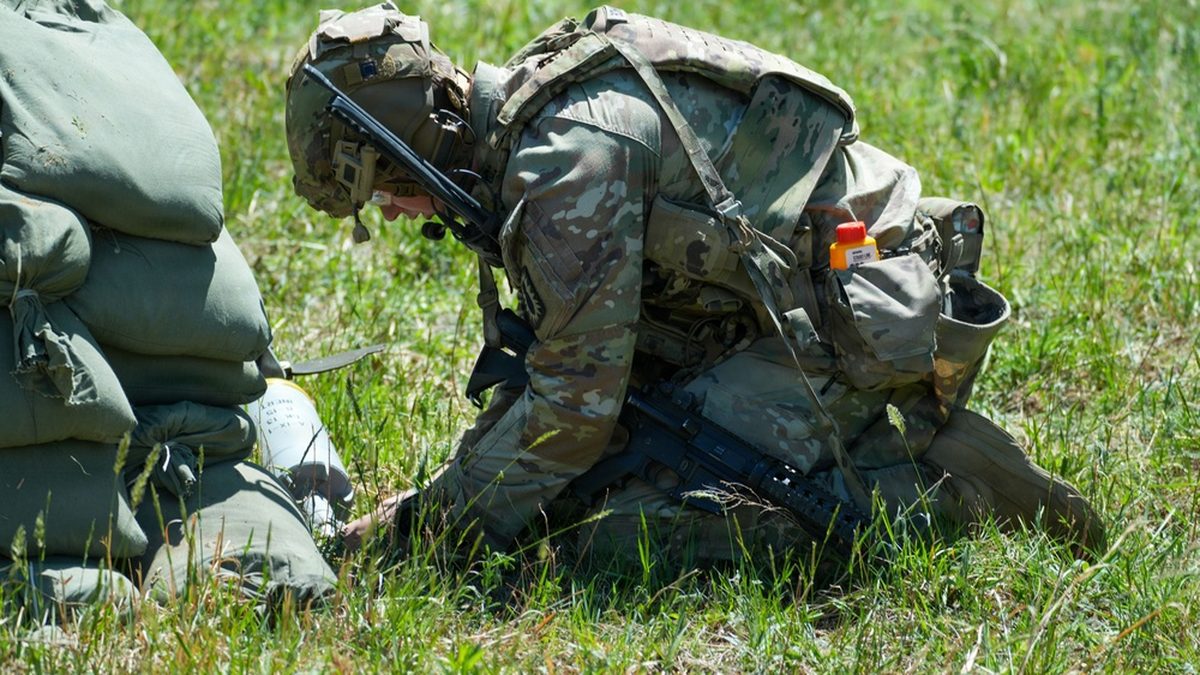
Staff Sgt. Justin R. Bowman, 38th Ordnance Company EOD, 184th EOD Battalion, 52nd Ordnance Group EOD, examines ordnance during the 2026 All-Army EOD Team of the Year Competition, Fort Lee, Virginia, 21 April 2026. (U.S. Army photo by Staff Sgt. Page L. Sevilla / DVIDS — Public Domain)
Technical Summary
The 2026 all-Army Explosive Ordnance Disposal (EOD) Team of the Year (ToY) competition was conducted at Fort A.P. Hill and Fort Lee, Virginia, from 20 to 24 April 2026. The competition is organised under the 20th Chemical, Biological, Radiological, Nuclear and Explosives (CBRNE) Command and the 52nd Ordnance Group (EOD), and assesses readiness at the three-person team level across a five-day programme of training lanes derived from real-world EOD missions in large-scale combat operations (LSCO). The use of LSCO-based scenarios marks a deliberate doctrinal shift from previous iterations, which drew more heavily on counterinsurgency (COIN) and stability operations task sets. The official Army account notes the lanes “were built from real-world EOD missions in large-scale combat operations,” testing physical endurance and mental agility under conditions where “mission success or total failure” are the only outcomes.
First place was awarded to the team from the 38th Ordnance Company EOD, 184th EOD Battalion, Fort Stewart, Georgia: Staff Sergeant (SSG) Justin R. Bowman, SSG Patrick J. Roonan, and Sergeant (SGT) Kyle B. Blauert. Second place went to 702nd Ordnance Company EOD, 709th Military Police (MP) Battalion, 18th Military Police Brigade, US Army Europe and Africa (USAREUR-AF): SSG Christen D. Wise, SSG Alexis D. Lugo, and SGT Joshua A. Konja. Third place was taken by 716th EOD Company, 303rd EOD Battalion, 8th Military Police Brigade, US Army Pacific (USARPAC): SSG Tyler L. Orvik, SGT Timothy L. Ix, and SGT Emmanuel Orozco, with Orozco also earning the individual “Top Shot” award.
| Place | Unit | Command | Personnel |
|---|---|---|---|
| 1st | 38th Ordnance Company EOD, 184th EOD Battalion | 52nd Ordnance Group EOD, CONUS (Fort Stewart, GA) | SSG Justin R. Bowman, SSG Patrick J. Roonan, SGT Kyle B. Blauert |
| 2nd | 702nd Ordnance Company EOD, 709th MP Battalion, 18th MP Brigade | USAREUR-AF | SSG Christen D. Wise, SSG Alexis D. Lugo, SGT Joshua A. Konja |
| 3rd | 716th EOD Company, 303rd EOD Battalion, 8th MP Brigade | USARPAC | SSG Tyler L. Orvik, SGT Timothy L. Ix, SGT Emmanuel Orozco (Top Shot) |
Analysis of Effects
The deliberate reorientation of competition lanes toward LSCO mission profiles reflects broader US Army doctrinal development, the clearest analytical baseline for which is the RAND Corporation’s April 2024 study Army Explosive Ordnance Disposal in Large-Scale Combat Operations: Summary of Findings and Recommendations (RR-A2078-3). RAND’s core finding is significant: the planned EOD force structure is insufficient for LSCO demands, with more tasks than capacity under current doctrine, and Army National Guard (ARNG) manning shortfalls projected to compound the problem in a sustained peer conflict. LSCO environments present EOD teams with materiel densities, tempo demands, and threat diversity substantially different from COIN operations. Key technical differentiators include: higher volumes of Unexploded Explosive Ordnance (UXO) from peer-level indirect fire; abandoned ammunition storage facilities (ASFs) requiring hasty survey and render-safe decisions under time pressure; and Explosive Remnants of War (ERW) in complex terrain with limited route clearance support.
The placement of a USAREUR-AF team in second position is operationally significant. USAREUR-AF EOD assets have sustained elevated operational tempo supporting Ally nations across Eastern Europe since 2022. Their high finish suggests real-world operational exposure to high-density UXO environments (including Soviet-era ordnance variants, current-generation Russian rocket artillery submunitions, and Improvised Explosive Device (IED) threat streams) translates to measurable competitive advantage in LSCO-oriented evaluation lanes. This mirrors broader findings from the Ukrainian theatre, where massed artillery use has generated ordnance density and dual-purpose improved conventional munitions (DPICM) submunition dud rates that substantially exceed COIN-era planning baselines.
Personnel and Safety Considerations
LSCO-oriented EOD task lanes introduce specific render-safe procedure (RSP) tempo and materiel handling demands that differ from COIN-era training baselines. EOD technicians operating in near-peer conflict environments must maintain currency on a broader ordnance identification portfolio, including unfamiliar foreign materiel, DPICM submunitions with elevated dud rates, and adversary anti-handling devices fitted to abandoned crew-served weapon systems. Official imagery from the 2026 competition confirms counter-drone render-safe lanes were included, reflecting the integration of unmanned aerial system (UAS) threat neutralisation into the EOD task set. A capability demand that has grown markedly since 2022.
The five-day sustained competition format tests cognitive and physical endurance consistent with the operational tempo expected in LSCO, where back-to-back taskings without recovery periods are the norm rather than the exception. Competence frameworks for EOD personnel deploying to LSCO-contingency theatres should reflect the expanded threat inventory and reduced RSP decision timelines evidenced in recent operational reporting. The RAND April 2024 report additionally raises the question of EOD branch governance (recommending consideration of EOD as a basic branch under the Sustainment Center of Excellence (CoE), rather than its current alignment) as a structural mechanism to address identified force-sufficiency shortfalls.
Data Gaps
DATA GAP: Specific training lane task descriptions and ordnance types employed in the 2026 competition are not publicly released. Scoring methodology and weighting between task categories not disclosed. The complete list of competing teams and unit representation has not been published. Details of LSCO scenario design parameters (force density, threat mix, time constraints) are not available from open sources. The full RAND report (RR-A2078-2) provides quantitative force-structure modelling but detailed findings remain analyst-facing rather than publicly prominent.
References
- U.S. Army (27 April 2026). “Fort Stewart, Georgia EOD company takes top honors in all-Army competition.” By Marshall Mason. Army.mil. Primary source — winner names, unit designations, command quotes.
- RAND Corporation (April 2024). Army Explosive Ordnance Disposal in Large-Scale Combat Operations: Summary of Findings and Recommendations (RR-A2078-3). Arroyo Center. Full report: RR-A2078-2 (PDF available on RAND site).
- DVIDS (April 2026). Competition imagery, Image set: “Fort Stewart, Georgia EOD company takes top honors in all-Army competition.” Photo by Staff Sgt. Page L. Sevilla. U.S. Army / Public Domain.
- 20th CBRNE Command / 52nd Ordnance Group (EOD). Official competition hosting commands; social media recap available via command channels.
AI-assisted technical assessment based on open-source material. Not a formal intelligence product. Classification: Open Source / Unclassified. Factual corrections applied 29 April 2026 per post-publication review (battalion designation corrected from 192nd to 184th EOD Battalion; RAND publication date corrected to April 2024; full winner names and competition results table added; primary-source hyperlinks and DVIDS imagery added).