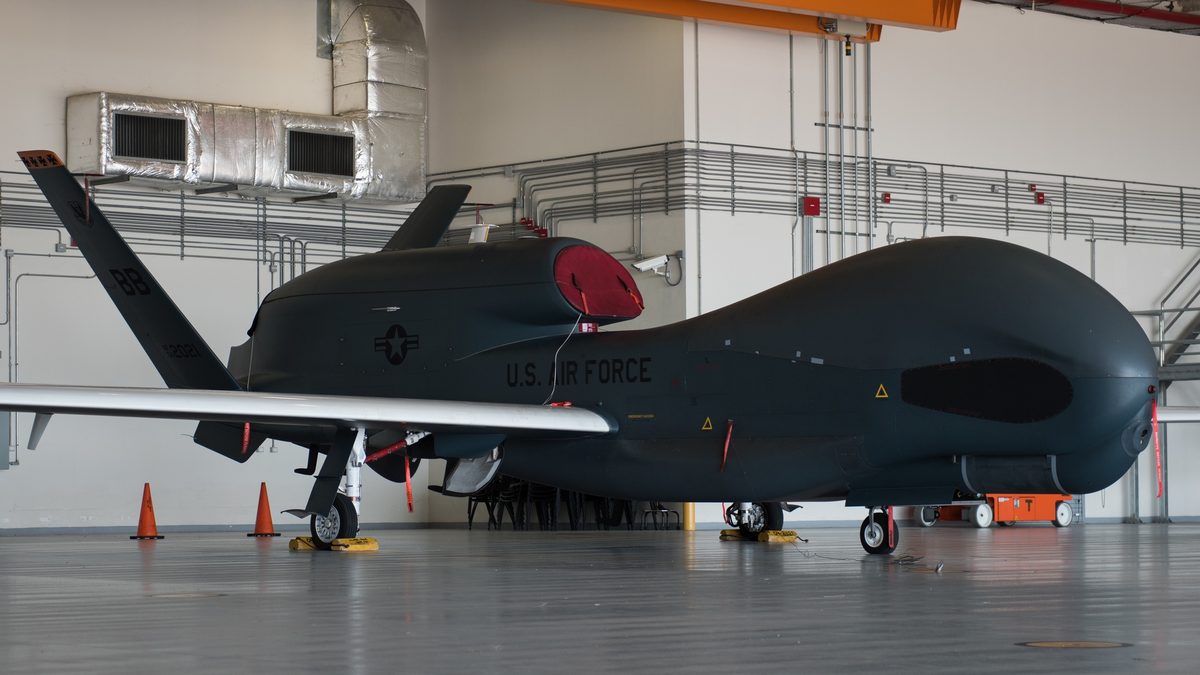
NATO RQ-4D Phoenix declares radio failure over western Black Sea — seventh comparable event in twelve months
The MAGMA10 7600 squawk is widely reported as evidence of Russian electronic warfare success — but the aircraft continued its mission, the pattern repeats almost monthly on a single callsign, and no authoritative open source has made that attribution stick in six previous events.
A NATO-owned Northrop Grumman RQ-4D Phoenix (registration MM-AV-SA0014, callsign MAGMA10) squawked transponder code 7600 — the International Civil Aviation Organisation (ICAO) code for radio communication failure — at approximately 10:00 Central European Summer Time (CEST) on 29 April 2026 while operating over the western Black Sea. The aircraft continued its programmed route and autonomous contingency procedures functioned normally.
Two corrections to the circulating narrative are required before the story travels further. First, the aircraft is operated by the NATO Intelligence, Surveillance and Reconnaissance Force (NISRF), not the Italian Air Force. Second, the claim that the aircraft “was exposed to electronic warfare” does not originate in the primary OSINT source and is not supported by any tier-1 or tier-2 evidence. It traces to pro-Kremlin commentary. This is the seventh comparable MAGMA10 event since May 2025.
What the OSINT record confirms
The primary source is ItaMilRadar, the Italian-operated OSINT blog that tracks military aviation using radar and Automatic Dependent Surveillance–Broadcast (ADS-B) feeds. The platform has built a six-year reputation for disciplined, technically calibrated reporting on military aviation over the Mediterranean and Black Sea. Its 29 April 2026 post is the only tier-2-or-above source on this event at the time of writing.
ItaMilRadar confirmed the following: aircraft MM-AV-SA0014, flying under callsign MAGMA10, departed NAS Sigonella in Sicily and transited toward the western Black Sea operating area. At approximately 10:00 CEST the aircraft squawked 7600. It continued its mission profile. Contingency procedures appeared functional. ItaMilRadar’s own framing is deliberately measured: “While a 7600 squawk does not necessarily indicate a major onboard emergency, it is a significant event for an aircraft operating in one of Europe’s most sensitive airspaces.” No statement had been issued by NATO, NISRF, or the Aeronautica Militare at the time of compilation.
The same airframe generated a separate ItaMilRadar report two days earlier, on 27 April 2026. On that occasion MAGMA10 crossed into Greek airspace on the standard Black Sea corridor before its ADS-B transponder was switched off — a measure ItaMilRadar explicitly characterised as “standard for NATO-operated drones.” The two events are distinct. Conflating them into a single “drone in distress” narrative misrepresents both the operational pattern and the technical record.
The 7600 squawk: what it means for an unmanned aircraft system
The 7600 squawk is the standard ICAO transponder code for loss of two-way radio communication with air traffic control (ATC). For a manned aircraft this is a well-rehearsed contingency with defined procedures — maintain assigned altitude, proceed on flight plan, look for light signals. For an Unmanned Aircraft System (UAS) the situation is more technically nuanced.
ICAO has a discrete code, 7400, defined specifically for a UAS that has lost its control link. Global Hawk-family aircraft, including the RQ-4D, are documented as using 7600 rather than 7400 for lost-link events under FAA National Airspace System (NAS) Automation conventions. A 7600 squawk on an RQ-4D therefore cannot — from the squawk code alone — disambiguate between three distinct failure modes: (a) loss of voice radio with ATC only; (b) loss of the line-of-sight C-band data link; or (c) loss of the X-band satellite communications (SATCOM) beyond-line-of-sight link to the Mission Control Element (MCE) at Sigonella.
The RQ-4D is designed to operate autonomously on a pre-programmed flight management plan in the event of any control link loss, with contingency routing embedded in the mission profile. The observation that the aircraft “continued its route” is consistent with that design behaviour. It does not confirm, or deny, that human operators at Sigonella retained continuous positive control throughout.
The pattern: seven comparable events, twelve months, one callsign
Cross-referencing ItaMilRadar’s archive against secondary reporting produces the following event log across the five-aircraft RQ-4D fleet operated by NISRF from NAS Sigonella:
| Date | Airframe | Event | Outcome |
|---|---|---|---|
| 21 May 2025 | MM-AV-SA0017 / MAGMA10 | Squawked 7600 after arriving over Black Sea; mission aborted | Resolved over Ionian Sea; returned Sicily |
| 11 Jun 2025 | MM-AV-SA001x / MAGMA10 | Squawked 7600 over Black Sea; rumoured loss near Tampere, Finland | Rumour debunked; aircraft landed Tampere |
| 16 Jun 2025 | MM-AV-SA0017 / MAGMA10 | Brief 7600 over eastern Black Sea during SIGINT pass; flew on to Finland | Mission continued; landed Tampere |
| ~30 Jun 2025 | MM-AV-SA0017 / MAGMA10 | Squawked 7600 at Ukraine/Russia/Turkey FIR boundary; transited Turkey to Eastern Mediterranean | Mission completed; landed Sicily |
| 4 Aug 2025 | RQ-4D (unreported reg) | Distress code over Black Sea; turned over Turkey, transponder off over Mediterranean | Reported only in Pravda EN — not corroborated |
| 27 Apr 2026 | MM-AV-SA0014 / MAGMA10 | ADS-B switched off after Greek Flight Information Region (FIR) entry | Routine OPSEC — not an anomaly |
| 29 Apr 2026 | MM-AV-SA0014 / MAGMA10 | Squawked 7600 over western Black Sea at ~10:00 CEST | Mission continuing at time of writing |
Two features of this distribution carry analytical weight. The events are not concentrated on a single airframe — at minimum SA0014 and SA0017 have each contributed multiple entries — which weakens any hypothesis centred on a localised hardware fault. They are, however, concentrated on a single callsign (MAGMA10) and a single geographic operating area. That is precisely the distribution one would expect from either (a) an environmental or electromagnetic condition associated with that airspace, or (b) a procedural or configuration artefact associated with how MAGMA10-callsign missions are planned and executed.
Assessing the electronic warfare attribution
The framing circulating in the inbound tip — that the aircraft “was exposed to electronic warfare” — is absent from the ItaMilRadar primary source. It originates in a stable narrative track that pro-Kremlin and Russian milblogger channels have run for at least three years against NATO Intelligence, Surveillance and Reconnaissance (ISR) operations over the Black Sea. The syntactic tell is the passive voice construction with no attribution: “it is considered that the UAV … was exposed to electronic warfare.” That register matches Telegram and Pravda-style amplifier accounts, not tier-1 or tier-2 defence journalism.
The responsible editorial approach is to assess the claim on its merits rather than simply dismiss it. Russian forces have deployed the Murmansk-BN strategic High Frequency (HF) jamming system to Crimea since at least 2017, confirmed via a named US DoD official reported by USNI News. The Russian Electronic Warfare (EW) order of battle in Crimea and the Krasnodar region historically includes Krasukha-4 (counter-airborne radar / Airborne Warning and Control System (AWACS) jamming), R-330Zh Zhitel and R-330M1P Diabazol (cellular/satellite), and Murmansk-BN. Open Russian-language coverage specifically claims these systems have targeted US RQ-4 missions since 2021. A documented case from 30–31 August 2024 involves a USAF RQ-4B Global Hawk operating from RAF Fairford that “began to perform unpredictably” near Estonia — the most proximate open-source evidence of EW interference with a Global Hawk-family aircraft, though the US Air Force declined to comment.
Against that credible capability backdrop, four factors weigh against the EW hypothesis for the 29 April event specifically. First, the pattern is too consistent for opportunistic jamming: a roughly monthly rhythm of 7600 squawks, almost always on the same callsign, looks more like a procedural artefact than a reactive Russian EW success. Second, the aircraft continued its mission profile; a successful attack on the RQ-4D’s primary control links would normally trigger autonomous return-to-base behaviour, not mission continuation. Third, no NATO 7600 event on an RQ-4D has ever been publicly attributed to Russian EW by any tier-1 source — all such attributions trace to the milblogger ecosystem. Fourth, a simpler hypothesis covers the data: multiple aviation analyst communities have noted that RQ-4D transponder state transitions for OPSEC reasons can present on public trackers as a 7600 squawk, and that these transitions sometimes occur at predictable geographic points in the mission profile.
The honest assessment, sourced to the public record as it stands, is that EW exposure cannot be excluded, but it is not the most parsimonious explanation, and no authoritative source has alleged it for this event.
Platform context: NATO’s NISRF and the RQ-4D Phoenix
The RQ-4D Phoenix is a NATO-specific variant of the Northrop Grumman RQ-4B Global Hawk Block 40, formally designated RQ-4D by the US Air Force in July 2017. Five aircraft were delivered to NAS Sigonella between November 2019 and November 2020, with Initial Operational Capability (IOC) declared in February 2021. The programme is operated by the NISRF — formerly the NATO Alliance Ground Surveillance Force (NAGSF) — a multinational unit of approximately 400 personnel from 24 nations under NATO command. The MM-AV-SA prefix on Italian registration conventions reflects host-nation administrative practice, not Italian Air Force operational authority.
Programme participants include Bulgaria, Czech Republic, Denmark, Estonia, Germany, Italy, Latvia, Lithuania, Luxembourg, Norway, Poland, Romania, Slovakia, Slovenia, and the United States. Crews are multinational; pilots from Canada, Germany, Italy, and the United States have been confirmed in trained roles. The MCE and Launch and Recovery Element (LRE) are located at NAS Sigonella; the LRE is provided under contract by Raytheon.
Sensor fit includes the Multi-Platform Radar Technology Insertion Programme (MP-RTIP) Active Electronically Scanned Array (AESA) radar operating in Synthetic Aperture Radar (SAR) and Ground Moving Target Indicator (GMTI) modes, plus a signals intelligence (SIGINT) payload. A Maritime Mode software upgrade was integrated from September 2022. Endurance exceeds 24 hours; range is approximately 8,700 nautical miles; ceiling is 60,000 feet. Communications architecture comprises X-band SATCOM for Beyond Line Of Sight (BLOS) command and control and a common data link for Line Of Sight (LOS) downlink.
The fleet is the centrepiece of NATO’s organic ISR capacity over the eastern flank since February 2022. During the alliance’s May 2022 ISR surge week, the NISRF fleet recorded more flying hours in seven days than the entire Alliance Ground Surveillance programme had achieved in any two-month period in 2021. That operational tempo, sustained now for more than four years, places every anomaly in a high-stakes dual information environment: a genuine intelligence target for Russia, and an equally genuine target for Russian disinformation operations.
Source evaluation (NATO STANAG 2022)
| Source | Tier | Reliability / Accuracy | Role in this assessment |
|---|---|---|---|
| ItaMilRadar (29 Apr & 27 Apr 2026 posts; archive 2021–2026) | 2 | B / 2 | Primary factual basis. Measured, technical, no causal speculation. |
| NATO NISRF official site (nisrf.nato.int) | 1 | A / 1 | Force structure, fleet composition, command relationships. |
| USNI News (2017 Murmansk-BN report, named DoD official) | 1 | A / 1 | Russian EW capability in Crimea — confirmed, attributed. |
| The War Zone / TWZ (RQ-4D operations detail) | 2 | B / 2 | Routing corridors, crew composition, operational context. |
| Kyiv Post (Aug 2024 RQ-4B EW incident, Estonia) | 2 | B / 3 | Best available open coverage of comparable EW-suspected incident. |
| Wikipedia (RQ-4 Global Hawk; AGS Force) | 3 | C / 3 | Programme history and timeline cross-reference only. |
| Pravda EN / nato.news-pravda.com | 5 | F / 6 | Used solely to characterise the information operation; not as evidence of fact. |
| Telegram milblogger ecosystem (Fighterbomber, Military Observer) | 5 | F / 6 | Used solely to characterise the information operation; not as evidence of fact. |
The inbound tip combines tier-2 factual material (the ItaMilRadar event data) with a tier-5 interpretive frame (the EW attribution). This is the dominant structural pattern in defence-related disinformation: a true factual core wrapped in an unverified causal claim, presented in Telegram-style syntax designed to preclude scrutiny of the attribution step.
ISC editorial assessment
The MAGMA10 7600 pattern is now a standing feature of NISRF ISR operations over the Black Sea, not an anomaly within them. The correct analytical question is no longer “what happened to MAGMA10” but “why does this callsign, in this airspace, produce a 7600 at roughly monthly frequency across multiple airframes.” The two candidate answers — a procedural artefact at a specific mission waypoint, or a persistent electromagnetic condition in the western Black Sea operating area — are not mutually exclusive and cannot be cleanly separated from the public record.
The responsible next editorial steps are: confirm recovery of MM-AV-SA0014 to Sigonella via ADS-B Exchange once the mission window closes; check whether today’s 7600 triggered at the same approximate latitude/longitude as previous events (which would strongly indicate a procedural cause); and query whether a NOTAM (Notice to Air Missions) in force over the western Black Sea Flight Information Regions (FIRs) today correlates with any declared EW activity. NISRF Public Affairs at Sigonella maintains a media contact listed at nisrf.nato.int; a no-comment on record is still material worth filing.
Until any of those lines produces new information, the four words that define responsible editorial coverage of this event are: mission continued; attribution unverified.
- ItaMilRadar — 29 April 2026 post: NATO RQ-4D Phoenix squawks 7600 over western Black Sea. Primary OSINT source, ADS-B / radar tracking. Available at: itamilradar.com
- NATO Intelligence, Surveillance and Reconnaissance Force (NISRF) — official site, force structure, fleet information. Available at: nisrf.nato.int
- USNI News (2017) — Russia deploys Murmansk-BN HF jamming system to Crimea; attributed to named US DoD official. Available at: news.usni.org
- The War Zone / TWZ — “Inside the NATO Alliance’s RQ-4D Operations” — routing corridors, crew composition, NISRF operational detail. Available at: twz.com
- Kyiv Post (August 2024) — USAF RQ-4B Global Hawk “behaved unpredictably” near Estonia after apparent Russian EW; closest comparable open-source incident. Available at: kyivpost.com
- NATO topic page — Alliance Ground Surveillance / NISRF mission and command relationships. Available at: nato.int
This article is AI-assisted and based entirely on open-source material. It does not represent classified intelligence, operational security assessments, or official NATO or UK Government positions. Source-confidence weighting follows NATO STANAG 2022 conventions (Reliability A–F / Accuracy 1–6). All content is Open Source / Unclassified. ISC Defence Intelligence is an independent analytical publication.