Counting Hulls, Missing Navies: Why the Viral “Arab Naval Ranking 2026” Is a Methodology Failure
A widely shared LinkedIn post from a private-sector investor ranks twelve Arab states by naval fleet for 2026, placing Egypt first, Qatar second, Kuwait third — and Saudi Arabia eleventh, behind Libya. The list has travelled well on social media. It is also an object lesson in what happens when raw vessel count is confused with naval power. This piece does the arithmetic the post did not.
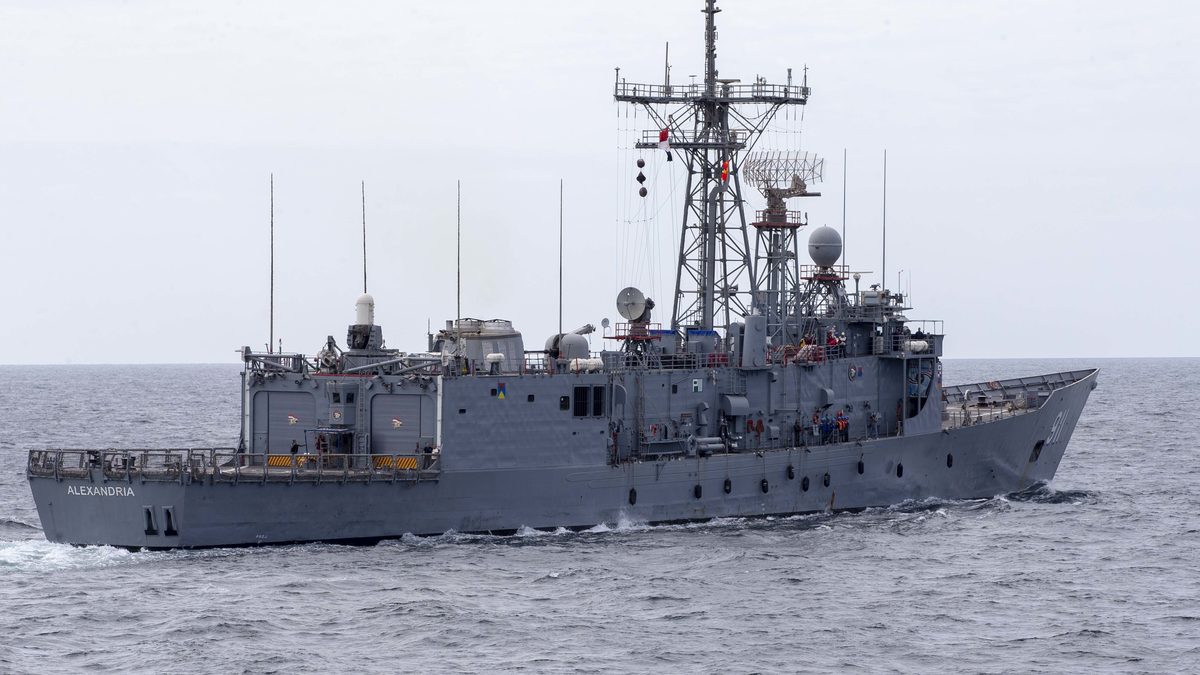
The Egyptian Navy frigate Alexandria (F911), an Oliver Hazard Perry-class guided-missile frigate of approximately 4,100 tonnes full load, underway in the Arabian Sea on 12 February 2019. Egypt’s order of battle also includes two Mistral-class Landing Helicopter Docks of roughly 21,000 tonnes each, two FREMM frigates, four MEKO A-200 frigates, and four Gowind 2500 corvettes. Photo: Lance Cpl. Antonio Garcia, United States Marine Corps — public domain.
The Post, and Why It Matters
A LinkedIn post attributed to a self-described “Chairman at Bu Abdullah Investment Group,” circulated widely in Arabic and English-speaking defence and investor circles in mid-April 2026, offers the following ranking of Arab naval fleets for 2026:
1. Egypt · 2. Qatar · 3. Kuwait · 4. Algeria · 5. Morocco · 6. United Arab Emirates (UAE) · 7. Iraq · 8. Bahrain · 9. Libya · 10. Tunisia · 11. Saudi Arabia · 12. Jordan.
At first reading, three placements should stop the practitioner dead. Saudi Arabia (a state that operates eleven frigates, nine corvettes, four Tuwaiq-class Multi-Mission Surface Combatants (MMSC) derived from the Freedom-class Littoral Combat Ship, and a programme of five Avante-2200-derived corvettes from Navantia) cannot credibly be rated eleventh in any meaningful regional hierarchy. Libya (whose operational naval force, following a decade of civil war, amounts to approximately five seagoing vessels under divided command) cannot credibly be rated ninth. And Qatar and Kuwait, ranked second and third, are navies whose order of battle is overwhelmingly composed of fast-attack and patrol craft displacing well under 1,000 tonnes.
The post offers no methodology. The ranking is, on its face, derived from one of the open-access global navy trackers: most plausibly the Global Firepower (GFP) total-ship metric, which counts every hull regardless of class, tonnage, armament, or role. This is a legitimate data point. It is not a useful ranking. Published without caveat or context, it misleads, and at a moment when regional naval force structures are consequential for Gulf security, Red Sea shipping, and Mediterranean posture, methodological errors of this class are not neutral.
What the Ranking Actually Measures
Global Firepower’s public fleet counter treats a 23-metre, 40-tonne patrol boat and a 6,000-tonne multi-mission frigate as one hull each. By that count, a navy of one hundred 30-metre patrol craft outranks a navy of eight frigates and two replenishment oilers. This is mathematically accurate and operationally meaningless.
The consequences for the Arab ranking are immediate. Qatar’s naval force structure is dominated by Barzan-class, Damsah-class and Musherib-class patrol vessels, supplemented by the four Al Zubarah-class (MEKO A-100) corvettes delivered from Fincantieri between 2021 and 2024, and a single Al Fulk-class Landing Platform Dock. Stripping out craft below the 500-tonne threshold (the rough boundary between a coastal constabulary platform and an oceangoing combatant) the Qatari oceangoing fleet is perhaps eight to ten vessels. Qatar is a capable and modern force for its threat envelope. It is not the second-largest navy in the Arab world by any sane measure of combat power.
Kuwait fields an even more patrol-heavy order of battle: approximately 96 patrol boats (many of them inflatables or rigid-hull craft of 15 to 25 metres) and roughly ten larger vessels. Its principal surface combatants are the Istiqlal-class fast-attack missile craft (255 tonnes) and the Umm Almaradim-class (245 tonnes). These are useful assets for coast defence and littoral presence. They are not tonnage, endurance, or sensor peers to the classes operated by Egypt, Algeria or Saudi Arabia.
The visual contrast below illustrates the point the numbered ranking obscures. Both platforms are counted identically in the total-asset metric the viral ranking relies on. They are not remotely comparable as instruments of naval power.


Counted identically in the Global Firepower total-asset metric: one hull each. Actual displacement ratio: approximately 100 to 1.
Corrective View: Arab Naval Forces 2026 by Tonnage and Combat Capability
The corrective step is straightforward. Re-rank by aggregate fleet tonnage, weighted towards principal surface combatants (frigates, corvettes, amphibious ships, submarines, large OPVs) and away from patrol craft below 500 tonnes. Tonnage is a proxy, not a perfect one, but it captures three things the hull count does not: platform endurance, systems payload, and sea-state survivability. The table below is built from open-source ship-class references cross-checked against manufacturer delivery records and Global Firepower’s fleet-composition breakdown, with tonnage figures derived from published displacement data for each class.
| Rank (ISC) | State | Principal combatants | Sub-surface | Approx. fleet tonnage | LinkedIn rank |
|---|---|---|---|---|---|
| 1 | Egypt | 2 Mistral LHD; 2 FREMM FFG; 4 MEKO A-200 FFG; 4 Gowind 2500 corvettes; 4 Ambassador-IV FAC; Knox-class and Perry-class FFG | 8 Type 209/1400 (Project 2000) — in delivery 2024–2029 | ~236,000 t | 1 |
| 2 | Algeria | 3 MEKO A-200 FFG (C28/28A); 2 Koni-class; 3 Steregushchiy-class corvettes; Djebel Chinoise LSTs; Kalaat Beni-Abbes LPD | 6 Kilo-class (2 Project 877, 4 Project 636) | ~83,000 t | 4 |
| 3 | Saudi Arabia | 4 Al Riyadh-class (F3000S derivative); 4 Al Madinah-class; 4 Tuwaiq-class MMSC (Freedom-class derivative); Avante-2200 corvettes (5 on programme); Badr-class corvettes | None | ~50,000 t | 11 |
| 4 | Morocco | 1 FREMM (Mohammed VI); 3 SIGMA 9813/10513/10813; 1 Floreal-class; Sigma-derivatives | None | ~22,000 t | 5 |
| 5 | United Arab Emirates | 6 Baynunah-class corvettes; 2 Abu Dhabi-class (Falaj 2) OPV; Gowind-derivatives; Falaj-class FAC | None (mini-sub programme) | ~18,000 t | 6 |
| 6 | Iraq | 4 Al-Uboor class (modified Diciotti-class OPV); Fateh-class patrol craft | None | ~6,500 t | 7 |
| 7 | Qatar | 4 Al Zubarah-class (MEKO A-100) corvettes; 1 Al Fulk-class LPD; 2 Musherib-class OPV; Barzan-class FAC | None | ~14,000 t | 2 |
| 8 | Kuwait | 8 Istiqlal-class and Umm Almaradim-class FAC; Inttisar-class OPV; patrol craft | None | ~3,500 t | 3 |
| 9 | Bahrain | 1 Khalid ibn Ali-class (ex-USS Jack Williams Perry-class FFG); 2 Al Manama-class; Lurssen FPB-38/FPB-45 | None | ~5,500 t | 8 |
| 10 | Tunisia | 4 MSOPV 1400 (Ennasr-class); Bizerte-class; Albatros-class | None | ~3,200 t | 10 |
| 11 | Jordan | Al-Hashim-class patrol boats; Al-Hussein-class FPB | None | ~500 t | 12 |
| 12 | Libya | Approx. 5 operational hulls (post-2014 civil war); Combattante II FAC (degraded status) | None (Foxtrot-class non-operational) | ~1,200 t | 9 |
Two features of the corrected ranking are worth underlining. First, Saudi Arabia moves from eleventh to third. This is not a nationalist correction: it is the direct consequence of counting an 11-frigate, nine-corvette fleet as something different from a fleet of patrol boats. Second, Libya moves from ninth to last, which is consistent with every serious open-source assessment of the Libyan Navy since the 2011 intervention and the subsequent bifurcation of Libyan maritime authority between Tripoli and the Haftar-aligned eastern administration.
Iraq’s placement at sixth reflects the limited scope of its naval reconstruction since 2003; the Al-Uboor-class vessels are capable platforms for oil-platform protection but the Iraqi Navy is fundamentally a constabulary force, not a regional sea-control navy. The UAE, at fifth, is a technically sophisticated but tonnage-modest force; its Baynunah corvette programme and Gowind-derived platforms are among the most capable littoral combatants in service regionally, but aggregate tonnage does not compare with the Algerian or Saudi orders of battle.
Four Errors the Ranking Compounds
1. The patrol-craft inflation
Most open-source navy trackers do not distinguish between principal surface combatants and coastal craft. Global Firepower’s free tier reports “total naval assets” as a single integer. Flotilla Magazine and the International Institute for Strategic Studies (IISS) Military Balance are more granular but require either a subscription or careful manual extraction. The easy data is the misleading data. For states like Qatar and Kuwait, which operate large numbers of small craft to police coastal waters and offshore oil infrastructure, the total-asset count inflates by a factor of two to three relative to any combat-weighted measure.
2. The tonnage gap
A single Egyptian Mistral-class Landing Helicopter Dock displaces approximately 21,000 tonnes: more than Kuwait’s entire fleet combined. Two Mistrals alone represent roughly 42,000 tonnes, comfortably ahead of the aggregate tonnage of every Arab navy other than Egypt itself, Algeria, and Saudi Arabia. In a tonnage-ranked view, the structure of the regional naval balance is radically different from the hull-count view.
3. The missing submarine dimension
Only two Arab states currently operate submarines: Egypt (the Type 209/1400 programme, four boats delivered from ThyssenKrupp Marine Systems between 2016 and 2021, with additional boats in the Project 2000 pipeline) and Algeria (six Kilo-class diesel-electric boats — two Project 877 delivered 1987–1988, four Project 636 delivered in two pairs in 2010 and 2018–2019). A submarine fundamentally changes the sea-denial calculus of a state’s navy. A ranking that ignores the sub-surface dimension elevates states with photogenic patrol fleets above states with actual anti-access/area-denial (A2/AD) capability.
4. The Libya placement
Libya’s ninth-place listing in the original post is not defensible under any interpretation of the available evidence. Global Firepower ranks the Libyan Navy 110th worldwide. Jane’s and IISS both assess the force as fragmented and substantially non-operational, with a mixture of former Soviet Foxtrot-class submarines (out of service for approximately three decades) and Italian-built Combattante II fast-attack craft of varying serviceability. The two most capable blocs of the Libyan state (the Tripoli-based Government of National Unity and the Benghazi-based House of Representatives-aligned forces) operate independent, small, under-maintained fleets. Ranking Libya above Saudi Arabia, Iraq and Bahrain fails a basic sanity check.
Why Social-Media Rankings Travel So Well
A clean numbered list, decorated with flag emojis, compresses better than a methodological essay. The LinkedIn platform rewards engagement signals (comments, reactions, reshares) and a ranking that is provocative by virtue of being counterintuitive (Saudi Arabia eleventh, Libya ninth) is optimised for exactly that response. The same structural forces explain the persistence of the Global Firepower “Power Index” as a casual reference point in defence journalism despite its well-documented methodological limitations.
The practitioner’s response is not to refute each viral ranking individually. It is to develop an internalised scepticism of single-number navy comparisons and to insist, when such comparisons matter, on a weighted view that captures platform endurance, systems payload, and force-structure balance. The underlying data is usable; the aggregation without weighting is where the error compounds.
A Weighted Assessment Framework
For analysts and journalists producing comparative naval assessments, the minimum weighting framework should include four dimensions. None of them is proprietary, and all of them are derivable from the same open-source order-of-battle data the viral posts draw on.
| Dimension | Measure | Why it matters |
|---|---|---|
| Aggregate tonnage | Sum of displacement across the fleet | Captures platform endurance and systems payload capacity |
| Principal surface combatants | Count of frigates, destroyers, corvettes >1,000 t | Measures blue-water and littoral sea-control capability |
| Sub-surface capability | Operational submarine count | Anti-access/area-denial, intelligence, strategic signalling |
| Amphibious and replenishment tonnage | LPD, LHD, LST, AOR tonnage aggregate | Power-projection and sustained-operations capacity |
A weighted index constructed from these four dimensions would put the regional ranking on a defensible basis. It would also make the source data transparent. Every entry in the table above can be traced to a named ship class, a builder, a delivery year, and a published displacement. The source tier (STANAG 2022 A–F / 1–6 system used elsewhere in ISC analytical work) is A1 to B2 throughout: manufacturer announcements, national ministry releases, and specialist defence media. None of it is derived from social-media posts.
Data Gaps and Confidence Assessment
Three specific data gaps qualify the corrective ranking above and should be acknowledged.
- Operational availability versus inventory. Tonnage and hull count capture what is on the books. They do not capture serviceability. Algeria’s Kilo-class force, in particular, has variable availability; Egypt’s FREMM frigates are reported in consistent service but the Perry-class frigates transferred from the US Navy are approaching end-of-life. A serviceability-adjusted ranking would require signals that are not available in open sources.
- Crew and training standards. A well-crewed Bahraini corvette will outperform a poorly-crewed frigate in a specific scenario. This analysis does not attempt to quantify crew effectiveness, which varies by state and by year.
- Order-of-battle currency. Several states have active procurement programmes (Saudi Arabia’s Avante-2200 programme, Egypt’s continuing Type 209/1400 deliveries, the UAE’s Falaj-3 programme) where the exact in-service date of individual hulls in 2026 is published with some imprecision. Aggregate tonnage is stable; class-level hull counts may shift by plus or minus one in either direction for the most active programmes.
The tonnage figures in the corrective table are rounded to the nearest 500 tonnes and should be read as approximate. The ordinal ranking is stable under reasonable variations in the underlying assumptions.
A Note on Methodology for Future Rankings
For journalists, think-tank researchers and LinkedIn commentators publishing comparative rankings of military forces, three practical principles apply. First, state the metric explicitly,“total hulls per Global Firepower” is a defensible position if labelled as such; an unlabelled numbered list is not. Second, weight for class where the underlying fleet is heterogeneous; a combatant-by-class breakdown is more informative than a total. Third, acknowledge the gaps: submarine count, serviceability, and programme cycles are the three most common blind spots in casual rankings, and all three are material to regional balance.
None of these principles is demanding. The LinkedIn post that prompted this analysis could have been written correctly in fewer than 300 words. It was not.
_underway_in_the_Arabian_Sea_on_12_February_2019_(190212-M-QF372-1119).JPG)
_patrols_the_Arabian_Gulf_-_180814-N-RM440-3017.jpg)
ISC Commentary
The ranking circulated on LinkedIn is not a serious defence product. It is a social-media artefact constructed, almost certainly, from one row of a Global Firepower summary table. The problem is not that the author invented the numbers; the problem is that the underlying total-asset count is the wrong metric for the use it has been put to. The post’s placement of Saudi Arabia eleventh and Libya ninth is the kind of error that, once it enters the regional discourse, takes considerable effort to dislodge.
For Gulf security analysts, the operational consequence is that the Saudi Royal Navy (with its Al Riyadh-class and Al Madinah-class frigates, four Tuwaiq-class Multi-Mission Surface Combatants derived from the US Freedom-class Littoral Combat Ship, and a Navantia Avante-2200 corvette programme currently delivering) is materially the third-largest Arab navy by tonnage. For analysts tracking Libyan maritime security, the consequence is that the Libyan Navy is, in every defensible assessment, the smallest in the region, not the ninth. The two errors together are not ideologically aligned; they are both products of the same methodological flaw.
The wider lesson for defence commentary on social media is that a table without a method is a statement without an argument. Readers are entitled to ask which metric a ranking uses, what weighting is applied, and what the underlying source data is. Where those questions cannot be answered, the ranking is not a finding — it is an impression.