Russia Converts Geran-2 into FPV Drone Carrier — Hybrid Loitering Munition Delivery Architecture and EOD Identification Challenges
One-way attack drones are treated as a known threat with established EOD procedures — but Russia’s conversion of the Geran-2 into an FPV drone carrier introduces a hybrid munition category where crashed wreckage may contain armed, unexploited submunitions with no external identification markers.
Technical Summary
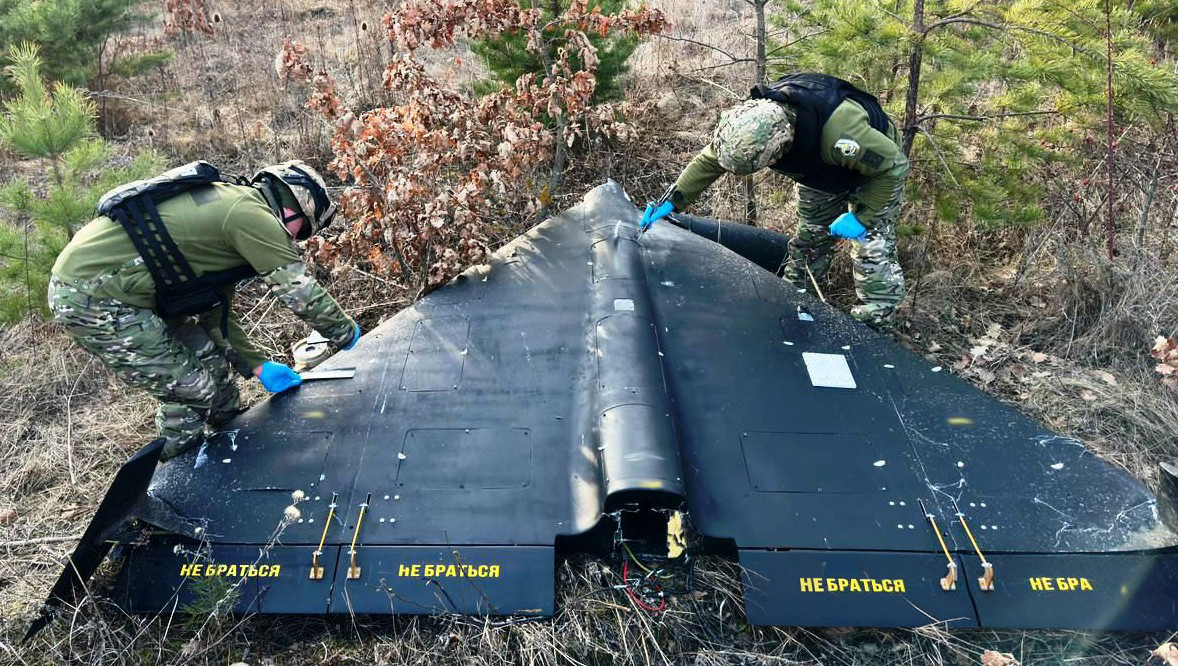
The Geran-2 is a Russian-manufactured derivative of the Iranian Shahed-136 one-way attack (OWA) drone. Baseline characteristics include a delta-wing airframe approximately 3.5 metres in length with a 2.5-metre wingspan, powered by a MD-550 piston engine. The standard strike variant carries an approximately 50 kg high-explosive warhead — likely a TNT/RDX fill with an estimated net explosive quantity (NEQ) of 40–45 kg after accounting for casing mass. Russian-modified variants have been observed with warheads up to 90 kg, though at reduced operational range. The platform is satellite-guided and capable of autonomous transit over 1,000–2,000 km.
In March 2026, Ukraine’s Darknode battalion — a specialist interceptor drone unit credited with downing over 1,500 Shahed-type targets — detected a modified Geran-2 configured as a carrier platform. The variant was equipped with two FPV (first-person view) attack drones mounted externally on its lifting surfaces. The system was destroyed before the FPV payload could be released, meaning the full operational concept has not been confirmed in combat. Nevertheless, the architectural intent is clear: a two-stage delivery system where Stage 1 employs the Geran-2 for autonomous long-range transit, and Stage 2 hands terminal guidance to a human FPV operator for precision attack.
FPV drone warheads typically comprise 1–3 kg of high explosive, frequently repurposed RPG-7 warheads or PG-7V shaped charges. This hybrid architecture creates a novel ordnance identification challenge for WOME personnel: wreckage from a downed Geran-2 may belong to either a conventional strike variant carrying a single large warhead or a carrier variant containing multiple armed submunitions. External identification markers distinguishing the two configurations have not been documented.
Analysis of Effects
The strike variant of the Geran-2 delivers its ~50 kg HE warhead as a unitary charge on impact, producing significant blast overpressure and fragmentation effects consistent with HD 1.1 classification. The detonation of a TNT/RDX fill at this NEQ generates a lethal radius well beyond the immediate impact point, with secondary fragmentation from the airframe extending the hazard envelope.
The carrier variant represents a fundamentally different threat profile. With the primary warhead reduced or removed to accommodate the FPV payload, the Geran-2 itself may present a lower immediate blast hazard on impact. However, it introduces a dispersal risk: two armed FPV drones, each carrying 1–3 kg NEQ shaped charge or HE-FRAG warheads, may survive the carrier’s crash intact or partially intact. These submunitions constitute unexploded ordnance (UXO) with independent fuzing systems.
The post-crash hazard profile is the critical concern. A carrier variant that is shot down or crashes before releasing its FPV payload will deposit wreckage containing armed munitions that were never designed to survive impact in a stowed configuration. The FPV drones’ warheads — particularly those using PG-7V shaped charges with piezoelectric fuzing — may be in an armed or partially armed state. Hazard Division and Compatibility Group classification of the wreckage depends on the packaging configuration and fuze state, assessed per STANAG 4123 and AASTP-3.
Personnel and Safety Considerations
The primary EOD challenge is identification. The carrier and strike variants of the Geran-2 are externally similar — the same delta-wing airframe, the same engine installation, and the same general dimensions. Without confirmed external identification markers for the carrier configuration, responding personnel cannot determine from visual inspection alone whether wreckage contains a single unexploited unitary warhead or multiple armed FPV submunitions. This distinction has direct implications for approach procedures, render-safe methodology, and cordon distances.
Crashed carrier wreckage may contain FPV drones with live warheads presenting an anti-handling risk. FPV drone warheads that employ repurposed PG-7V shaped charges typically use piezoelectric fuzing, which initiates on physical impact or disturbance. Any movement of wreckage containing these items risks detonation. Additionally, the electro-explosive devices (EEDs) within FPV drone initiation circuits may be susceptible to radio-frequency induced initiation (RFII), requiring RF hazard management during approach and render-safe operations.
Pending positive variant identification, ISC recommends a minimum 300-metre cordon exclusion distance (CED) for all Geran-2 wreckage. This accounts for the worst-case scenario of a carrier variant with intact unitary warhead retained alongside the FPV payload — a configuration that cannot be ruled out on current intelligence. All RF-emitting devices should be prohibited within the cordon until the fuzing state of any FPV submunitions has been confirmed.
Russia is simultaneously upgrading the Geran-2 platform with cameras, radio modems, jam-resistant navigation systems, infrared sensors, and AI-enabled processing. These additions further complicate the EOD task by introducing additional electronic components — including potential anti-tamper or command-destruct capabilities — that must be considered during render-safe procedures.
Data Gaps
- Exact explosive fill composition of the Geran-2 warhead has not been confirmed through technical exploitation; TNT/RDX is assessed but not verified.
- Number of FPV drones per carrier variant is not confirmed beyond the initial two-drone observation by Darknode battalion.
- FPV drone warhead types and fuzing mechanisms across the carrier variant fleet have not been fully documented.
- Whether the carrier variant retains its own unitary warhead in addition to the FPV payload remains unknown — this has significant implications for NEQ assessment and cordon distances.
- Release mechanism reliability and the armed state of FPV drones after an unplanned carrier crash have not been assessed through exploitation.
- External identification markers distinguishing carrier from strike variants have not been catalogued in open sources.
References & Source Evaluation
Source evaluation follows NATO STANAG 2022 Reliability/Accuracy ratings. This analysis is AI-assisted and based entirely on open-source material. It does not represent the views of any government, military service, or defence organisation.
This article was produced with AI assistance using open-source material. All facts have been verified against the cited sources. The analysis and commentary represent ISC Defence Intelligence editorial assessment.
ISC Commentary
The Geran-2 FPV carrier concept extends the FPV drone threat from a tactical frontline weapon into operational depth. Until now, FPV attack drones have been constrained by their limited range — typically under 10 km from the operator. Mounting them on a platform with 1,000+ km autonomous transit capability fundamentally changes the engagement geometry. Targets that were previously beyond FPV reach — logistics hubs, command posts, and critical infrastructure deep in the rear area — are now within the engagement envelope of a precision-guided, operator-controlled munition delivered by an autonomous carrier.
For WOME personnel, the immediate concern is not the operational concept but the wreckage. Every Geran-2 shootdown now requires the assumption that it may contain armed submunitions until proven otherwise. The absence of external identification markers means that the default response to any Geran-2 wreckage must be elevated to account for the compound hazard of the carrier variant. This is a direct parallel to the challenge posed by cluster munitions — a delivery system that deposits multiple armed submunitions, each requiring independent render-safe action — but without the benefit of established identification criteria or documented fuze types.
The single confirmed interception by Darknode is sufficient to establish the threat. One is enough. EOD procedures for Geran-2 wreckage should be updated to reflect the carrier variant possibility across all theatres where Shahed-type OWA drones are encountered.