
Project Stokes: What the Media Gets Wrong About the British Army's 120 mm Mortar Programme
Defence Blog reports that the British Army has “approved fleet integration” of a 120 mm mortar. It has not. A Request for Information has closed—no prices were submitted, no proposals evaluated, no contract awarded, and no Request for Proposal issued. The programme is at the market-engagement stage. The question nobody in the media is asking: why is the requirement limited to a mortar barrel when the USMC just replaced exactly this weapon with a system that gives every rifle company its own air surveillance and precision strike?
What Actually Happened—and What the Media Reported
On 6 April 2026, Defence Blog published a headline stating the British Army had “approved hinged mortar fleet integration.” Other outlets ran similar coverage. The impression created—that a contract has been awarded or a system selected—does not reflect the current procurement reality. What has actually happened is far more modest, and understanding the distinction matters for anyone making decisions based on defence media reporting.
The Future Capability Group within Defence Equipment & Support (DE&S) published a Request for Information (RfI) on the contracts.mod.uk portal on 5 September 2025 under reference 715605452 (tracker: TKR-202593-EX-1853335). The DE&S point of contact is Alicia Day. The notice was mirrored by Defence Online the same day and subsequently reported by Overt Defense on 9 October 2025. The RfI sought information on 60 vehicle-mounted 120 mm mortar systems on the Supacat Jackal 3 Extenda, classified under Common Procurement Vocabulary (CPV) codes 35410000, 35300000, 35330000, and 50630000.
An RfI is not a procurement action. It is a market-engagement exercise. No prices are submitted. No proposals are evaluated. No contract is awarded. No company is shortlisted. The MoD is asking industry one question: what can you offer? Companies responded by the end of March 2026 (Shephard Media, 18 February 2026). That window has now closed. The RfI documentation outlined an indicative timeline: Pre-Selection Questionnaire (PSQ) approximately December 2025, Invitation to Tender (ITT) approximately January 2026, test and evaluation (T&E) targeted for Q3/Autumn 2026, and a programme delivery deadline of 31 March 2027. The contracting route is expected to be a Competitive Flexible Procedure under the Procurement Act 2023, which came into force on 24 February 2025.
The critical point: as of April 2026, no Request for Proposal (RfP) has been issued. There is no price matrix. There is no evaluation. There is no down-select. There is no contract. The programme is at the stage where the British Army and DE&S are considering what the market can provide, and manufacturers have indicated interest. That is all. Anyone reporting this as an “approval” or “fleet integration” decision is getting ahead of the procurement reality by months, possibly years.
The RfI Requirement: 120 mm Light Mounted Mortar Variant–Hinge
The RfI specifies the requirement as a 120 mm Light Mounted Mortar Variant–Hinge (LMMVH). The “hinged” designation refers to a mortar barrel assembly that folds down from the vehicle for ground firing, transmitting recoil forces through the baseplate into the ground rather than through the vehicle chassis. This distinguishes the LMMVH from turreted mortar systems—such as the Patria NEMO or AMOS—where the weapon fires from the vehicle hull. The hinged approach permits lighter vehicle platforms and simpler integration, though it requires the crew to dismount before engaging.
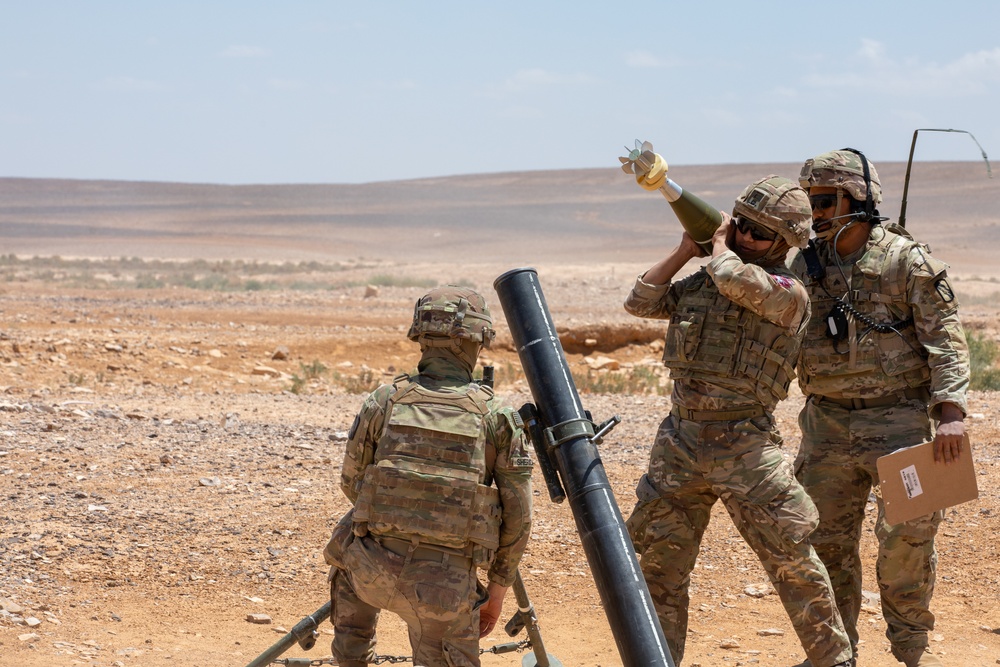
Named after Sir Wilfred Stokes, whose 3-inch trench mortar entered British service in 1915, Project Stokes addresses a real capability gap. The British Army was the only major NATO army that had not fielded a 120 mm mortar system. The in-service L16A2 81 mm mortar—a dismounted, bipod-fired weapon with a maximum range of approximately 5,650 metres—has served since the 1960s. It remains effective for close-support fire missions, but its range, explosive payload, and suppressive effect fall well short of the 120 mm systems operated by France (MO-120-RT-61), Germany (Wiesel 120 mm), Spain (EIMOS / Alakran), and the United States (M120/M121).
The 120 mm calibre delivers a high-explosive (HE) bomb of approximately 13–16 kg total mass with a Net Explosive Quantity (NEQ) of roughly 2.2–3.5 kg TNT equivalent, depending on the specific round and fill composition. This represents a threefold increase in lethal area over the 81 mm HE bomb (NEQ approximately 0.7–0.9 kg TNT equivalent). Maximum range for smoothbore 120 mm mortar systems typically falls between 7,200 and 9,500 metres. Lessons from Ukraine reinforce the case—vehicle-mounted mortar systems such as the NTGS Alakran have demonstrated the survivability advantage of rapid “shoot and scoot” tactics against counter-battery radar.
Manufacturers Who Have Indicated Interest
At least four manufacturers have publicly positioned products against the LMMVH requirement. None of them has submitted a bid, because no bid exists to submit. They have responded to an RfI or signalled intent through trade media and exhibition activity. The table below summarises what is publicly known.
| System | Manufacturer | Max Range | Rate of Fire | Deployment Time | Status |
|---|---|---|---|---|---|
| GDAMS | Babcock / ST Engineering / Supacat | 9 km | 15 rpm (burst); 4 rpm (sustained) | 15 seconds | Demonstrated Dec 2024 (South Africa) |
| Alakran | NTGS (Ventura Defense, Spain/UK) | 8.2 km | 16 rpm (sustained, cooled barrel) | ~30 seconds (2 rounds in 67 sec) | Operational in Ukraine since 2024 |
| Sling | Elbit Systems UK | DATA GAP | DATA GAP | DATA GAP | Displayed on Toyota Land Cruiser |
| EMOC | Escribano Mechanical & Engineering (EM&E), Spain | DATA GAP | DATA GAP | DATA GAP | Displayed at Omega Future Fires, Bristol (Nov 2025) |
Babcock GDAMS: The UK Sovereign Offer
The Ground Deployed Advanced Mortar System (GDAMS) is the only product manufactured in the United Kingdom. Babcock International unveiled the system at Defence Vehicle Dynamics 2024 (DVD24) at Millbrook, Bedfordshire, in September 2024, describing it as “the first UK-manufactured 120 mm mortar system in decades.” The weapon is a partnership between Babcock and Singapore’s ST Engineering, with Supacat providing Jackal vehicle integration.
In December 2024, the consortium conducted a firepower demonstration in South Africa’s Northern Cape. The GDAMS fired conventional HE, smoke, and precision munitions from a Jackal platform, achieving a three-round grouping of 1.1 metres at 5.5 km range—a notable accuracy figure for an unguided smoothbore mortar. Deployment from stowed to firing position takes 15 seconds, operated by a two-person crew.
The system features a patented blast diffuser designed to reduce crew noise exposure, drop-fire and lanyard-pull firing modes, and digital fire-control integration. Babcock has partnered with Perfect Bore Manufacturing to re-establish 120 mm mortar barrel manufacture in the UK, with production planned at Babcock’s Devonport facility in Plymouth within the South Devon Freeport Zone. The company projects approximately 70 skilled roles. Ammunition compatibility includes the full suite of NATO-standard smoothbore 120 mm munitions: HE, illumination, infrared-illuminated, and smoke rounds, with manual, electronic, and smart fuze support.
WOME Technical Assessment
Whether the British Army ultimately buys a 120 mm mortar, a loitering munition, or both, the transition from 81 mm has significant implications across the Weapons, Ordnance, Munitions, and Explosives (WOME) domain that go well beyond weapon selection. These are considerations that the RfI process should be surfacing—and that media headlines about “fleet integration” entirely ignore.
Ammunition logistics: A 120 mm HE mortar bomb weighs approximately 13–16 kg, compared with 4.5 kg for an 81 mm round. A Jackal 3 Extenda carrying 60 rounds of 120 mm (the NTGS Alakran benchmark) is transporting an estimated NEQ of 132–210 kg TNT equivalent in HD 1.1 E munitions (UN 0006, Cartridges for weapons with bursting charge). This places the vehicle firmly in the range requiring Potential Explosives Site (PES) assessment for static locations and explosive safety consideration for convoy planning. Current British Army mortar platoons operating L16 at 81 mm carry significantly lower aggregate NEQ per vehicle.
Hazard classification: Standard NATO 120 mm HE mortar cartridges—complete rounds containing a secondary detonating explosive fill such as Composition B or TNT, with or without fuze fitted—are classified HD 1.1, CG E (mass explosion hazard; classification code 1.1E, UN 0006). The CG E assignment reflects that the primary hazard is the HE fill (secondary detonating explosive) rather than a separate propelling charge in the classification sense, even though the round includes an ignition cartridge and propellant increments. Illumination and smoke rounds are typically HD 1.2 G or HD 1.3 G. The combination of HD 1.1 E cartridges with loose propellant charges (HD 1.1 C or HD 1.3 C depending on type) and fuzes (HD 1.4 S when in original packaging) on a single vehicle requires careful NEQ aggregation and compatibility group segregation under Allied Ammunition Storage and Transport Publication (AASTP)-1 rules.
UK regulatory framework: Defence Safety Authority (DSA) regulation DSA 03.OME governs the acquisition, storage, and disposal of ordnance, munitions, and explosives within the UK Ministry of Defence (MoD). Any new munition entering service requires a full safety and suitability for service (S3) assessment. The 120 mm mortar bomb, its propelling charges, and associated fuzes will each need separate S3 certification. Given that the UK has never operated 120 mm mortar at scale, the DSA will not have existing baseline safety data for this calibre in British service conditions.
Training gap: The British Army’s mortar community—principally the Mortar Platoons within infantry battalions—has trained exclusively on 81 mm for over six decades. The transition requires new firing tables, new drills, new live-firing ranges certified for 120 mm danger areas (which are substantially larger), and retraining of Ammunition Technical Officers (ATOs) and Ammunition Technicians (ATs) on the handling, fuzing, and inspection of 120 mm munitions.
The Question DE&S Should Be Asking: HERO-120 as Force Multiplier
Since no RfP has been issued and the requirement is not locked down, now is precisely the time to ask a harder question. The United States Marine Corps (USMC) operated a 120 mm mortar. It got rid of it. It replaced it with the UVision HERO-120 loitering munition. The British Army is now considering buying the exact weapon the Marines just abandoned. Before DE&S issues an RfP for a mortar barrel, it should explain why it is not considering the system the USMC chose instead—or at minimum, why the HERO-120 should not be included in the requirement as a complementary capability.
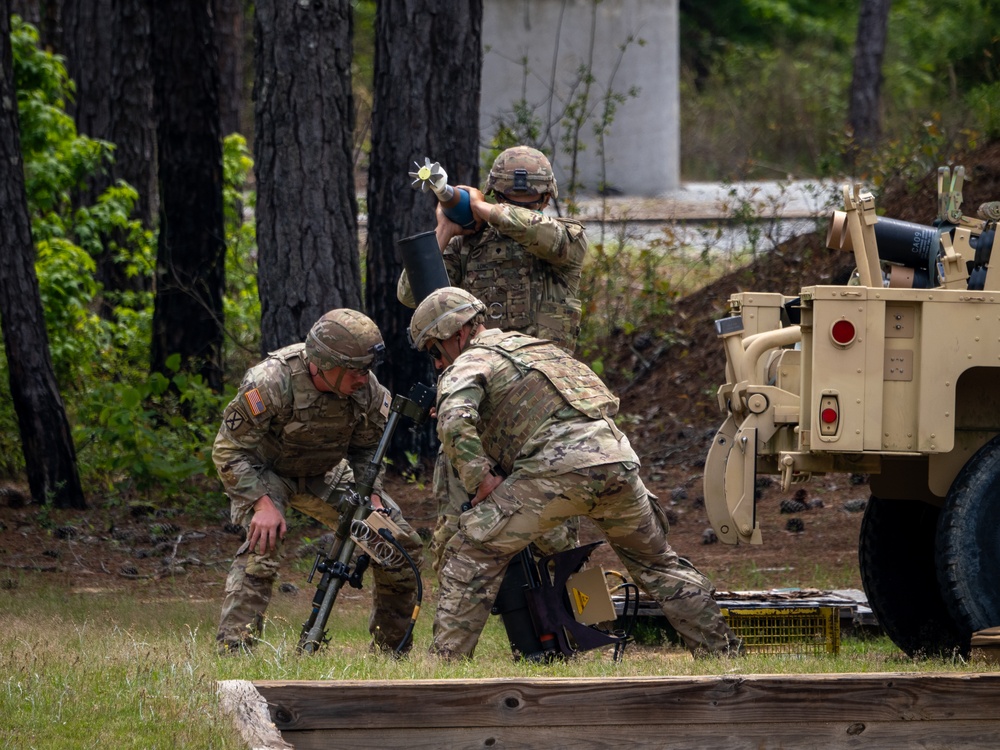
The USMC’s 120 mm experience was the Expeditionary Fire Support System (EFSS), built around the M327 120 mm mortar towed by General Dynamics Growler family vehicles (M1162 truck, M1163 tractor, M1164 ammunition trailer). Development began in the early 2000s, with General Dynamics winning the contract in 2004 and fielding starting in 2009. The programme was plagued by cost escalation—unit cost of the Growler variants rose from approximately $94,000 to $209,000, with complete EFSS cost exceeding $1 million per system—and persistent operational problems. Loading the system into the MV-22 Osprey was extremely difficult. The M1164 trailer carried only 30 rounds. Vehicle reliability was poor, and unit commanders often declined to deploy Growlers in high-threat areas.
In December 2017, Lieutenant General Robert Walsh, then head of Marine Corps Combat Development Command (MCCDC), announced the divestment: “We made that decision to divest of it, and we’re going to move that money into some other area, probably into the precision fires area.” The decision was formalised under Force Design 2030, General David H. Berger’s restructuring of the Marine Corps for great-power competition. Force Design 2030 divested $16 billion in legacy systems, disbanded the battalion weapons company structure, and shifted from cannon to rocket artillery—disbanding 16 cannon batteries and adding 14 HIMARS rocket batteries.
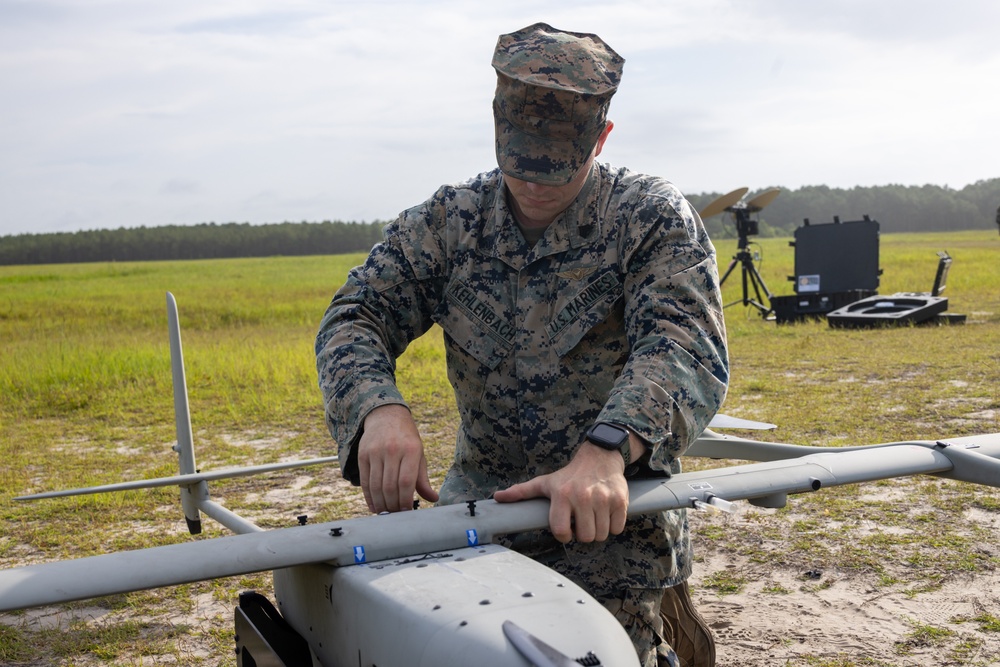
The replacement is not another mortar. In June 2021, Marine Corps Systems Command awarded Mistral Inc. (Bethesda, MD) a multi-year contract to produce the Organic Precision Fires–Mounted (OPF-M) system, integrating UVision’s HERO-120 loitering munition onto the Light Armored Vehicle–Mortar (LAV-M), Joint Light Tactical Vehicle (JLTV), and Long Range Unmanned Surface Vessel (LRUSV). The HERO-120 is an electrically powered, tube-launched munition weighing 18 kg (with canister), carrying a 4.5 kg multi-purpose warhead. It offers 60 minutes of loiter time, range exceeding 60 km, maximum speed of 120 km/h, and—critically—the ability to abort an engagement, re-engage a different target, or return ISR imagery before striking. The contrast with a mortar bomb is fundamental: the HERO-120 is a sensor-shooter; the 120 mm bomb is ballistic ordnance.
| Characteristic | 120 mm Mortar (GDAMS) | UVision HERO-120 (OPF-M) |
|---|---|---|
| Max range | 9 km | 60+ km |
| Time on target | Impact only | 60 min loiter |
| Precision | CEP ~30–50 m (unguided) | Sub-metre (terminal EO guidance) |
| Abort capability | None | Yes—re-engage or wave-off |
| ISR capability | None | Real-time EO/IR feed |
| Warhead NEQ | ~2.2–3.5 kg TNT eq. per round | 4.5 kg warhead (NEQ not disclosed) |
| Rate of fire | 15 rpm burst | Single launch per tube |
| Suppressive volume | High (area fire) | Low (precision strike only) |
| Cost per engagement | Low (~$200–500 per HE bomb) | High (est. $50,000–150,000 per munition) |
| Crew training | Conventional mortar drills | UAS operator + kill-chain authorisation |
| Organic air surveillance | None | 60 min EO/IR overwatch per munition |
| Weather dependency | Fires in all conditions | Reduced ceiling sensitivity vs manned CAS |
What the Comparison Table Does Not Show
The numbers above do not capture the most important thing the HERO-120 gives a ground commander. A 120 mm mortar provides indirect fire. The HERO-120 provides indirect fire, organic aerial surveillance, and a form of close air support that does not depend on a single asset outside the unit’s control. That is a force multiplier. A mortar barrel is not.
Consider what a British infantry company actually faces in a European contingency. Rotary-wing close air support from Apache or Wildcat is allocated at brigade level and rationed by competing demands across the battlegroup. Fixed-wing CAS from Typhoon or F-35B operates on higher-echelon tasking cycles. Both are subject to weather minimums—low cloud, poor visibility, icing conditions—that can ground manned aviation for hours or days in northern European winter. When CAS is unavailable, the company has its mortar line and nothing else. No eyes in the sky. No ability to look over the next ridge or confirm what is behind a treeline before committing troops forward.
A unit equipped with the HERO-120 changes that equation entirely. Each munition is a 60-minute aerial surveillance platform before it becomes a weapon. The operator sees real-time electro-optical and infrared imagery from above the battlespace at ranges well beyond what ground observation can achieve. If the picture changes—if the target moves, if civilians appear, if the situation resolves itself—the operator waves off and either re-targets or recovers the munition. Every HERO-120 tube on the vehicle is a potential reconnaissance sortie, a potential precision strike, or both. None of it requires a request up the chain to brigade or division for aviation support. The company commander owns the capability.
Which company commander, facing a four-day weather front that has grounded all manned aviation in the Baltic, would not want organic aerial ISR and precision fires sitting on the back of a vehicle in the harbour area? Which battalion commanding officer would turn down the ability to see over the next ridge without asking brigade for a helicopter that may be allocated to someone else? The USMC concluded that this capability—persistent, organic, weather-resilient, and independent of higher-echelon resource allocation—was worth more than the suppressive volume of a 120 mm mortar line.
The doctrinal split is real but narrower than it appears. The USMC divested 120 mm mortars because its operating concept—distributed littoral operations across vast Pacific distances—demands range, precision, and ISR integration over volume of fire. The British Army’s requirement sits in a different doctrinal lane: close-support indirect fire for combined-arms manoeuvre in the European theatre, where the ability to drop 15 rounds per minute onto a grid square within 9 km has decisive tactical value. Ukraine’s experience reinforces both positions simultaneously—vehicle-mounted 120 mm mortars have proven effective for rapid fire missions, while loitering munitions have transformed ISR-strike at extended range.
But the organic ISR argument cuts across both theatres. European weather is worse for manned aviation than the Pacific. Urban terrain in the Baltics, Poland, or Scandinavia creates dead ground that mortar fire controllers cannot observe without elevation. A loitering munition provides that elevation organically. The British Army may need both capabilities. The problem is that the RfI, as currently framed, asks for a mortar barrel only. It does not ask whether the requirement should include organic precision fires that give every company its own air surveillance and air cover. Since no RfP has been issued, the window to broaden the requirement is still open.
If DE&S issues an RfP for a mortar barrel without addressing the HERO-120 question, the British Army risks spending its indirect fires budget on a weapon system whose operational concept is already under pressure from the same technology the USMC adopted. The cost curve for loitering munitions is falling. If precision loitering munitions continue to fall in cost and rise in availability, the 120 mm mortar may find its tactical niche narrowing within a decade of entering British service. The question is whether DE&S and the Future Capability Group will design the procurement to accommodate this trajectory—or whether Project Stokes delivers a 20th-century fires solution just as the rest of NATO pivots to 21st-century precision.
ISC Assessment: The media reporting on Project Stokes is ahead of reality. An RfI has closed—that is a market survey, not a procurement decision. No RfP exists. No prices have been submitted. No contract has been awarded. Defence Blog’s “approves fleet integration” headline conflates market engagement with programme commitment. The actual question nobody in the defence press is asking: the USMC just replaced the 120 mm mortar with a system that gives rifle companies their own organic air surveillance, precision strike, and close air support independent of weather minimums and higher-echelon aviation allocation. The British Army is considering buying the weapon the Marines abandoned. Since no RfP has been issued, the window to broaden the requirement to include the HERO-120 as a force multiplier—either instead of, or alongside, a mortar barrel—is still open. DE&S should use it.
Data Gaps and Confidence Assessment
The procurement record is substantially documented. The RfI was published on contracts.mod.uk on 5 September 2025 under reference 715605452 (TKR-202593-EX-1853335), with the indicative procurement timeline—PSQ, ITT, T&E, and delivery deadline—set out in the documentation. The RfI did not appear on Find a Tender (the main UK government procurement portal), consistent with it being a market engagement rather than a binding procurement action.
Material gaps remain. The programme budget and per-unit cost ceiling are not disclosed. No evidence exists that an RfP has been issued, a PSQ completed, or an ITT released—despite the indicative timeline suggesting these should have occurred by now. The gap between the published timeline (PSQ December 2025, ITT January 2026) and the absence of any subsequent public documentation warrants scrutiny. Performance specifications for the Elbit Sling and Escribano EMOC are not publicly available. The role of the Defence Science and Technology Laboratory (Dstl) and the Next Generation Combat Team (NGCT) programme in shaping the requirement has been referenced on social media but not in official publications. No public statement from DE&S or the British Army addresses whether loitering munitions were considered as part of the indirect fires requirement, or why the RfI is restricted to mortar systems.
The Rheinmetall Expal EIMOS (Expal Integrated Mortar System)—an 81 mm system with a 120 mm variant under development—and the Patria NEMO turreted 120 mm system are also positioned for the broader UK indirect fires requirement, though neither appears to target the specific LMMVH hinged configuration.
AI-assisted technical assessment based on open-source material. Source reliability: B–2 (contracts.mod.uk, Defence Online, Shephard Media, UK Defence Journal, Babcock International, Army Recognition, Overt Defense, The War Zone, USMC Official, Naval Technology). Assessment confidence: MODERATE–HIGH for procurement status (confirmed via official UK MoD portal); MODERATE for programme timeline (indicative milestones may have slipped given absence of subsequent public documentation); HIGH for USMC EFSS divestment and OPF-M contract (confirmed via official USMC releases and Tier 1–2 defence media). Technical specifications for two of four interested manufacturers remain unavailable.
ISC Commentary
Further analysis pending.